Medieval Manuscript Art: 10 Breathtaking Illuminated Pages
Medieval manuscript art is the only branch of medieval painting that has come down to us with its colours intact. Frescoes faded, panels darkened under varnish, mosaics fell, but a book that stayed shut for eight hundred years kept its lapis blue and its burnished gold exactly as the painter left them. That is why a page from the Book of Kells still looks wet, and why these ten pages are the closest thing we have to seeing the Middle Ages in colour.
What “illuminated” actually means
The word has nothing to do with brightness of colour. It comes from the Latin illuminare, to light up, and in the trade it meant one thing: gold. A decorated book is only truly an illuminated manuscript if metal has been laid on the page, gold leaf or shell gold or silver, so that the letter catches the light of a candle and throws it back. Everything else is called decoration. The second word people get wrong is miniature. It does not mean small. It comes from minium, the red lead the scribes used to mark the opening of a passage, and the men who applied it were called miniatores long before anyone thought of the word as a measure of size. The materials were harder to come by than the skill. The support was vellum, calfskin scraped, limed and stretched, and a full Bible could consume the hides of an entire herd: the Codex Amiatinus is reckoned to have taken around five hundred calves. The blue was ultramarine, ground from lapis lazuli mined at Sar-e-Sang in what is now Afghanistan and carried overland for four thousand miles, which in some periods made it more expensive by weight than the gold beside it. The gold itself was laid as leaf over a raised cushion of gesso, then burnished with a tooth, usually an agate or a dog’s tooth mounted in a handle, until it behaved like a mirror. The greens came from verdigris, the yellows from orpiment, which is arsenic sulphide and quietly poisonous, and the reds from vermilion.
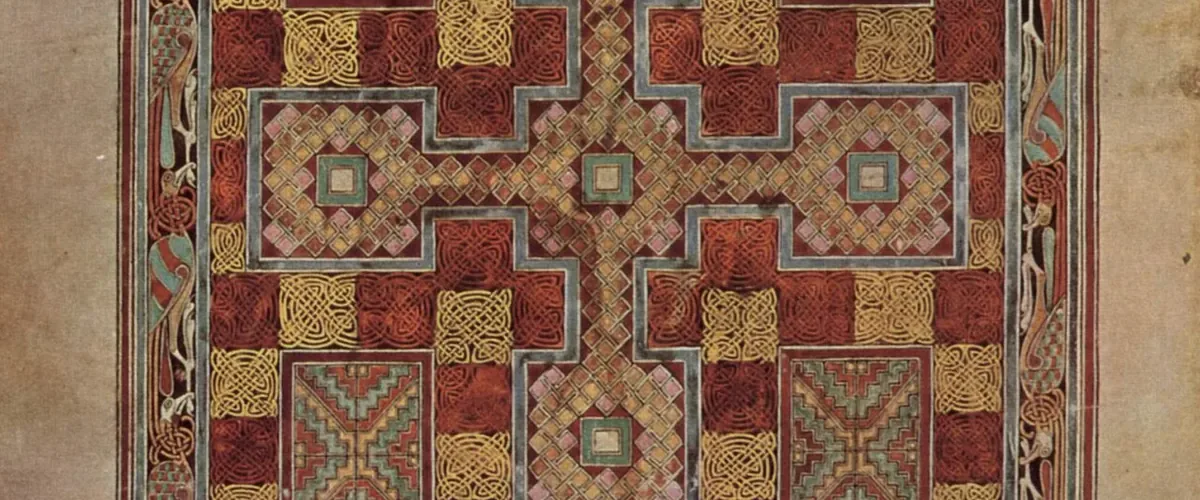
1. The Book of Durrow, around 680
The oldest of the great insular gospel books opens not with a picture but with a carpet page: a whole sheet of vellum given over to pure pattern, ribbon animals biting their own bodies into knots inside a plain frame. There is no text on it and no story in it. It is there to make the reader stop before the gospel begins, the way a threshold makes you slow down before a door. The Book of Durrow is at Trinity College Dublin as MS 57, and its ornament comes straight out of metalwork: the same interlace was being hammered into Anglo-Saxon buckles and Irish brooches while this page was drying.
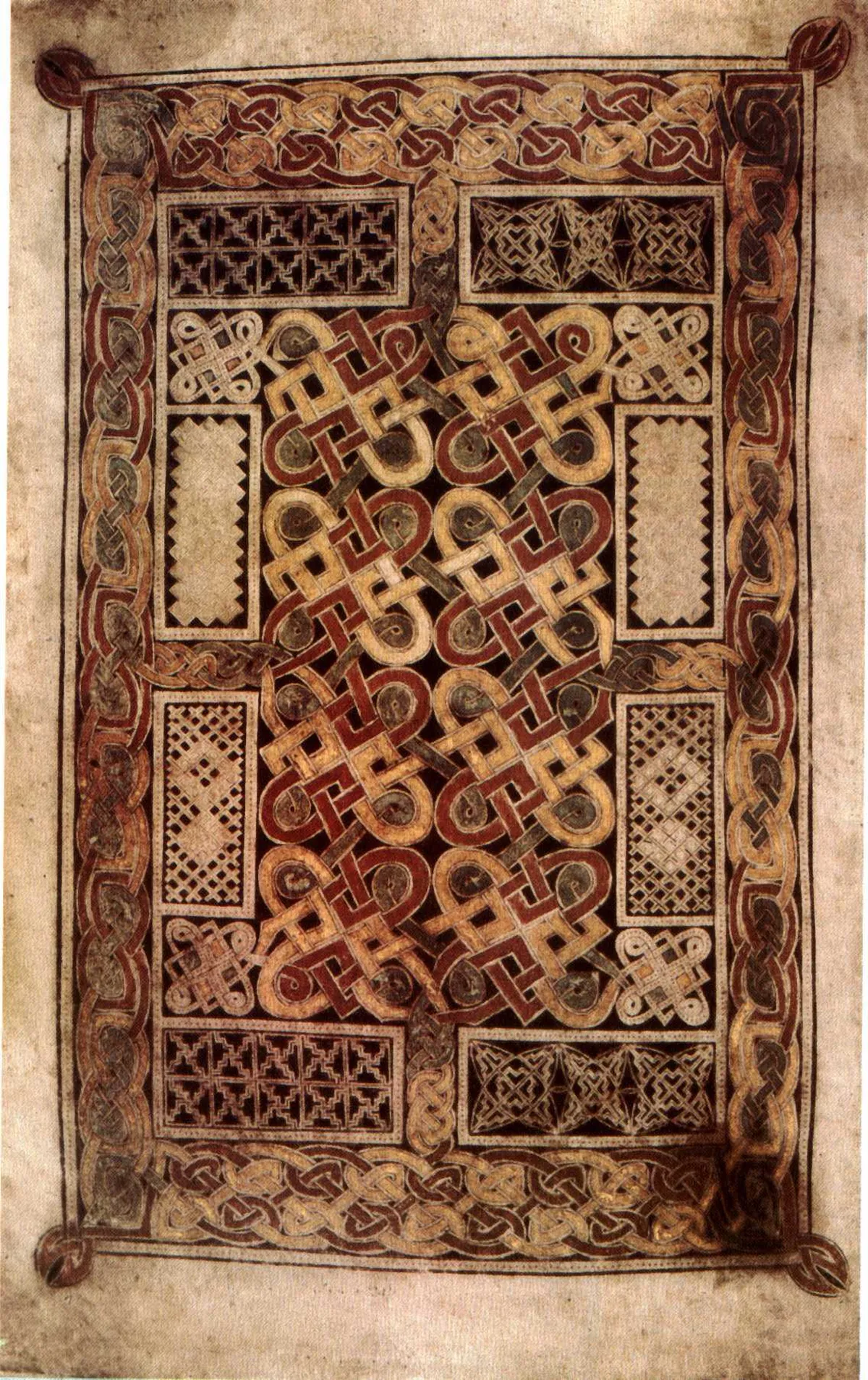
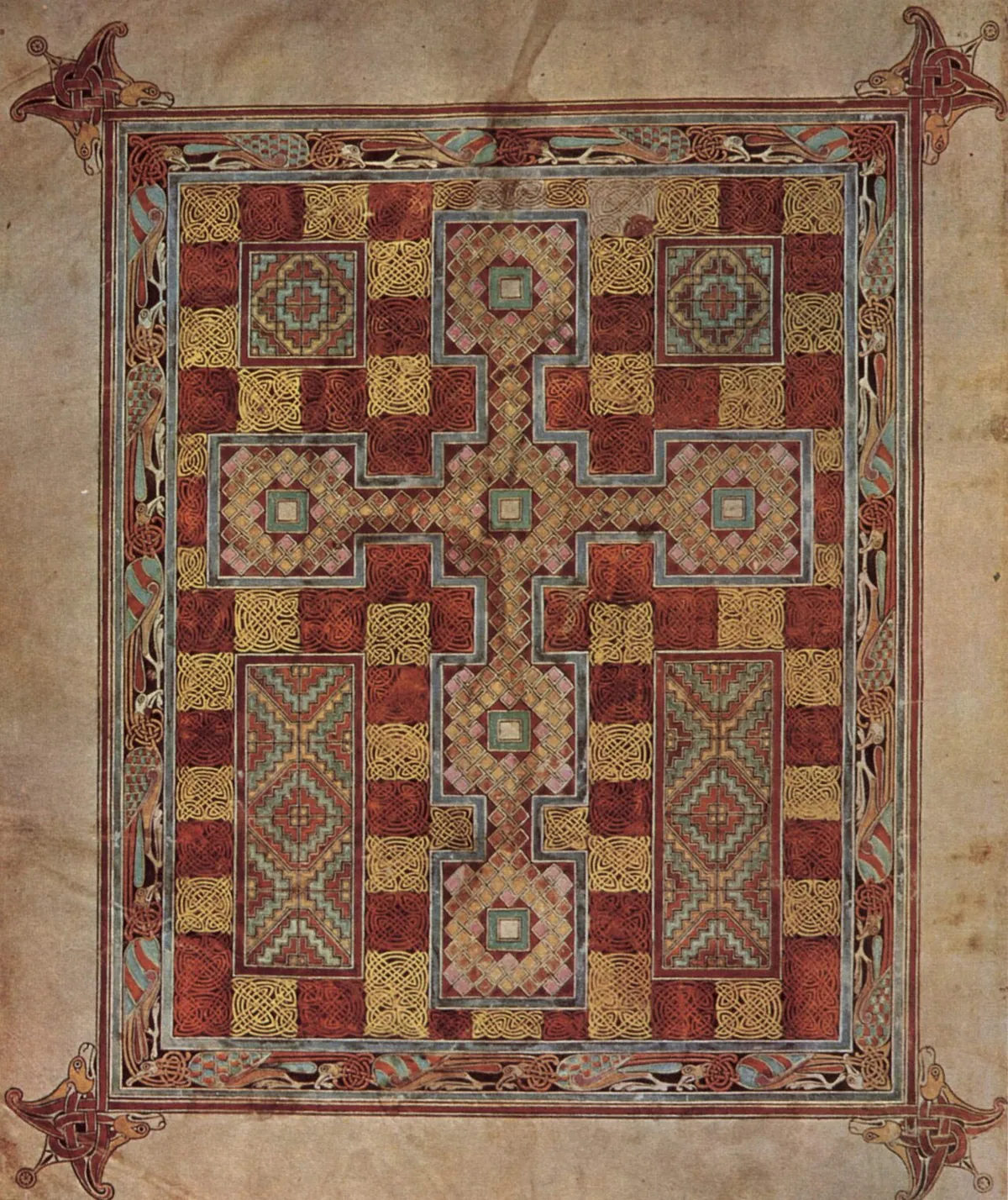
2. The Lindisfarne Gospels, around 700
Made on a tidal island off the Northumbrian coast, probably by one man, Eadfrith, who was bishop of Lindisfarne and who seems to have written and painted the entire book himself. That is unusual: most manuscripts were a workshop product. The carpet pages are built as crosses of knotwork so dense that the eye cannot follow a single strand to its end, and modern analysis has found the underdrawing was set out with compass and lead point before a single colour went down. Two and a half centuries later a priest called Aldred wrote an English gloss between the Latin lines, and in doing so produced the oldest surviving translation of the gospels into any form of English. It is British Library, Cotton MS Nero D IV.
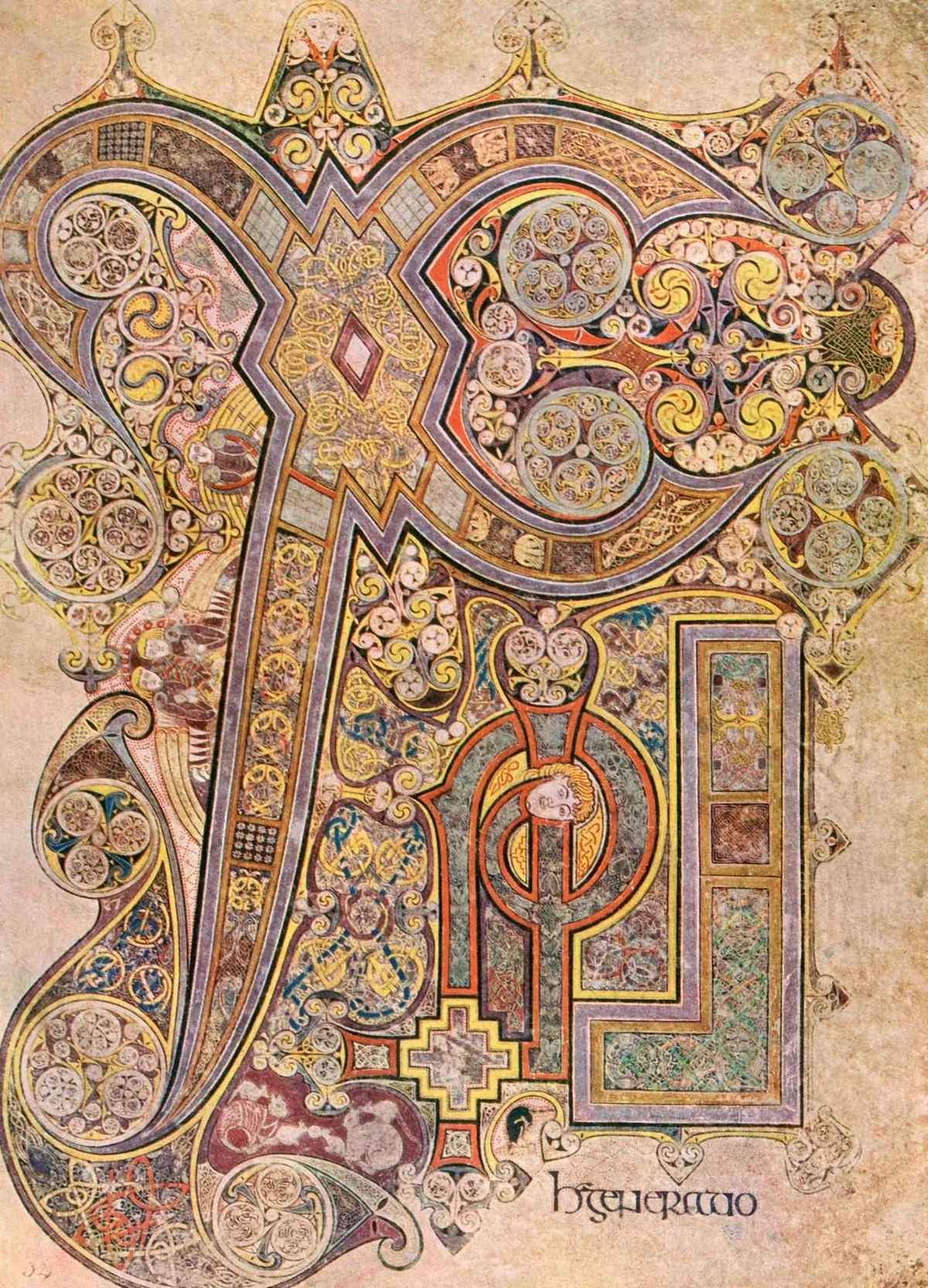
3. The Book of Kells, Chi Rho page, around 800
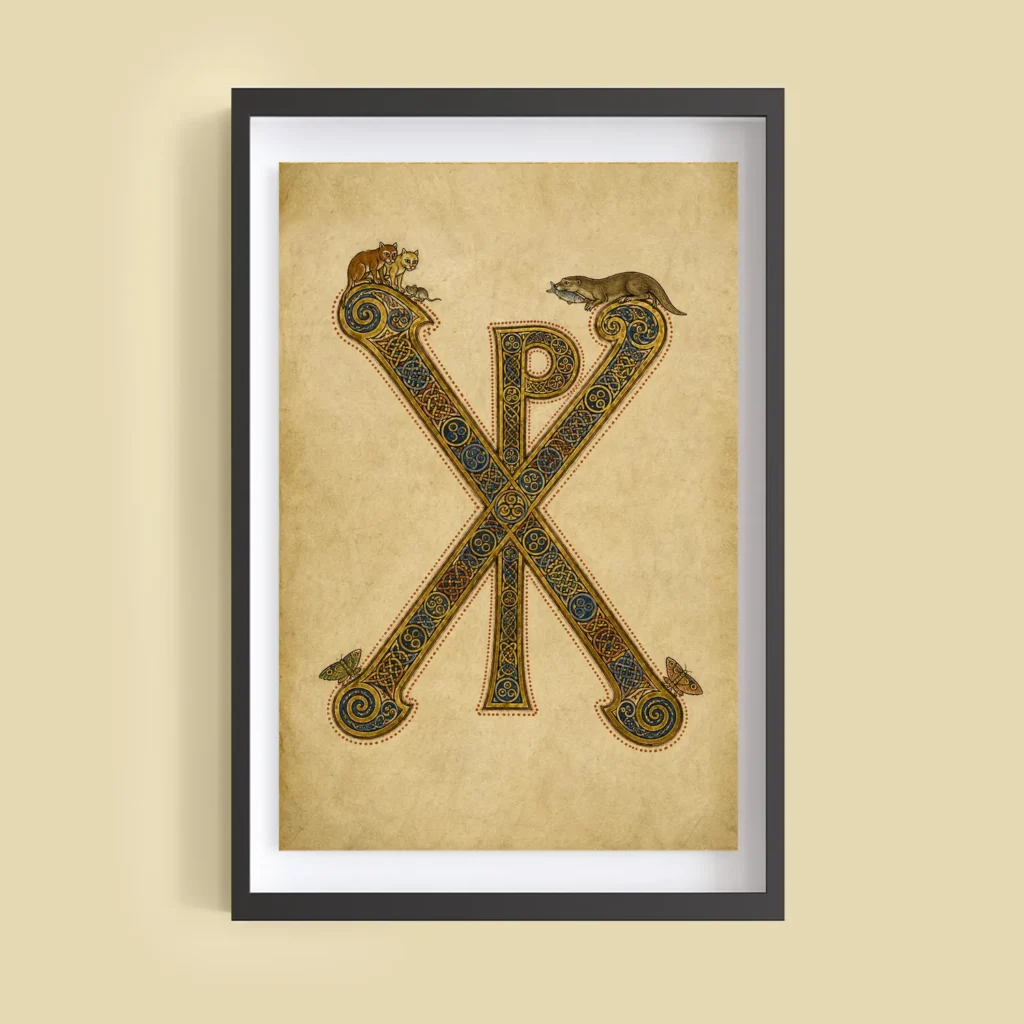
This is the most famous page in medieval manuscript art, and it is a monogram. The Greek letters chi, rho and iota, the first letters of Christ, are blown up to fill an entire sheet at the opening of Matthew’s account of the Nativity. Follow the ornament and it stops being abstract: two cats sit at the foot of the letter watching two mice tug at a communion host, an otter carries a salmon along one arm, moths rest on the curls. The scribes put a joke about vermin inside the most sacred word of the book, and nobody has ever quite explained why. Giraldus Cambrensis, seeing a book like it in the twelfth century, wrote that it must have been made by angels rather than men. It is Trinity College Dublin, MS 58, and it is the direct ancestor of our own Chi Rho panel further down this page. The Irish monks who made it, and the saints who founded their houses, are the subject of our page on Irish saints and the art they left behind.
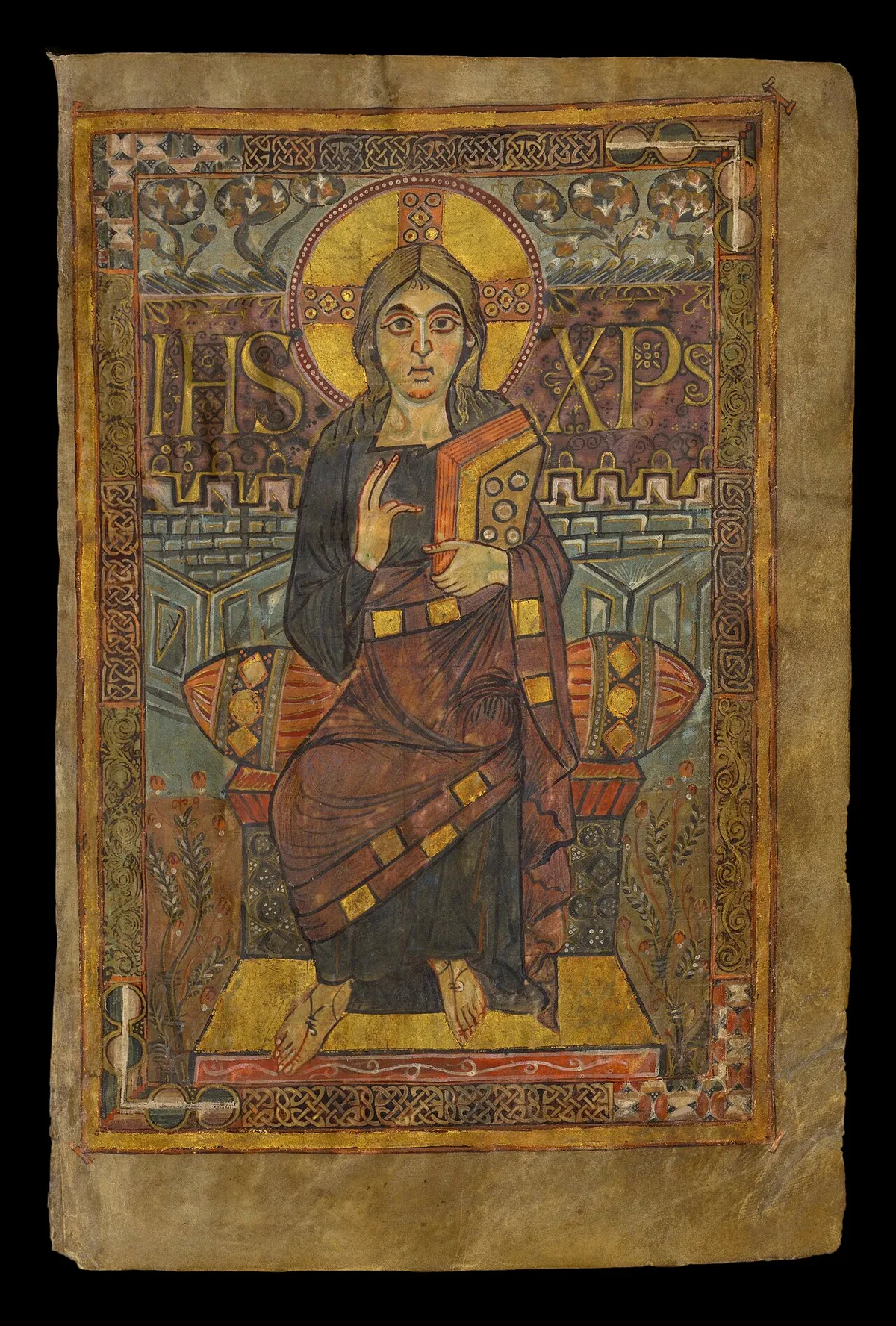
4. The Godescalc Evangelistary, 781 to 783
Charlemagne and his queen Hildegard commissioned this book from a scribe named Godescalc to mark their journey to Rome, and it is the first product of the court school that would carry Carolingian art across Europe. The pages are dyed purple, the imperial colour, and written in gold and silver, an expense that was itself the message. The Christ in Majesty here sits frontally with the book, and the modelling of the face is deliberately Roman: Charlemagne’s project was a renewal of the empire, and his painters were told to look south for it, past three centuries of insular knotwork. It is at the Bibliotheque nationale de France, NAL 1203.
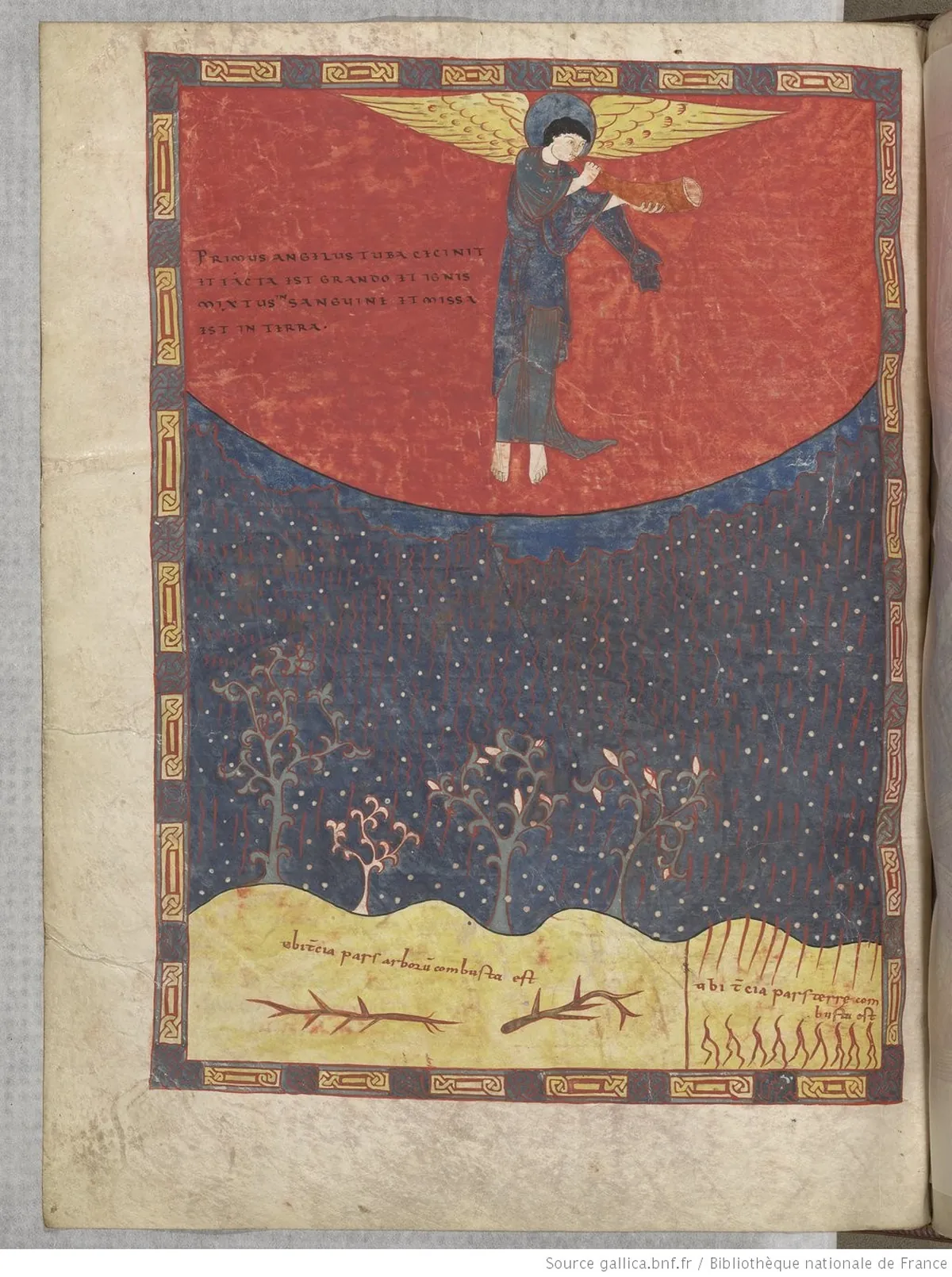
5. The Saint-Sever Beatus, around 1060
In the eighth century a Spanish monk called Beatus of Liebana wrote a commentary on the Apocalypse, and for the next five hundred years Iberian scriptoria copied it with cycles of full-page paintings unlike anything else in Europe: flat bands of red, blue and yellow instead of landscape, figures with enormous eyes, and a colour sense that comes from Islamic Spain rather than from Rome. The Saint-Sever copy is the only one made in France, in a Gascon abbey, and this page shows the first trumpet of the seventh chapter, hail and fire mixed with blood falling on trees that are already burnt. It is at the Bibliotheque nationale de France, Lat. 8878.
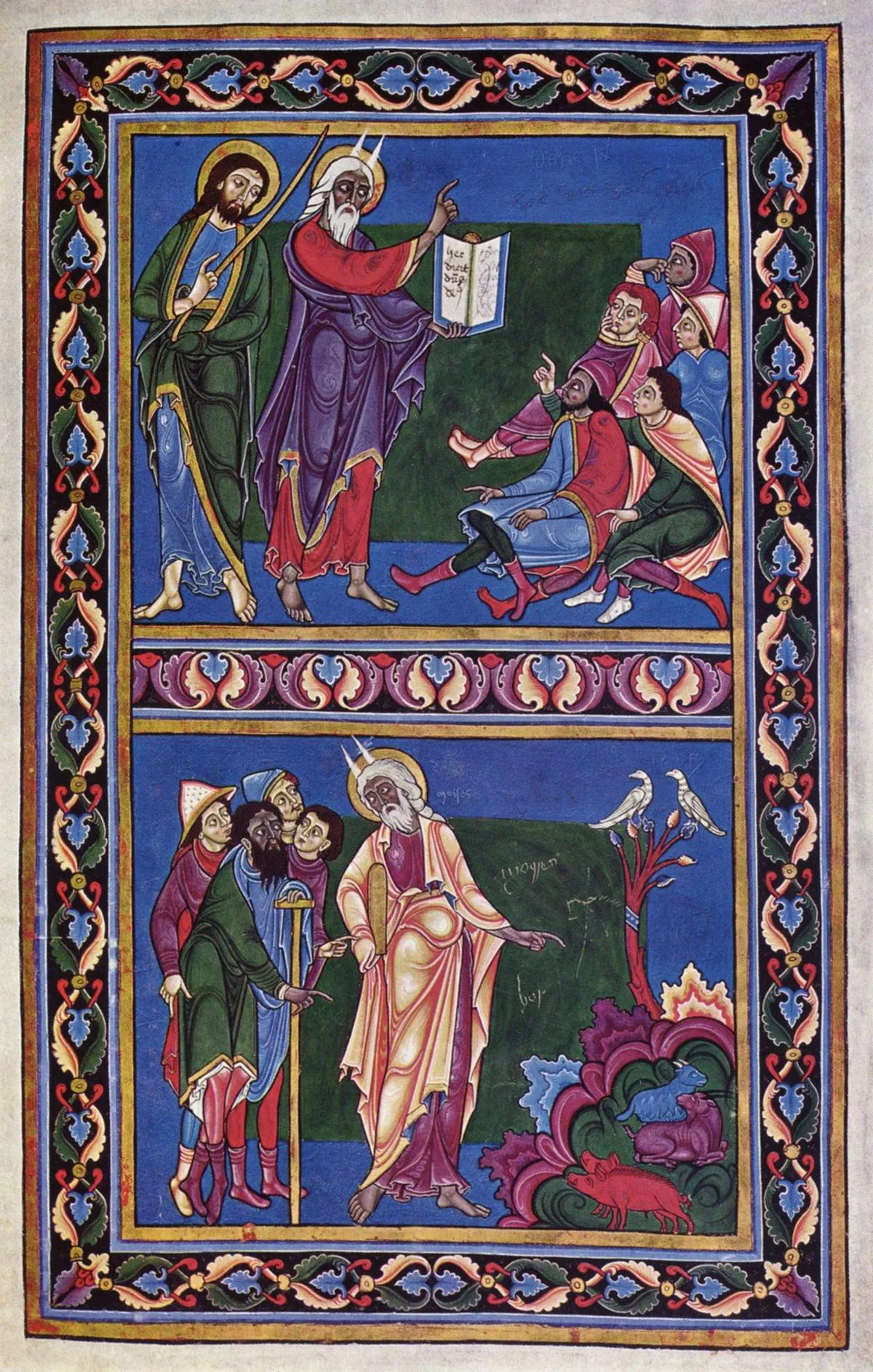
6. The Bury Bible, around 1135
Romanesque England produced enormous lectern Bibles, and this is the finest of them. What makes it exceptional is that we know who painted it: Master Hugo, a layman, one of the earliest named professional artists in England, who also cast the abbey’s bronze doors and carved a crucifix. The chronicle of Bury St Edmunds records that he could not find pigments good enough in England and sent to Ireland for them. The figures here have the swept, folded drapery that art historians call the damp fold style, and the acanthus frame is worth as much attention as the scene inside it. It is Corpus Christi College, Cambridge, MS 2. The same generation of painters is covered in our survey of the great medieval painters of Catholic art.
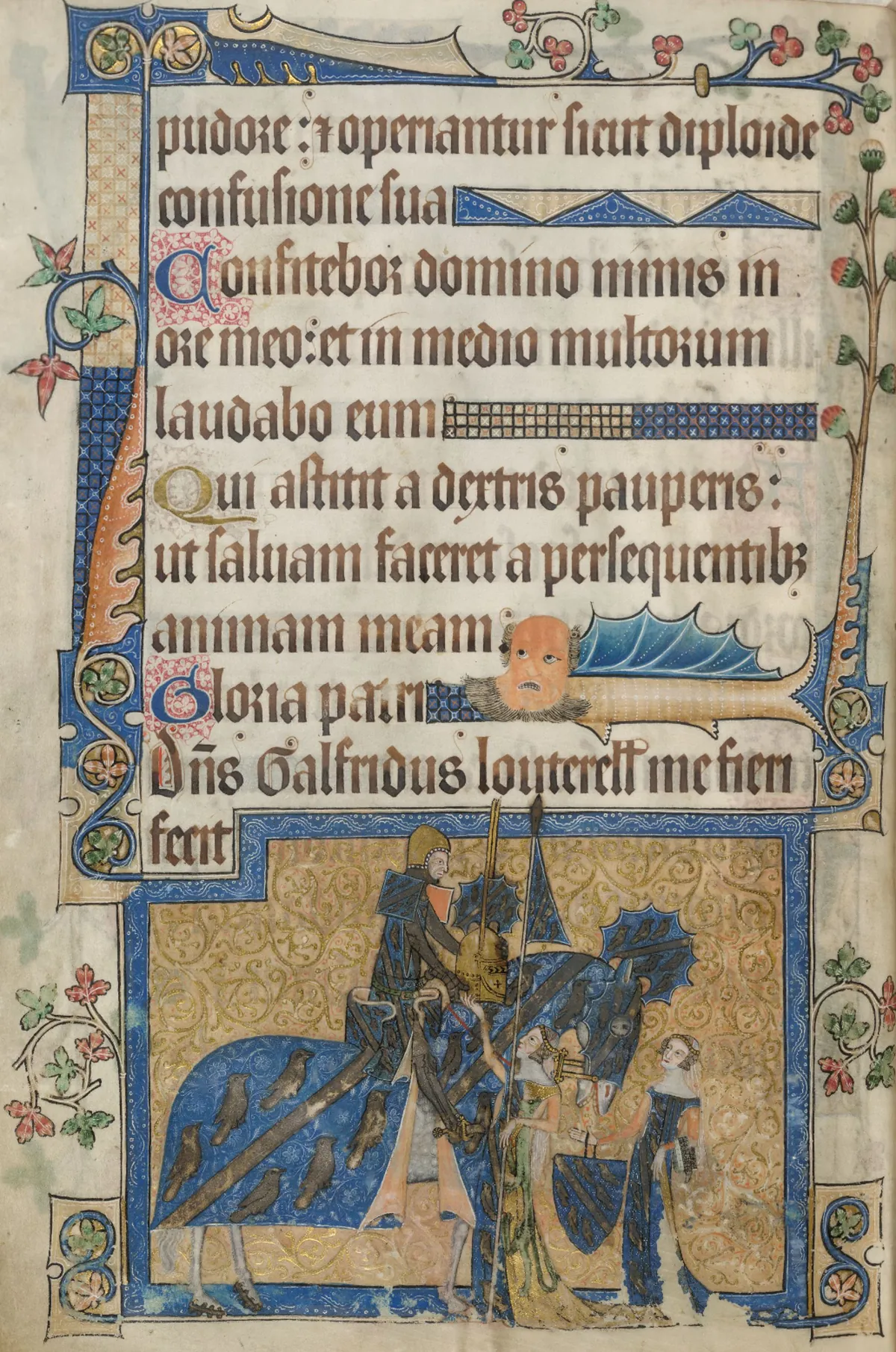
7. The Luttrell Psalter, around 1330
Sir Geoffrey Luttrell, a Lincolnshire knight, paid for a psalter and had himself painted into it in full heraldry, receiving his helm from his wife and his daughter-in-law. What made the book famous is not that page but the margins: ploughmen, harvesters, cooks, a man carting dung, and among them a menagerie of grotesques, half-human, half-animal, that have no business anywhere near the psalms. Medieval margins are full of this, snails fighting knights above all, and no theory of why has ever convinced everyone. It is British Library, Add MS 42130, and it is the best single source we have for what English rural work actually looked like.
8. The Tres Riches Heures du duc de Berry, 1412 to 1416
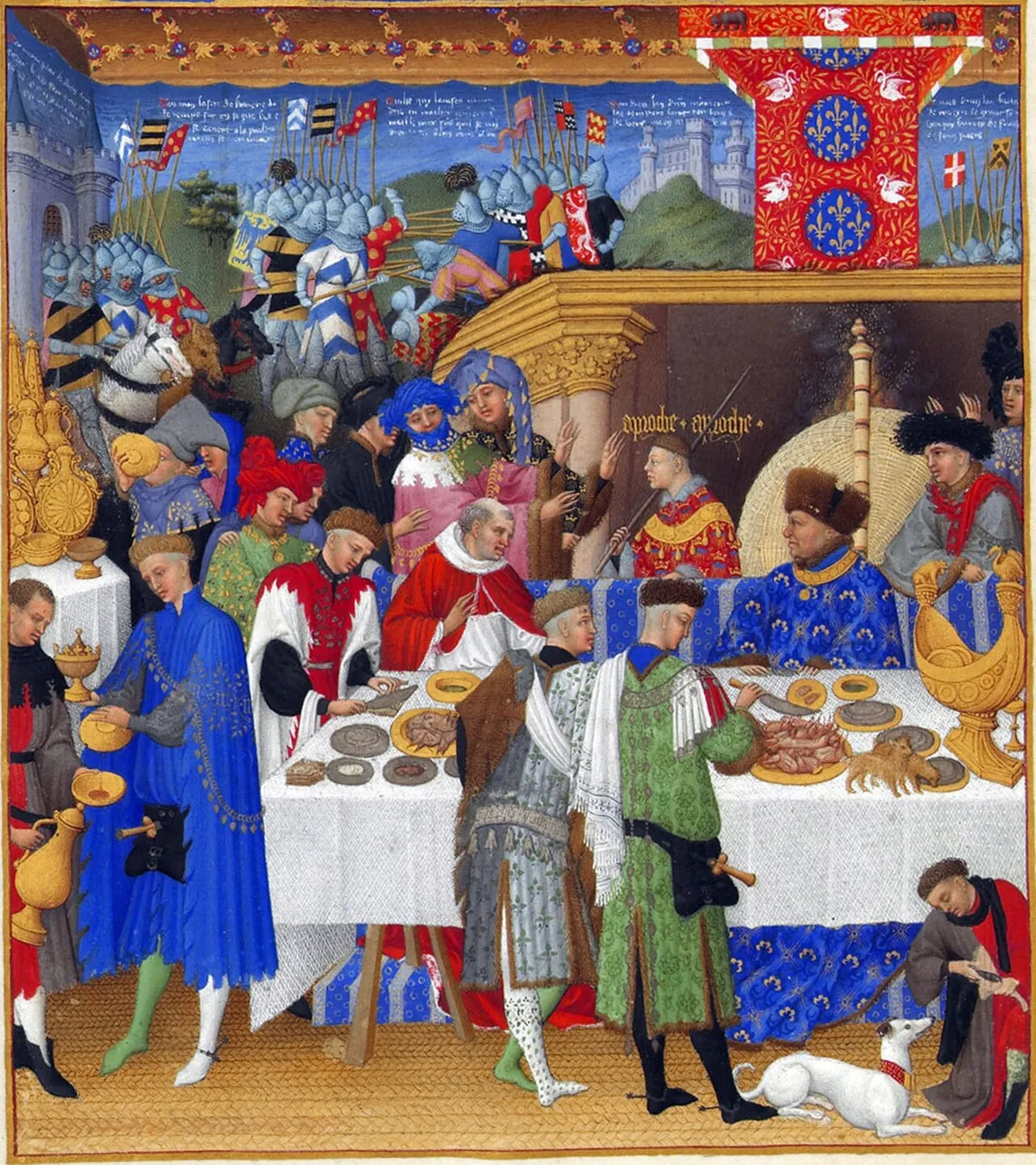
The most celebrated book of hours ever made, painted for Jean de Berry by three brothers from Nijmegen, Paul, Jean and Herman de Limbourg. The calendar cycle that opens it invented a whole genre: twelve months, each with a real castle in the background and real work in the foreground, the peasants in the snow, the sowers, the harvest. January shows the duke himself at table in blue and gold under a tapestry of battle, with the words aproche aproche woven into the scene as his chamberlain waves the guests forward. All three brothers and their patron died in 1416, probably of plague, and the book was left unfinished; Jean Colombe completed it seventy years later. It is at the Musee Conde in Chantilly, MS 65.
9. The Hours of Catherine of Cleves, around 1440
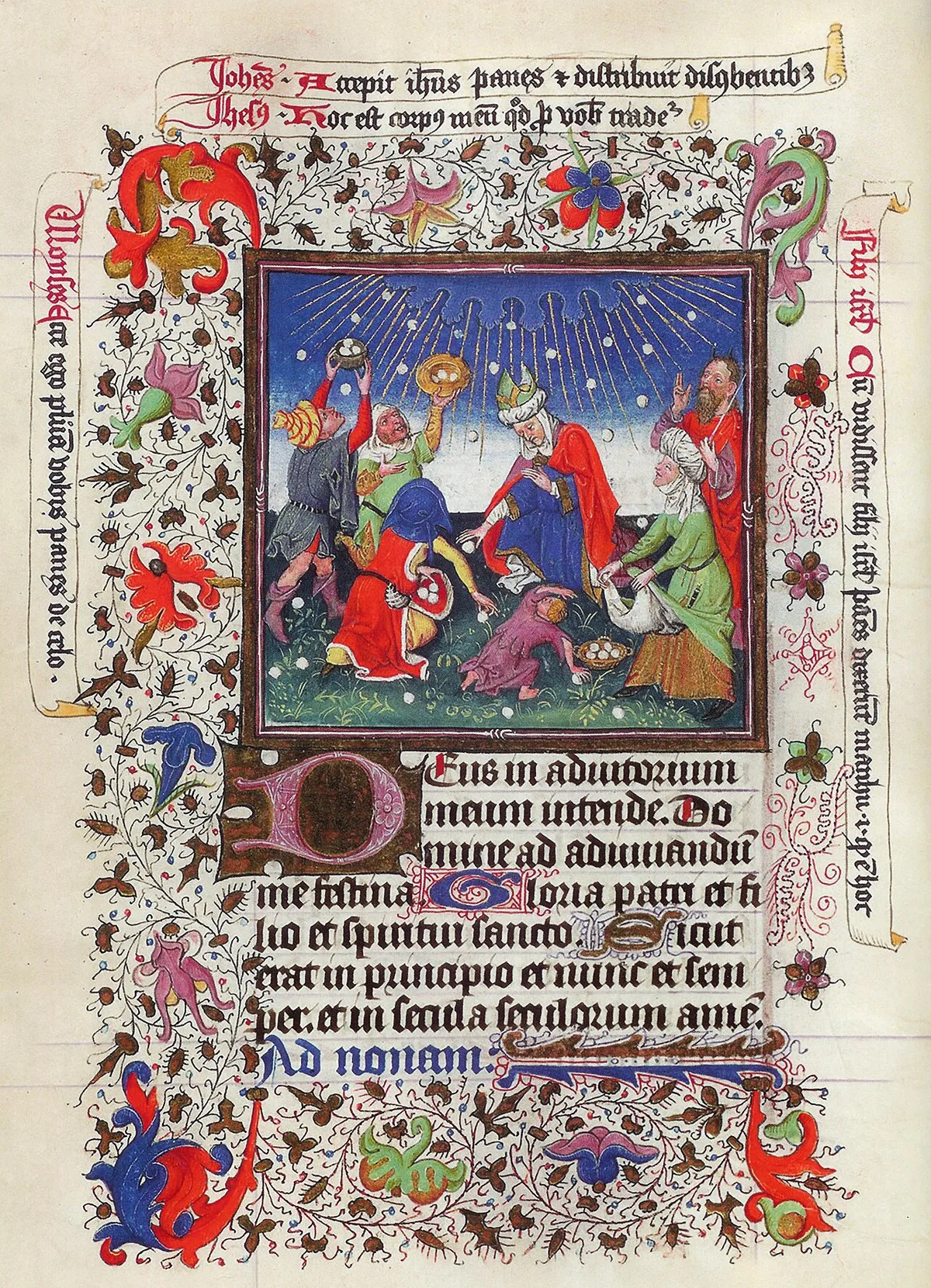
The finest Dutch manuscript in existence, made for the duchess of Guelders, and the one that did the strangest thing with its borders. Instead of vines, its painter framed the sacred scenes with objects: fish and nets, mussel shells, coins, pretzels, birdcages, arrows, all painted at actual size and casting shadows onto the parchment as though they had been laid on the page. This page, the gathering of the manna, is bordered with the catch of a day. It is at the Morgan Library and Museum in New York, MS M.917/945, and the Morgan has the whole book online.
10. The Hours of Queen Isabella the Catholic, around 1497
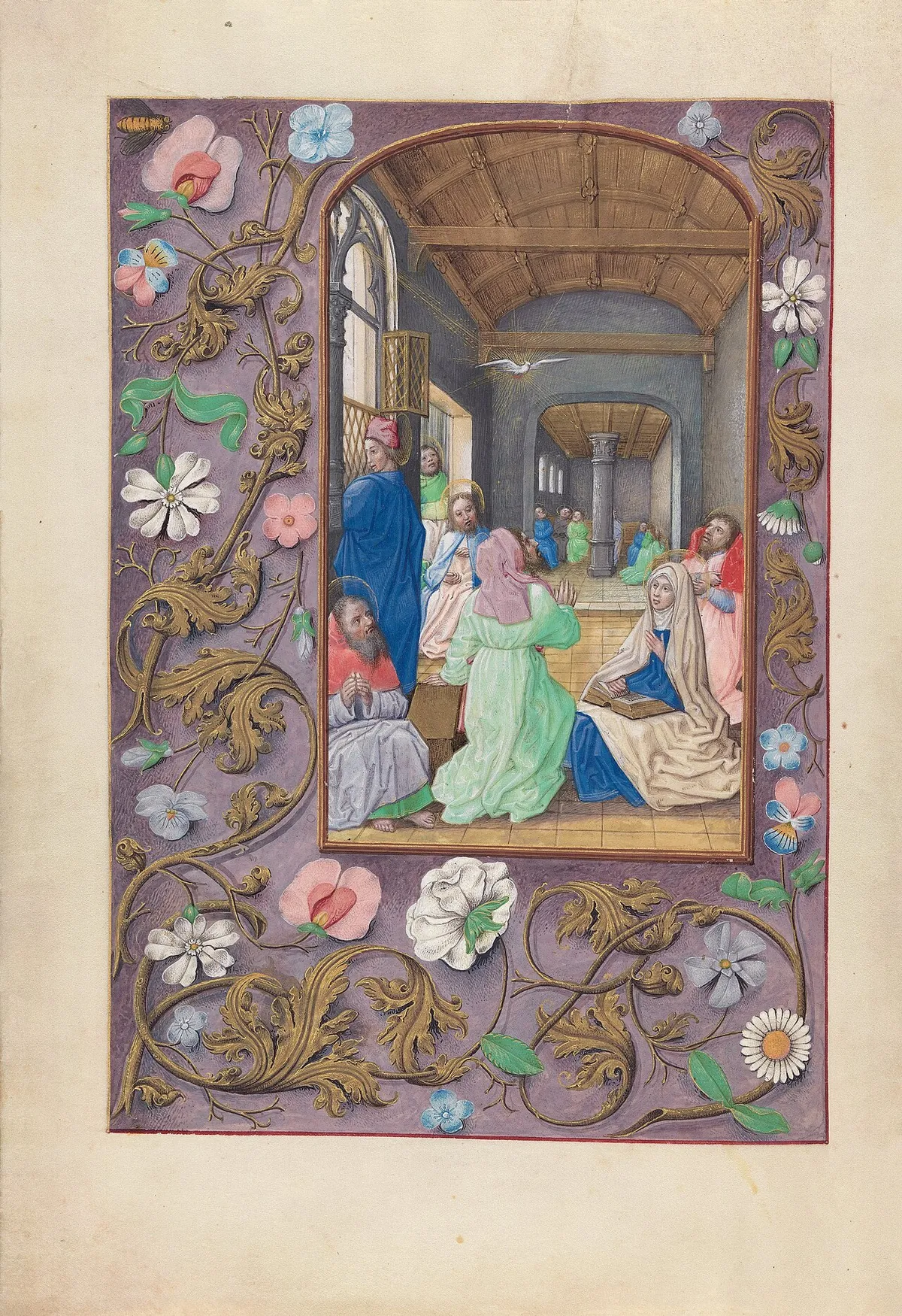
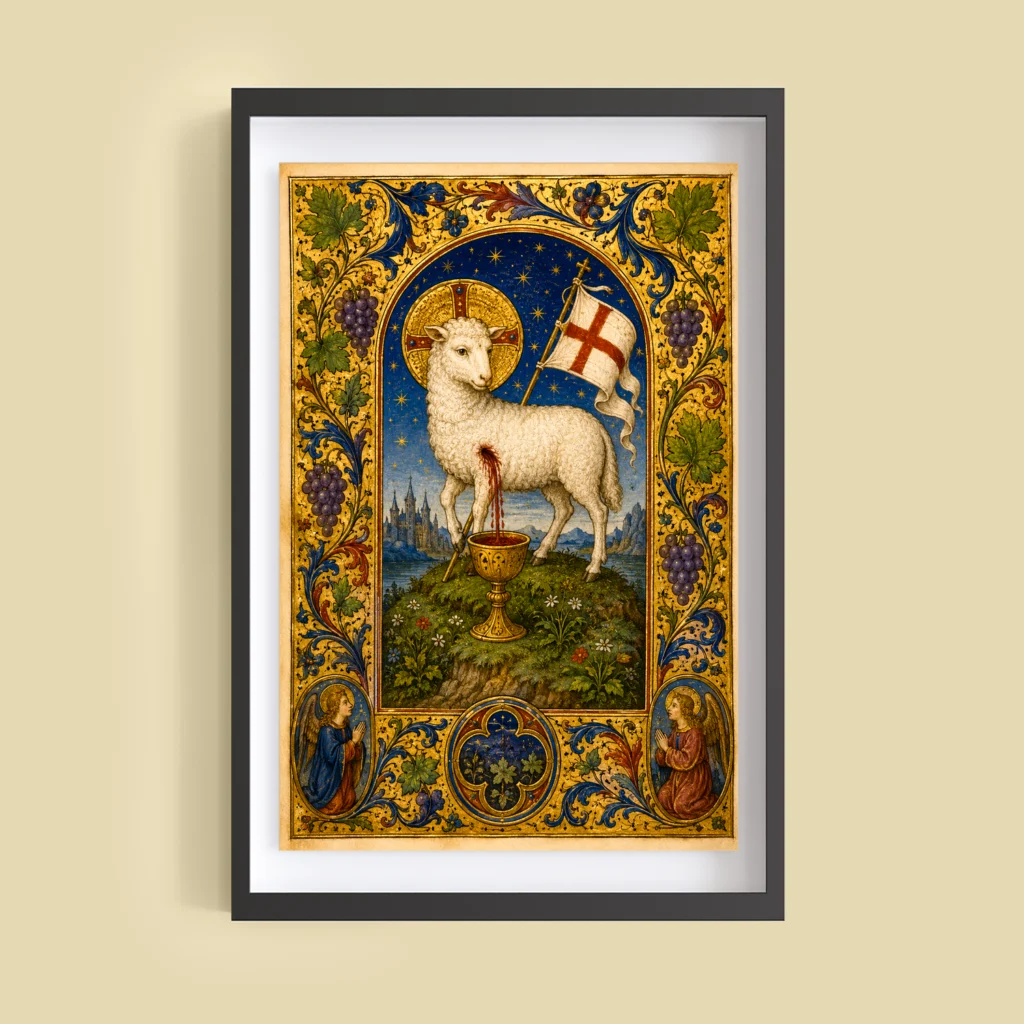
The last great phase of European illumination happened in Ghent and Bruges just as printing was killing the trade, and it went out with borders like this one: a field of coloured ground strewn with gold acanthus, roses, pansies, daisies and insects, each casting its own small shadow, so that the margin reads as a table top seen from above rather than as ornament. The scene inside is Pentecost. This manuscript belonged to Isabella of Castile, and its leaves are now at the Cleveland Museum of Art, 1963.256. This is the exact language our own Agnus Dei panel is written in, five hundred years later.
The ten manuscripts, and where to see them
| Manuscript | Date | Where it is |
|---|---|---|
| Book of Durrow | around 680 | Trinity College Dublin, MS 57 |
| Lindisfarne Gospels | around 700 | British Library, Cotton MS Nero D IV |
| Book of Kells | around 800 | Trinity College Dublin, MS 58 |
| Godescalc Evangelistary | 781 to 783 | Bibliotheque nationale de France, NAL 1203 |
| Saint-Sever Beatus | around 1060 | Bibliotheque nationale de France, Lat. 8878 |
| Bury Bible | around 1135 | Corpus Christi College, Cambridge, MS 2 |
| Luttrell Psalter | around 1330 | British Library, Add MS 42130 |
| Tres Riches Heures | 1412 to 1416 | Musee Conde, Chantilly, MS 65 |
| Hours of Catherine of Cleves | around 1440 | Morgan Library, New York, MS M.917/945 |
| Hours of Isabella the Catholic | around 1497 | Cleveland Museum of Art, 1963.256 |
When the gold left the book
The gold ground did not die with the manuscript. It moved onto wood. The panel painters of Siena and Florence kept the burnished gold sky, the punched haloes and the tooled borders of the illuminators well into the fourteenth century, which is why a Duccio altarpiece and a page from a psalter look like cousins. Cimabue and Giotto are the hinge: with Giotto the ground stays gold but the figures start to take up room in it. Further north the same gold survived inside oil painting, in the brocades and metal of Jan van Eyck. You can follow that whole passage in our pages on medieval Christian paintings and Byzantine Jesus paintings.
Medieval manuscript art for a modern wall
Illumination was always domestic art. A book of hours was made to be held at arm’s length by one person praying alone, not to be seen from the back of a church, which is exactly the distance at which a print works in a bedroom, a study or a prayer corner. Everything below is painted in the tradition described above, in our own studio, and printed as giclee fine art on 200 gsm paper or on canvas.
Monograms and symbols
The oldest Christian images are not portraits, they are signs. Our Chi Rho follows the insular tradition of Kells and Lindisfarne, cats, mice, otter and all; the Agnus Dei is written in the Ghent-Bruges language of the last section, vine, grapes and burnished gold; the Tree of Jesse takes the genealogy that medieval glaziers and illuminators invented and puts it back on a gold ground; and the San Damiano Cross is the Italo-Byzantine icon cross that spoke to Francis of Assisi.
Illuminated prayers and psalms
The psalter was the book every medieval Christian knew by heart, and the one most often illuminated. Ours keep the form: a text block in a decorated frame, meant to be read slowly. Psalm 23, Psalm 25, Psalm 51, Psalm 91 and Psalm 121, then the prayers: the Lord’s Prayer, the Hail Mary, the Memorare, the peace prayer of Saint Francis, the Serenity Prayer and the fruits of the Holy Spirit. The text of each, with its history, is on our pages for Psalm 23, Psalm 51, Psalm 91, Psalm 121 and the Memorare.
Saints and archangels in the margin
A medieval prayer to a saint sat inside a decorated frame, often with the saint painted in the initial. The same idea drives our prayer posters for Saint Michael, Saint Gabriel, Saint Raphael and Uriel, and for Saint Cecilia, Saint Dymphna and Saint Jude. Their stories are told on our pages for Saint Cecilia, Saint Dymphna and Saint Jude Thaddeus.
Gold ground icons
The other half of the tradition is the panel, and the gold behind the figure rather than around the text: Christ Pantocrator, the Madonna and Child, the Transfiguration, the Sacred Heart, the gilded Virgen de Guadalupe, the Black Madonna, Our Lady of Czestochowa, Our Lady of Perpetual Help, the Miraculous Medal and Saint Rita of Cascia. What each of these icons means is explained in Catholic icons and Marian iconography.
Important facts about medieval manuscript art
Illuminated means gilded, not brightly coloured: without metal on the page, a decorated book is not illuminated. Miniature comes from minium, red lead, and originally said nothing about size. Ultramarine was ground from Afghan lapis lazuli and could cost more by weight than gold. A single large Bible could take the skins of several hundred calves. Gold leaf was laid over raised gesso and burnished with an agate or a dog’s tooth. The scribe and the illuminator were usually two different people, and neither normally signed. Printing did not end illumination at once: the finest Flemish borders were painted after Gutenberg.
Frequently asked questions
What is medieval manuscript art called?
It is called illumination, and a book carrying it is an illuminated manuscript. The full-page paintings inside are miniatures, the decorated capitals are historiated initials when they contain a scene and inhabited initials when they contain only figures or animals, and the pages of pure ornament in insular gospel books are carpet pages.
What is the most famous medieval manuscript?
The Book of Kells, made around 800 and kept at Trinity College Dublin, where it is seen by about a million visitors a year. Its Chi Rho page is the single most reproduced page in medieval art. The Tres Riches Heures du duc de Berry and the Lindisfarne Gospels come next.
How was a medieval manuscript made?
Skins were limed, scraped and stretched into vellum, then cut and folded into gatherings and ruled with a lead point. The scribe wrote the text first and left the spaces empty. The illuminator came afterwards, laid the gold leaf over raised gesso and burnished it, then painted the colours on top, mineral pigments bound in egg white or gum. Binding came last. A great gospel book was years of work.
Why are there monsters and snails in the margins?
Marginal drawings, called drolleries, run riot in thirteenth and fourteenth century books: grotesques, rabbits hunting men, and the famous knight fighting a snail, which appears in dozens of manuscripts. Explanations range from a joke about cowardice to a satire on the Lombards, and none is agreed. The Luttrell Psalter is the best place to see how far a margin could travel from the text it framed.
What was written in medieval manuscripts?
Mostly Scripture and liturgy: gospel books, Bibles, psalters, missals and, from the thirteenth century onwards, books of hours for lay owners, which became the medieval bestseller. Beyond religion, scriptoria copied chronicles, herbals, bestiaries, law and classical authors, which is the only reason much of Latin literature survived at all.
Can you buy medieval manuscript art as prints?
You can buy medieval manuscript art at jesuschrist.pictures, in our shop, as giclee fine art prints and canvases painted in the illuminated tradition: the Chi Rho, the Agnus Dei and the Tree of Jesse, illuminated psalms and prayers, prayer posters for the archangels and the saints, and gold ground icons. They are printed with twelve colour giclee technology on 200 gsm FSC-certified paper, in sizes from 27×35 cm to 60×90 cm, which is the right scale for the arm’s length viewing a book of hours was designed for.


