The Sacred Paintings of Jan van Eyck and the Birth of Oil
Jan van Eyck is the founding master of Western oil painting. The Jan van Eyck paintings that survive today, fewer than twenty securely attributed panels and miniatures, gave Northern Europe a wholly new way of seeing. He looked at the Virgin Mary and rendered every thread of her crimson robe, every facet of her crown’s gemstones, every reflection in the water of the heavenly meadow. He looked at a city and painted every brick of its towers. He looked at a face and gave it a psychological depth no Northern painter had ever before achieved. With his elder brother Hubert he completed the great Ghent Altarpiece in 1432, and with that single work he reshaped the visual world of fifteenth century Europe.
This article gathers nine of his most important religious works, from the great Ghent polyptych to the small private devotional Madonnas of his last Bruges years.

From Maaseik to the Court of Philip the Good
Jan van Eyck was born around 1390 in Maaseik, in the Prince-Bishopric of Liège, the younger brother of Hubert van Eyck. He is first documented in 1422 to 1425 as a painter to John of Bavaria, the Prince-Bishop of Liège, at The Hague. After his patron’s death in 1425 he entered the service of Philip the Good, Duke of Burgundy, as court painter and valet de chambre. He remained in Philip’s service until his own death in 1441, undertaking diplomatic missions for the duke to Portugal in 1428 and 1429, where he painted the portrait of the future duchess Isabella.
By 1432 he had completed the Ghent Altarpiece, begun by his elder brother Hubert before his death in 1426. He settled in Bruges in 1432, where he ran an active workshop and produced almost all of the surviving panels for which he is now famous. His patrons included the Burgundian court, the Italian merchant communities of Bruges, the Chancellor of Burgundy Nicolas Rolin, and the great commercial families of the Low Countries.
The Ghent Altarpiece
Begun by Hubert van Eyck before 1426 and completed by Jan in 1432 for the patrician Joos Vijd and his wife Elisabeth Borluut, the great Adoration of the Mystic Lamb is the founding masterpiece of European oil painting. The polyptych is composed of twelve panels arranged on two registers, with the cosmic Adoration of the Lamb of God in the central lower panel and the great Deisis of God the Father, the Virgin, and John the Baptist in the upper register.

The altarpiece still hangs in the chapel for which it was painted, at Saint Bavo’s Cathedral in Ghent.
The Adoration of the Mystic Lamb
The central lower panel of the Ghent Altarpiece is the most reproduced single image of the early Netherlandish school. The Lamb of God stands on the altar at the centre of a flowering meadow, his blood pouring into a chalice. Around him gather the prophets, the apostles, the popes, the bishops, the martyrs, the virgins, the confessors, and the holy hermits. The composition is built directly on the imagery of the Book of Revelation, and every flower in the meadow has been identified as a precise botanical specimen of the southern Low Countries.

The panel still hangs in Saint Bavo’s Cathedral in Ghent.
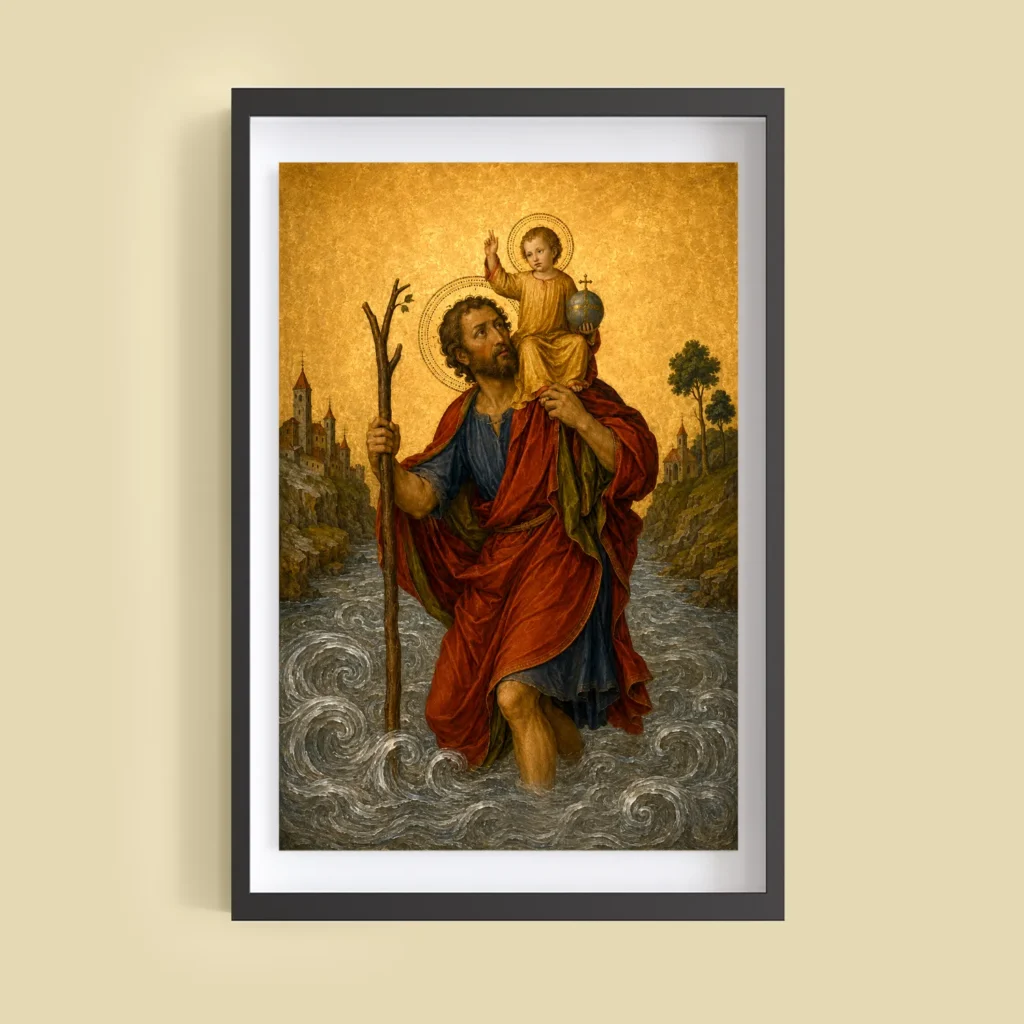
Saint Christopher Leading the Pilgrims
One of the four flanking panels of the Adoration of the Mystic Lamb, this composition shows Saint Christopher leading the pilgrims of God toward the central altar. The figures behind him are dressed in the costumes of fifteenth century Flemish travellers, with their walking staves and broad-brimmed hats.

The panel still hangs in Saint Bavo’s Cathedral in Ghent, in the chapel of the Ghent Altarpiece.
The Madonna of Chancellor Rolin
Painted around 1435 for Nicolas Rolin, the Chancellor of Burgundy, this panel is one of the founding paintings of the modern Western portrait tradition. The Chancellor kneels in prayer in the foreground while the Virgin and Christ child appear to him on the other side of a marble hall opening onto a vast landscape. Through the central arches we see a fortified city, a winding river, and distant mountains rendered with extreme atmospheric precision.

The painting is at the Louvre Museum in Paris, Room 818 of the Department of Paintings.
The Lucca Madonna
Painted around 1437, this small panel of the Virgin and Christ child takes its modern name from a brief sojourn in the collection of the Duke of Lucca. The Virgin is enthroned with the infant in her lap, in a Flemish bourgeois interior with a window opening onto a small garden. Two small lions adorn the throne, recalling the throne of Solomon, the traditional medieval prefiguration of the throne of the Virgin.

The painting is at the Städel Museum in Frankfurt.
The Virgin and Child with Saints and Donor
This devotional panel of around 1441 shows the Virgin and Christ child in a Flemish interior, with Saint Barbara and a male donor presented by Saint Elizabeth. The composition is one of Van Eyck’s last completed works and shows the calm linear refinement of his late style at its most concentrated.

The painting is at the Frick Collection in New York.
Saint Francis Receiving the Stigmata
This small panel shows Saint Francis of Assisi kneeling in his rocky retreat at La Verna when the seraphim appeared to him in 1224 and impressed the wounds of the Passion on his hands and feet. The composition is built on the calm vertical of the saint and his attendant brother Leo, set against a deep Italian landscape that opens onto a fortified city. The picture is one of Van Eyck’s rare Italian devotional subjects.

The painting is at the Philadelphia Museum of Art.
Christ on the Cross with the Virgin and Saint John
This small Crucifixion of around 1430 shows Christ on the cross against a stormy sky, with the Virgin and John the Evangelist at his feet. The figures of the mourners are reduced to a kneeling Mary in the foreground and a standing John, and the panel’s deep landscape opens out behind them onto a fortified city of crystalline precision. The composition is a study in contained grief.

The painting is at the Gemäldegalerie in Berlin. For a wider survey of the subject, see our article on famous Crucifixion paintings.
The Crucifixion and Last Judgement Diptych
A small pair of panels designed to be hung together as a portable altarpiece, this diptych presents the Crucifixion on the left wing and the Last Judgement on the right. The two scenes are conceived as theological complements, with the dying Christ on Calvary on one side and the cosmic judge of souls in glory on the other. The compositions are densely populated with figures and have the precise observed detail of all of Van Eyck’s miniature work.

The diptych is at the Metropolitan Museum of Art in New York.
For more context on Van Eyck’s Netherlandish world, see our articles on his elder brother Hubert van Eyck, on the next generation of Rogier van der Weyden, and on his Tournai contemporary Robert Campin.
Summary Table of Jan van Eyck’s Religious Paintings
| Name | Artist | Date | Medium | Museum |
|---|---|---|---|---|
| The Ghent Altarpiece | Hubert and Jan van Eyck | completed 1432 | Oil on panel | Saint Bavo’s Cathedral, Ghent |
| The Adoration of the Mystic Lamb | Hubert and Jan van Eyck | completed 1432 | Oil on panel | Saint Bavo’s Cathedral, Ghent |
| Saint Christopher Leading the Pilgrims | Hubert and Jan van Eyck | completed 1432 | Oil on panel | Saint Bavo’s Cathedral, Ghent |
| The Madonna of Chancellor Rolin | Jan van Eyck | c. 1435 | Oil on panel | Louvre Museum, Paris |
| The Lucca Madonna | Jan van Eyck | c. 1437 | Oil on panel | Städel Museum, Frankfurt |
| The Virgin and Child with Saints and Donor | Jan van Eyck | c. 1441 | Oil on panel | Frick Collection, New York |
| Saint Francis Receiving the Stigmata | Jan van Eyck | c. 1430 | Oil on parchment on panel | Philadelphia Museum of Art |
| Christ on the Cross with the Virgin and Saint John | Jan van Eyck | c. 1430 | Oil on panel | Gemäldegalerie, Berlin |
| The Crucifixion and Last Judgement Diptych | Jan van Eyck | c. 1430 to 1440 | Oil on canvas transferred from panel | Metropolitan Museum of Art, New York |
Conclusion
Jan van Eyck’s religious painting is the founding visual statement of Northern European Catholic devotion. His Madonnas, his Crucifixions, his great Adoration of the Mystic Lamb, and his small private diptychs gave Europe a new pictorial language built on the patience of the eye, the science of perspective, and the precision of oil paint. His motto als ich kan, “as I can”, written in mock Greek letters on several of his works, is a reminder that even the founding master of European oil painting saw his vision as a humble approximation of an infinite reality.
Important Facts About Jan van Eyck
- Jan van Eyck was born around 1390 in Maaseik, in the Prince-Bishopric of Liège, the younger brother of the painter Hubert van Eyck and a member of a family of craftsmen of the upper Meuse valley.
- He is first documented in 1422 to 1425 as a painter to John of Bavaria, the Prince-Bishop of Liège, and in 1425 he entered the service of Philip the Good, Duke of Burgundy, as court painter and valet de chambre.
- Jan van Eyck is the founding figure of the early Netherlandish school and is celebrated for perfecting the technique of oil painting on panel, for the precise observed detail of his religious panels, and for the depth of psychological observation in his portraits.
- His most famous religious work is the great Ghent Altarpiece, completed by him in 1432 after the death of his elder brother Hubert, and still preserved in the chapel of Saint Bavo’s Cathedral in Ghent.
- He died on 9 July 1441 in Bruges, having served the Burgundian court for sixteen years, and his pictorial revolution shaped the visual world of Northern Europe for the next two centuries.
Questions and Answers About Jan van Eyck Paintings
What is Jan van Eyck’s most famous painting?
His best known religious work is the great Ghent Altarpiece of 1432, completed with his elder brother Hubert and still preserved in Saint Bavo’s Cathedral in Ghent. His best known secular work is the Arnolfini Portrait of 1434 at the National Gallery in London. Among the smaller religious panels, the Madonna of Chancellor Rolin at the Louvre is the most often reproduced.
Where can I see Jan van Eyck paintings today?
The Ghent Altarpiece and its surviving panels are at Saint Bavo’s Cathedral in Ghent. The Louvre in Paris owns the Madonna of Chancellor Rolin, the National Gallery in London the Arnolfini Portrait, the Städel Museum in Frankfurt the Lucca Madonna, the Frick Collection in New York the Virgin with Saints and Donor, the Metropolitan Museum the great Crucifixion and Last Judgement Diptych, and the Gemäldegalerie in Berlin Christ on the Cross.
What style is Jan van Eyck associated with?
Jan van Eyck is one of the founding figures of the early Netherlandish school, sometimes called the Flemish Primitives. His mature style perfected the technique of oil painting on panel and introduced an unprecedented level of observed detail, atmospheric perspective, and psychological depth into Northern European religious art. His pictorial revolution shaped the entire fifteenth and sixteenth century tradition of the Low Countries.
Did Jan van Eyck invent oil painting?
The legend that he invented oil painting was already current in Italy by the late fifteenth century, but modern scholarship has shown that oil-based pigments had been used in painting for several centuries before him. What Van Eyck did was perfect the technique by layering thin transparent glazes of oil paint, achieving an optical depth, a luminosity, and a precision of detail that no earlier panel painter had ever attained. The technique spread rapidly across Europe in the second half of the fifteenth century.
Was Jan van Eyck Catholic?
Yes, like all of his Burgundian contemporaries he was a devout Catholic. He served as court painter to Philip the Good, the most powerful Catholic prince of the Low Countries, and worked extensively on devotional commissions for the Burgundian court, the merchant patrician houses of Bruges, and the great religious foundations of Flanders. His pictorial language is entirely shaped by the Catholic theology of his time.
How did Van Eyck’s brother Hubert contribute to the Ghent Altarpiece?
The 1432 inscription on the frame of the altarpiece attributes the beginning of the work to Hubert and the completion to Jan, after Hubert’s death in 1426. Modern infrared and dendrochronological analysis has confirmed that two hands were at work in the underdrawings, and most specialists today accept that the upper Deisis panels of God the Father, Mary, and John the Baptist were begun by Hubert and finished by Jan after his brother’s death.
Can you buy Jan van Eyck paintings as canvas prints?
The shop at jesuschrist.pictures offers museum-quality canvas reproductions of the great Christian paintings, and the collection keeps growing; it is the best place to look for Jan van Eyck paintings as canvas prints.