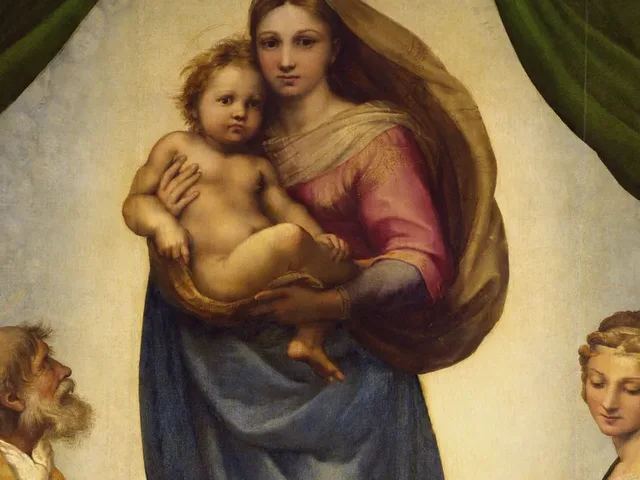
The Timeless Masterworks & paintings of Duccio di Buoninsegna
The timeless masterworks of Duccio di Buoninsegna occupy a position in the history of sacred art that is difficult to overstate. He was the greatest painter medieval Siena ever produced, and one of the defining figures of Italian painting in any era. Born around 1255 and active until his death around 1318 or 1319, he worked at a moment when painting was on the threshold of its most radical transformation in a thousand years. He did not push it across that threshold in the way Giotto did. But the extraordinary refinement of his line, the luminous spirituality of his color, and the narrative ambition of his great altarpiece gave the Sienese school a foundation that would sustain painters for generations after him.

Duccio and the City That Made Him
Siena in the late thirteenth century was a prosperous republic at the height of its political and economic power. It was also a city with a deep and public devotion to the Virgin Mary, who was considered the city’s celestial protector. That devotion shaped the patronage of art in ways that are visible throughout Duccio’s work: his Madonnas are not background figures in a narrative, they are the subject itself, the object of collective faith and civic pride.
The artistic tradition Duccio inherited had been formed by Byzantine painting, filtered through the innovations of Cimabue. From Cimabue, who may have been his teacher in the early 1280s, Duccio absorbed the vocabulary of the large altarpiece, the Maestà format, and the technical vocabulary of tempera and gold on panel. What he added was his own: a quality of line that is at once precise and gentle, a sensitivity to color that borders on the lyrical, and a gift for narrative composition that allowed him to fit emotional complexity into panels no larger than a book. For the broader context of how medieval painters approached the figure of Christ, our article on medieval Jesus paintings provides a useful overview.
He was a difficult man by contemporary accounts. He was fined multiple times by Sienese authorities for various infractions, and he died with considerable debts. None of this contradicts what his paintings say, which is that he was one of the most naturally gifted artists of the entire Middle Ages.
The Masterworks of Duccio di Buoninsegna
Madonna di Crevole (c. 1283-1284)
This small panel is one of Duccio’s earliest surviving works, and it already shows the qualities that would define him. Originally made for the hermitage of Montespecchio near Siena, it later passed to the church of Santa Cecilia in Crevole, from which it takes its name. It is now in the Museo dell’Opera del Duomo in Siena, displayed alongside the Maestà that would be Duccio’s crowning achievement.

The composition follows the Byzantine Hodegetria type: the Virgin holds the Child on her left arm and presents him to the viewer. But the gesture of the Christ child, reaching his right arm upward to touch his mother’s veil with a tenderness that is entirely unconventional, immediately separates this panel from Byzantine precedent. The Virgin’s expression is melancholy and inward, already aware of what her son’s life will carry. The faces have a delicacy, a softness of modeling, that distinguishes Duccio sharply from the more architectural approach of Cimabue. He was learning from the Florentine master and at the same time moving in a different direction entirely.
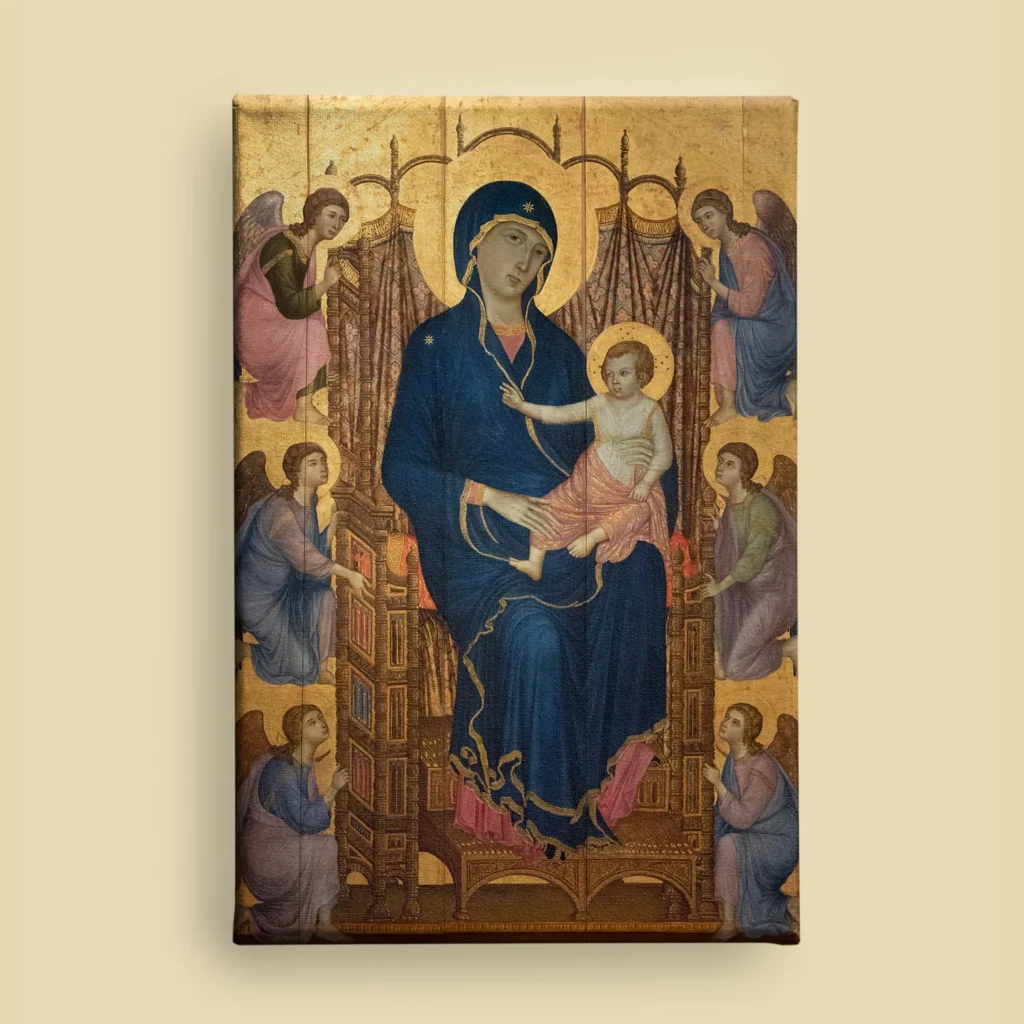
Rucellai Madonna (1285)
This is the largest surviving panel painting of the thirteenth century: 450 centimeters high by 290 centimeters wide. It was commissioned on April 15, 1285, by the Compagnia dei Laudesi, a Florentine confraternity that gathered in the church of Santa Maria Novella to sing hymns in praise of the Virgin. Duccio was paid 150 lire for a painting that would have dominated whatever wall it hung on.

Today it hangs in Room 2 of the Uffizi Gallery in Florence, in the same room as Cimabue’s Santa Trinita Maestà and Giotto’s Ognissanti Madonna. The juxtaposition is one of the most instructive encounters in art history. For many years, the Rucellai Madonna was attributed to Cimabue. It was only in the twentieth century that scholars definitively reassigned it to Duccio, a correction with significant implications for understanding both artists.
The painting shows the Virgin enthroned with the Christ Child, flanked by six adoring angels. The throne has a delicacy and Gothic elaboration that is entirely Duccio’s own, distinct from the more massive thrones of Cimabue. The angels do not simply frame the composition: they lean in, they gaze with absorbed attention, and the scene has a sense of devotional intimacy that transforms its monumental scale. This is a painting made for collective contemplation, and it rewards it.
The Maestà (1308-1311)
Everything else in Duccio’s career leads toward this, and nothing after it needs to be measured against anything else. The Maestà of Siena Cathedral is the most ambitious altarpiece of the Middle Ages and one of the greatest works of sacred art ever made.

The commission was agreed in 1308. Duccio was required to work exclusively on the painting until its completion, and he was paid sixteen soldi per day. Three years later, on June 9, 1311, the finished altarpiece was carried in procession from his workshop to the cathedral, with the bishop at the head of the procession, followed by the city’s clergy, officials, and people. Shops closed. Musicians played. The inscription at the base of the throne records the occasion in permanent form: Mater sancta Dei sis causa Senis requiei sis Ducio vita te quia pinxit ita (“Holy Mother of God, be thou the cause of peace for Siena and life to Duccio because he painted thee thus”).
The altarpiece was double-sided, designed to be seen from both directions when placed above the high altar. The front showed the Virgin and Child enthroned in majesty, surrounded by twenty angels and nineteen saints, with the four patron saints of Siena kneeling in the foreground. Below, a predella of the Childhood of Christ alternated narrative panels with standing figures of prophets. The reverse showed forty-three small panels depicting the Passion of Christ, with the Crucifixion at the center, double the size of the surrounding scenes. It is the first altarpiece in the history of painting to be fully conceived on both sides simultaneously as a unified artistic and theological program.
The main panels and the majority of the narrative scenes remain in the Museo dell’Opera del Duomo in Siena, where they have been since 1878. But in 1771 the altarpiece was dismantled and sawn apart, and a number of predella panels were sold and dispersed. Eight are now in collections outside Italy. Each one deserves individual attention.
The Annunciation (1311)
This small panel, 44.5 by 45.8 centimeters, was painted for the front predella of the Maestà, positioned at the left edge beneath the great image of the Virgin. It shows the Archangel Gabriel announcing to Mary that she will conceive the Son of God. The Virgin holds a Bible open at the words of Isaiah: Ecce virgo concipiet et pariet filium (“Behold a Virgin shall conceive and bear a son”). A dove descends from above. The two figures face each other across a modest architectural space, their exchange rendered with a directness and quietness that makes the panel feel much larger than its physical dimensions.

It is now in the National Gallery in London, acquired in 1883. For a broader exploration of how the Annunciation was treated by painters from different centuries and schools, our article on famous Annunciation paintings covers the full tradition.
Nativity with the Prophets Isaiah and Ezekiel (1308-1311)
This is the panel that gives the clearest sense of what Duccio’s predella looked like at its most intimate and luminous. The Nativity scene at the center, flanked by standing prophets holding scrolls, shows the Virgin reclining in the stable, the angels gathered above, the shepherds to the right, and at the lower left, the bathing of the newborn Christ. The whole composition breathes with a tender domesticity that has no precedent in painting of this period.

The panel is now in the National Gallery of Art in Washington D.C., part of the Andrew W. Mellon Collection. For a survey of how the Nativity was treated across the history of Christian painting, our article on famous Nativity paintings traces the tradition in depth.
The Transfiguration (1311)
Small in scale but immense in what it achieves, this panel from the back predella of the Maestà shows Christ at the moment of the Transfiguration on Mount Tabor, when his body became radiant with divine light. Duccio renders the light as golden striations across Christ’s white robes, a device that is simultaneously technically precise and spiritually evocative. Moses and Elijah flank him. Below, the disciples Peter, James, and John react with a combination of awe and physical collapse. Their postures are genuinely observed from life, which makes the supernatural quality of the central figure even more striking.

This panel is also in the National Gallery in London, positioned in that collection between the Annunciation and the Healing of the Man Born Blind from the same predella series.
The Raising of Lazarus (1308-1311)
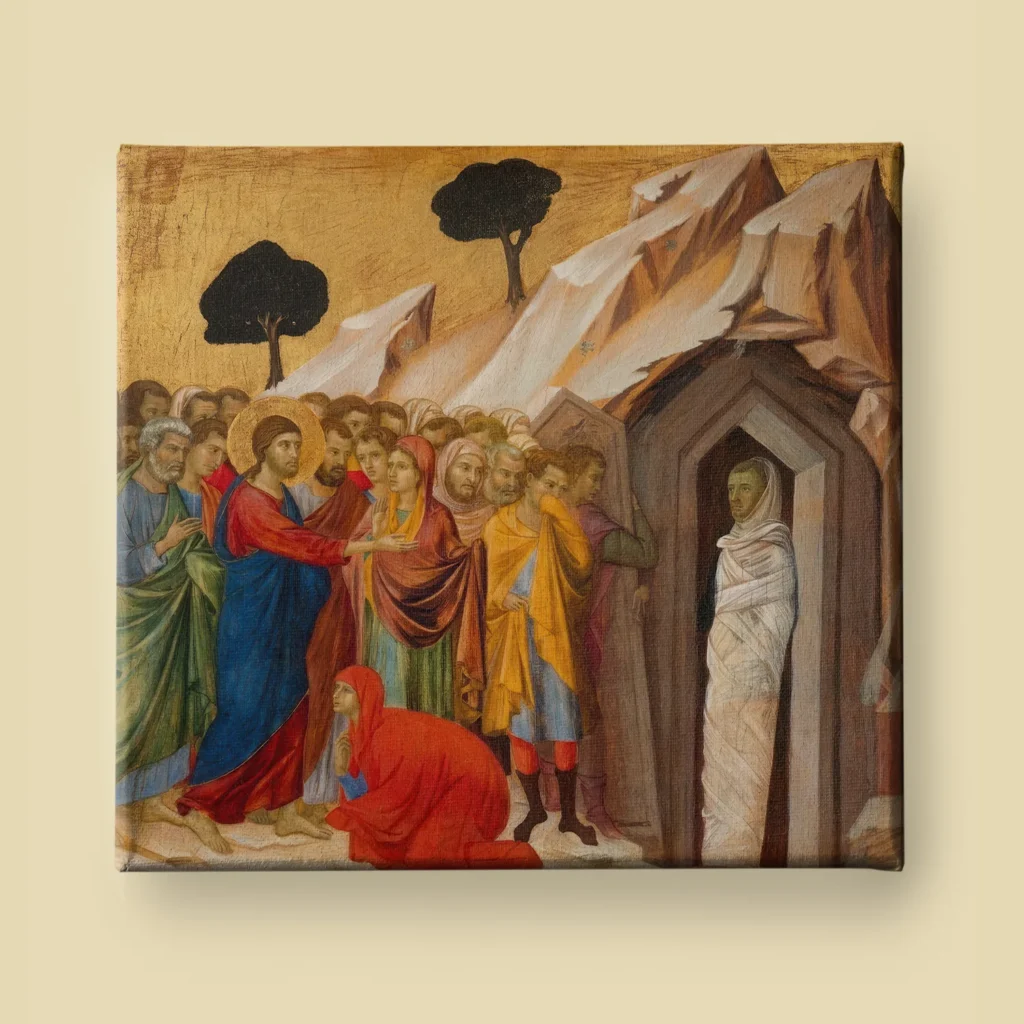
Of all the predella panels from the Maestà now outside Italy, this may be the most dramatic. The scene is set before the tomb of Lazarus: Christ commands his resurrection, extending his right hand in a gesture of divine authority. Lazarus emerges, still wrapped in his burial cloths. Around them, the figures of Mary and Martha, the disciples, and the bystanders react in a range of expressions and postures that show Duccio at his most narratively inventive.

The spatial arrangement of the scene, with the rocky landscape receding behind the figures, is one of the most sophisticated spatial compositions of the late thirteenth century. This panel is now at the Kimbell Art Museum in Fort Worth, Texas.
Virgin and Child (late period)
Among Duccio’s later works are several small devotional panels depicting the Virgin holding the Christ Child in compositions of great tenderness and concentrated spirituality. These panels were made for private devotion rather than for public altars, and they have a different character from the large Maestà format: more intimate, more focused on the relationship between mother and child, more deliberately moving.

One such panel, attributed to Duccio’s later career, is held in the Pinacoteca Nazionale in Siena. The Virgin’s dark cloak, the Child’s orange-red garment, the gold ground incised with circular halo patterns, and the quiet melancholy of the Virgin’s expression are all characteristic of Duccio’s mature style. These small panels may lack the monumental ambition of the Rucellai Madonna or the Maestà, but they contain some of his most deeply felt work.
Duccio’s Legacy
When Duccio died around 1318 or 1319, he left behind a school of painting that would sustain Siena for the rest of the fourteenth century and beyond. Simone Martini, who may have been his student, carried his gift for line and color into the Gothic elegance that defines the Trecento’s most refined works. The Lorenzetti brothers absorbed his narrative ambition and took it in a more dramatic direction. Ambrogio Lorenzetti‘s Annunciation of 1344 could not have existed without Duccio’s example.
His relationship with Florence is more complex. He and Giotto were exact contemporaries, working in parallel in their respective cities, and the comparison between them has fascinated art historians for generations. Giotto was the more radical innovator, the painter who truly broke with the past. Duccio was the finer craftsman, the more lyrical spirit, and arguably the more complete artistic personality. The two approaches were not in competition. They were complementary: the Florentine path led toward the Renaissance, and the Sienese path led toward something equally valid and equally beautiful, a painting tradition of spiritual refinement that enriched European devotional art for centuries.
Conclusion
There is a quality in Duccio’s painting that resists easy description. It is not the dramatic power of Giotto, nor the intellectual rigour of Cimabue, nor even the elegance of Simone Martini. It is something quieter and perhaps more lasting: a sense that the sacred is genuinely present in the image, that the gold ground is not merely decoration but light, that the Virgin’s expression carries real emotional weight. His Maestà was carried through the streets of Siena with the whole city watching. Seven hundred years later, standing in the room of the Museo dell’Opera del Duomo where the main panels are displayed, it is still possible to understand why.
Duccio Paintings featured in this article
| Painting | Date | Medium | Location |
|---|---|---|---|
| Madonna di Crevole | c. 1283-1284 | Tempera and gold on panel | Museo dell’Opera del Duomo, Siena |
| Rucellai Madonna | 1285 | Tempera and gold on panel | Uffizi Gallery, Florence |
| Maestà (central panel) | 1308-1311 | Tempera and gold on panel | Museo dell’Opera del Duomo, Siena |
| Annunciation (from the Maestà) | 1311 | Egg tempera on panel | National Gallery, London |
| Nativity with the Prophets Isaiah and Ezekiel (from the Maestà) | 1308-1311 | Tempera and gold on panel | National Gallery of Art, Washington D.C. |
| The Transfiguration (from the Maestà) | 1311 | Egg tempera on panel | National Gallery, London |
| The Raising of Lazarus (from the Maestà) | 1308-1311 | Tempera and gold on panel | Kimbell Art Museum, Fort Worth, Texas |
| Virgin and Child | after 1311 | Tempera and gold on panel | Pinacoteca Nazionale, Siena |
Key Facts About Duccio di Buoninsegna
- Duccio di Buoninsegna was born in Siena around 1255 and died around 1318 or 1319. He is the founding master of the Sienese school of painting.
- He was a direct contemporary of both Cimabue and Giotto. All three were active in the same decades, and the comparison between Duccio and Giotto has defined art historical discussion of the period for generations.
- His earliest known work is probably the Madonna di Crevole (c. 1283-1284), now in the Museo dell’Opera del Duomo, Siena.
- The Rucellai Madonna (1285), commissioned by a Florentine confraternity for the church of Santa Maria Novella, is the largest surviving painted panel of the thirteenth century (450 x 290 cm). It hangs in the Uffizi, Florence.
- The Maestà (1308-1311), painted for the high altar of Siena Cathedral, is the most ambitious altarpiece of the Middle Ages. It was double-sided and originally comprised over seventy individual scenes. The main panels remain in the Museo dell’Opera del Duomo, Siena.
- The Maestà is the only surviving signed work by Duccio. The inscription at the base of the throne is both a prayer and a personal statement: “Holy Mother of God, be thou the cause of peace for Siena and life to Duccio because he painted thee thus.”
- When the Maestà was installed in Siena Cathedral on June 9, 1311, the entire city processed through the streets to accompany it. Shops were closed and musicians played. It was a civic and religious event without precedent in the history of Italian art.
- Eight predella panels from the Maestà are now held in museums outside Italy, including the National Gallery in London, the National Gallery of Art in Washington D.C., the Kimbell Art Museum in Fort Worth, and the Frick Collection in New York.
- Duccio’s most likely student was Simone Martini, who carried the Sienese tradition of lyrical line and refined color into the next generation. The Lorenzetti brothers were also deeply influenced by his work.
- Unlike Giotto, whose innovations were primarily spatial and plastic, Duccio’s contributions were above all coloristic and narrative. His combination of Byzantine elegance with Gothic tenderness defines the Sienese school at its finest.
Questions and Answers
Who was Duccio di Buoninsegna?
Duccio di Buoninsegna (c. 1255 to c. 1318-1319) was the greatest painter medieval Siena produced and one of the defining figures of Italian art at the turn of the fourteenth century. Working in tempera and gold on panel, he created a body of sacred paintings that combined Byzantine elegance with Gothic tenderness and genuine narrative ambition. His Maestà of 1311 is the most ambitious altarpiece of the Middle Ages. He is the founding master of the Sienese school of painting.
What is the Maestà by Duccio?
The Maestà (1308-1311) was a monumental double-sided altarpiece commissioned for the high altar of Siena Cathedral. The front showed the Virgin and Child enthroned in majesty, surrounded by saints and angels, with a predella of scenes from the Childhood of Christ. The reverse showed forty-three scenes from the Passion and life of Christ. Measuring approximately five meters square in its original state, it was carried through the streets of Siena in a civic procession on June 9, 1311. Most of the main panels remain in the Museo dell’Opera del Duomo in Siena; eight predella panels were sold and are now in museums in London, Washington D.C., Fort Worth, and New York.
Where can you see Duccio’s paintings today?
The greatest concentration of Duccio’s work is in Siena, at the Museo dell’Opera del Duomo, which holds the main panels of the Maestà and the Madonna di Crevole. The Rucellai Madonna is in the Uffizi Gallery in Florence. The National Gallery in London holds the Annunciation and Transfiguration predella panels. The National Gallery of Art in Washington D.C. holds the Nativity with the Prophets. The Raising of Lazarus is at the Kimbell Art Museum in Fort Worth, Texas. The Pinacoteca Nazionale in Siena holds several smaller Duccio panels.
What is the difference between Duccio and Giotto?
Duccio and Giotto were exact contemporaries, working in Siena and Florence respectively in the same decades, but they represent two distinct approaches to the transformation of medieval painting. Giotto was the more radical spatial innovator, the painter who most decisively broke from the Byzantine tradition to create figures with three-dimensional weight and presence. Duccio worked within a more lyrical, coloristic tradition, refining the Byzantine inheritance rather than abandoning it. His contributions were above all in the quality of his line, the luminosity of his color, and his gift for narrative in small format. The two approaches were not in competition; they defined the Florentine and Sienese schools respectively, both of which shaped European painting for the following two centuries.
Where can I buy a canvas reproduction of a Duccio painting?
You can buy a canvas reproduction of a Duccio painting at jesuschrist.pictures: browse all the Duccio canvas prints in our shop. Our shop carries a curated selection of canvas reproductions of medieval and Renaissance sacred works from the Sienese and Florentine traditions, available in multiple formats for private devotion or display.