12 Medieval Christian Paintings from the Masters of the Gothic Tradition
Medieval Christian paintings are where the story of Western sacred art truly begins. Long before Leonardo or Raphael reinvented the language of painting, the masters of the Gothic tradition were doing something equally revolutionary: they were pulling Christ out of the abstract golden world of Byzantine icons and placing him, step by step, in a space that had weight, depth, and human emotion. The painters on this list, from Cimabue in thirteenth-century Florence to Hieronymus Bosch at the threshold of the Renaissance, built the visual vocabulary that all later Christian art would inherit. Their works are arranged here in chronological order, from c. 1280 to c. 1500.
To understand this tradition in full, see our series on the great medieval Christian painters and our articles on medieval Jesus paintings and Gothic Jesus paintings.
1. Maestà by Cimabue (c. 1280)
Everything begins here. The Louvre’s Maestà, painted by Cimabue around 1280 for the Church of San Francesco in Pisa, has been described by art historians as “the founding act of Western painting.” That claim is not idle hyperbole. Before Cimabue, Italian painters worked in a mode inherited from Byzantine tradition: sacred figures were frontal, flat, symbolic, their bodies suggestions of holiness rather than representations of flesh. Cimabue broke this open. His Virgin and Child are still enthroned in a golden sacred space, but the angels around them overlap, their bodies suggest volume, and the throne itself recedes into something approaching perspective. The faces are no longer interchangeable. They are individual.
Dante immortalized the rivalry between Cimabue and his pupil Giotto in the Purgatorio, suggesting that Giotto’s fame had already eclipsed his teacher’s. But the debt Giotto owed to Cimabue is enormous, and this painting makes clear why. The Maestà was seized by Napoleon’s troops in 1813 and has been at the Louvre ever since. A major restoration completed in 2024 revealed its colors as Cimabue originally painted them: the Virgin’s cloak a saturated cobalt blue, the gold of the throne gleaming as it did seven hundred and forty years ago. For more on Cimabue, see our article on Cimabue’s paintings.


2. Rucellai Madonna by Duccio di Buoninsegna (c. 1285)
Duccio was Cimabue’s great Sienese contemporary, and the Rucellai Madonna is among his earliest surviving masterpieces. Commissioned in 1285 for the Confraternity of the Laudesi in the Church of Santa Maria Novella in Florence, the painting measures nearly five meters in height, making it one of the largest panel paintings of the thirteenth century. The Virgin is enthroned, the Christ Child in her arms, surrounded by six angels whose wings overlap in a pattern of extraordinary rhythmic beauty. The gold ground glows. The drapery falls in precise, linear folds that carry the full decorative intelligence of the Sienese tradition.
The Rucellai Madonna was attributed to Cimabue for centuries before a nineteenth-century discovery of Duccio’s original contract settled the question. It now hangs in the Uffizi Gallery in Florence, where the contrast with the works around it is instructive: here, still firmly in the Gothic world, is the tradition that the Renaissance would both inherit and transform. For more on this artist, see our article on Duccio’s paintings.


3. The Kiss of Judas by Giotto (c. 1304–1306)
The Scrovegni Chapel in Padua is the greatest single achievement of medieval painting in the Western world. Between 1303 and 1305, Giotto covered every surface of the small chapel with a fresco cycle depicting the lives of the Virgin and Christ. Among those scenes, the Kiss of Judas stands out for a quality that is almost impossible to define and impossible to miss: moral drama rendered as pure visual fact. Judas wraps his yellow cloak around Christ and leans in to kiss him. Their faces are inches apart. The soldiers press in from either side. Torches flare. Peter, in the background, raises a sword to cut off the ear of a servant. And Christ, at the center of all this turmoil, looks into the eyes of his betrayer with an expression of complete, heartbroken knowledge.
No painter before Giotto had achieved this. The idea that a fresco could carry the full weight of a human moral encounter, that paint on plaster could show what it means to betray someone who loves you, was genuinely new. It changed everything that came after. For more on this master, see our dedicated article on Giotto’s paintings.


4. The Crucifixion by Giotto (c. 1304–1306)
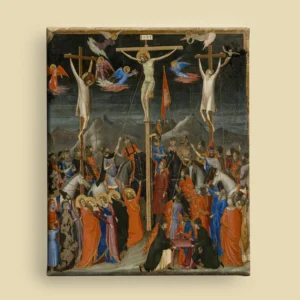
A few steps along the wall of the Scrovegni Chapel, Christ hangs on the cross against a sky of pure ultramarine blue. The angels circling above him weep with open mouths, their grief visceral and ungoverned. Below, the Virgin collapses into the arms of the holy women. Mary Magdalene clutches the base of the cross. John turns away. A Roman soldier points upward at the dying figure. Giotto uses none of the familiar medieval shorthand for sacred events: no gold ground, no symbolic crowd of identical faces. He paints specific people responding to a specific catastrophe.
This Crucifixion is the direct ancestor of every great Passion painting that followed, from Rogier van der Weyden to Rubens to Dalí. The approach of beginning with the human reality of grief and building outward toward the theological meaning, rather than starting with the symbol and filling in the human detail, is Giotto’s invention. The fresco is part of the cycle at the Scrovegni Chapel in Padua. For a broader view of this subject, see our article on famous Crucifixion paintings.

5. The Raising of Lazarus by Duccio di Buoninsegna (c. 1308–1311)
The Maestà altarpiece that Duccio painted for Siena Cathedral between 1308 and 1311 was the most ambitious panel painting of the entire medieval period, and its unveiling was treated as a civic festival: the city authorities declared a public holiday, the bishop led a procession through the streets, and the altarpiece was carried to the cathedral to the sound of bells and trumpets. The altarpiece was later dismembered, and its panels are now scattered across several collections. One of the finest is the Raising of Lazarus, which shows Christ commanding the dead man to rise from his tomb while the bystanders react with expressions that range from astonishment to skepticism to barely contained joy.
Duccio’s figures are less monumental than Giotto’s but more decorative, more refined, more attentive to the beauty of color and the elegance of gesture. In the Raising of Lazarus, these qualities serve the story perfectly: this is a scene about wonder, and Duccio makes wonder feel like a natural state. The panel is at the Kimbell Art Museum in Fort Worth, Texas.


6. The Annunciation by Simone Martini (1333)
There is no painting in the entire Gothic tradition that demonstrates the movement’s capacity for pure visual beauty more completely than this one. Simone Martini painted the Annunciation in 1333 for the cathedral of Siena, together with his brother-in-law Lippo Memmi who painted the flanking saints. The central panel shows the Angel Gabriel kneeling before the Virgin, an olive branch in his hand, the words of his greeting traced in gold relief across the gold ground of the panel. Mary recoils slightly, her cloak pulled close, her expression a mixture of modesty and bewilderment. A vase of white lilies stands between them.
The gold ground, the sinuous Gothic line, the extraordinary precision of the drapery, and the way the two figures are held in tension across the space of the panel combine to produce an image of absolute formal mastery. This is Gothic art at the summit of its achievement. The painting is at the Uffizi Gallery in Florence. For more on this artist and his contemporaries, see our article on Simone Martini’s paintings. For how artists across history depicted this mystery, see our article on famous Annunciation paintings.

7. The Annunciation by Ambrogio Lorenzetti (1344)
Eleven years after Simone Martini’s Annunciation, his Sienese contemporary Ambrogio Lorenzetti painted his own interpretation of the same subject, and the difference between the two paintings captures the full range of Gothic painting’s ambitions. Where Simone favored line, elegance, and decorative gold, Lorenzetti reached toward geometry and space. His Angel and Virgin are set in a tiled room whose perspective recession, though not yet fully scientific, is a remarkable attempt to depict a real architectural interior. The figures themselves are simpler, more solid, less decorative than Simone’s.
The painting is signed and dated (“Ambrosius Laurentii de Senis hoc opus pinxit, MCCCXLIV”) which makes it one of the very few precisely dated masterpieces of the entire medieval period. Lorenzetti died in 1348, almost certainly from the Black Death, which claimed over half of Siena’s population that year. The Annunciation, painted just four years before his death, has an austere dignity that feels, in retrospect, like a farewell. It is at the Pinacoteca Nazionale in Siena. See our article on Ambrogio Lorenzetti’s paintings for more.


8. Adoration of the Magi by Gentile da Fabriano (1423)
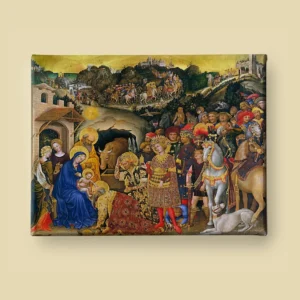
If the painters discussed so far were moving, however tentatively, toward naturalism and space, Gentile da Fabriano reminds us that the Gothic tradition still had its own language to speak, and that language had not said its last word. The Adoration of the Magi, painted in 1423 for the Florentine banker Palla Strozzi, is a riot of gold, color, texture, and narrative detail that has no interest in restraint. The Three Kings process through a landscape packed with riders, horses, leopards, monkeys, and attendants from what appears to be the entire eastern world. Their robes are encrusted with gold. Their horses’ tack glitters. The stable, in the background, barely contains the press of figures surrounding the Christ Child.
This style, known as International Gothic, was the last flowering of medieval decorative painting before the Renaissance swept it aside. Gentile was doing something genuinely different from Giotto or Duccio, but the painting’s opulence is not empty. The extraordinary richness of the Magi’s retinue is a theological statement: all the splendor of the world is being offered to this child in a manger. The painting is at the Uffizi Gallery in Florence. For more on this subject across the centuries, see our article on famous Adoration of the Magi paintings.

9. Madonna of the Rose Bower by Martin Schongauer (1473)
Martin Schongauer was the greatest German painter of the fifteenth century, and one of the finest engravers in the history of printmaking. The Madonna of the Rose Bower, still in the Church of the Dominicans in Colmar where it was painted in 1473, shows the Virgin seated in a bower of red and white roses, the Christ Child in her lap, two angels placing a crown on her head while two more hover above her with crowns of their own. The background is a dense pattern of gold that suggests both the divine realm and the garden of paradise.
What makes this painting exceptional is not novelty but perfection. Schongauer was not trying to reinvent painting. He was trying to make a devotional image so beautiful that it would serve as a window into the sacred, and he succeeded completely. The softness of the Virgin’s features, the delicate hands, the careful rendering of each individual rose petal, the gravity with which the Child gazes outward, these are the marks of an artist in full command of his tradition. The painting has never left Colmar.

Here is another Madonna by Martin Schongauer

10. The Seven Joys of Mary by Hans Memling (c. 1480)
Hans Memling’s Seven Joys of Mary is one of the most extraordinary paintings of the fifteenth century, and one of the most unusual. Rather than depicting a single sacred moment, the altarpiece compresses the entire cycle of Marian joy into a single panoramic landscape. The Seven Joys, from the Annunciation to the Assumption, unfold simultaneously across the panel, with dozens of figures moving through a Flemish countryside that is partly holy land, partly Bruges in summer. The eye travels from scene to scene, discovering the Flight into Egypt here, the Massacre of the Innocents there, the Adoration of the Magi in the foreground, the Resurrection on a hillside in the distance.
This form of continuous narrative, where time and sequence are collapsed into spatial coexistence, is one of the great inventions of Northern Gothic painting. It demands patience from the viewer, and it rewards it. The painting is at the Alte Pinakothek in Munich. For more beautiful images of the Virgin, see our article on the most beautiful Virgin Mary paintings.


11. Nativity at Night by Geertgen tot Sint Jans (c. 1490)
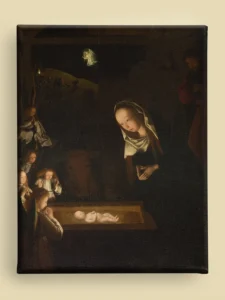
Geertgen tot Sint Jans died before he was thirty, leaving behind a handful of paintings of remarkable originality. The Nativity at Night is the most astonishing of them. The scene is set entirely in darkness. The stable is a cave. The only light in the picture comes from the Christ Child himself: a warm golden radiance that illuminates the faces of the Virgin, the attending angels, the cattle in the background, and the single shepherd visible through the cave’s opening, looking up at an angel who appears in a shaft of heavenly light above him.
This painting solved a problem that Christian artists had struggled with since the beginning: how to show the divine light that scripture says surrounded the Nativity without resorting to symbolic shorthand. Geertgen’s answer was to make the light literal and physical, emanating directly from the body of the infant Christ. The effect is technically dazzling and theologically precise. Correggio would revisit the idea forty years later in his Holy Night; Rembrandt would draw on it still later. The painting is at the National Gallery in London. For more, see our article on famous Nativity paintings.

12. Christ Crowned with Thorns by Hieronymus Bosch (c. 1500)
Bosch marks the edge of the medieval world. His art is rooted in the Gothic tradition and yet points unmistakably toward something that has no precedent: a vision of human wickedness so complete, so inventive, so strangely funny and terrifying at once, that it reads less like religious instruction than like a nightmare too coherent to dismiss. Christ Crowned with Thorns shows five faces pressed close around a suffering Christ. Each tormentor is specific, individual, and in some way grotesque: a man in a spiked collar, a soldier with a crossbow bolt in his cap, a figure whose wrinkled face expresses a contempt so precise it feels personal. Christ, at the center, looks outward with an expression of sorrowful patience that is all the more devastating for the faces surrounding it.
There is no action here, no movement, no narrative event. Just these five faces, pressed together, and the theological question they force: who are these people? The answer Bosch implies is the same answer he gives throughout his work. They are us. The painting at the Museo del Prado in Madrid is among the most concentrated and disturbing images of the Passion in the entire history of Christian art.


Summary of the 12 Medieval Christian Paintings Featured in This Article
| Painting | Artist | Date | Medium | Location |
|---|---|---|---|---|
| Maestà | Cimabue | c. 1280 | Tempera on panel | Musée du Louvre, Paris |
| Rucellai Madonna | Duccio di Buoninsegna | c. 1285 | Tempera on panel | Uffizi Gallery, Florence |
| The Kiss of Judas | Giotto | c. 1304–1306 | Fresco | Scrovegni Chapel, Padua |
| The Crucifixion | Giotto | c. 1304–1306 | Fresco | Scrovegni Chapel, Padua |
| The Raising of Lazarus | Duccio di Buoninsegna | c. 1308–1311 | Tempera on panel | Kimbell Art Museum, Fort Worth |
| The Annunciation | Simone Martini | 1333 | Tempera and gold on panel | Uffizi Gallery, Florence |
| The Annunciation | Ambrogio Lorenzetti | 1344 | Tempera on panel | Pinacoteca Nazionale, Siena |
| Adoration of the Magi | Gentile da Fabriano | 1423 | Tempera and gold on panel | Uffizi Gallery, Florence |
| Madonna of the Rose Bower | Martin Schongauer | 1473 | Oil on panel | Church of the Dominicans, Colmar |
| The Seven Joys of Mary | Hans Memling | c. 1480 | Oil on panel | Alte Pinakothek, Munich |
| Nativity at Night | Geertgen tot Sint Jans | c. 1490 | Oil on panel | National Gallery, London |
| Christ Crowned with Thorns | Hieronymus Bosch | c. 1500 | Oil on panel | Museo del Prado, Madrid |
Conclusion
The twelve paintings on this list span two hundred and twenty years and four countries. They were made for cathedrals and private chapels, for merchant patrons and religious confraternities, for monks who prayed before them and faithful who processed through the streets to honor them. What they share is a common conviction: that the sacred stories of Christianity deserved the full force of the painter’s intelligence, and that beauty was not an ornament added to faith but an expression of it.
The Gothic tradition did not fail when the Renaissance arrived. It completed itself. The painters on this list had built a foundation of expressive power and spiritual seriousness on which Leonardo, Raphael, and Michelangelo would construct their own world. To follow that story into the next great chapter, see our article on Renaissance Jesus paintings, or explore the full arc of Christian art in our overview of the great renaissance Christian painters.
Frequently Asked Questions
What is the oldest Christian painting on this list?
The oldest work featured here is Cimabue’s Maestà, painted around 1280 for the Church of San Francesco in Pisa. It is now at the Musée du Louvre in Paris, where a major restoration completed in 2024 has restored the original brilliance of its colors. Art historians have described the Maestà as “the founding act of Western painting,” marking the first decisive break from the flat Byzantine style toward the naturalism that would define all subsequent European sacred art.
What is the difference between Gothic and medieval painting?
The terms overlap considerably. “Medieval” is the broader category, covering all art produced from roughly the fifth to the fifteenth century. “Gothic” refers to a specific style that emerged in the twelfth century and dominated European art until the Renaissance, characterized by pointed arches in architecture, gold grounds and elongated figures in painting, and an increasing attention to naturalistic detail in the human figure. The paintings on this list are all Gothic or proto-Renaissance, spanning the period roughly from 1270 to 1510.
Who were the most important medieval Christian painters?
The Italian masters are the most studied: Cimabue and Giotto in Florence, Duccio and Simone Martini in Siena, the Lorenzetti brothers in both cities. In Northern Europe, the great Flemish masters of the fifteenth century, Jan van Eyck, Rogier van der Weyden, Hans Memling, and Hieronymus Bosch, produced a parallel tradition of equal importance. Gentile da Fabriano and Martin Schongauer represent the International Gothic that linked Italy and the North. Our articles on Giotto, Duccio, Simone Martini, and Ambrogio Lorenzetti explore many of these painters in depth.
Where can I see the Scrovegni Chapel frescoes by Giotto?
The Scrovegni Chapel is in Padua, Italy, part of the Musei Civici di Padova complex. Visits require advance booking, as the number of visitors allowed inside at one time is strictly limited for conservation reasons. The chapel was declared a UNESCO World Heritage Site in 2021. It is, without question, one of the great pilgrimage destinations for anyone who cares about Christian art.
What happened to Duccio’s great Maestà altarpiece?
Duccio’s Maestà, painted between 1308 and 1311 for Siena Cathedral, was one of the largest and most celebrated panel paintings of the medieval period. In 1771 the altarpiece was dismembered, and its component panels were sold and dispersed across several collections. The main panels, including the large front showing the enthroned Virgin, are still at the Museo dell’Opera del Duomo in Siena. Individual narrative panels from the back are now at the Kimbell Art Museum in Fort Worth, the National Gallery in Washington, the National Gallery in London, and several other collections around the world.
Is Hieronymus Bosch considered a medieval painter?
Bosch is a transitional figure. He was born around 1450 and died in 1516, placing him squarely in the period when the Renaissance was already fully underway in Italy. His style, however, is rooted entirely in the Gothic tradition: gold grounds, symbolic imagery, compressed narrative space, and an iconographic vocabulary drawn from medieval theology and popular devotion. His vision is too original and too disturbing to fit neatly into any category, which is part of why he remains one of the most discussed painters in the history of Western art.
Where can I buy reproductions of these medieval Christian paintings?
You can buy reproductions of these medieval Christian paintings at jesuschrist.pictures, in our shop. All twelve works on this list, including Cimabue’s Maestà, both Duccio panels, Giotto’s Kiss of Judas and Crucifixion, Ambrogio Lorenzetti’s Annunciation, Gentile da Fabriano’s Adoration of the Magi, Schongauer’s Madonna, Memling’s Seven Joys of Mary, Geertgen’s Nativity, and Bosch’s Christ Crowned with Thorns, are available as canvas reproductions in our shop.


