Inside Michelangelo’s Creation of Adam
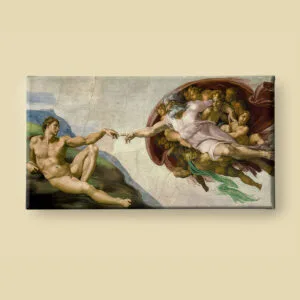
The Creation of Adam is the most famous scene from the Sistine Chapel ceiling, painted by Michelangelo during the High Renaissance. Executed around 1511, as part of the ceiling he worked on between 1508 and 1512, it shows God reaching toward Adam to give him life. The scene is in the Sistine Chapel, Vatican Museums. Its medium is fresco, color painted directly into fresh plaster.
At first the scene looks simple. Two figures stretch toward each other across an open space, their fingers almost touching. Yet that small gap carries the whole meaning of the image. God, carried forward by angels, extends his hand with energy and purpose. Adam, reclining on the earth, lifts his arm slowly, as if life has not yet fully reached him. The drama lives in the distance that still remains between them.
What makes the Creation of Adam so powerful is how much Michelangelo says with so little. There is no Garden of Eden, no crowd, no ornament. There is only the human body, the divine gesture, and the charged space in between. It is one of the clearest images ever made of the moment a human being receives life from God.
The fresco belongs to Michelangelo’s vast work on the Sistine ceiling and to his wider achievement as a painter and sculptor. Readers who want to see more of his sacred work can also read our article on Michelangelo’s paintings.
The History of the Creation of Adam
The Creation of Adam was painted as part of the Sistine Chapel ceiling, the project Pope Julius II commissioned from Michelangelo in 1508. The artist, who thought of himself first as a sculptor, worked on the ceiling until 1512. The scene of Adam sits near the center of the vault, within a sequence of nine panels drawn from the Book of Genesis.

Michelangelo painted in true fresco, applying color to fresh plaster so that the image became part of the wall as it dried. The technique demands speed and certainty, since each section has to be finished before the plaster sets. The scale of the ceiling, painted high above the chapel floor, makes the confidence of the drawing all the more striking.
By the time he reached the Creation of Adam, Michelangelo had found the grand, sculptural style that defines the ceiling. The figures are monumental, modeled like carved stone, yet full of movement. The work changed the course of Western art and helped set the standard for the High Renaissance.
The Meaning and Symbolism of the Creation of Adam
The heart of the fresco is the space between the two hands. God’s finger is firm and fully extended. Adam’s is relaxed, still heavy with sleep. Michelangelo does not show the moment of contact, but the instant just before it. Life is about to pass from Creator to creature, and the viewer is left holding that suspense.

God appears not as a distant ruler but as an active, surging presence, borne forward by angels and wrapped in a billowing cloak. Beneath his left arm a female figure looks out toward Adam. She is often read as Eve, present in the mind of God before her own creation, though some scholars have suggested the Virgin Mary or divine Wisdom. The fresco keeps the question open.

Adam, by contrast, is earthbound. His body is beautiful and complete, yet still without the spark that God is about to give. The contrast between the two figures, one rising and one reclining, expresses the relationship between heaven and earth, divine power and human dependence.
The Power of Michelangelo’s Design
The composition is built on a mirror. God and Adam echo each other, two reclining bodies facing across an open gap. This balance gives the scene its calm, while the strong diagonal of God’s group adds motion. Michelangelo, the sculptor, treats paint like marble. Every muscle is modeled with weight and clarity, and the figures feel as solid as carved stone.
The empty space at the center matters as much as the figures. Most painters would have filled it. Michelangelo leaves it bare, so that the two fingers, and the small distance between them, become the focus of the entire ceiling. It is one of the most effective uses of empty space in the history of art.
A Famous Theory: The Shape Around God
For a long time viewers admired the cloak that surrounds God and the angels without asking what it might mean. In 1990 the physician Frank Lynn Meshberger proposed that its outline matches the cross section of a human brain. By this reading, Michelangelo, who studied anatomy through dissection, may have hidden a sign that God gives Adam not only life but mind and soul.
The idea is debated and has never been confirmed, and the Vatican does not present it as fact. Yet it points to something real about the fresco. Michelangelo knew the human body with a scientist’s precision, and he used that knowledge to make a spiritual statement. Whether or not the brain is intentional, the work joins flesh and spirit in a single image.
Why the Creation of Adam Became Michelangelo’s Most Famous Image
Many paintings show God and man. Few reduce the encounter to something so simple and so charged. The Creation of Adam works because it gives a vast theological idea a single human gesture. Anyone can read it at a glance, yet it rewards long looking.
The image has also traveled far beyond the chapel. The two reaching hands appear on posters, book covers, and screens around the world. That fame can make the fresco feel familiar, but standing beneath the real ceiling restores its scale and its silence. It remains one of the defining works of Christian art.
Conclusion
The Creation of Adam turns the first moment of human life into one of the most memorable images ever painted. Through two reaching figures and the gap between their hands, Michelangelo expresses creation, dependence, and the nearness of God in a way that needs no explanation.
More than five centuries later, the fresco still speaks to believers and visitors alike. It shows Michelangelo at the height of his powers, able to make stone seem to breathe and to give a sacred truth a form that the whole world recognizes.
Artwork Information
| Artwork | Artist | Date | Medium | Current Location |
|---|---|---|---|---|
| The Creation of Adam | Michelangelo | c. 1511 | Fresco | Sistine Chapel, Vatican Museums |
Five Facts About the Creation of Adam
- The Creation of Adam is a fresco by Michelangelo on the Sistine Chapel ceiling, in the Vatican Museums.
- It was painted around 1511, part of the ceiling Michelangelo worked on between 1508 and 1512.
- The scene shows God reaching out to give life to Adam, the first man, their fingers almost touching.
- The narrow gap between the two hands is its most famous detail, holding the instant just before life is given.
- In 1990 a physician suggested the shape around God resembles a human brain; the idea is debated and unconfirmed.
FAQ
What does the Creation of Adam symbolize?
The Creation of Adam symbolizes the gift of life passing from God to the first man. The narrow gap between their fingers captures the instant before that life is given, which is why the image feels both peaceful and full of expectation.
Why is the Creation of Adam famous?
The fresco is famous for reducing a vast idea to one clear gesture, two hands reaching across an open space. It is also a central panel of the Sistine Chapel ceiling, and the reaching hands have become one of the most reproduced images in the world.
Where is the Creation of Adam today?
The Creation of Adam is part of the ceiling of the Sistine Chapel, in the Vatican Museums.
When was the Creation of Adam painted?
It was painted around 1511, within the Sistine Chapel ceiling that Michelangelo worked on between 1508 and 1512.
Is the Creation of Adam a painting or a fresco?
It is a fresco, painted into fresh plaster on the chapel ceiling rather than on a panel or canvas.
What does the gap between the fingers mean?
Michelangelo painted the moment just before God and Adam touch. The gap holds the viewer in suspense and turns the act of creation into something still about to happen.
What is the brain theory in the Creation of Adam?
In 1990 the physician Frank Lynn Meshberger suggested that the shape around God resembles a human brain, hinting that God gives Adam intellect along with life. The theory is debated and has never been confirmed.
Where can I buy Michelangelo’s Creation of Adam as a canvas print?
You can buy Michelangelo’s Creation of Adam as a canvas print at jesuschrist.pictures: see the canvas reproduction in our shop, printed on museum-grade canvas and available in several sizes.