The Spiritual Journey in Paul Gauguin’s Post-Impressionist Jesus Paintings
Introduction: Gauguin and the Spiritual Canvas of Post-Impressionism
Paul Gauguin, one of the most enigmatic figures of the Post-Impressionist movement, brought to religious art a voice colored by personal rebellion, deep symbolism, and the search for spiritual truth. At a time when European art was shifting from academic realism to more emotional and symbolic interpretations of the world, Gauguin turned inward, infusing Christian themes with personal suffering and cultural commentary. His depictions of Jesus Christ are not confined to traditional biblical settings but emerge as intimate reflections of his own journey through doubt, suffering, and hope.
Unlike many of his contemporaries, Gauguin was not interested in glorifying religion through majestic forms. Instead, his Jesus paintings present the figure of Christ in stylized, emotionally charged scenes often tied to his own inner turmoil or missionary encounters in Polynesia. Through bold color palettes and symbolic distortion, Gauguin offered new ways of contemplating the divine, ways rooted not in institutional faith, but in the soul’s solitude.
This article explores how Gauguin, in a handful of profound works, reimagined the face of Christ. Through pieces such as The Yellow Christ and Christ in the Garden of Olives, Gauguin reshaped the conversation around Jesus in modern painting, leaving behind a spiritual legacy that still stirs reflection today.
If you’re interested in how artists across different periods have portrayed Jesus with powerful emotion and unique visual language, be sure to browse more of our articles, including Romantic Jesus paintings, Dali’s Surrealist Jesus paintings, and Realist Jesus paintings.
Gauguin’s Role in Post-Impressionism and His Vision of Christ
Within the broader movement of Post-Impressionism, Paul Gauguin stands as both a pioneer and an outlier. While artists like Vincent van Gogh or Georges Seurat explored expressive brushwork or optical theory, Gauguin pursued emotional symbolism rooted in myth, religion, and the subconscious. His approach was less about representing the visible world and more about expressing internal truths, a quality that profoundly influenced Symbolism and modern art to follow.
Religious themes appear throughout Gauguin’s career, with Jesus Christ often taking center stage, not as a distant Savior, but as a figure of intense human suffering and identification. His portrayals of Christ frequently mirror his own spiritual despair and isolation. For Gauguin, the Passion of Jesus became a metaphor for the artist’s suffering, for alienation from society, and for the human longing for redemption.
Crucially, Gauguin’s Christ paintings are not only autobiographical but also cultural commentaries. Painted during and after his time in Brittany and Tahiti, his works reflect a blending of Christian iconography with indigenous symbolism. This is particularly evident in The Yellow Christ, where the crucified Jesus is shown within a Breton landscape, surrounded by Breton women in prayer, suggesting the fusion of timeless sacrifice with local piety. In other works, the figure of Christ is stylized or even replaced with self-portraits in Christ-like roles, underscoring Gauguin’s deep personal identification with the narrative of Jesus.
In the context of Post-Impressionism, Gauguin redefined religious art, not as a tool of doctrine, but as a mirror of inner anguish, cultural identity, and the universal search for meaning. His Christ is not painted from dogma, but from experience.
Famous Post-Impressionist Jesus Paintings by Paul Gauguin
Though Paul Gauguin did not produce a large body of explicitly religious works, the few that focus on Jesus Christ are among his most introspective and symbolically potent. These paintings reveal not only his technical mastery, but also his willingness to confront spiritual questions through deeply personal imagery. Below are five of his most significant works that portray Jesus or Christ-like themes.
1. The Yellow Christ (1889)
Perhaps Gauguin’s most recognized religious painting, The Yellow Christ places the crucified Jesus in the rolling hills of 19th-century Brittany. Rendered in bold yellow tones, Christ is stylized and flattened, echoing Gauguin’s interest in cloisonnism and Japanese prints. Surrounding Jesus are Breton women in traditional dress, gathered in prayer, as if Christ’s suffering were an eternal presence in their everyday lives. The work functions as both a symbolic representation of sacrifice and a reflection of Breton piety.


2. Christ in the Garden of Olives (1889)
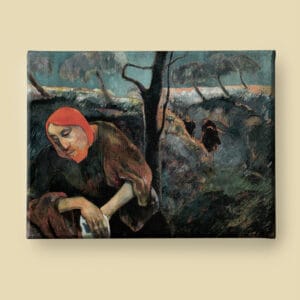
Painted in the same year as The Yellow Christ, this lesser-known but equally moving piece is often interpreted as a spiritual self-portrait. Jesus is depicted in anguish, isolated against a dark and flattened landscape. The emotional weight and stylization point to Gauguin’s own feelings of abandonment and despair. Unlike more traditional treatments of Gethsemane, this Jesus does not seek divine aid (he is alone), emblematic of the modern individual’s struggle with faith.

3. Self-Portrait with the Yellow Christ (1890–1891)
In this complex and introspective work, Gauguin paints himself alongside the crucified Christ, specifically, his own earlier image from The Yellow Christ. The Christ figure is visible in the background, acting as a spiritual doppelgänger. The artist’s expression is both detached and thoughtful, suggesting a deep identification with the role of the suffering Christ. The painting blurs the lines between religious icon and personal mythology, positioning Gauguin himself as a Christ-like figure alienated from society.

4. The Green Christ (1889)
Painted in the same year as The Yellow Christ, The Green Christ shows Gauguin’s continued exploration of the Crucifixion through bold, symbolic colors and Breton landscapes. In this version, the crucified Christ appears green, a hue associated with nature, rebirth, and spiritual unease. The statue is once again situated in rural Brittany, with Breton women praying at its feet, echoing traditional piety while filtered through Gauguin’s personal mysticism.
Compared to the yellow figure, this Jesus feels more somber and withdrawn. The color choice conveys a deeper spiritual alienation, perhaps mirroring Gauguin’s own growing disillusionment with European society and institutional religion. The contrast between human devotion and the remote, emotionally distant statue evokes themes of detachment, inner struggle, and the elusive presence of divinity in the world.
This painting further solidifies Gauguin’s use of color as a theological device and supports the idea that for him, Christ was not just a savior. He was a symbol of personal exile, suffering, and ultimately, a vehicle for spiritual inquiry.

5. Christian Symbolism in Other Works
While not centered solely on Jesus, several of Gauguin’s paintings incorporate subtle Christian symbols. Works like Vision After the Sermon (1888) and Where Do We Come From? What Are We? Where Are We Going? (1897) reflect spiritual inquiry and moral struggle. In the former, a vision of Jacob wrestling an angel speaks to inner conflict, while the latter is a meditation on human existence that evokes a Christ-like journey from birth through suffering to transcendence. These works, while not direct depictions of Christ, reinforce Gauguin’s deep engagement with Christian themes.
Together, these paintings form a spiritual arc in Gauguin’s career, an arc in which Christ is not only a theological figure but a stand-in for the suffering artist, the cultural outsider, and the eternal questioner.
Conclusion
Paul Gauguin’s Post-Impressionist Jesus paintings are more than artistic interpretations of biblical scenes, they are visual reflections of spiritual anguish, cultural displacement, and personal introspection. By portraying Christ not in traditional glory, but as a solitary, suffering figure, Gauguin offered a powerful reinterpretation that resonated with the modern viewer. His works do not aim to instruct religious doctrine; instead, they probe the emotional and symbolic depths of Christian themes, often reflecting his own inner turmoil.
Whether placing Christ in the fields of Brittany or in the jungles of Polynesia, Gauguin blurred the line between sacred narrative and autobiographical expression. These paintings remain significant within both religious and art historical contexts, standing as testaments to how faith, doubt, and identity can be rendered with radical honesty, and profound beauty.
To see how contemporary artists reinterpret Christ through modern styles and visual language, visit our Modern Jesus Art gallery.
Paul Gauguin’s Post-Impressionist Jesus Paintings Featured in This Article
| Painting | Year | Medium | Location |
|---|---|---|---|
| The Yellow Christ | 1889 | Oil on canvas | Albright-Knox Art Gallery, Buffalo |
| The Green Christ | 1889 | Oil on canvas | Musée d’Orsay, Paris |
| Christ in the Garden of Olives | 1889 | Oil on canvas | LaM – Lille Métropole Museum of Modern Art |
| Self-Portrait with the Yellow Christ | 1890-1891 | Oil on canvas | Musée d’Orsay, Paris |
Frequently Asked Questions
Did Paul Gauguin consider himself a religious painter?
While Gauguin was not conventionally religious, he frequently explored Christian themes as metaphors for personal suffering, exile, and spiritual searching. His depictions of Christ often reflect his own struggles rather than a doctrinal message.
Why did Gauguin depict Jesus in modern or non-traditional settings?
Gauguin used familiar surroundings (like Brittany or Tahiti) to express universal spiritual truths. By placing Jesus in contemporary or local settings, he made biblical themes more personal and accessible, highlighting the timeless relevance of Christ’s story.
What makes Gauguin’s religious paintings unique?
Gauguin’s religious works stand out for their use of symbolic color, stylized forms, and emotional depth. His paintings often depict Christ not in triumph, but in sorrow and solitude, mirroring the artist’s own psychological and spiritual state.
Where can I see Gauguin’s Jesus paintings?
Key works such as The Yellow Christ and Self-Portrait with the Yellow Christ are housed in major museums like the Albright-Knox Art Gallery and the Musée d’Orsay. Others are featured in national collections or exist in letters and sketches.
Are there other Post-Impressionist artists who painted Jesus?
Few Post-Impressionists engaged religious themes as directly as Gauguin. However, Symbolist and Expressionist artists that followed were influenced by his approach to spirituality, paving the way for new interpretations of Jesus in modern art.
Where can I buy Post-Impressionist Jesus paintings on canvas?
You can buy Post-Impressionist Jesus paintings on canvas at jesuschrist.pictures. Our contemporary Christian art buying guide includes works by Gauguin, Moreau, and Toorop available as premium canvas prints, ready to hang.


