Saint Cecilia: Why She’s the Patron Saint of Music
Saint Cecilia is the patron saint of music, one of the most honoured martyrs of the early Roman Church, a young noblewoman who, according to her legend, sang in her heart to God even on the day she was married against her will. From that single image, a bride who heard a music no one else could hear, grew her patronage of musicians, singers and Church music, and one of the richest traditions in all of Christian art.
This article tells Cecilia’s story, from her marriage and the conversion of her husband to her three-day martyrdom, explains why she became the patroness of music, reads her symbols in painting, and ends with her feast day and her prayer. To see how the great painters imagined her, from Raphael to Waterhouse, visit our companion gallery of famous Saint Cecilia paintings.
Who Was Saint Cecilia?
Cecilia was a Roman noblewoman of the early Church, honoured as a virgin and martyr since at least the fifth century, when a church was already dedicated to her name in Trastevere. She is one of the very few women named in the Roman Canon, the ancient prayer at the heart of the Mass, which places her among Agatha, Lucy, Agnes and Anastasia.
Almost everything we know of her comes from the Passio, a legendary account written some centuries after her death. Historians treat its details with caution, and even the century of her martyrdom is uncertain, but the antiquity of her cult is not in doubt: Cecilia was one of the most venerated saints of Christian Rome long before her story was written down. She appears among the great holy women in our gallery of female saints in art.
The Story: A Wedding, a Conversion, and a Martyrdom
According to the Passio, Cecilia was born into a patrician family and secretly vowed her virginity to Christ. Her parents nonetheless gave her in marriage to a young pagan named Valerian. On their wedding night, while the instruments still played in the house, Cecilia told her husband that an angel of God watched over her, and that he would see it if he too were baptised.
Valerian went to find Pope Urban among the tombs of the martyrs, was baptised, and returned to see the angel standing beside his bride, crowning them both with roses and lilies brought from paradise. His brother Tiberius was converted in turn. When the two brothers were arrested for burying the bodies of martyrs and put to death, Cecilia buried them and continued to preach, winning many to the faith.
She was arrested next. Ordered to sacrifice to the Roman gods and refusing, she was condemned to die. Tradition says they tried to suffocate her in the hot room of her own baths, but she was unharmed. An executioner then struck her neck three times with his sword and, forbidden by law to strike a fourth, left her mortally wounded. Cecilia lived three more days, giving her goods to the poor and asking Pope Urban to make her house into a church, before she died.
Why Is She the Patron Saint of Music?
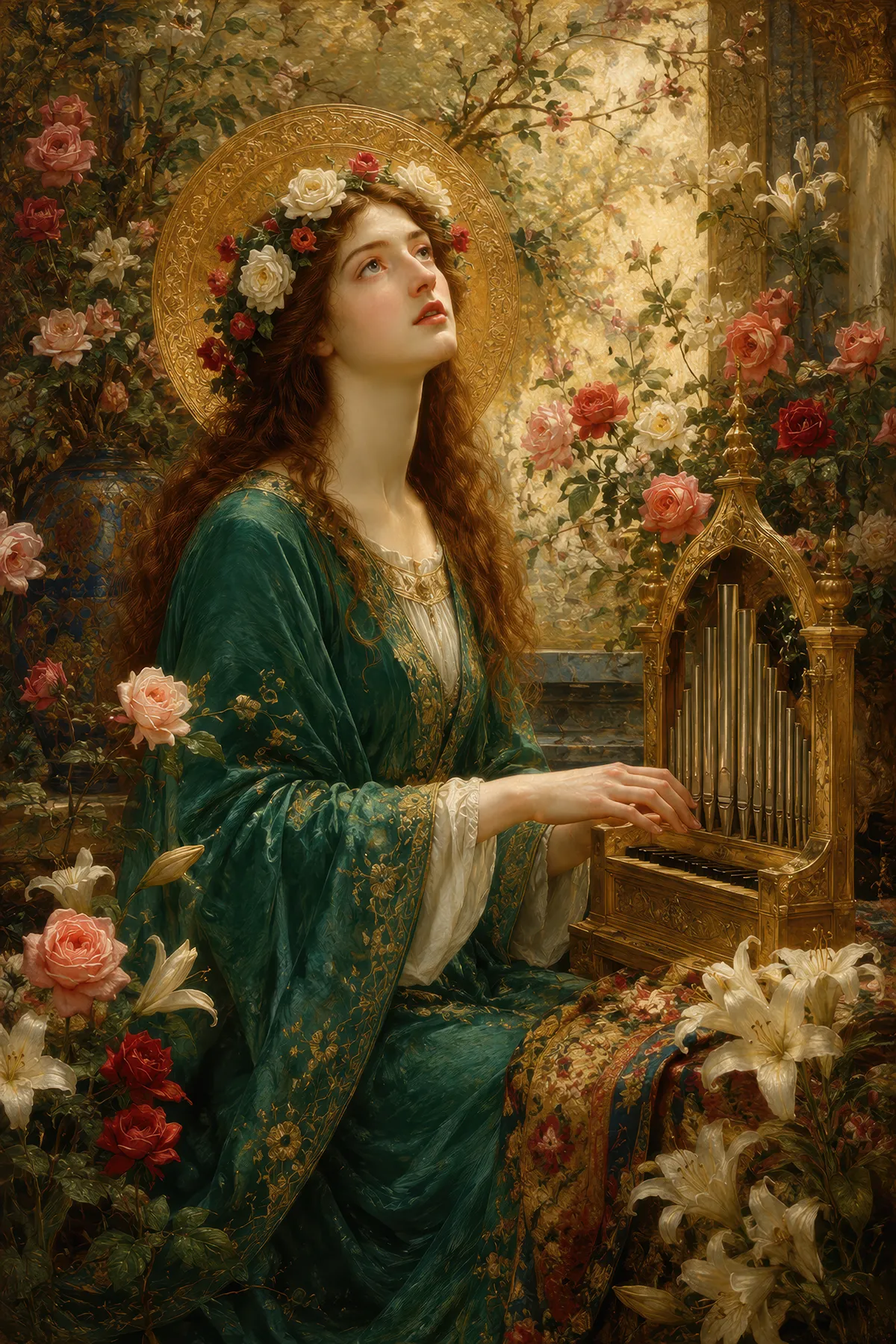
Cecilia’s patronage of music rests on one sentence in the Passio. It says that on her wedding day, cantantibus organis, “while the instruments played, Cecilia sang in her heart to the Lord alone.” The line was meant to show that she withdrew from the worldly celebration into inner prayer, but by the late Middle Ages it had made her the patroness of music, and painters gave her the organ, the harp and the viol as her signs.
From there the tradition never stopped. Musical academies took her as their protectress, composers wrote odes and Masses for her feast, and the greatest painters returned to her again and again, giving her the upward, listening gaze and, often, a garland of the roses the angel had brought from paradise.
The Most Famous Painting of Saint Cecilia
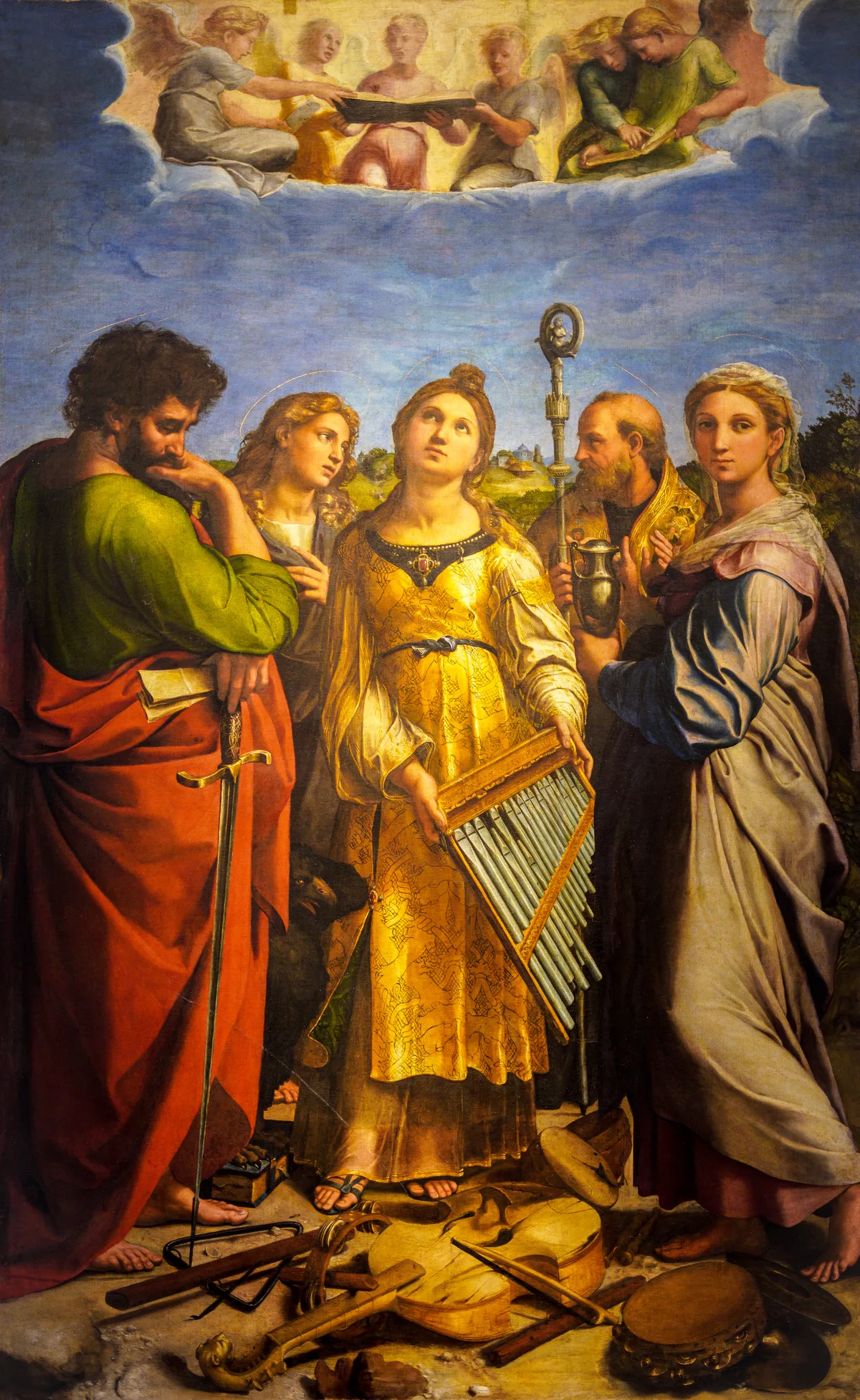
The definitive image of the saint is Raphael’s Ecstasy of Saint Cecilia, painted around 1516 for a chapel in Bologna. Cecilia stands among Saints Paul, John, Augustine and Mary Magdalene, letting a small organ slip from her hands while broken instruments lie silent at her feet and a choir of angels sings in the clouds above. Every earthly sound is abandoned for that heavenly one, and her whole legend is gathered into a single upward glance. It became the model for how later artists pictured her, and to follow its creator you can read our article on Raphael’s paintings.
Raphael’s is only the most famous of countless images of her. From Guido Reni and Artemisia Gentileschi to the dreaming Pre-Raphaelite saint of John William Waterhouse, painters have returned to Cecilia for four centuries, and we gather seven of the greatest in our companion gallery of famous Saint Cecilia paintings. Her cult left one further marvel: when her tomb in Trastevere was opened in 1599 her body was reported incorrupt, and the sculptor Stefano Maderno carved the marble figure that still lies beneath her altar, three fingers of one hand and one of the other extended in a silent profession of the Trinity.
Feast Day: November 22
Saint Cecilia’s feast is kept on November 22, and it has long been a day of music. Choirs, orchestras and musical societies celebrate their patroness with concerts and festival Masses, a custom that goes back centuries and gave the world such works as Purcell’s and Handel’s odes for her day. Her relics rest in the church of Santa Cecilia in Trastevere, built over the house where, tradition says, she lived and died.
A Prayer to Saint Cecilia
This prayer asks her intercession for all who make music, and it is the one on our printable prayer card and poster.
Dear Saint Cecilia, while the music played at your wedding feast, you sang in your heart to the Lord alone.
Obtain for all musicians, singers, and composers the grace to make of their art a prayer, and of their talent an offering.
When we perform, keep us from vanity; when we fail, keep us from discouragement; and in every melody, help us hear an echo of the music of heaven.
Saint Cecilia, virgin and martyr, patroness of music, pray for us. Amen.
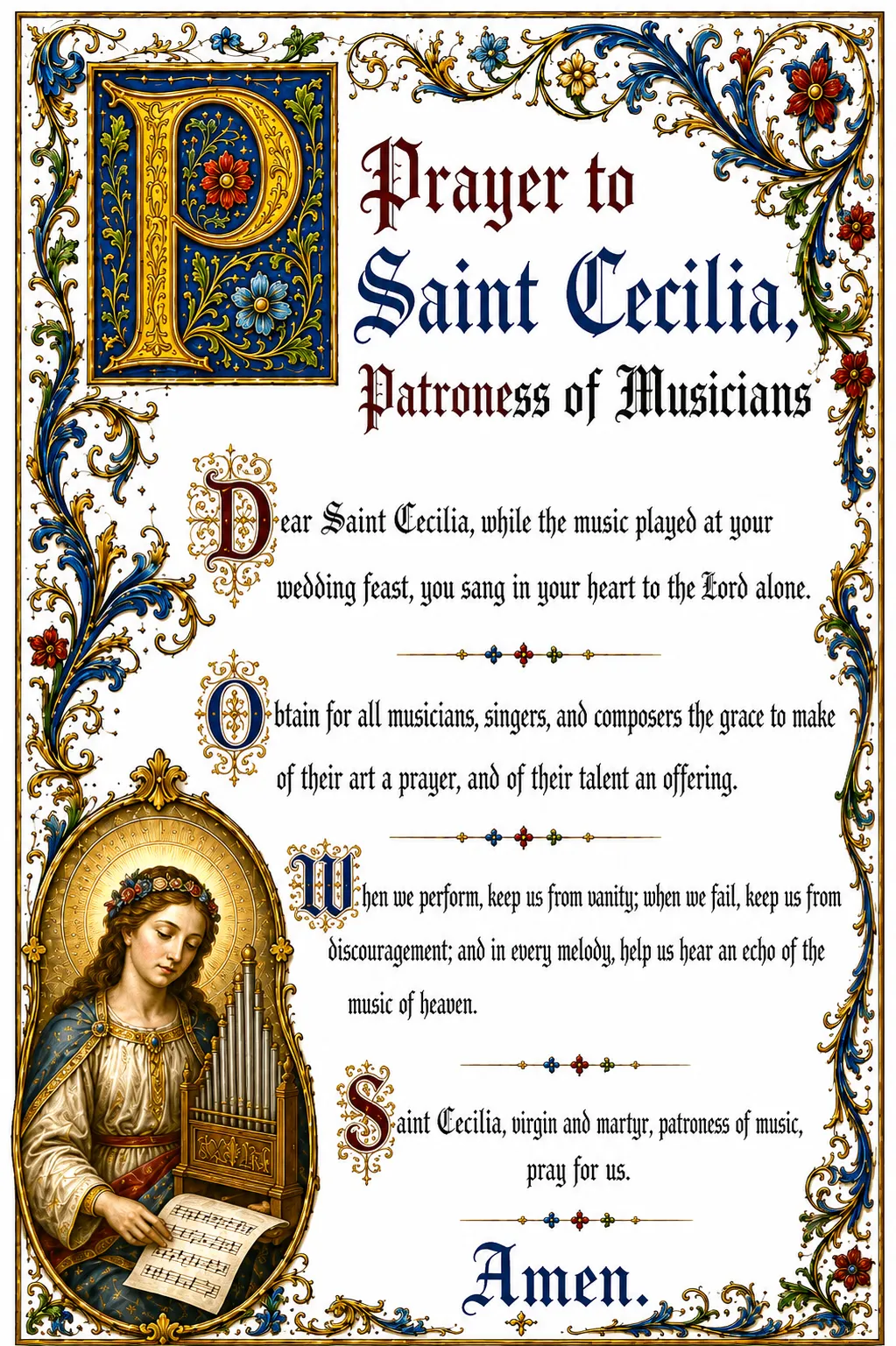
Free printable prayer card:
These files are free for personal use, for your parish, or for your choir.
✦ Free Christian & Catholic Printables
Love this one? Find it, and our complete collection of illuminated prayer cards and Scripture printables, ready to print, free, in one place.
Browse all free printables →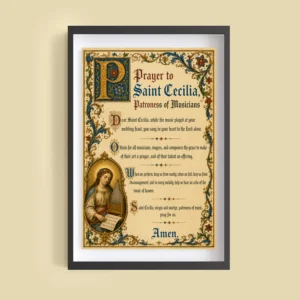
Conclusion
Saint Cecilia’s story begins at a wedding and ends in three quiet days of dying, and out of it the Church drew not a lament but a song. The bride who turned from the music of her feast to the music of heaven became the patroness of everyone who has ever tried to lift a melody toward God. Whether she is Raphael’s saint lost in ecstasy or Waterhouse’s saint asleep among the roses, she stands for the hope that all our music is an echo of a greater one. To see her through the eyes of the great painters, visit our gallery of famous Saint Cecilia paintings.
Five Facts About Saint Cecilia
- Saint Cecilia is the patron saint of music, musicians, composers and singers, and one of the most venerated martyrs of the early Roman Church.
- Her patronage of music comes from a line in her legend that says she “sang in her heart to the Lord alone” at her wedding.
- According to tradition she survived being struck three times with a sword and lived three more days before she died.
- When her tomb was opened in 1599 her body was reported incorrupt, and Stefano Maderno carved the famous marble figure that lies beneath her altar in Rome.
- Her feast day is November 22, and her relics rest in the church of Santa Cecilia in Trastevere, Rome.
Frequently Asked Questions
What is Saint Cecilia known for?
Saint Cecilia is known as the patron saint of music. A Roman noblewoman and martyr of the early Church, she is remembered from her legend for singing to God in her heart on her wedding day, for converting her husband Valerian, and for a three-day martyrdom. Her patronage of musicians, singers and Church music has made her one of the most painted and celebrated of all the saints.
What was Saint Cecilia’s famous line?
Her famous line comes from the Latin of her legend: cantantibus organis, Caecilia in corde suo soli Domino decantabat, “while the instruments played, Cecilia sang in her heart to the Lord alone.” That single sentence, describing her wedding feast, is the reason she became the patroness of music, and it is echoed in almost every painting of her.
What was the miracle of Saint Cecilia?
Several wonders are told of her. An angel guarded her virginity and crowned her and her husband with roses and lilies from paradise; an attempt to suffocate her in her own baths failed; and after being struck three times with a sword she lived three more days. Many also point to the discovery of her incorrupt body in 1599, more than a thousand years after her death, as a lasting sign.
What do you pray to Saint Cecilia for?
The faithful pray to Saint Cecilia above all for musicians, singers, composers and choirs, asking that their art may become a prayer and their talent an offering to God. She is also invoked for a happy and holy marriage, in memory of her own, and by anyone who wishes to keep the love of God at the centre of their work. Her prayer for musicians is on this page.
When is Saint Cecilia’s feast day?
Saint Cecilia’s feast day is November 22. It is traditionally a day of music, marked by concerts, choral festivals and celebratory Masses in her honour, and many musical societies and academies bear her name. Her relics are venerated in the church of Santa Cecilia in Trastevere, Rome, built over her legendary home.
Where can I buy Saint Cecilia wall art?
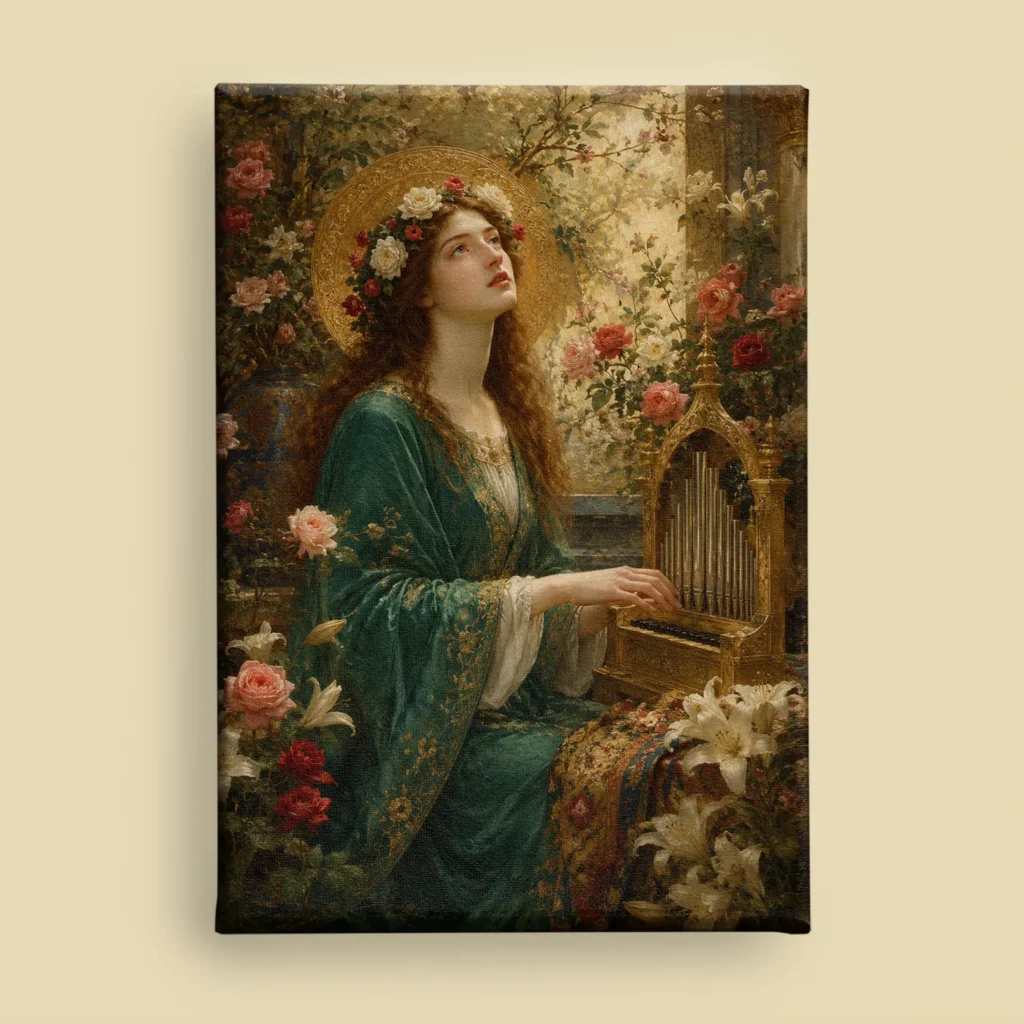
You can buy Saint Cecilia wall art at jesuschrist.pictures: our original Saint Cecilia canvas shows the patron saint of music crowned with roses beside her organ, and the prayer to Saint Cecilia featured above is available as an illuminated prayer poster. Both are printed to gallery standard and ship ready to hang, and the printable prayer card remains free.


