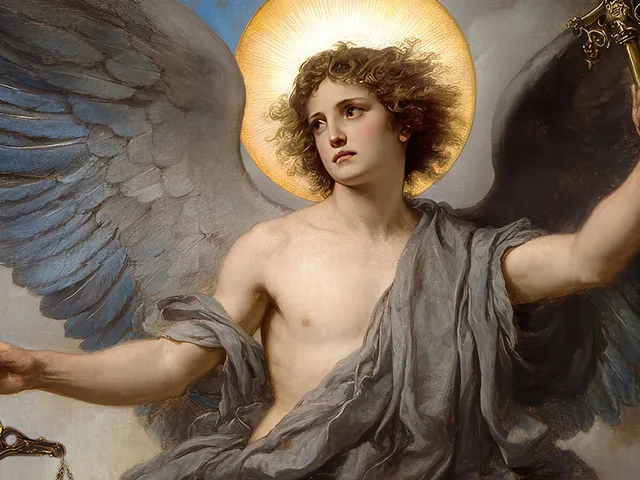
Some psalms comfort with quiet words. Psalm 91 does something bolder. It promises protection so complete that no terror of the night, no arrow of the day, not even the lion or the serpent can touch the one who shelters in God. “He shall cover thee with his feathers, and under his wings shalt thou trust.” That image of the sheltering wing has made Psalm 91 one of the most loved prayers of refuge in all of scripture, and it gave medieval artists some of their most striking subjects. This is the story of Psalm 91 through art, from the warrior Christ of Ravenna to the guardian angels of the Baroque, and of the Psalm 91 wall art that still carries its promise of shelter into our homes.
Psalm 91, King James Version (Full Text)
Before we follow the psalm through the centuries, here is the whole of it in the King James Version.
He that dwelleth in the secret place of the most High shall abide under the shadow of the Almighty.
I will say of the Lord, He is my refuge and my fortress: my God; in him will I trust.
Surely he shall deliver thee from the snare of the fowler, and from the noisome pestilence.
He shall cover thee with his feathers, and under his wings shalt thou trust: his truth shall be thy shield and buckler.
Thou shalt not be afraid for the terror by night; nor for the arrow that flieth by day;
Nor for the pestilence that walketh in darkness; nor for the destruction that wasteth at noonday.
A thousand shall fall at thy side, and ten thousand at thy right hand; but it shall not come nigh thee.
Only with thine eyes shalt thou behold and see the reward of the wicked.
Because thou hast made the Lord, which is my refuge, even the most High, thy habitation;
There shall no evil befall thee, neither shall any plague come nigh thy dwelling.
For he shall give his angels charge over thee, to keep thee in all thy ways.
They shall bear thee up in their hands, lest thou dash thy foot against a stone.
Thou shalt tread upon the lion and adder: the young lion and the dragon shalt thou trample under feet.
Because he hath set his love upon me, therefore will I deliver him: I will set him on high, because he hath known my name.
He shall call upon me, and I will answer him: I will be with him in trouble; I will deliver him, and honour him.
With long life will I satisfy him, and shew him my salvation.
A Free Printable Psalm 91 Prayer Card
The medieval scribes believed a psalm of such protection deserved to be written in gold, and that conviction is the spirit behind this Psalm 91 prayer card. The full prayer is set in a careful calligraphic hand, opened by a gilded initial and framed by the bright flowering border of a Gothic prayer book. It keeps the whole psalm in view, from “He that dwelleth in the secret place” to the final promise of long life and salvation, in the visual language that first carried it through the Middle Ages.
The Psalm 91 prayer card, free to print.Free printable prayer card:
Christ Treading on the Beasts, mosaic, Archiepiscopal Chapel, Ravenna, around 500.
Christ treading on the beasts (Psalm 91:13)
One verse of this psalm gave early Christian art an unforgettable image. “Thou shalt tread upon the lion and adder: the young lion and the dragon shalt thou trample under feet.” Artists read it as a prophecy of Christ’s victory over evil, and they pictured him doing exactly what the verse describes.
The finest surviving example is the mosaic in the Archiepiscopal Chapel at Ravenna, made around the year 500. Here Christ is no gentle shepherd but a young Roman soldier, dressed in armour, a long cross resting on his shoulder like a spear. In his hand an open book declares, “I am the way, the truth, and the life.” Beneath his feet the lion and the serpent are crushed. It is Psalm 91:13 turned into a portrait of triumph, the conquering Christ who has trodden down every danger the psalm names.
Stuttgart Psalter, illustration for Psalm 91, around 820 to 830, Wurttembergische Landesbibliothek, Stuttgart.
Psalm 91 in the Carolingian psalter
Three centuries later, the makers of the Stuttgart Psalter set out to picture the psalm verse by verse. On its page for Psalm 91, known there as Psalm 90 in the older numbering, two scenes sit one above the other. In the upper image angels lift a figure in their hands, illustrating the promise that “they shall bear thee up.” In the lower image a man strides over a lion and a coiling dragon, sword in hand, a literal rendering of treading upon the beasts.
What is striking is how directly the Carolingian artist worked from the words. He did not soften the psalm into a mood. He read each line as an instruction for what to draw, so that the page becomes a kind of illustrated map of God’s protection. This same careful, line-by-line spirit shaped the great manuscripts behind our companion pieces on Psalm 23 and Psalm 51 in art.
His angels will guard you (Psalm 91:11)
Two of the psalm’s verses have done more than any other text to shape the Christian belief in guardian angels. “For he shall give his angels charge over thee, to keep thee in all thy ways. They shall bear thee up in their hands, lest thou dash thy foot against a stone.” From these lines grew a whole tradition of art showing the angel who walks beside the soul.
The Guardian Angel, Pietro da Cortona, 1656, Galleria Nazionale d’Arte Antica, Rome.
Pietro da Cortona gave the theme its most tender Baroque form in 1656. His Guardian Angel, now in the Galleria Nazionale d’Arte Antica in Rome, shows a radiant angel pointing toward heaven with one hand while leading a small child by the other. The child looks up in complete trust. The whole painting is a picture of the eleventh verse, the angel given charge to keep us in all our ways.
Tobias and the Angel, Workshop of Andrea del Verrocchio, around 1470 to 1475, National Gallery, London.
The most beloved Renaissance image of angelic protection comes from the workshop of Andrea del Verrocchio, painted in Florence around 1470. It shows the young Tobias walking hand in hand with the archangel Raphael, who guards him along the road. A little dog trots at their feet, and Tobias carries the fish that will heal his father. Though the scene comes from the Book of Tobit rather than the psalm, it gives the same promise a human face, the traveller kept safe by a companion sent from God.
The Meaning of Psalm 91: Under His Wings
At the heart of the psalm is its gentlest image, and the one that has lasted longest in devotion. “He shall cover thee with his feathers, and under his wings shalt thou trust.” The picture is of a bird gathering its young beneath its wings against the storm, a tenderness that sits beside all the psalm’s talk of armies and beasts. Christ himself took up the same image when he longed to gather Jerusalem as a hen gathers her chicks. To live “under his wings” is to find a refuge that no terror by night can reach, and that promise is why the words still bring comfort in every kind of trouble.
Praying Psalm 91: The Prayer of Protection
Psalm 91 is not only read, it is prayed. For centuries Christians have recited it over a home at night, before a journey, in illness and in danger. Soldiers have carried it folded in a pocket through every modern war, which is why it is sometimes called the Soldier’s Psalm. In the Liturgy of the Hours the Church gives it to everyone as the psalm of Sunday Compline, the night prayer said before sleep.
The simplest way to pray it is slowly, verse by verse, letting each image settle: the refuge, the sheltering wings, the angels given charge over your ways. The psalm is not a charm against trouble; it is a declaration of trust spoken into it, and that is how the Church has always used it. For the angels the psalm speaks of, see our series on the archangels and their sacred mission.
Psalm 91 has comforted soldiers and travelers, the sick and the frightened, for thousands of years, because it dares to promise what every heart longs for, a shelter that holds. Artists answered that promise in their own ways. Some pictured the conquering Christ who tramples the lion and the dragon, others the gentle angel who guides a child by the hand, and the medieval scribes set every line in gold. To keep that promise of refuge close, you can choose our illuminated Psalm 91 poster, or look through the wider collection of Christian wall art and the world of medieval Christian painting.
Important Facts About Psalm 91 in Art
Psalm 91 is a psalm of divine protection, known by its opening line, “He that dwelleth in the secret place of the most High.”
In the Latin Vulgate and most medieval manuscripts it is numbered Psalm 90 rather than Psalm 91.
Verse 13, “Thou shalt tread upon the lion and adder,” inspired one of the earliest images of the victorious Christ, Christ treading on the beasts.
Verses 11 and 12, “He shall give his angels charge over thee,” are among the chief scriptural sources for the Christian belief in guardian angels.
The same verses were quoted by the devil when tempting Christ on the pinnacle of the temple, as recorded in the Gospels of Matthew and Luke.
Questions and Answers
What does Psalm 91 mean?
Psalm 91 is a song of trust in God’s protection. It promises that the one who shelters in God will be kept safe from danger, disease, and fear, whether it comes by night or by day. The psalm moves through a series of vivid images, from the sheltering wing to the guarding angel to the trampled lion. Its message is not that the faithful escape all trouble, but that God remains their refuge through it.
What does “under his wings” mean?
The phrase comes from verse 4, “He shall cover thee with his feathers, and under his wings shalt thou trust.” It pictures God as a bird sheltering its young beneath its wings, a tender image of safety and closeness. The same picture appears elsewhere in scripture, and Christ used it when he wished to gather Jerusalem as a hen gathers her chicks. To be under his wings is to rest in God’s protection and care.
What is “Christ treading on the beasts”?
It is an early Christian image based on verse 13 of Psalm 91, which speaks of treading upon the lion and the adder. Artists pictured Christ as a young warrior trampling these creatures underfoot as a sign of his victory over evil and death. The most famous example is the mosaic in the Archiepiscopal Chapel at Ravenna, made around the year 500. The beasts stand for every danger the psalm promises God will overcome.
Are guardian angels in the Bible?
The belief draws above all on Psalm 91:11, “For he shall give his angels charge over thee, to keep thee in all thy ways.” Other passages, such as Christ’s words about the angels of little children in the Gospel of Matthew, support the same idea. From these texts the Church developed its teaching on guardian angels. Paintings like Pietro da Cortona’s Guardian Angel give that belief a gentle visual form.
Why did the devil quote Psalm 91?
In the Gospels of Matthew and Luke, Satan tempts Christ to throw himself from the pinnacle of the temple, quoting Psalm 91:11 and 12 about the angels who will bear him up. Christ refuses, answering that one must not put God to the test. The episode shows that even true scripture can be twisted when torn from its purpose. It also gave the psalm a lasting place in the Gospel story.
Where can I see Christ Treading on the Beasts?
The most celebrated version is the mosaic in the Archiepiscopal Chapel, also called the Chapel of Saint Andrew, in Ravenna, Italy. It dates to around the year 500 and is part of the city’s group of early Christian monuments listed by UNESCO. Visitors usually see it together with the other famous mosaics of Ravenna. The chapel is reached through the Archiepiscopal Museum next to the cathedral.
Who wrote Psalm 91?
The psalm itself names no author. Jewish tradition attributes it to Moses, reading it as the continuation of Psalm 90, which is titled “A prayer of Moses”; the old Greek and Latin versions of the Bible attribute it to David instead. The uncertainty changes nothing of its force: both traditions have prayed it as scripture from the beginning.
Where can I buy a Psalm 91 print?
The illuminated design shown on this page is available as a large poster, printed on high quality matte paper, from our own shop, jesuschrist.pictures: see the Psalm 91 medieval wall art. The shop also offers Psalm 23 and other psalms and prayers in the same illuminated style.
My help comes from the Lord. Psalm 121, the pilgrim psalm, through Christian art: the Songs of Ascents, the Keeper who never sleeps, and the angel who guards the traveler.