Bruegel’s Tower of Babel: Two Survivors, One Lost
The Tower of Babel is the most famous painting by Pieter Bruegel the Elder, the leading Netherlandish painter of the sixteenth century. Signed and dated 1563, it is painted in oil on oak panel and hangs today in the Kunsthistorisches Museum in Vienna. What few people realise is that Bruegel returned to this subject more than once. Two paintings survive, one in Vienna and a smaller one in Rotterdam, and a third, an ivory miniature made in Rome, has been lost for centuries.
That makes the Tower of Babel one of the rare biblical subjects an artist felt compelled to paint again and again. The reason is not hard to find. The story gave Bruegel everything he loved, a vast crowd of tiny figures, a feat of engineering, and a warning about human pride that still feels modern.
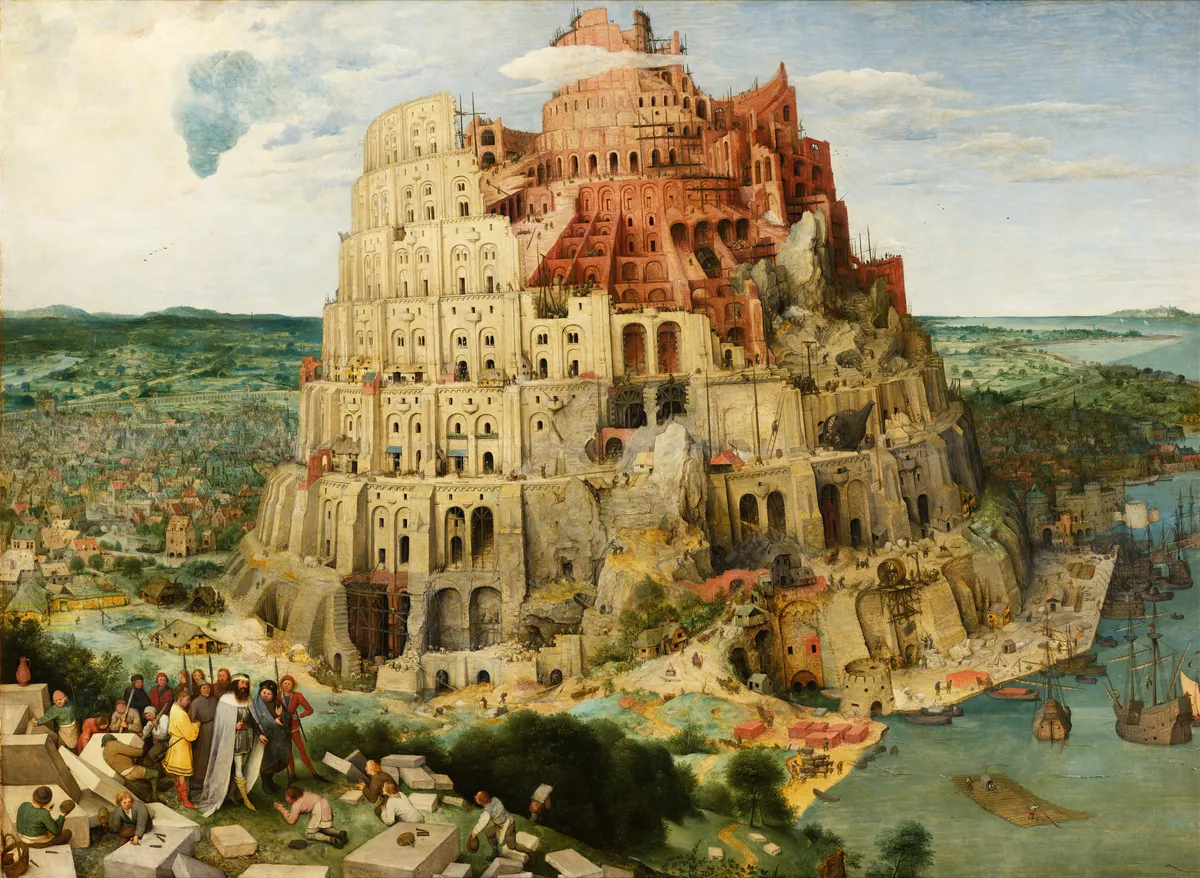
The Vienna panel is enormous in feeling though modest in size, a little over a metre tall. A single colossal tower fills the picture, built on a rock beside the sea, with a busy Flemish city spreading out at its foot and a harbour crowded with ships. Hundreds of workers swarm over its floors. The longer you look, the more you find, and the more you sense that something is quietly wrong with the whole enterprise.
What Was the Tower of Babel?
The story comes from the Book of Genesis, chapter eleven. After the Flood, the Bible says, the whole earth spoke a single language. The descendants of Noah settled in the plain of Shinar, in Mesopotamia, and decided to build a city with a tower whose top would reach the heavens, so that they could make a name for themselves and not be scattered across the world.
God saw the tower and the ambition behind it. To check their pride, he confused their language so that the builders could no longer understand one another, and he scattered them across the face of the earth. The unfinished city was called Babel, a name the text links to the Hebrew word for confusion. It is one of the Bible’s great explanations for why humanity is divided into many peoples and many tongues. For more sacred stories told in paint, see our overview of famous biblical masterpieces.
Bruegel knew this story as a lesson about hubris, the ambition that overreaches and is punished. He did not paint the moment of collapse. He painted something more unsettling, a tower still rising, already doomed, with its builders too absorbed in their work to notice.
The History of Bruegel’s Tower of Babel
Bruegel painted the Vienna Tower in 1563, the year he married and settled in Brussels. Its first owner was the wealthy Antwerp merchant and collector Niclaes Jonghelinck, who at one point owned sixteen paintings by the artist. The panel was displayed in his suburban villa outside Antwerp, a city that was then the richest port in northern Europe, full of foreign merchants speaking dozens of languages. A picture about a proud tower and a confusion of tongues would have carried a sharp edge in such a place.
The design owes a clear debt to Bruegel’s journey to Italy around 1552 to 1554. In Rome he saw the ruins of the Colosseum, and its tiers of arches return here in the curving, arcaded floors of the tower. By giving Babel the form of a Roman monument, Bruegel tied the ancient sin of pride to the empire that once persecuted Christians, a connection his first viewers would not have missed.
The medium matters too. This is a panel painting in oil, not a fresco or a print. Bruegel works at a miniaturist’s scale, fitting hundreds of legible figures into a surface you can take in at a glance, a balance of the vast and the tiny that became his signature. In his own century he was hailed as a second Hieronymus Bosch, and like that older master he filled his panels with teeming detail and a sharp moral edge. Bruegel stands at the heart of the Northern Renaissance tradition, where close observation of ordinary life carried serious moral weight.
Three Towers, and the One That Vanished
Bruegel is recorded as having painted the Tower of Babel three times. The first was the smallest and is the one we have lost. According to the early biographer Karel van Mander, writing in 1604, Bruegel painted a Tower of Babel in miniature on ivory while he was in Rome, working alongside the celebrated miniaturist Giulio Clovio. An inventory of Clovio’s possessions, drawn up after his death in 1578, indeed lists a small Tower of Babel by the hand of Master Peter Bruegel. After that the trail goes cold. The ivory panel has never been found, and no copy of it is known.
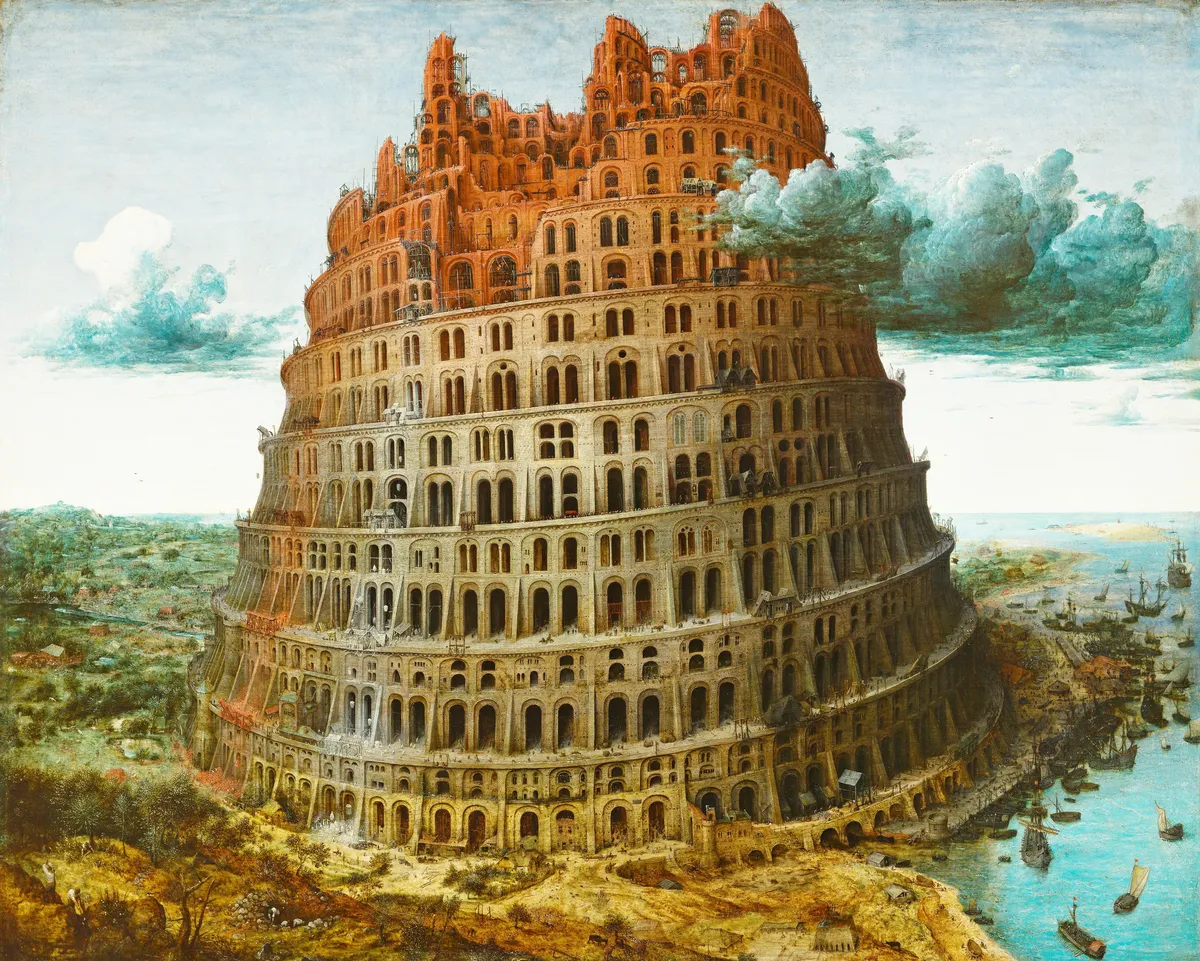
The two survivors are very different in mood. The great Vienna panel shown above is grounded and detailed, a tower set in a sunlit world of work. The second surviving version, in the Museum Boijmans Van Beuningen in Rotterdam, is smaller and darker, which is why it is usually called the Little Tower of Babel. It has no king and no foreground crowd. The tower rises alone, narrower and steeper, its summit already swallowed by storm clouds, a more anxious vision of the same idea.
King Nimrod and the Builders
In the lower left corner of the Vienna panel, Bruegel stages a small scene that anchors the whole picture. A crowned figure, traditionally identified as Nimrod, the king whom tradition credits with raising the tower, arrives to inspect the work. A group of stonemasons drops to its knees before him, some pressing their faces to the ground.
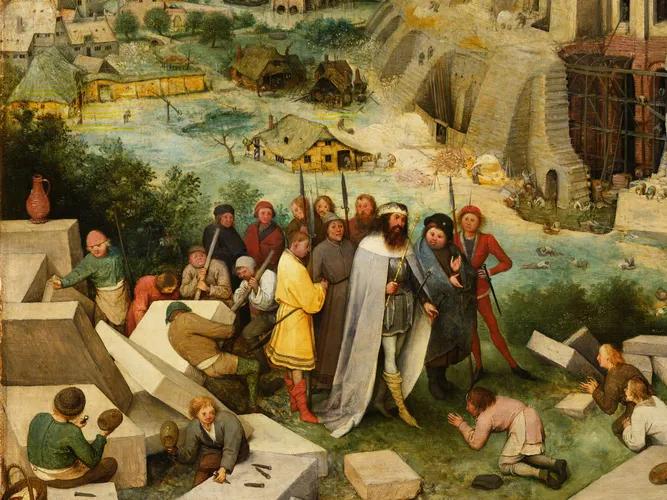
The gesture is telling. These men bow to an earthly king while their tower presumes to climb toward heaven, and Bruegel lets the irony sit quietly in the corner. Around the kneeling masons, other workers keep cutting and dressing the great blocks of stone, indifferent to the visit. On one of those blocks, near the lower edge, the painter signed his name. It is easy to miss the king in the sweep of the architecture, which is precisely the point. Human authority looks very small beside the thing it has set in motion.
A Tower Built to Fall
Look closely at the structure and you notice that it is not sound. The floors do not sit level. The whole mass leans, and the lower arches are already being cut into the natural rock in a way that could never bear the weight above. The white stone of the finished floors gives way, higher up, to raw red brick that is still going up, as if the builders were racing upward before the base was ever secure.
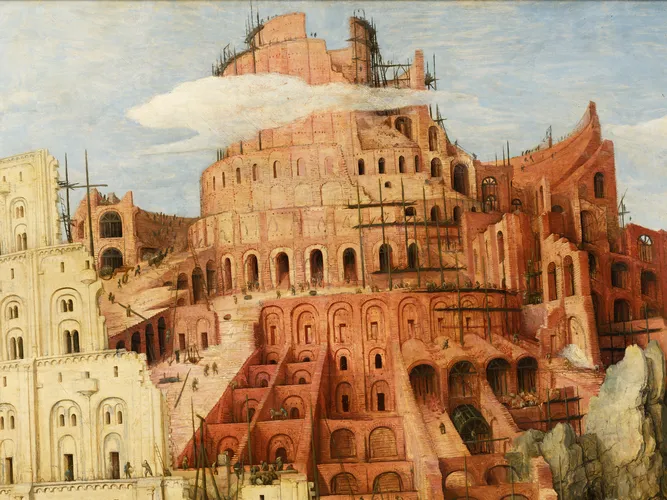
This is Bruegel’s quiet masterstroke. He does not need to show the tower falling, because he shows it failing as it rises. The summit pushes into the clouds, scaffolding clinging to its flanks, while the foundations below are flawed beyond repair. The painting holds the moment of doomed ambition in suspense, a building that is at once the greatest achievement of its age and a ruin in the making.
The City, the Harbour and the Scale of Ambition
Bruegel surrounds his tower with a complete working world. At its base a Flemish city of red roofs stretches toward the horizon. On the right a harbour is packed with ships that have brought stone and timber from far away, and along the waterline cranes powered by men walking inside great wooden wheels haul blocks up the sides.
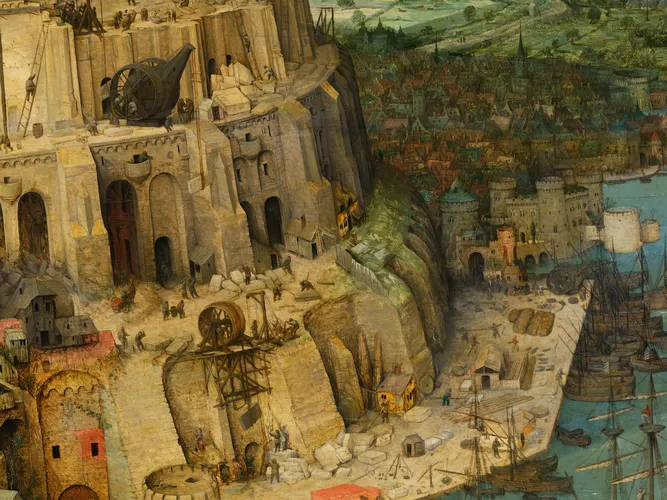
This is not the ancient Near East. It is the world Bruegel knew, the cranes, the quarries and the shipping of a sixteenth century trading empire, set to work on a project beyond any human power to finish. By dressing the Babel story in the dress of his own time, Bruegel turns an old warning into a comment on the present. The energy and the engineering are real and impressive. So is the blindness of pouring them into a tower that defies God and cannot stand.
The Meaning of Bruegel’s Tower of Babel
At its simplest the painting illustrates the lesson the Bible draws from Babel, that pride reaching beyond its limits will be brought low. That reading was common in Bruegel’s day, and the picture states it with calm authority. Yet the artist deepens it. The confusion of languages is not shown directly, but it is everywhere implied in the sheer number of hands at work with no single mind to guide them.
Many scholars also read the Vienna Tower as a comment on Bruegel’s own city. Antwerp was a place of dazzling wealth and many tongues, proud of its commerce and its reach. The Colosseum form adds a further layer, linking the tower to the power of Rome and, for some viewers, to the Catholic Church and the Holy Roman Empire that ruled the Netherlands. These political readings are debated and cannot be pinned down, but they show how much meaning Bruegel packed into a single panel. The painting works as Bible illustration, as social comment, and as a timeless image of ambition that overreaches.
Conclusion
Bruegel’s Tower of Babel has lost none of its force in more than four centuries. It takes a short biblical story and gives it a body, a vast, glowing, faintly absurd monument crawling with the energy of human work. We admire the achievement and we sense its futility at the same time, which is exactly the tension the painter intended.
That the subject drew him back three times, and that one of those versions has vanished entirely, only adds to its hold on us. Together with works such as Jan van Eyck’s Ghent Altarpiece, the great panel in Vienna and the darker little one in Rotterdam are among the most studied paintings of the Northern Renaissance, and the lost ivory miniature remains one of the tantalising gaps in the history of art. For more of the artist’s sacred work, see our roundup of Pieter Bruegel’s religious paintings.
Artwork Information
| Artwork | Artist | Date | Medium | Current Location |
|---|---|---|---|---|
| The Tower of Babel (the great version) | Pieter Bruegel the Elder | 1563 | Oil on oak panel | Kunsthistorisches Museum, Vienna |
Five Facts About Bruegel’s Tower of Babel
- Bruegel painted the subject three times. Two panels survive, in Vienna and Rotterdam, and a third on ivory is lost.
- The Vienna panel is signed and dated 1563 and is painted in oil on oak, a little over a metre tall.
- The tiered, arcaded design is modelled on the Roman Colosseum, which Bruegel had seen on his journey to Italy.
- The tower is deliberately shown leaning and structurally unsound, doomed before it is even finished.
- Its first owner was the Antwerp collector Niclaes Jonghelinck, who once owned sixteen paintings by Bruegel.
FAQ
Why did Pieter Bruegel paint the Tower of Babel?
Bruegel painted the Tower of Babel as an image of pride punished, the central lesson of the Genesis story. Living in Antwerp, a rich and polyglot trading city, he also found in the subject a mirror for the ambition and the confusion of his own age.
Where is the original Tower of Babel painting?
The great version of 1563 hangs in the Kunsthistorisches Museum in Vienna. The second surviving version, the smaller Little Tower, is in the Museum Boijmans Van Beuningen in Rotterdam.
How many Tower of Babel paintings did Bruegel make?
Three. The large Vienna panel and the smaller Rotterdam panel both survive. A third, an ivory miniature painted in Rome and recorded by the biographer Karel van Mander, has been lost.
What is the most famous painting of the Tower of Babel?
Bruegel’s Vienna panel of 1563 is by far the most famous depiction of the subject and one of the best known paintings of the Northern Renaissance.
What does Bruegel’s Tower of Babel mean?
On the surface it shows humanity’s attempt to reach heaven and the fall that follows from such pride. Bruegel deepens the theme by making the tower structurally unsound and by setting it in a recognisable sixteenth century world, so the warning applies to his own time as well as to the Bible.
Was the Tower of Babel based on the Colosseum?
Its form clearly recalls the Colosseum in Rome, with the same rising tiers of arches. Bruegel saw the ancient amphitheatre during his Italian journey, and many scholars read the resemblance as a deliberate link between the tower and the power of Rome.
Was Noah still alive during the Tower of Babel?
According to the genealogies in Genesis, Noah lived for centuries after the Flood, and the building of Babel by his descendants falls within that span, so the text places the event during his long lifetime. The painting itself does not show Noah, focusing instead on the tower and its builders.
Where can I buy a print of Bruegel’s Tower of Babel?
You can buy a print of Bruegel’s Tower of Babel at jesuschrist.pictures: see the canvas reproduction in our shop, printed on museum-grade canvas and available in several sizes.