Few lines of scripture have been loved as widely, or pictured as often, as the opening of Psalm 23. “The Lord is my shepherd; I shall not want.” Long before any artist tried to paint the face of Christ, believers were already drawing him as a young shepherd carrying a lamb across his shoulders. That single image, born in the Roman catacombs and still printed today on every kind of Psalm 23 wall art, is one of the oldest and most tender pictures in all of Christian history. This is the story of how one verse shaped the way the West has imagined God’s care, from painted tombs to illuminated psalters to the quiet devotional prints that still hang in family homes.
Psalm 23, King James Version (Full Text)
Before we follow the image through the centuries, it helps to read the words that started it all. Here is the psalm in the King James Version, the form most English readers know by heart.
The Lord is my shepherd; I shall not want.
He maketh me to lie down in green pastures: he leadeth me beside the still waters.
He restoreth my soul: he leadeth me in the paths of righteousness for his name’s sake.
Yea, though I walk through the valley of the shadow of death, I will fear no evil: for thou art with me; thy rod and thy staff they comfort me.
Thou preparest a table before me in the presence of mine enemies: thou anointest my head with oil; my cup runneth over.
Surely goodness and mercy shall follow me all the days of my life: and I will dwell in the house of the Lord for ever.
A Free Printable Psalm 23 Prayer Card
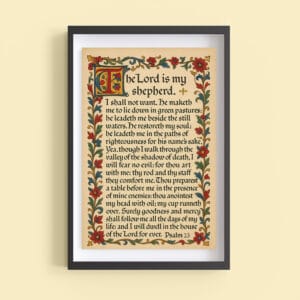
The medieval love of the decorated initial and the flowering border never really faded, and it is the spirit we returned to for this Psalm 23 prayer card. The whole psalm is set in a calligraphic hand, opened by a gilded initial and framed by the same red and blue foliage that fills a Gothic prayer book. It is a way to keep the words of the shepherd psalm in view every day, in the visual language that first carried them through the Middle Ages.
The Psalm 23 prayer card, free to print.Free printable prayer card:
Christ the Good Shepherd, fresco, Catacombs of Priscilla, Rome, 3rd century.
The oldest image of Christ: the Good Shepherd in early Christian art
When the first Christians wanted to picture their faith on the walls of the catacombs, they did not paint the crucifixion or the empty tomb. They painted a shepherd. In the Catacombs of Priscilla in Rome, dating from the early third century, a beardless young man stands with a sheep draped gently around his neck. He is calm, almost pastoral in the old Roman sense, and he says everything the early Church wanted to say about Christ: he seeks the lost, he carries the weak, he does not let go.
The form was not invented from nothing. Roman and Greek art already knew the kriophoros, the youth bearing a ram on his shoulders, a figure of piety and provision. Early believers took that familiar shape and filled it with new meaning, reading it through the words of Psalm 23 and the parable of the lost sheep in Luke 15. By doing so they gave Christ a face that any viewer, Jewish or Gentile, could understand at a glance.
The Good Shepherd, mosaic, Mausoleum of Galla Placidia, Ravenna, around 425.
By the fifth century the simple shepherd had grown in glory. In the Mausoleum of Galla Placidia in Ravenna, around the year 425, the Good Shepherd sits enthroned among his flock in shimmering gold mosaic, dressed in royal purple and gold, a long cross resting in his hand like a staff. The humble lamb-bearer has become a king who still keeps watch over his sheep. The same idea, the same psalm, but now charged with the majesty of an empire that had finally embraced the faith.
The Good Shepherd, marble statuette, Museo Pio Cristiano, Vatican Museums, 3rd century.
Sculpture told the same story. The small marble Good Shepherd now kept in the Museo Pio Cristiano at the Vatican Museums, also from the third century, is one of the rare free-standing statues to survive from the early Church. The shepherd steadies the ram with both hands, his weight shifted onto one leg in a pose borrowed straight from classical art. It is proof that the image of Psalm 23 was not confined to painted walls. It was carried, handled, and treasured in three dimensions too.
Psalm 23 in the medieval psalter
In the Middle Ages the psalms became the heart of daily prayer, and the illuminated psalter became one of the great achievements of medieval art. The most famous of all, the Utrecht Psalter, was made in a workshop near Reims around 820 to 835. Its nervous, lively pen drawings translate each psalm into a crowded little scene, and the shepherd psalm is no exception. (Medieval Bibles followed the older Greek and Latin numbering, so what we call Psalm 23 appears there as Psalm 22.)
Utrecht Psalter, pen drawing for the shepherd psalm, around 820 to 835, Utrecht University Library.
What makes these drawings so moving is their literalism. The artist tries to picture every phrase at once. You can find the green pastures, the still waters, the table spread in the presence of enemies, even the cup that runs over, all gathered into a single restless landscape. The medieval scribe read the psalm not as a vague comfort but as a series of vivid promises, each one worth drawing. That same instinct, to take the words seriously and set them in gold and ink, lives on in the illuminated style of our own Psalm 23 medieval wall art.
The shepherd in devotional painting
The image never really left the Church, but it returned with new warmth in the nineteenth century, the great age of devotional painting. As the faithful filled their homes with religious prints, the Good Shepherd became a favorite once more, softer now, more sentimental, and meant to be lived with rather than admired in a basilica.
The Lost Sheep, Alfred Usher Soord, around 1898, St Barnabas Church, Homerton, London.
The English painter Alfred Usher Soord caught the drama of the psalm better than almost anyone. His painting The Lost Sheep, shown at the Royal Academy in 1898, shows the shepherd stretched out full-length over the edge of a cliff, reaching down toward a single sheep stranded on the rock below. There is real danger in it. The shepherd risks his own life for one animal, which is exactly the point. The picture struck such a chord that hundreds of thousands of reproductions were sold within a generation, and the original still hangs in St Barnabas Church in Homerton, London.
The Good Shepherd, Bernhard Plockhorst, 1878.
The German painter Bernhard Plockhorst gave the theme its gentlest face. In his Good Shepherd of 1878, Christ walks a rocky path cradling a lamb, while a ewe lifts her head to gaze at the little one in his arms. The mood is tender and protective, almost maternal, and it became one of the most reproduced religious images in the homes of nineteenth-century Europe and America. If you have ever seen a Good Shepherd print in a grandparent’s house, there is a good chance it descends from Plockhorst.
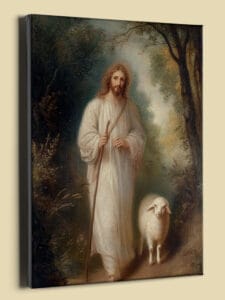
That same devotional warmth is what we tried to keep alive in our own canvas of Jesus as the Good Shepherd, painted in the Romantic spirit of these nineteenth-century masters.
Jesus the Good Shepherd, our canvas reproduction in the Romantic style.
Part of what makes Psalm 23 so endlessly paintable is that it is not a story. It is a chain of images, and artists have always been free to seize on whichever phrase speaks loudest to them. Some, like Soord, fix on the lost sheep and the rescue. Others, like Plockhorst, dwell on the lamb carried safely home. The Ravenna mosaicists chose the still, enthroned shepherd of the green pastures, while the catacomb painters held to the simplest gesture of all, a man lifting a sheep onto his shoulders.
The symbols carry the meaning. The rod and the staff stand for protection and guidance, the two things a shepherd offers in the wilderness. The still waters and green pastures promise rest and provision. The valley of the shadow of death is the moment of fear that faith walks straight through. Read together, these images turn a short Hebrew poem into a complete picture of a soul kept safe by God, which is precisely why it has never gone out of fashion. To see how the same impulse runs through the wider tradition, it is worth setting the shepherd beside the great narrative cycles in the life of Christ in twenty paintings and the broader world of medieval Christian painting.
Psalm 23 has outlasted empires, languages, and styles, and the picture it inspired has proven just as durable. From a sketch on a catacomb wall to a golden mosaic in Ravenna, from the busy pages of a Carolingian psalter to the heartfelt canvases of the nineteenth century, the Good Shepherd keeps returning because the need behind it never changes. We still want to know that someone is watching, guiding, and willing to come after us when we stray. To keep that promise close, you can choose the illuminated medieval design, or explore the wider collection of Jesus Christ wall art.
Important Facts About Psalm 23 in Art
Psalm 23 belongs to the Book of Psalms and is traditionally attributed to King David, opening with the words “The Lord is my shepherd; I shall not want.”
The Good Shepherd is the oldest surviving image of Christ, appearing on the walls of the Roman catacombs from the early third century.
The early Christian Good Shepherd borrowed its form from the pagan kriophoros, a young man carrying a ram on his shoulders.
In the Greek and Latin numbering used by most medieval manuscripts, the shepherd psalm is counted as Psalm 22 rather than Psalm 23.
The Good Shepherd was the dominant way of picturing Christ until about the fifth century, when enthroned and majestic images gradually took its place.
Questions and Answers
Why is Jesus called the Good Shepherd?
The title comes from the Gospel of John, where Christ says, “I am the good shepherd: the good shepherd giveth his life for the sheep.” Early Christians joined that saying to Psalm 23 and to the parable of the lost sheep in Luke 15. Together these passages present Christ as the one who seeks, guides, and protects his flock at the cost of his own life. The image gave believers a warm and personal way to picture their relationship with God.
What is the oldest image of Jesus as the Good Shepherd?
The earliest surviving examples are found in the Roman catacombs, especially the Catacombs of Priscilla, and date to the early third century. They show a beardless young man with a sheep across his shoulders, painted on the walls and ceilings of underground burial chambers. These are among the oldest known images of Christ in any form. They were made at a time when Christians still worshipped quietly, before the faith was made legal in the fourth century.
Where can I see the Good Shepherd mosaic in Ravenna?
The famous golden mosaic is in the Mausoleum of Galla Placidia, a small fifth-century building in Ravenna, Italy. It is part of a group of early Christian and Byzantine monuments in the city that are listed by UNESCO. The mosaic shows Christ seated among his sheep in a landscape of gold, holding a long cross. Visitors usually see it as part of a combined ticket with the other monuments of Ravenna.
Who painted The Lost Sheep?
The Lost Sheep was painted by the English artist Alfred Usher Soord and exhibited at the Royal Academy in London in 1898. It shows the shepherd reaching down a steep cliff to rescue a single stranded sheep. The image became hugely popular and was reproduced hundreds of thousands of times in Britain and America. The original is kept in St Barnabas Church in Homerton, London.
What do the symbols in Psalm 23 mean?
Each line of the psalm gives the artist a different image to work with. The rod and staff stand for God’s protection and guidance, the still waters and green pastures for rest and provision, and the valley of the shadow of death for the fear that faith passes through. The table prepared in the presence of enemies and the overflowing cup speak of abundance and welcome. Painters across the centuries have chosen to emphasize whichever of these promises spoke most to their own time.
Is the Good Shepherd actually in the Bible?
Yes. The shepherd image runs through both the Old and New Testaments. Psalm 23 calls the Lord a shepherd, the prophets use the same picture for God’s care of Israel, and in John 10 Christ applies it directly to himself. The parable of the lost sheep in Luke 15 completes the picture by showing the shepherd searching for the one that strayed. Christian artists drew on all of these texts when they shaped the Good Shepherd we know today.
Who wrote Psalm 23?
Tradition attributes Psalm 23 to King David, and the psalm’s Hebrew superscription reads “A Psalm of David.” The image fits the author: before he was a king, David kept his father’s sheep near Bethlehem, and the psalm reads like a shepherd’s own experience turned toward God. Scholars debate the dating, as they do for most psalms, but no other name has ever been seriously attached to it.
Why is Psalm 23 read at funerals?
Because it speaks directly to the moment: “Yea, though I walk through the valley of the shadow of death, I will fear no evil: for thou art with me.” The psalm does not deny grief; it answers it with presence, and it ends with the promise of dwelling in the house of the Lord for ever. That is why it is read at Christian funerals of every tradition, and why many families frame it in memory of someone they loved.
Where can I buy a Psalm 23 print?
The illuminated design shown on this page is available as a large poster, printed on high quality matte paper, from our own shop, jesuschrist.pictures: see the Psalm 23 medieval wall art. The shop also offers other psalms and prayers as posters and canvas prints.
Martin Schongauer paintings are the rare painted survival of the great German engraver who shaped Albrecht Dürer. Step into the upper Rhine Madonnas of Colmar.
Create in me a clean heart, O God. Follow Psalm 51 and the penitent King David through Christian art, from the Stuttgart Psalter and Books of Hours to Honthorst, de Grebber and Guercino.