Anima Christi Prayer: Words, Meaning, and the Story Behind It
Soul of Christ, sanctify me. Few Catholic prayers are said by so many people, so quietly, and so often without anyone knowing where they come from. The Anima Christi is the prayer of the minute after Communion, when the church is kneeling and nobody is looking at anyone else. It is eleven short lines long, and it asks for almost nothing that can be seen.
It is usually printed with the name of Saint Ignatius of Loyola above it. He did not write it. It was already old when he was born, carved on a palace gate in Seville and copied into the prayer books of cardinals. Here is the full text in English and Latin, the real story of where it came from, and what each line means, with the paintings that show what the words ask for.

The Anima Christi Prayer (Full Text)
This is the traditional English translation, the one printed on most prayer cards and in older missals:
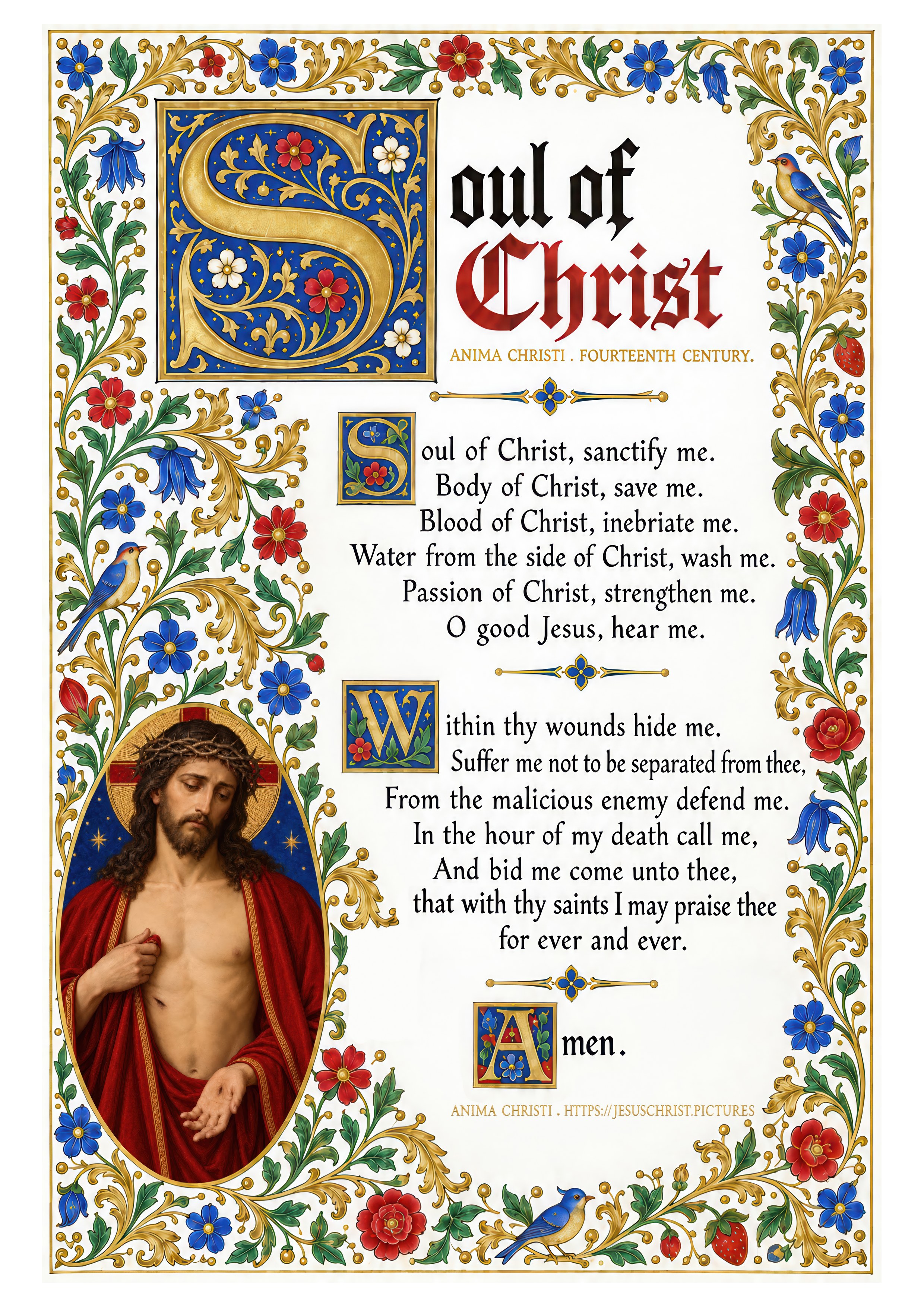
Soul of Christ, sanctify me.
Body of Christ, save me.
Blood of Christ, inebriate me.
Water from the side of Christ, wash me.
Passion of Christ, strengthen me.
O good Jesus, hear me.
Within thy wounds hide me.
Suffer me not to be separated from thee.
From the malicious enemy defend me.
In the hour of my death call me,
and bid me come unto thee,
that with thy saints I may praise thee
for ever and ever. Amen.
Modern versions change a few words. The USCCB text says “embolden me” for the blood and “the wicked foe” for the enemy, and some translations replace “suffer me not” with “permit me not”. The shape of the prayer never changes.
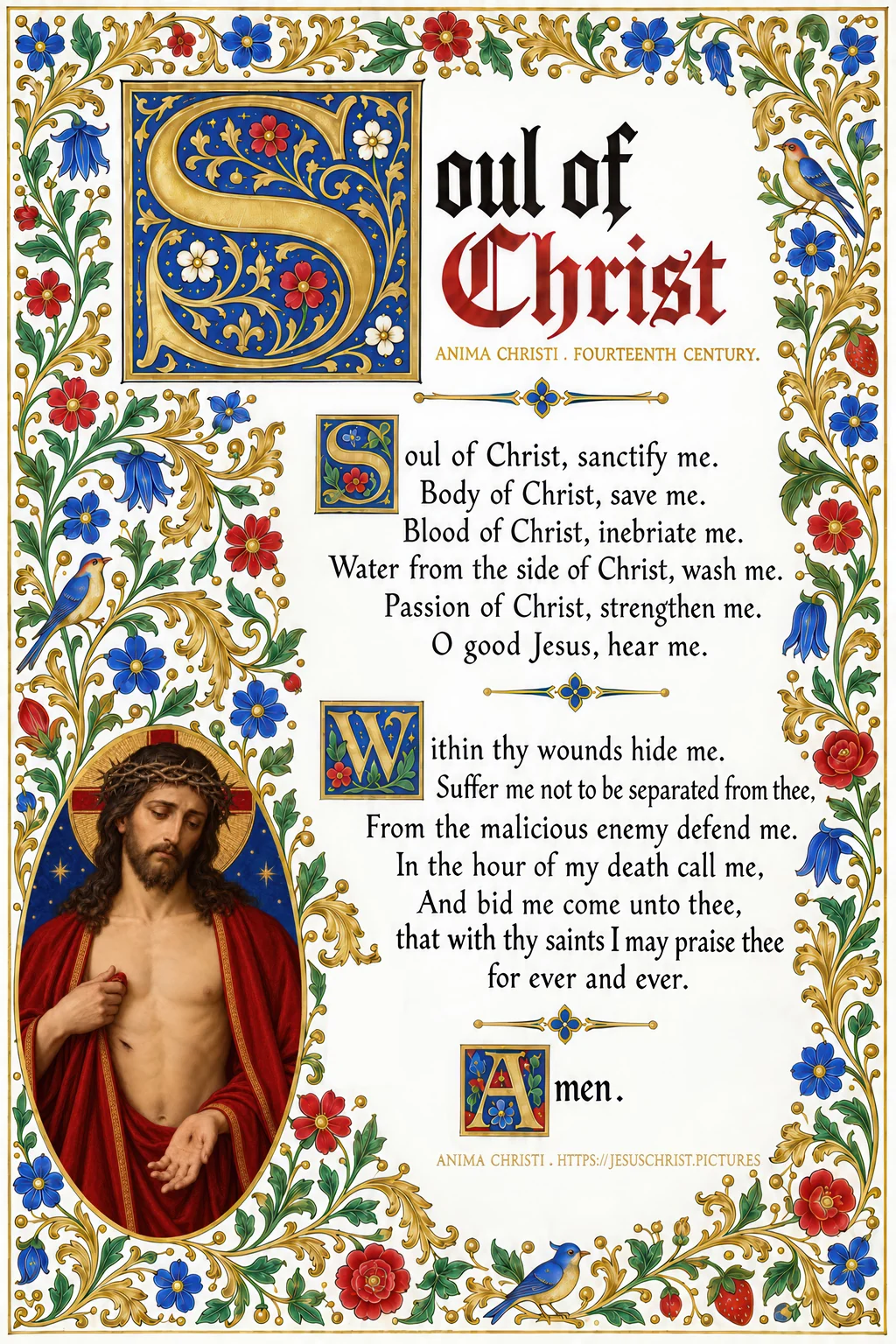
Free printable Anima Christi prayer card:
- Prayer card, PDF, US Letter
- Prayer card, PDF, A4
- Pocket prayer cards, 4 per sheet, PDF
- High resolution image, JPG
These files are free for personal use, for your parish, or for a First Communion class.
✦ Free Christian & Catholic Printables
The Anima Christi card sits with our whole collection of illuminated prayer cards and Scripture printables, all free to print at home.
Browse all free printables →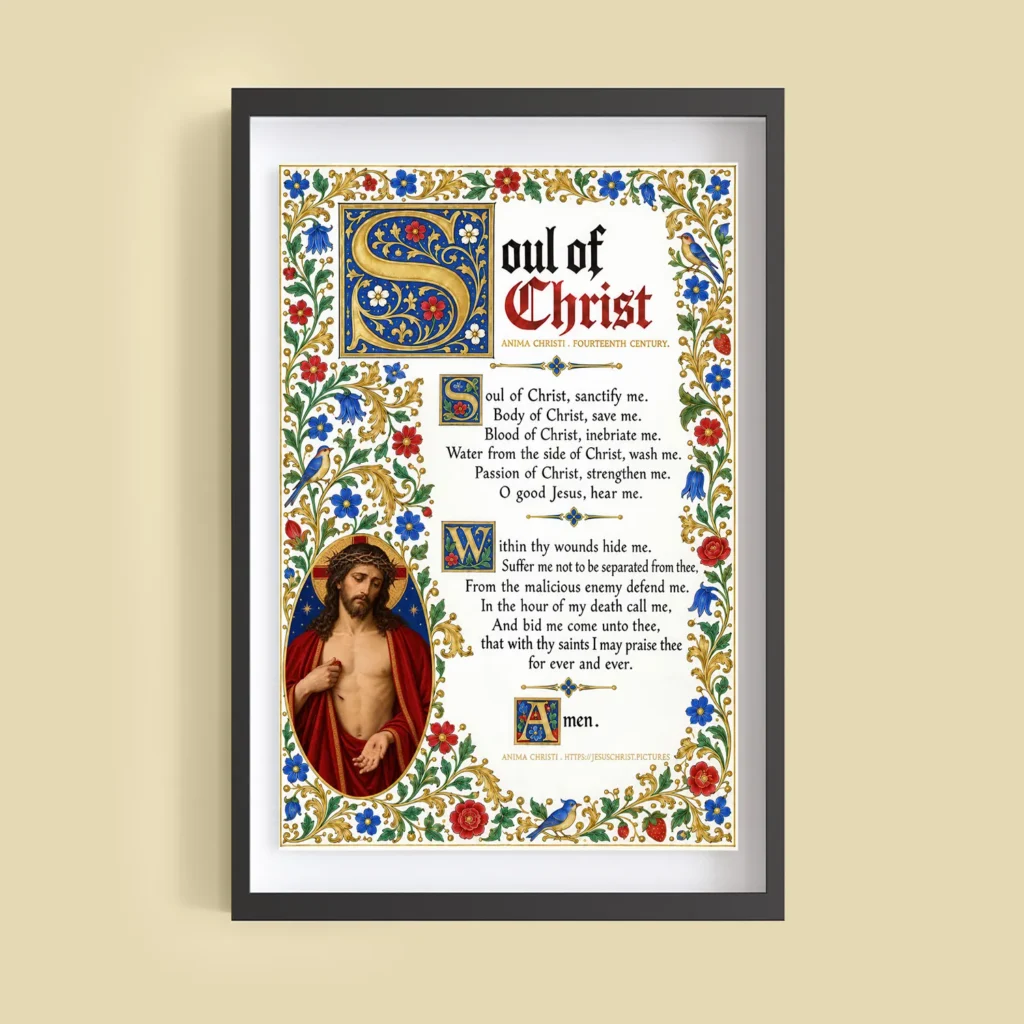
The Latin Text: Anima Christi, Sanctifica Me
The prayer was written in Latin, and it is short enough to learn by heart in that language. The rhythm is part of it: each line is a name and a verb, and almost every verb ends on the same sound.
Anima Christi, sanctifica me.
Corpus Christi, salva me.
Sanguis Christi, inebria me.
Aqua lateris Christi, lava me.
Passio Christi, conforta me.
O bone Iesu, exaudi me.
Intra tua vulnera absconde me.
Ne permittas me separari a te.
Ab hoste maligno defende me.
In hora mortis meae voca me,
et iube me venire ad te,
ut cum Sanctis tuis laudem te
in saecula saeculorum. Amen.
Who Wrote the Anima Christi?
Nobody knows. The prayer belongs to the early fourteenth century, and the evidence for it is older than any name attached to it. A manuscript in the British Library, identified by the hymnologist James Mearns, contains it around 1370. The prayer book of Cardinal Pierre de Luxembourg, who died in 1387 and is buried at Avignon, contains a version almost word for word. And it was inscribed on one of the gates of the Alcázar of Seville in the reign of Pedro I of Castile, between 1350 and 1369, which means it was well enough known to be carved into the walls of a royal palace.
It is sometimes credited to Pope John XXII, who reigned at Avignon from 1316 to 1334, but that attribution is a tradition, not a record. What the evidence does show is the world the prayer came from. The late Middle Ages were intensely devoted to the Eucharist and to the wounds of Christ: the feast of Corpus Christi had just spread through the whole Church, and painters were showing the risen Christ standing in his tomb, showing his wounds to the faithful. The legend of the Mass of Saint Gregory, in which Christ appears on the altar during the consecration, put that devotion into a single image.

Look at Hans Baldung’s version and you are looking at the Anima Christi before it was written down: the body on the altar, the blood, the side, the Passion, and a crowd of clergy asking to be sanctified by what they see.
Why Everyone Thinks Saint Ignatius Wrote It
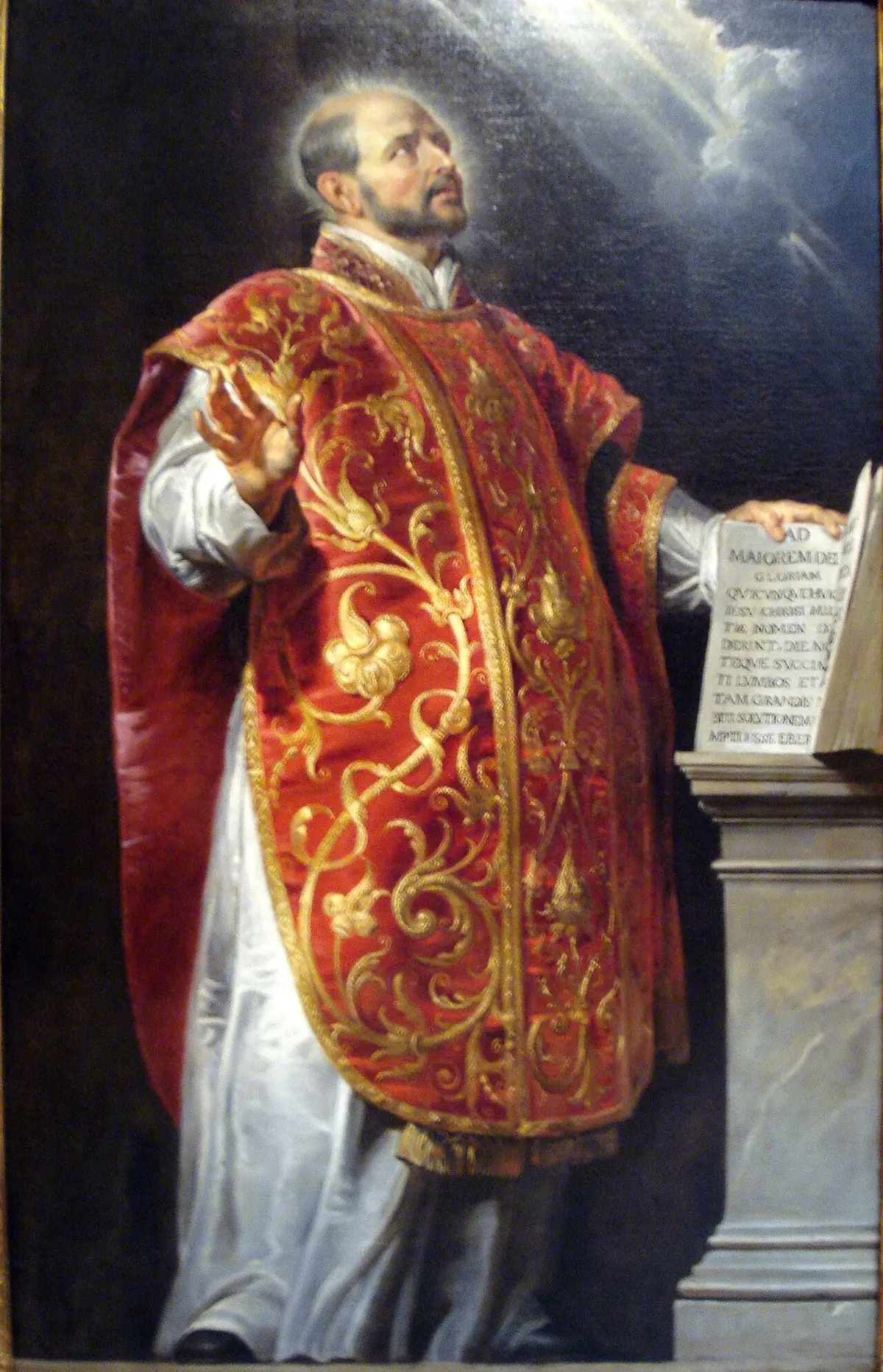
Ignatius of Loyola was born in 1491, more than a century after the Seville inscription, and the prayer was already in books printed during his youth. He loved it. In the Spiritual Exercises he refers to it several times, and the triple colloquy of the First Week, the three conversations with Mary, with Christ and with the Father, ends with the Anima Christi before the Our Father. He also recommends a way of praying it slowly, word by word, which he calls praying by rhythm.
Later editions of the Exercises printed the whole prayer on the opening pages, and generations of readers assumed that a text printed at the head of Ignatius’s book was by Ignatius. The Jesuits then carried the book and the prayer to every continent, so the attribution travelled with them. It is a misattribution, but an honest one, and without it the prayer would be far less known.
The Anima Christi, Line by Line
The prayer moves through the body of Christ as a pilgrim would move through a church: from the soul to the body, from the body to the blood, from the blood to the water, and then into the wounds themselves. The first half asks to be changed. The second half asks to be kept.
Soul of Christ, sanctify me. Body of Christ, save me.
The prayer begins with the whole Christ, soul and body, the same Christ the person praying has just received. Catholic teaching holds that the Eucharist contains the body, blood, soul and divinity of Christ, and the first two lines ask each of them to do its work. Sanctify is the slow work of becoming holy; save is the rescue. Luca Signorelli painted the moment the prayer answers: Christ himself placing the host on the tongue of each apostle.

Blood of Christ, inebriate me.
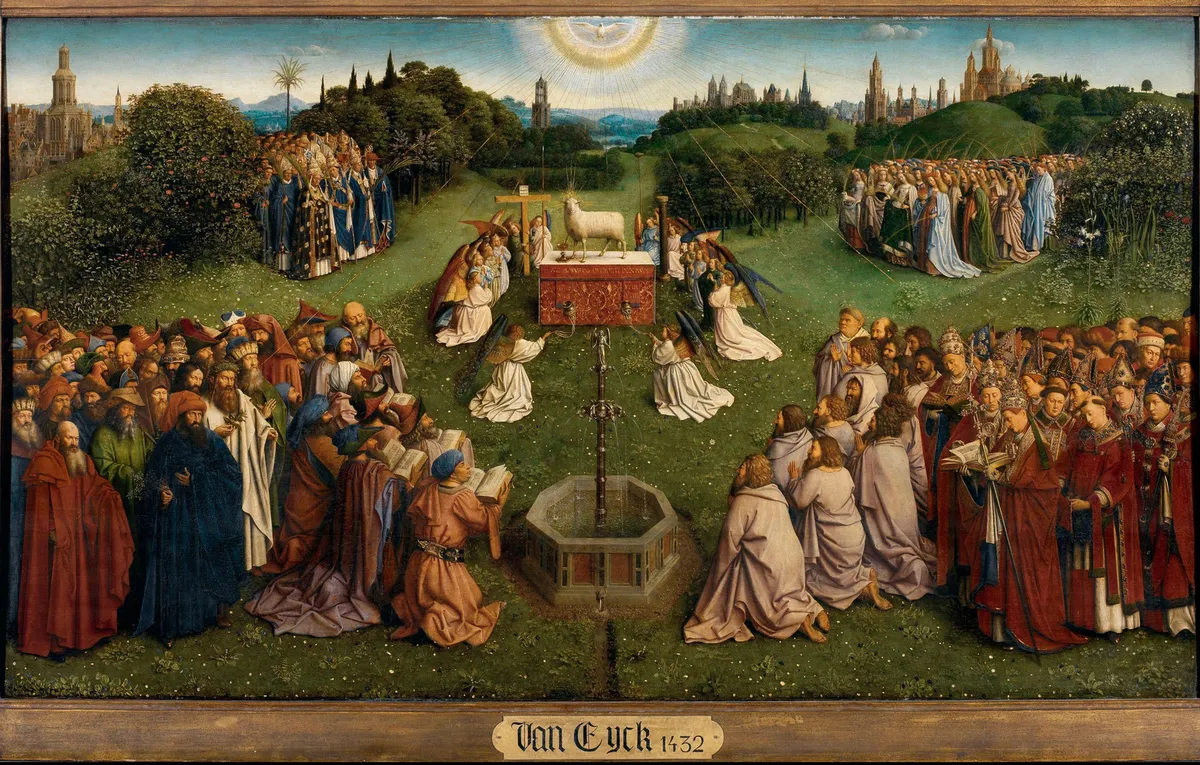
This is the line people stumble on, and the line modern translators soften. The Latin inebria means exactly what it sounds like: make me drunk. It comes from the language of the Psalms, where the just “shall be inebriated with the plenty of thy house” (Psalm 35:9 in the Douay version, 36:8 in modern numbering), and it asks not for a sip of grace but for the kind of abundance that overwhelms. Jan van Eyck painted it at the centre of the Ghent Altarpiece: the Lamb of God on the altar, its blood falling in an unbroken stream into a gold chalice.

Water from the side of Christ, wash me.
When the soldier opened Christ’s side with a lance, “at once there came out blood and water” (John 19:34). The Fathers of the Church read the two as the two great sacraments, the water of baptism and the blood of the Eucharist, and Saint Augustine wrote that the Church was born from that wound as Eve was drawn from the side of Adam. To ask the water to wash you is to ask for your baptism to be made new.

Passion of Christ, strengthen me. O good Jesus, hear me.
The Passion here is not a scene to be pitied but a strength to be borrowed. El Greco’s Christ Carrying the Cross shows exactly that: no stumbling and no crowd, only a man holding the cross against his body and looking up. Then the prayer turns, for the first and only time, into direct address. O good Jesus, hear me: it is the most personal line, and the shortest.

Within thy wounds hide me.
This is the heart of the prayer. The image comes from the Song of Songs, where the beloved is called “my dove in the clefts of the rock” (Song of Songs 2:14), and Saint Bernard of Clairvaux, preaching on that verse, read the clefts of the rock as the wounds of Christ, a shelter where the soul is safe. Caravaggio painted the wounds as something Christ offers, not something he suffers: in The Incredulity of Saint Thomas he takes the doubter’s hand and guides it into his side.

Suffer me not to be separated from thee. From the malicious enemy defend me.
The second half of the prayer is about staying. The fear it names is not pain but separation, and it echoes Saint Paul: nothing “shall be able to separate us from the love of God, which is in Christ Jesus” (Romans 8:39). The malicious enemy is the devil, the same adversary named in the Saint Michael prayer, and the request is simply to be defended.
In the hour of my death call me, and bid me come unto thee.
For centuries this was a deathbed prayer as much as a Communion prayer, said for the dying and by them. The picture it asks for is a summons: not to be taken, but to be called by name and told to come. Agostino Carracci painted the last Communion of Saint Jerome, the old saint too weak to stand, kneeling to receive the host that will carry him through death. Domenichino’s more famous version in the Vatican is built directly on this one.

That with thy saints I may praise thee for ever and ever.
The prayer ends where the Ghent Altarpiece ends: in a crowd. Having asked to be hidden in the wounds of one person, it asks at the last to be lost among all the others, prophets, martyrs, virgins and confessors converging on the Lamb from every side of a flowering meadow. The Anima Christi begins alone after Communion and closes in the company of the whole Church.
When and How to Pray the Anima Christi
The Anima Christi is above all a prayer after Communion. Many Catholics say it kneeling as soon as they return to their place, and older missals print it among the prayers of thanksgiving after Mass. The Church attaches a partial indulgence to it when it is prayed after Communion, in the current Enchiridion of Indulgences.
It is also prayed in Eucharistic adoration, before the tabernacle, and at the bedside of the dying, where the last lines take on their full weight. To pray it slowly, follow Ignatius’s advice: say one line, stay with it for the length of a breath, and move on only when the words have been heard. Eleven lines take less than a minute at speed; said this way, they can fill the whole silence after Communion.
Soul of My Saviour: The Anima Christi Hymn
Many people who search for the Anima Christi “lyrics” are looking for the hymn. The best known English version begins:
Soul of my Saviour, sanctify my breast;
Body of Christ, be thou my saving guest;
Blood of my Saviour, bathe me in thy tide,
wash me, ye waters, gushing from his side.
It is usually credited to the Jesuit John Hegarty, who died in 1834, though some hymnals give it to Edward Caswall, and it is sung to a tune by the Jesuit William Maher. The Latin text has also been set by Jean-Baptiste Lully, Heinrich Schütz and Franz Liszt, and by many modern composers.
Anima Christi Paintings Featured in This Article
| Painting | Artist | Date | Museum |
|---|---|---|---|
| The Man of Sorrows | Sandro Botticelli | c. 1500 | Private collection |
| The Mass of Saint Gregory | Hans Baldung | 1511 | Cleveland Museum of Art |
| Saint Ignatius of Loyola | Peter Paul Rubens | c. 1620-1622 | Norton Simon Museum, Pasadena |
| Communion of the Apostles | Luca Signorelli | c. 1512 | Museo Diocesano, Cortona |
| The Adoration of the Mystic Lamb | Hubert and Jan van Eyck | 1432 | Saint Bavo’s Cathedral, Ghent |
| Christ as the Man of Sorrows Wept by Mary and Angels | Hans Baldung | Early 16th century | Private collection |
| Christ Carrying the Cross | El Greco | c. 1577-1587 | Metropolitan Museum of Art, New York |
| The Incredulity of Saint Thomas | Caravaggio | c. 1601-1602 | Sanssouci Picture Gallery, Potsdam |
| The Last Communion of Saint Jerome | Agostino Carracci | c. 1592-1597 | Pinacoteca Nazionale, Bologna |
A Prayer Small Enough to Carry
The Anima Christi has outlived its author, its first manuscripts and the palace gate it was carved on, because it asks for so little and means so much. Eleven lines, each a name and a verb, that can be said in the minute after Communion or in the last minute of a life. Print the card, keep it in a missal or a wallet, and let the lines come back when there is nothing else to say.
Important Facts About the Anima Christi Prayer
- The Anima Christi dates from the early fourteenth century; its author is unknown.
- It appears in a British Library manuscript of around 1370 and in the prayer book of Cardinal Pierre de Luxembourg (died 1387).
- It was inscribed on a gate of the Alcázar of Seville under Pedro I of Castile (1350-1369).
- It is often attributed to Pope John XXII, but without documentary proof.
- Saint Ignatius of Loyola did not write it; he recommended it in the Spiritual Exercises, and later editions printed it at the front.
- It is traditionally prayed after Communion, and carries a partial indulgence when prayed then.
- The hymn “Soul of my Saviour” is an English paraphrase of the prayer.
Frequently Asked Questions
What is the original Anima Christi prayer?
The original is in Latin: Anima Christi, sanctifica me. Corpus Christi, salva me. Sanguis Christi, inebria me. Aqua lateris Christi, lava me. Passio Christi, conforta me. O bone Iesu, exaudi me. Intra tua vulnera absconde me. Ne permittas me separari a te. Ab hoste maligno defende me. In hora mortis meae voca me, et iube me venire ad te, ut cum Sanctis tuis laudem te in saecula saeculorum. Amen. The English “Soul of Christ, sanctify me” is a translation of it.
Who came up with the Anima Christi prayer?
No one knows. It was written in the early fourteenth century and is found in manuscripts from around 1370 and on a gate of the Alcázar of Seville from the 1350s or 1360s. It is sometimes credited to Pope John XXII, without proof. Saint Ignatius of Loyola, to whom it is often attributed, was born in 1491, long after it was written.
When do you say the Anima Christi?
Traditionally after receiving Holy Communion, as a prayer of thanksgiving, which is why it is printed among the prayers after Mass in older missals. It is also said during Eucharistic adoration and as a prayer for the dying, because of its last lines about the hour of death.
How do you pray the Anima Christi?
Slowly. Saint Ignatius recommended praying such prayers by rhythm: say one line, stay with it for the length of a breath, then move to the next. Kneeling after Communion, the eleven lines can fill the whole time of thanksgiving. Some people pray only one line, the one that speaks to them that day.
Is the Anima Christi prayer biblical?
It is not a text from the Bible, but almost every line comes from it. The blood and water from the side of Christ are in John 19:34, the wounds in John 20:27, the hiding place in the clefts of the rock in Song of Songs 2:14, the fear of separation in Romans 8:39, and the language of being inebriated with the abundance of God’s house in Psalm 36:8.
What does “Blood of Christ, inebriate me” mean?
The Latin inebria means make me drunk, and the word is chosen on purpose. It asks for grace in overwhelming abundance, in the language of the Psalms, where the just are inebriated with the plenty of God’s house. Some modern translations, such as the USCCB text, soften it to “embolden me” or “fill me”.
Can you buy Anima Christi art?
You can buy Anima Christi paintings at jesuschrist.pictures, in our shop, where the Man of Sorrows, the Passion and the great Eucharistic paintings are printed on canvas. The prayer itself is available as an illuminated Anima Christi prayer poster, a giclee fine art print with Christ as the Man of Sorrows in a medallion, and the prayer card is free to print from our free printables page.