12 Irish Saints and the Art They Left Behind
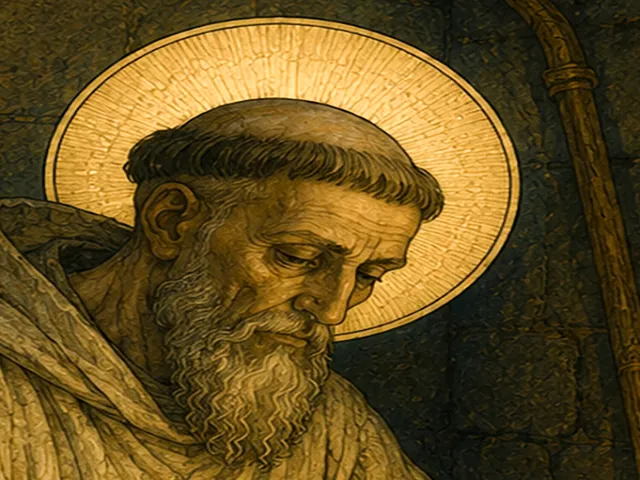
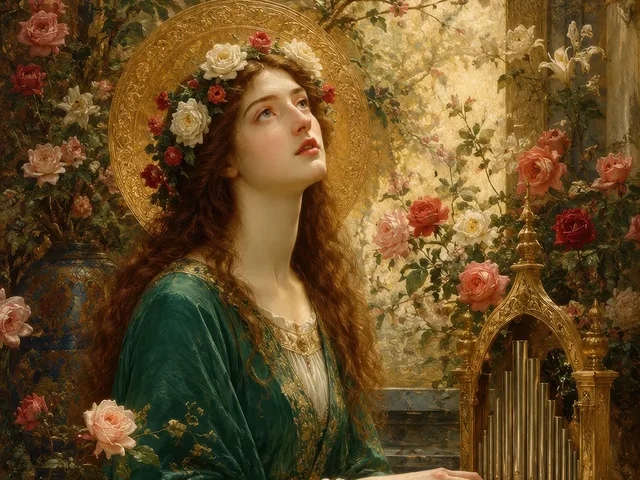
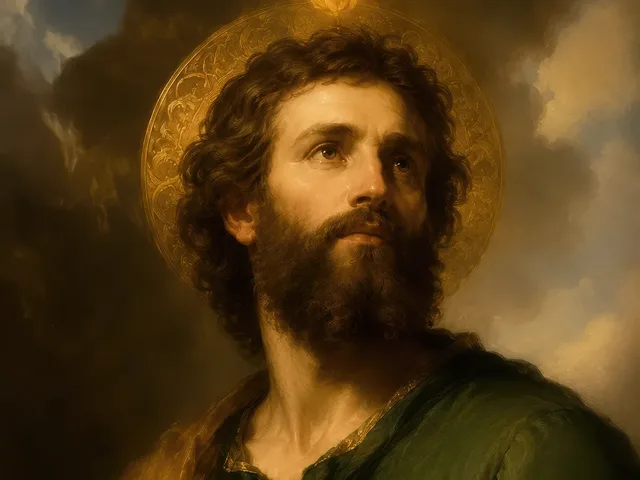
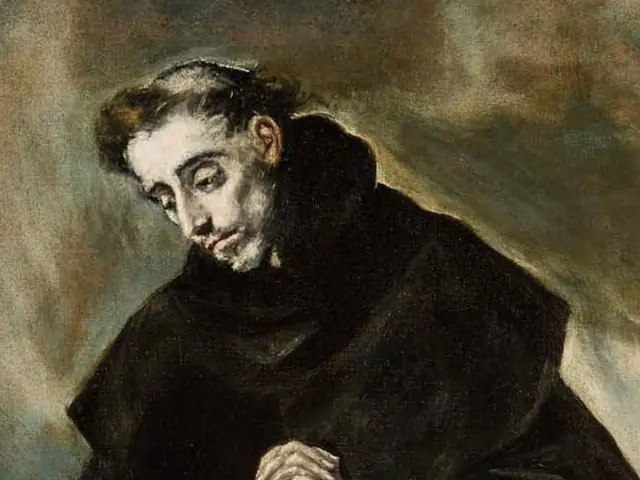
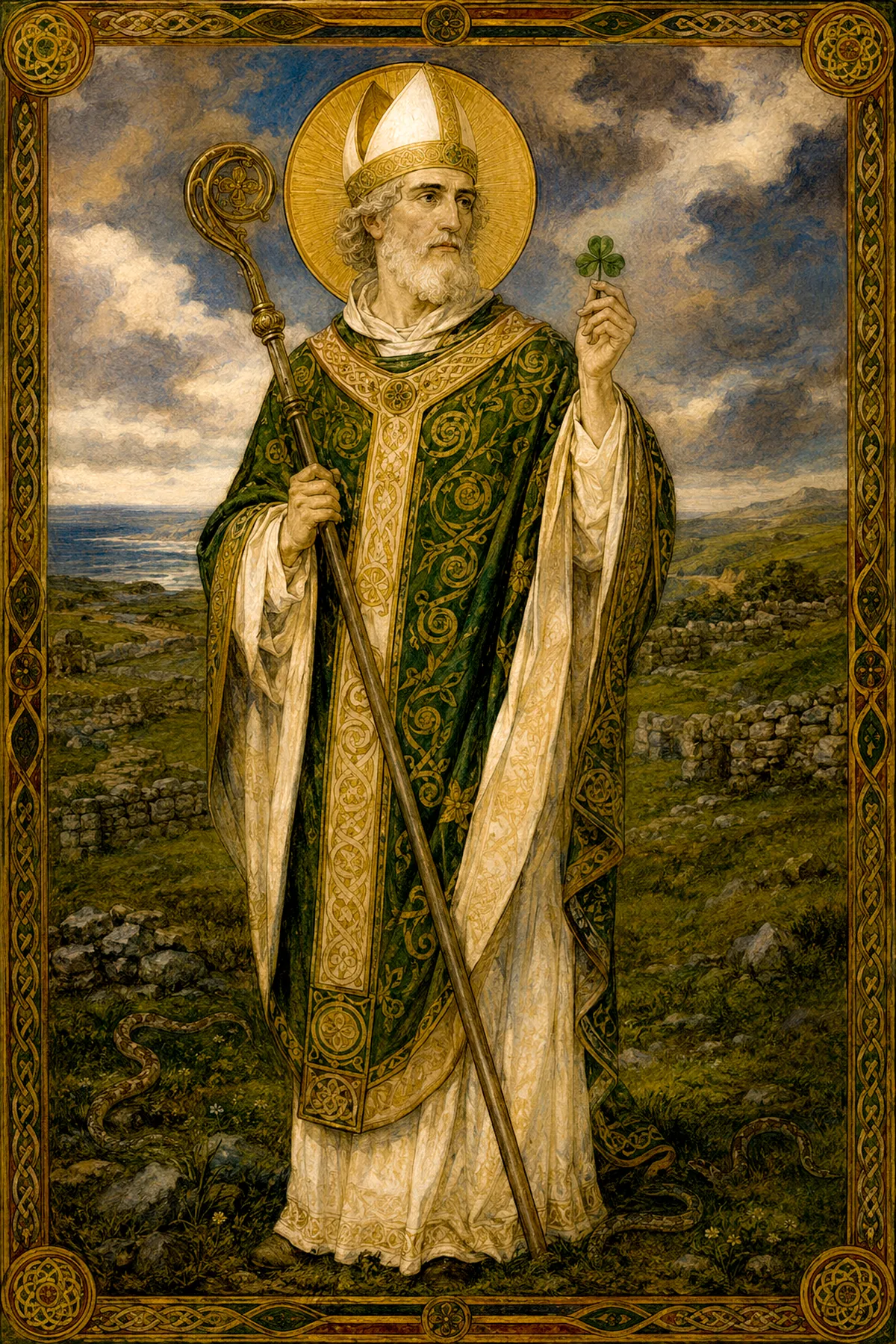
Ireland is called the land of saints and scholars, and it earned the title early. By the time the first panel painters of Italy picked up a brush, the great Irish saints had already been dead for six hundred years. Patrick died around 461. Giotto was born in 1267. That gap is the reason a page about Irish saints cannot look like a page about Spanish or Italian ones: there is no gallery of Zurbarans and Riberas waiting to illustrate it. What Ireland made instead was books. The monasteries founded by these men and women produced the finest illuminated manuscripts in Europe, and it is in those pages, not on canvas, that their world survives. Add a handful of later altarpieces made abroad, where Irish missionaries were remembered long after their deaths, and one single portrait painted from the life of a man executed in London in 1681, and you have the whole visual record. For five of the twelve, even that comes up empty. Where nothing survives, we have had new panels painted in the manner of the Celtic Revival, the idiom John Duncan and Harry Clarke used a century ago, and every one of them is captioned as what it is. Here are twelve of them, in the order they lived, with the art that survives for each.
1. Saint Patrick (around 385 to 461)
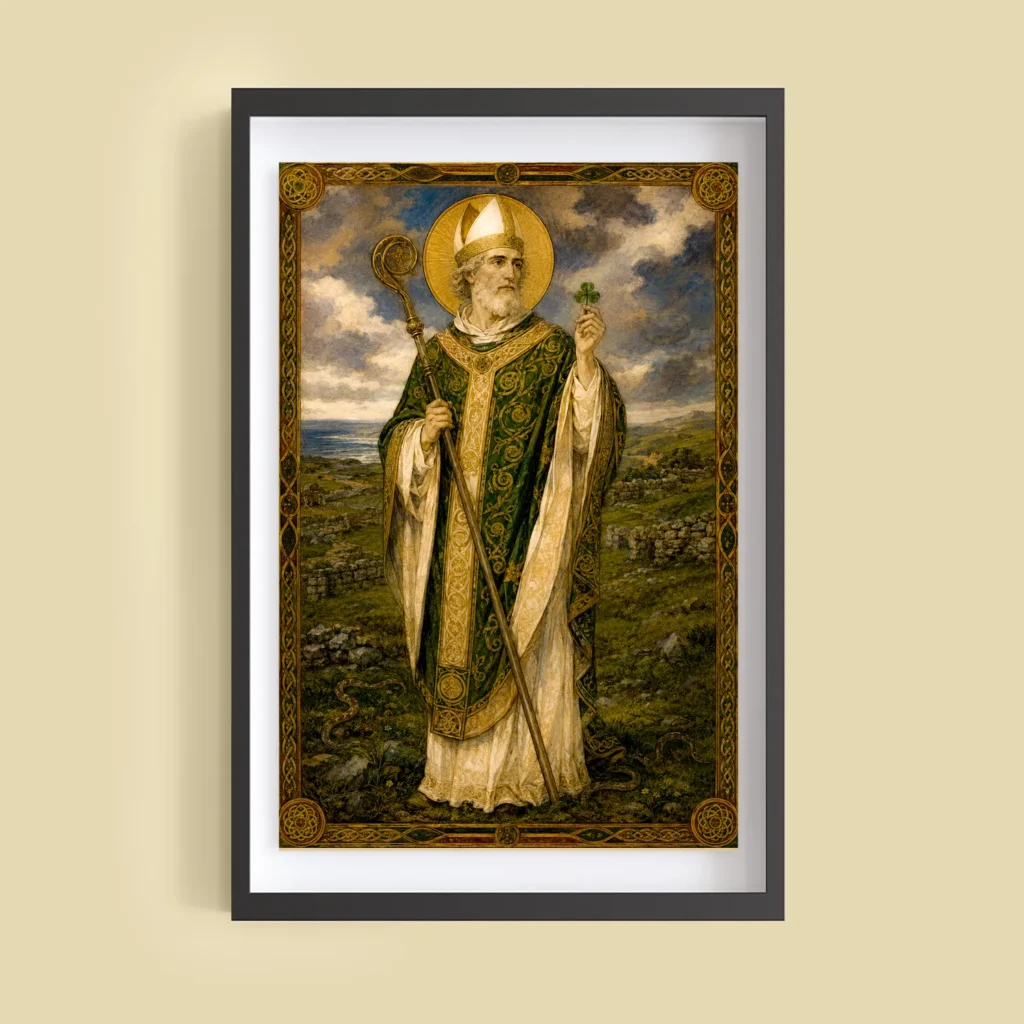
He was not Irish. Patrick was a Roman Briton, the son of a deacon and the grandson of a priest, and he came to Ireland the first time as cargo. Raiders took him at sixteen and sold him to a landowner in the west, where he spent six years herding sheep and, by his own account, praying a hundred times a day in the cold. He escaped, walked two hundred miles to a ship, went home, and then did the thing nobody expected: he trained as a cleric and went back to the people who had enslaved him. We have his own words. The Confessio is a short, defensive, oddly moving document, written in awkward Latin by a man who never stopped being ashamed of his poor education. It is one of the earliest texts written in Ireland, and it says nothing at all about shamrocks or snakes. Those came later, the shamrock as a teaching image for the Trinity, the snakes as a metaphor for paganism. Ireland has had no snakes since the last ice age. The prayer said in his name for a thousand years, St. Patrick’s Breastplate, is later than him too, and it is still the finest thing ever attributed to him.
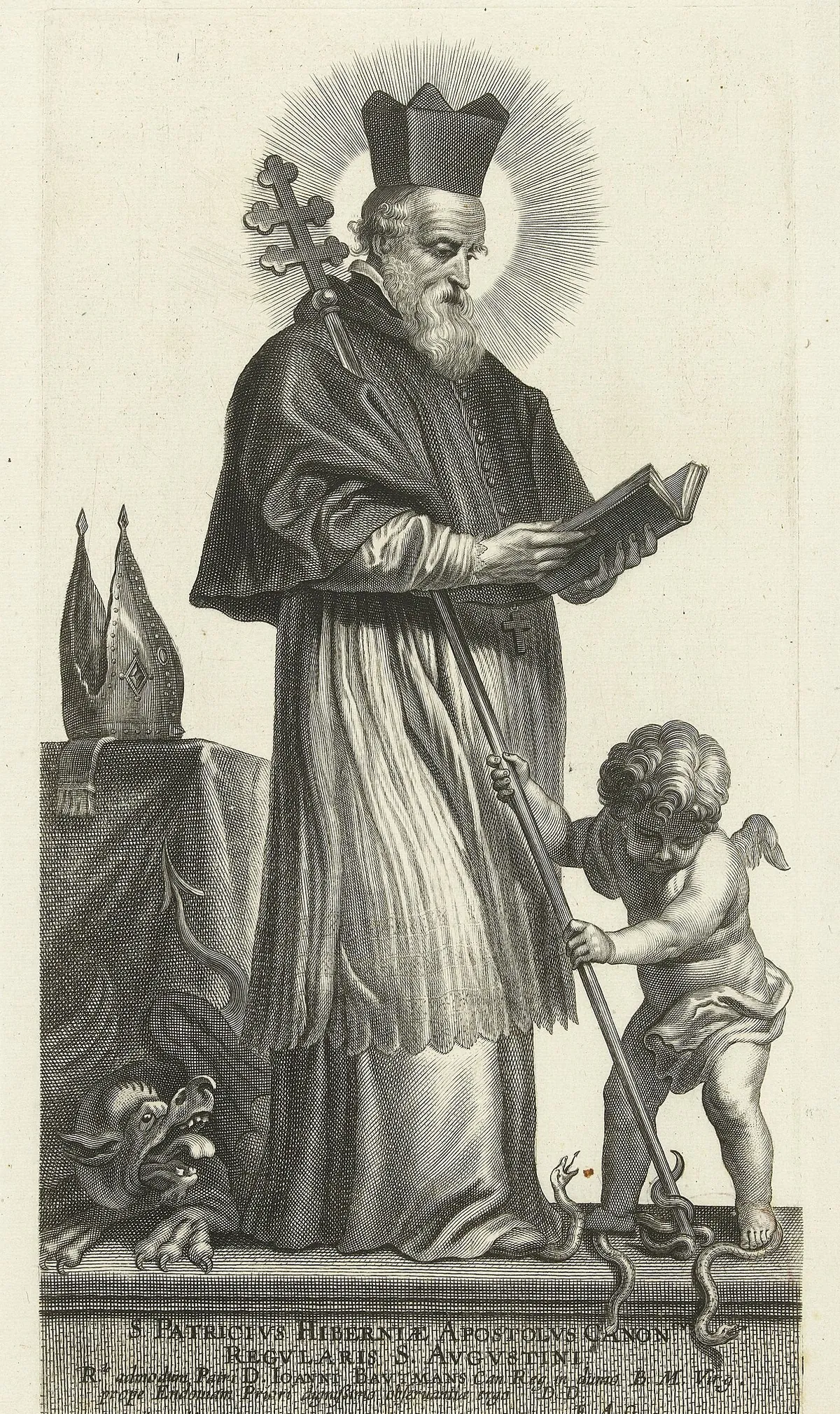
No image of Patrick exists from anywhere near his lifetime. The best old one is this Antwerp engraving by Mattheus Borrekens, made in the middle of the seventeenth century after a design by Erasmus Quellinus, a painter from the workshop of Peter Paul Rubens. The Latin inscription names him plainly, Apostle of Ireland. He wears a mitre, holds a book and a cross staff, and the serpents are already there, sliding away from the hem of his robe. It is a Flemish baroque idea of an Irish shepherd boy, and it is the closest thing to a great artist’s Patrick that survives. The Rijksmuseum in Amsterdam holds the sheet: https://www.rijksmuseum.nl/ The whole life, the two letters he left behind and the reason the snakes and the shamrock arrived so late, is told on our page for Saint Patrick.
2. Saint Brigid of Kildare (around 451 to 525)
Brigid is the one who feels least like a saint and most like a force of nature. The daughter of a chieftain and a slave, she gave away her father’s sword to a beggar, refused every marriage offered her, and founded at Kildare a double monastery, men and women together, with herself in charge. A fire was kept burning in her enclosure and tended in turn by her nuns, a practice that ran until the Reformation. Since 2023 her feast day, 1 February, is a public holiday in Ireland, the first named for a woman.
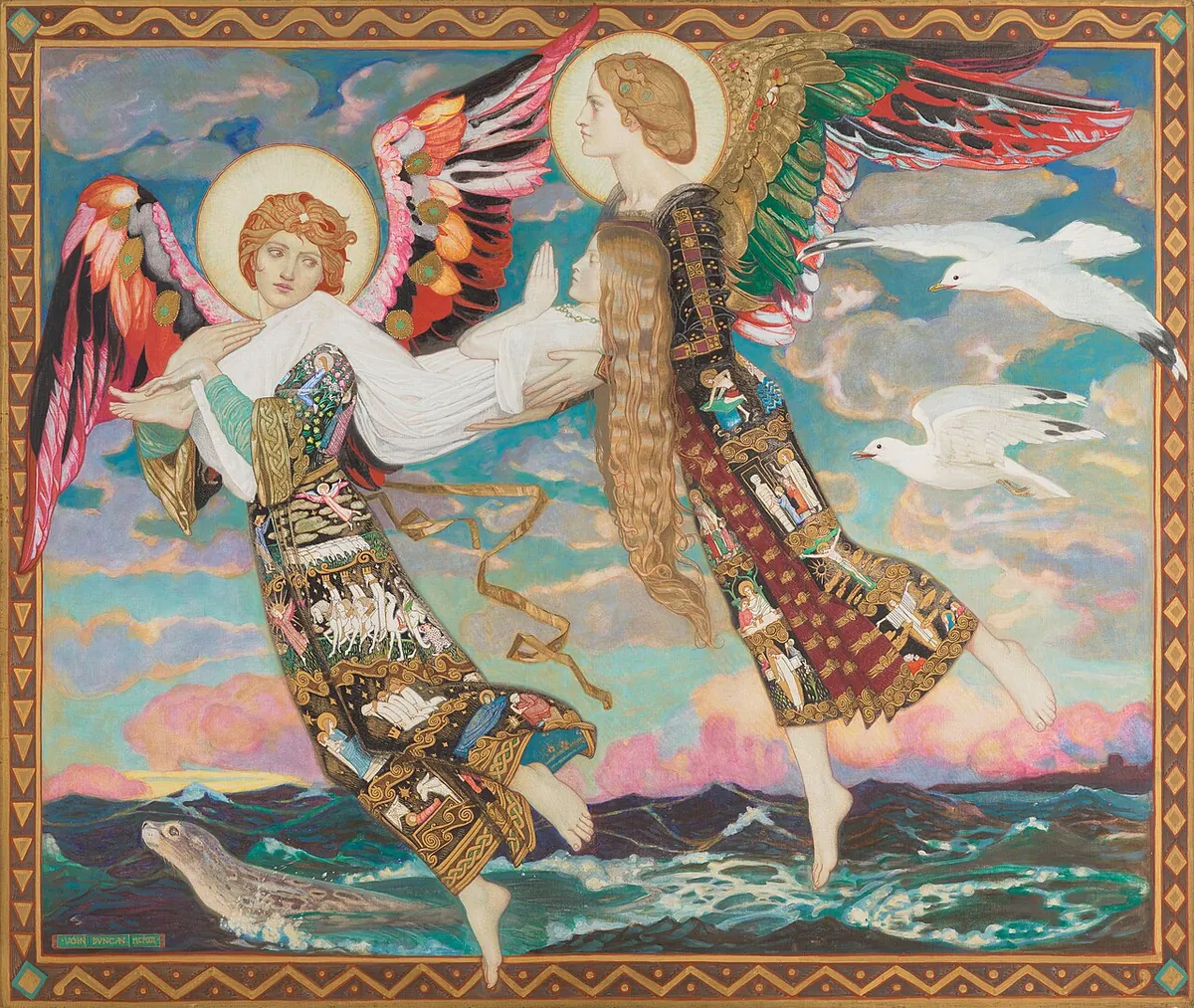
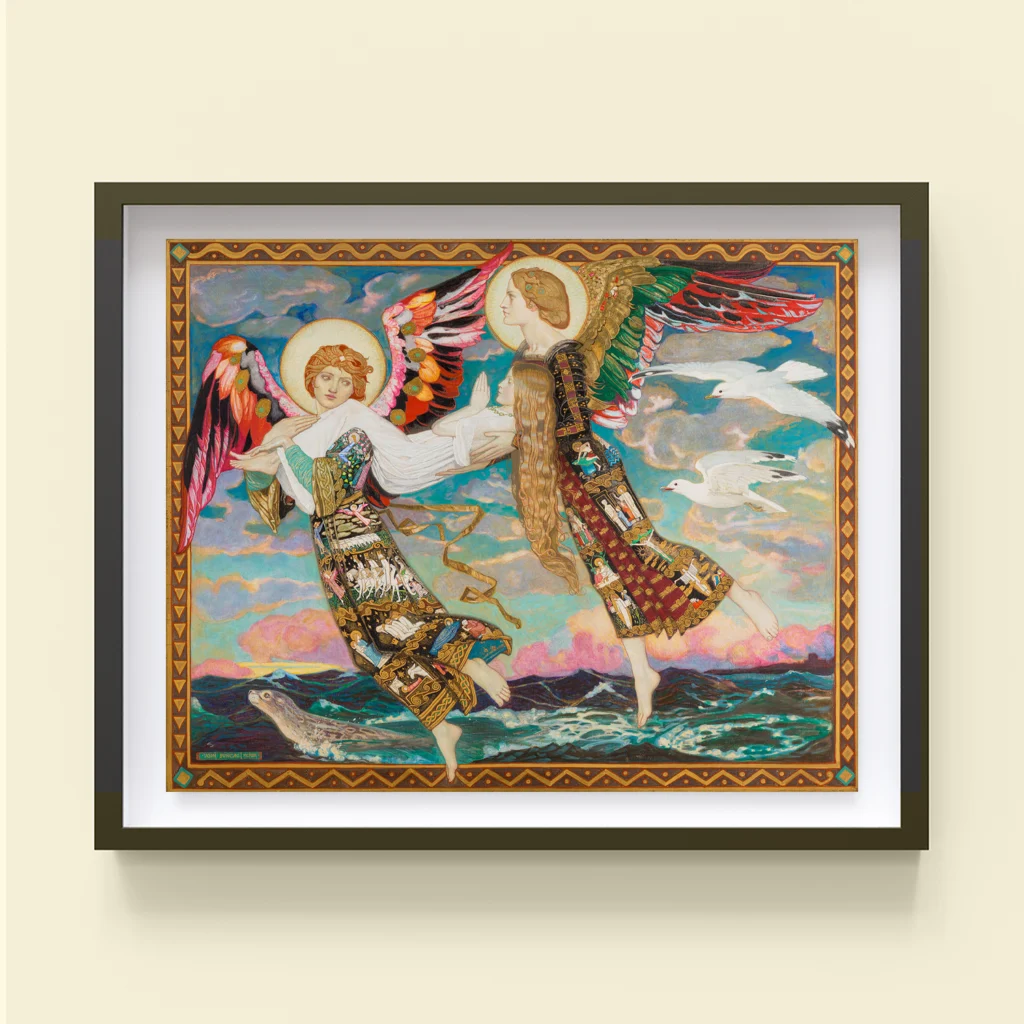
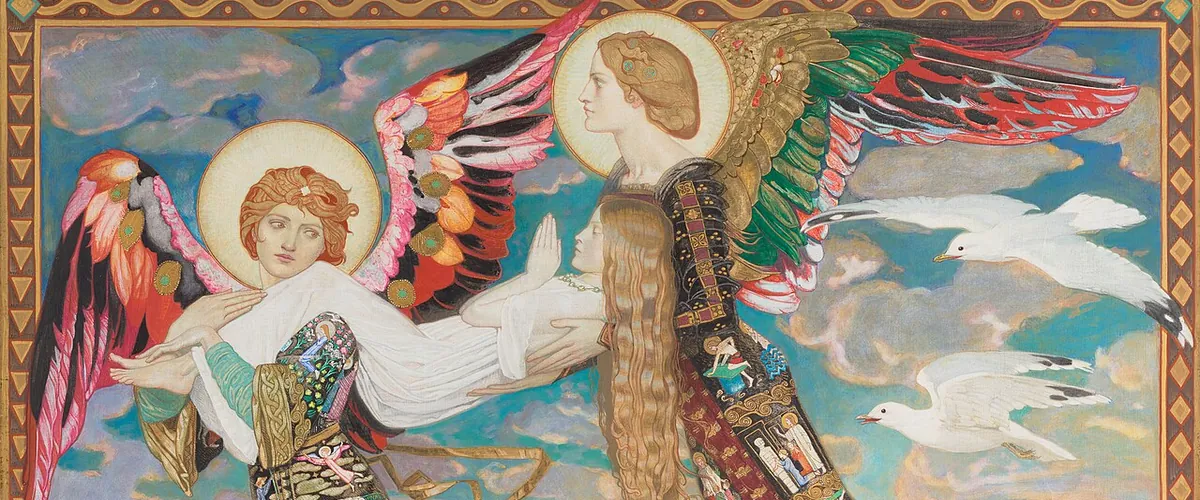
The painting is John Duncan’s Saint Bride, made in Edinburgh in 1913 and the single most beautiful image any Irish saint has ever been given. It shows a Hebridean legend: angels carry the girl Brigid across the sea to Bethlehem, so that she can be present at the birth of Christ and hold him. Duncan painted it in tempera, deliberately, to get the matte chalky surface of a medieval panel, and he covered the angels’ robes with tiny scenes from the life of Christ, each one the size of a fingernail. Look for the seal in the water and the two gulls. It hangs in the National Galleries of Scotland: https://www.nationalgalleries.org/ Brigid is one of only three patron saints of Ireland and the only woman among them. She sits naturally alongside the other women we have gathered in Female Saints in Art. The fire at Kildare, the goddess who shares her name and the rumour that she was struck off the calendar are all taken up on our page for Saint Brigid of Kildare.
3. Saint Brendan the Navigator (around 484 to 577)
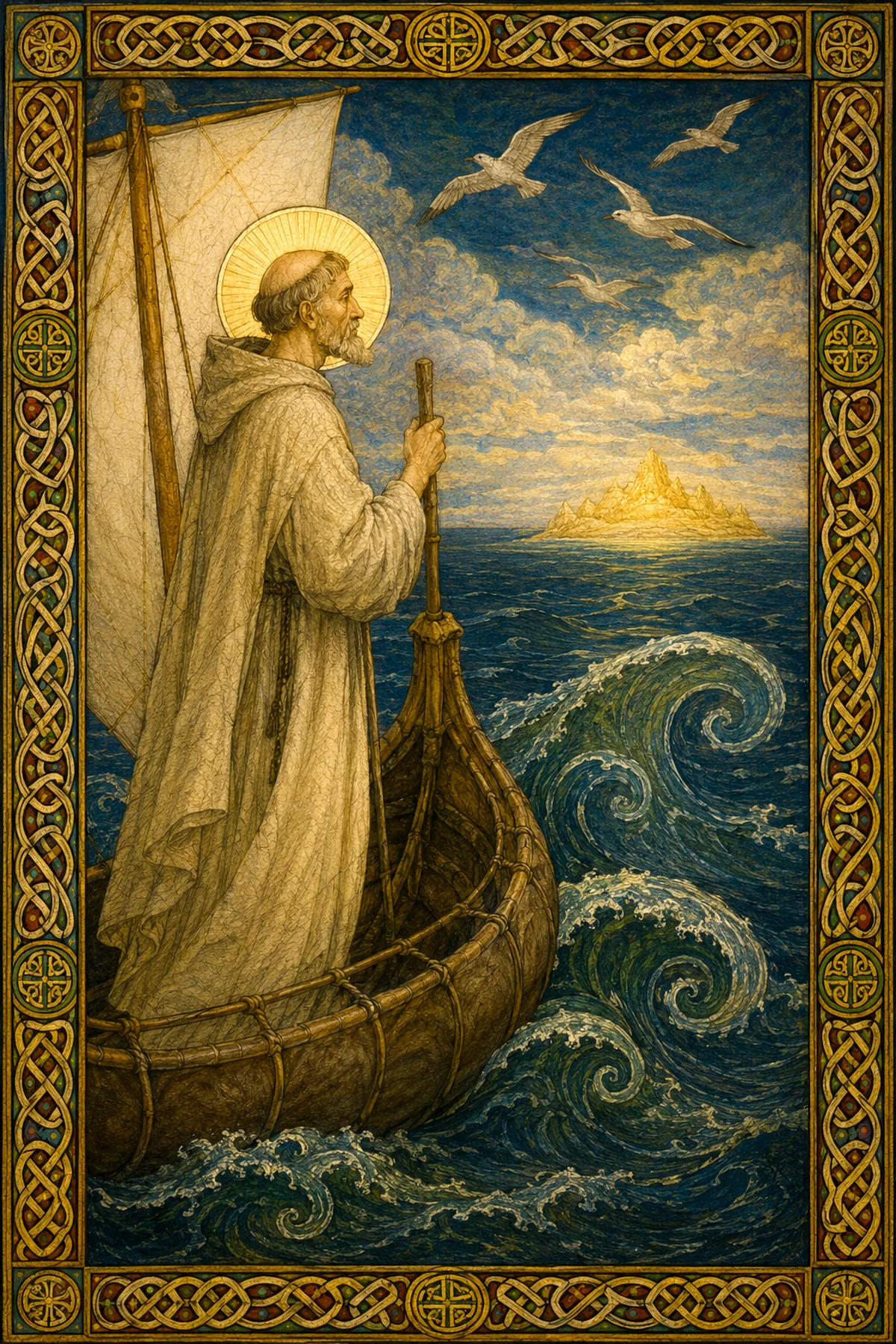
Brendan founded the monastery of Clonfert in County Galway, which would be quite enough for most saints. What made him famous across medieval Europe was a book: the Navigatio Sancti Brendani, written around the tenth century, which recounts a seven year voyage into the Atlantic in a leather boat with a crew of monks. They meet an island that turns out to be a whale, Jasconius, and celebrate Easter Mass on its back. They pass a pillar of crystal in the sea, and an island of fire and slag where the inhabitants throw burning rocks at them. They reach, at last, the Isle of the Blessed.
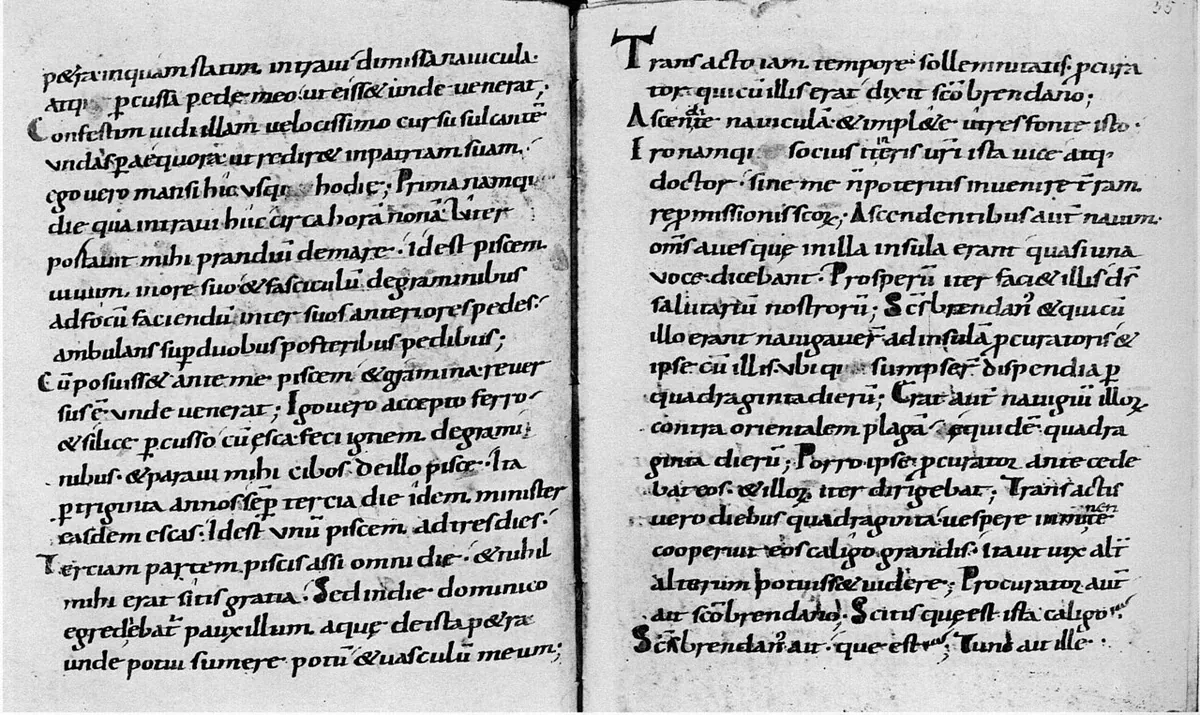
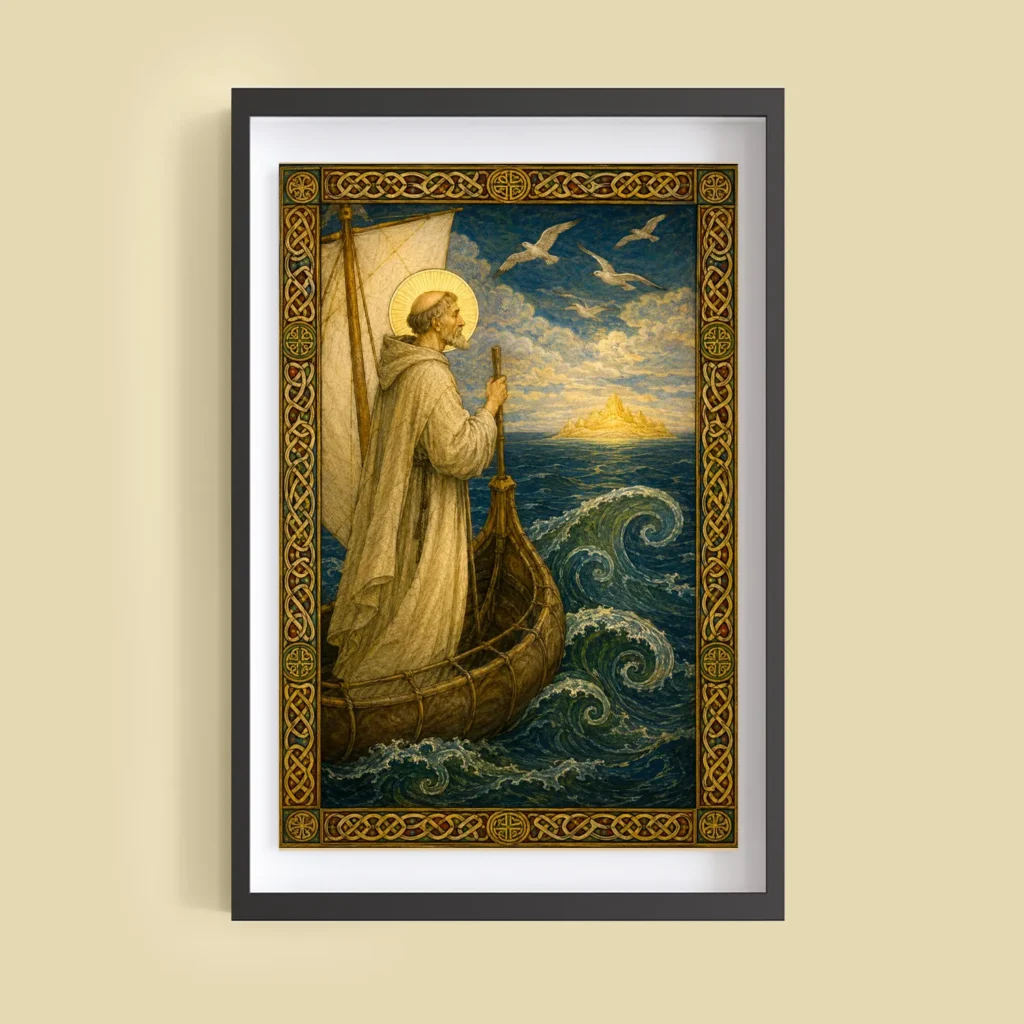
Over one hundred and twenty five manuscripts of the voyage survive, in Latin and in half a dozen vernaculars. It was one of the genuine bestsellers of the Middle Ages, and the islands it describes were still being drawn on Atlantic charts in the sixteenth century. In 1976 and 1977 the explorer Tim Severin built a boat of oak and ox hide to the description in the text and sailed it from Kerry to Newfoundland, which settled the question of whether it could be done, though not the question of whether it was. The manuscript above is what the Middle Ages actually had of Brendan: dense Latin script, no picture. The iceberg, the whale and the crystal column were left entirely to the reader. The panel below fills what the manuscript leaves out. The voyage island by island, and the serious version of the question of whether an Irish monk reached America, are on our page for Saint Brendan the Navigator.
4. Saint Columba, Colum Cille (521 to 597)
Columba was born into the royal Ui Neill and never quite stopped behaving like it. He founded Derry and Durrow, and then, in 563, he left Ireland for the island of Iona off the Scottish coast, with twelve companions. The reason for that departure is the best story in early Irish history. Columba borrowed a psalter from Finnian of Moville and copied it without permission. Finnian claimed the copy. The high king judged between them and delivered what is probably the first copyright ruling in Europe: to every cow its calf, and to every book its copy. Columba refused the verdict, his kinsmen fought the battle of Cul Dreimhne over it, and three thousand men are said to have died. He went into exile to atone, resolving to win as many souls as had been lost.
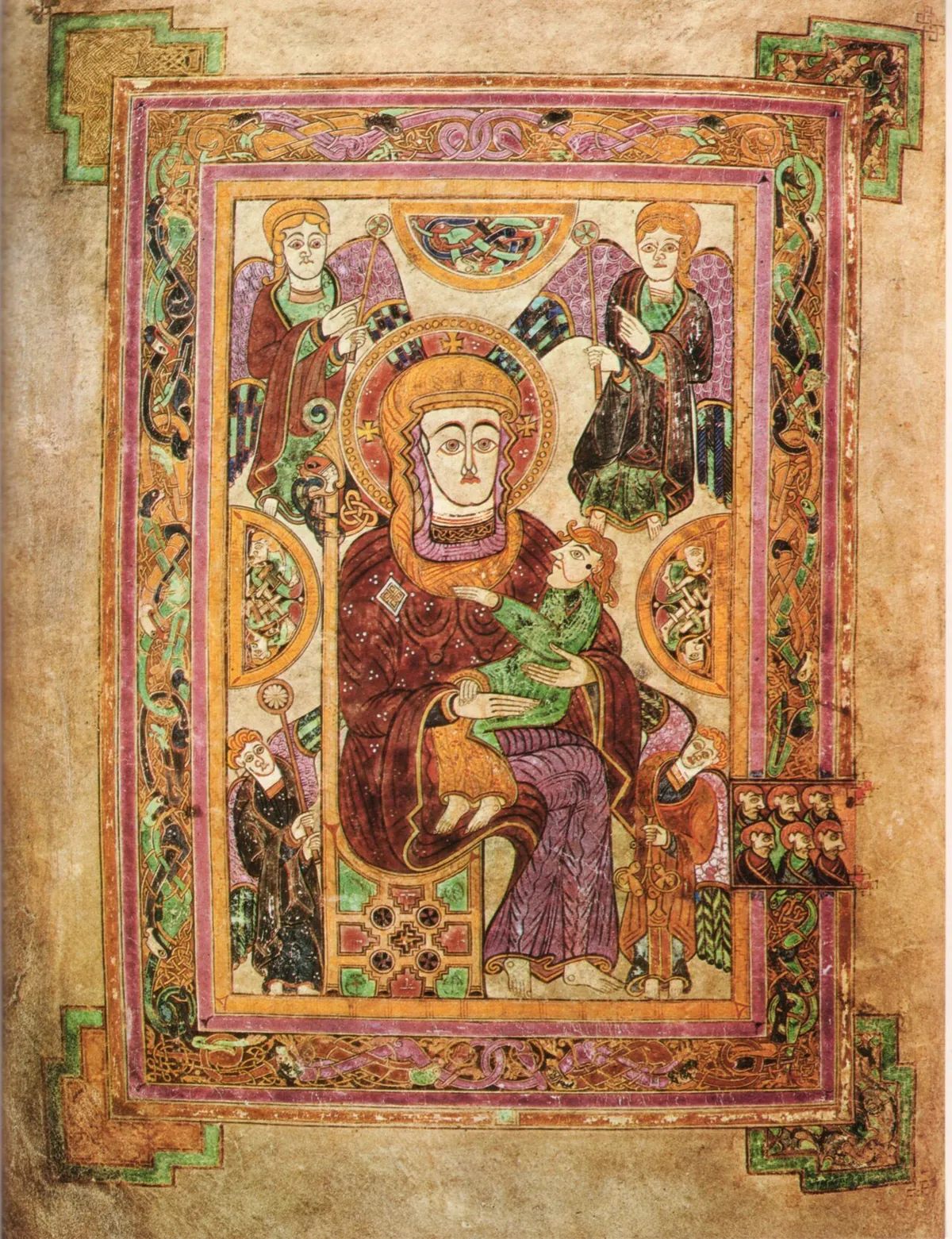
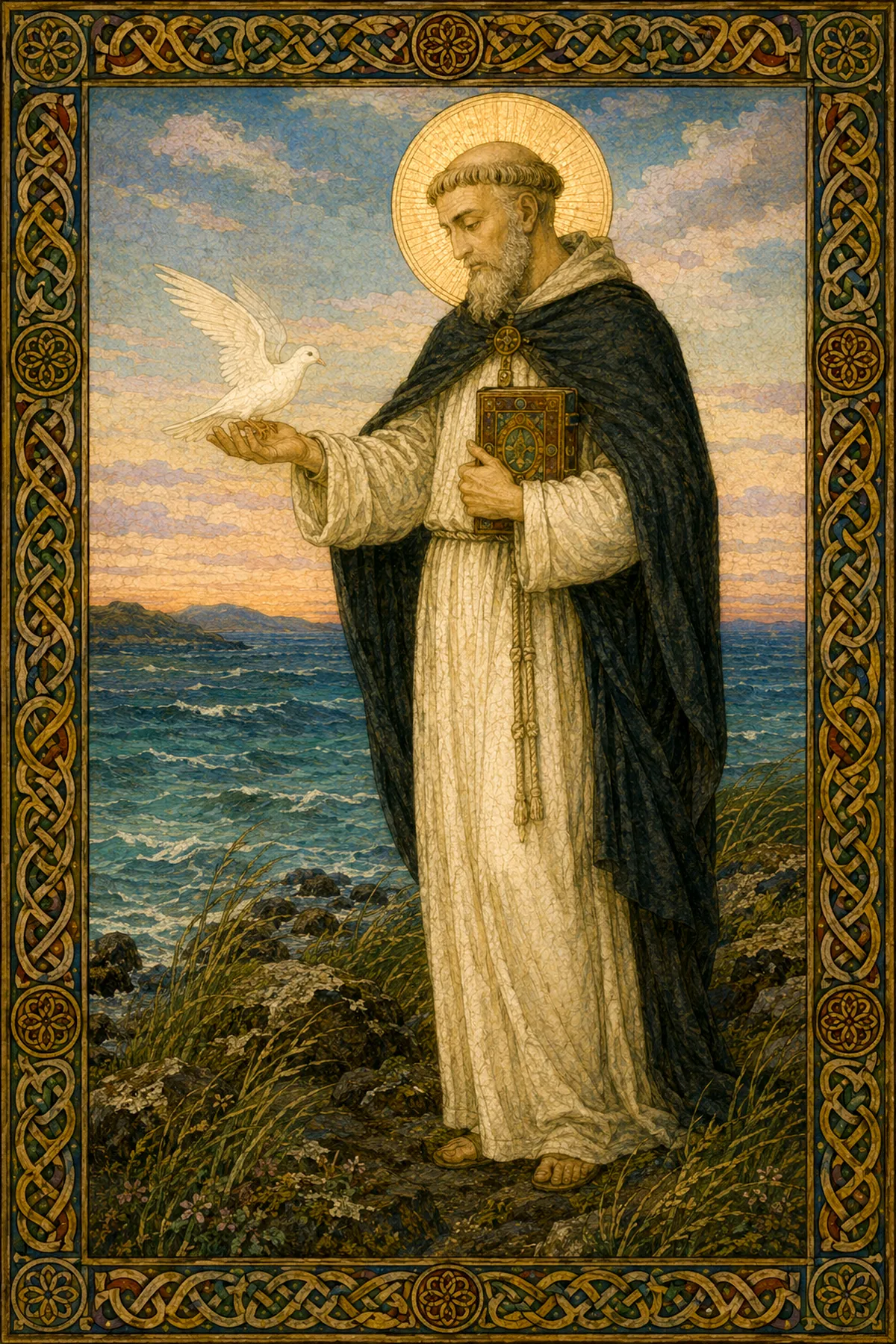
Iona became the mother house of a family of monasteries, and it is to that family that the Book of Kells belongs, begun on Iona and finished at Kells around the year 800. The page above is folio 7v, the Virgin and Child, and it deserves more attention than it usually gets: it is the earliest surviving image of the Virgin in any Western manuscript. The Virgin sits in three quarter view with the Child on her lap, four angels around her, the whole thing locked inside a border of interlace. It is at Trinity College Dublin: https://www.tcd.ie/library/ For the long story of how the Virgin was painted after this, see Marian Iconography. Of Columba himself there is no old image at all. The panel below gives him his two emblems, the book that cost him his country and the dove his name means. The battle fought over that copied psalter, the years on Iona and the oldest written account of the beast in the Ness are on our page for Saint Columba.
5. Saint Columbanus (around 543 to 615)
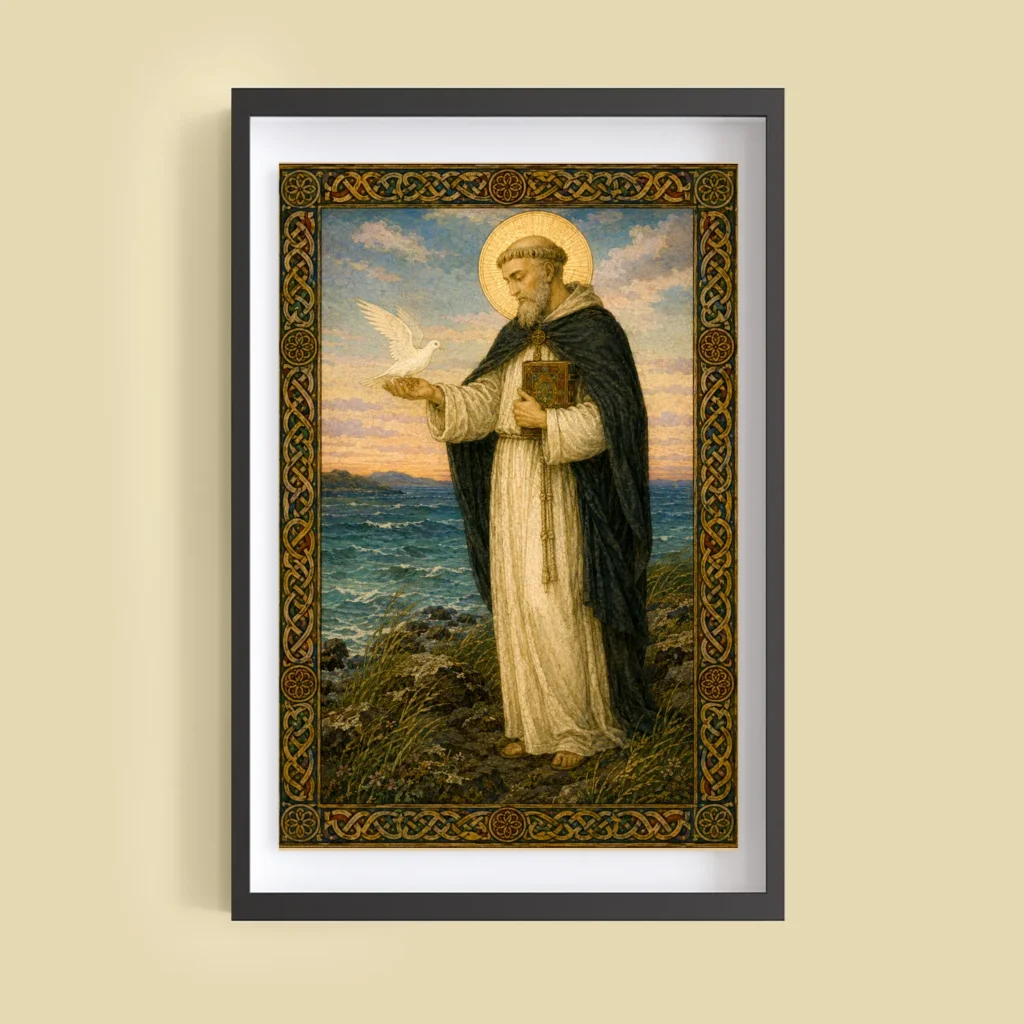
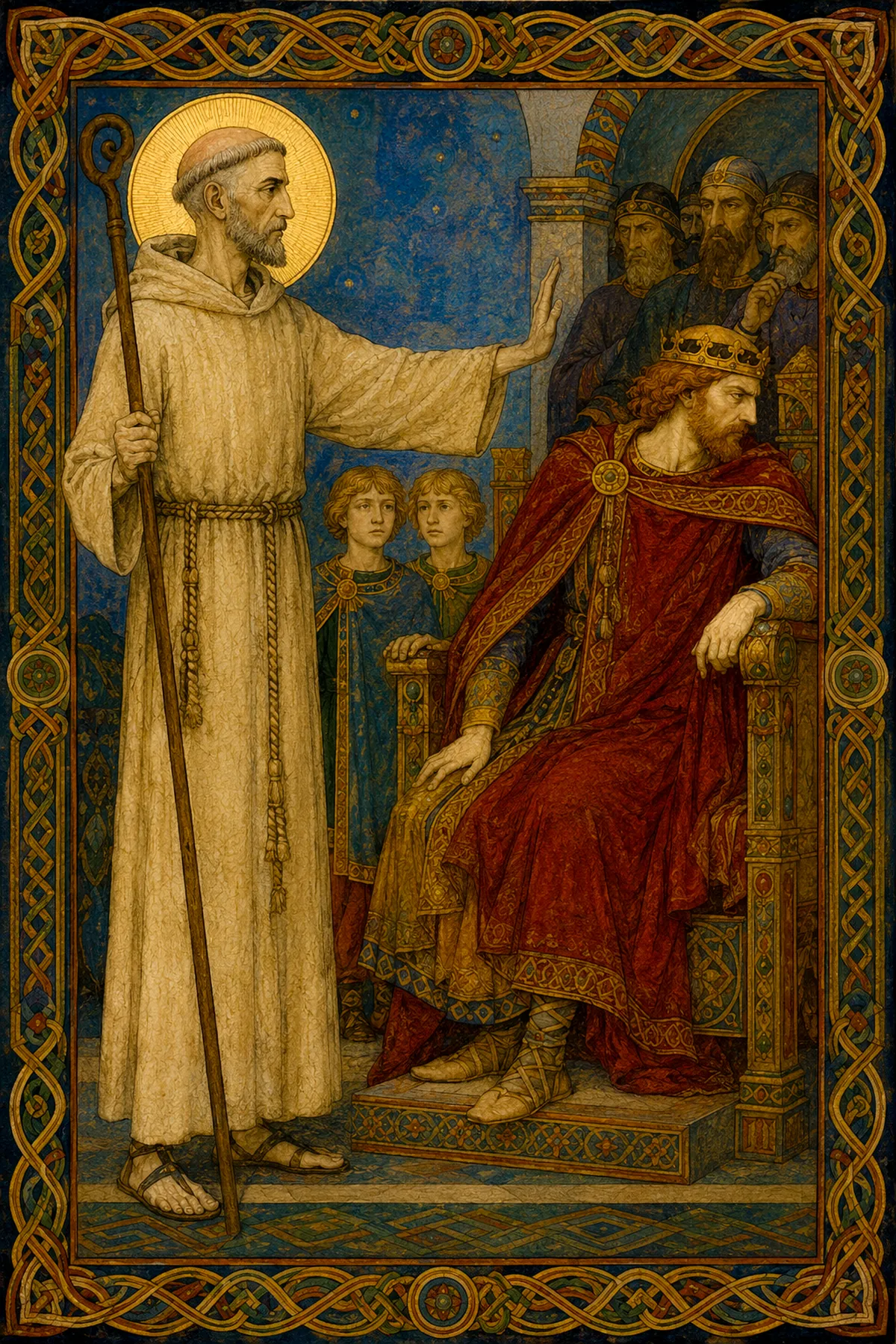
If Patrick converted Ireland, Columbanus repaid the favour to Europe. He trained at Bangor, and around 590, already in his forties, he crossed to Gaul with twelve companions and started founding monasteries in the Vosges: Annegray, Luxeuil, Fontaines. His rule was ferocious even by the standards of the age, and his monasteries filled anyway. He was also incapable of keeping quiet. He wrote to Pope Gregory the Great to tell him the Roman calculation of Easter was wrong. He told Queen Brunhild to her face that her grandson’s children, born of concubines, could not be blessed by him. That got him expelled from Burgundy under armed escort. He walked to the sea, refused deportation, went east instead, crossed the Alps in his seventies and founded Bobbio in the Apennines in 614. He died there the following year. Bobbio’s library became one of the great collections of the early Middle Ages. Robert Schuman, one of the architects of the European Union, called Columbanus the patron saint of those who seek to build a united Europe. There is no old image of him worth the name: the Commons category of Columbanus in art holds a single nineteenth century window. So the panel below was painted for this article, and it shows the moment that decided the rest of his life. The whole road from Bangor to Bobbio, and the crossing of the Alps at seventy, is on our page for Saint Columbanus.
6. Saint Gall (around 550 to 646)
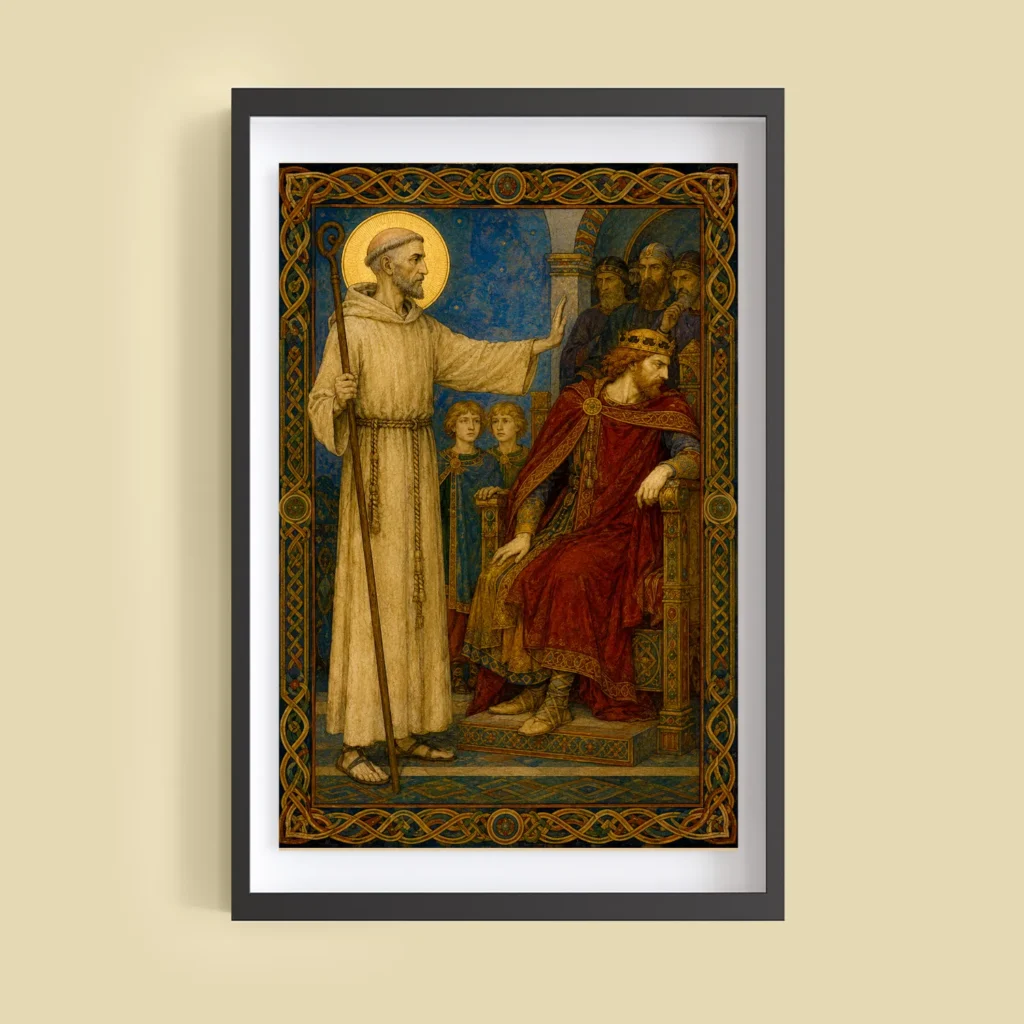
Gall walked out of Ireland with Columbanus and stayed with him for twenty years, until the crossing of the Alps. Then he refused to go. He said he was too ill to continue. Columbanus, who did not take refusals well, forbade him to celebrate Mass again as long as he, Columbanus, lived, and went on to Italy without him. Gall stayed by the river Steinach in what is now Switzerland and lived as a hermit. The legend has a bear come to his fire in the night: instead of driving it off, he gave it bread and told it to fetch firewood, which it did, and the bear with a log is still on the arms of the canton to this day. A century after his death an abbey was built over his cell. Its library is the oldest in Switzerland and still holds the manuscripts.
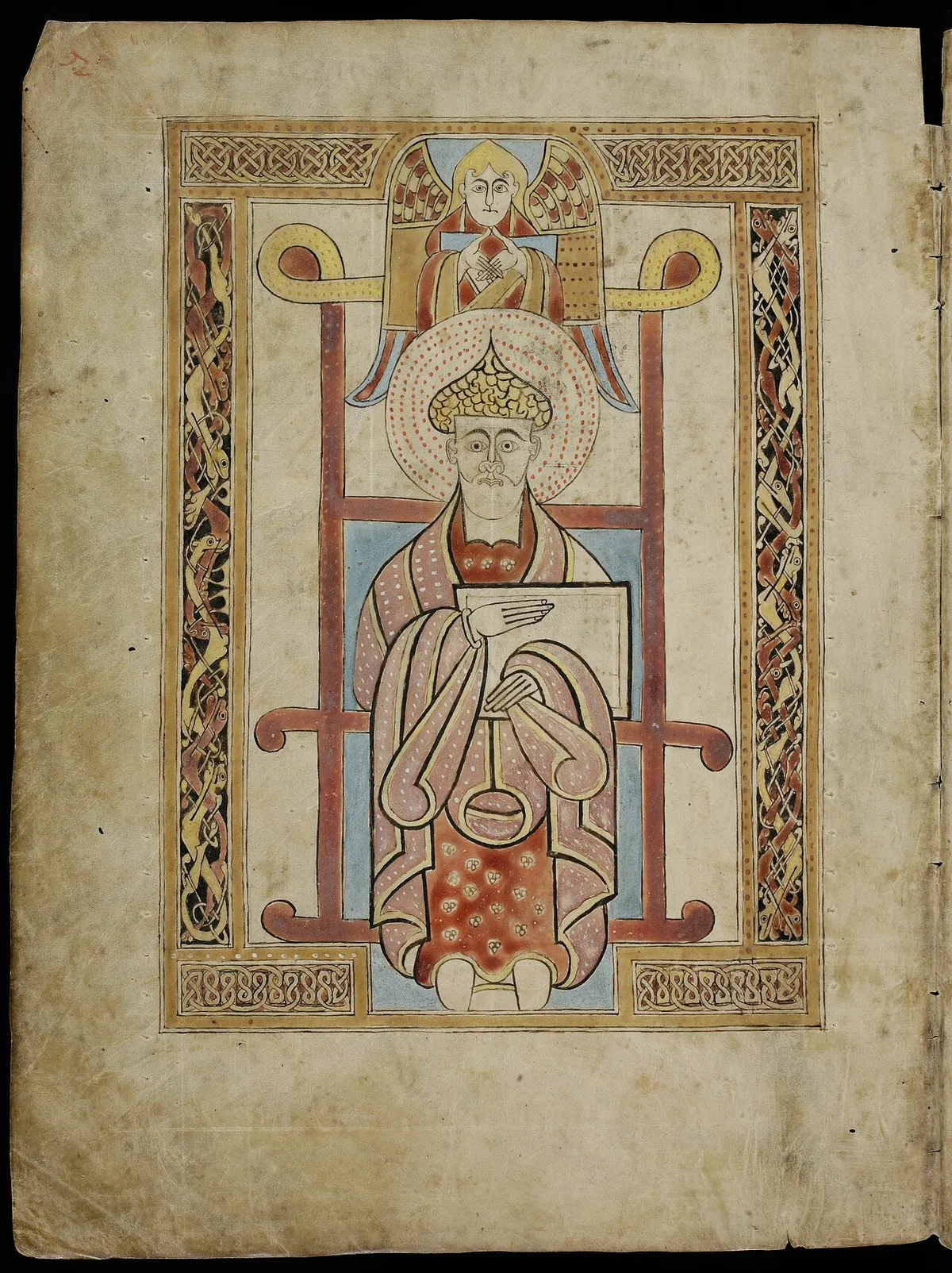
This is one of them: the St Gall Gospels, an Irish manuscript of the eighth century, showing Saint Matthew frontally with his book. The style is unmistakably insular, the same world as Kells and Lindisfarne, and it sits today a few hundred metres from where Gall built his hut: https://www.stiftsbibliothek.ch/ Gall is also the rare early Irish saint who did get a proper painted portrait, though much later. The Master of Messkirch painted him in 1537 for an altarpiece now in the Staatsgalerie Stuttgart, and Niklaus Weckmann carved him around 1500.
7. Saint Aidan of Lindisfarne (died 651)
When King Oswald of Northumbria asked Iona for a bishop, the first man they sent came back and reported that the English were too stubborn to convert. Aidan, listening, said the problem was the missionary and not the audience: he had offered them the strong meat of doctrine before the milk. They sent Aidan. He founded his monastery on Lindisfarne, a tidal island, in 635, and he walked everywhere rather than ride, so that he could stop and talk to anyone he met on the road. Bede, writing a century later and no admirer of Irish practice, could not find a bad word for him.
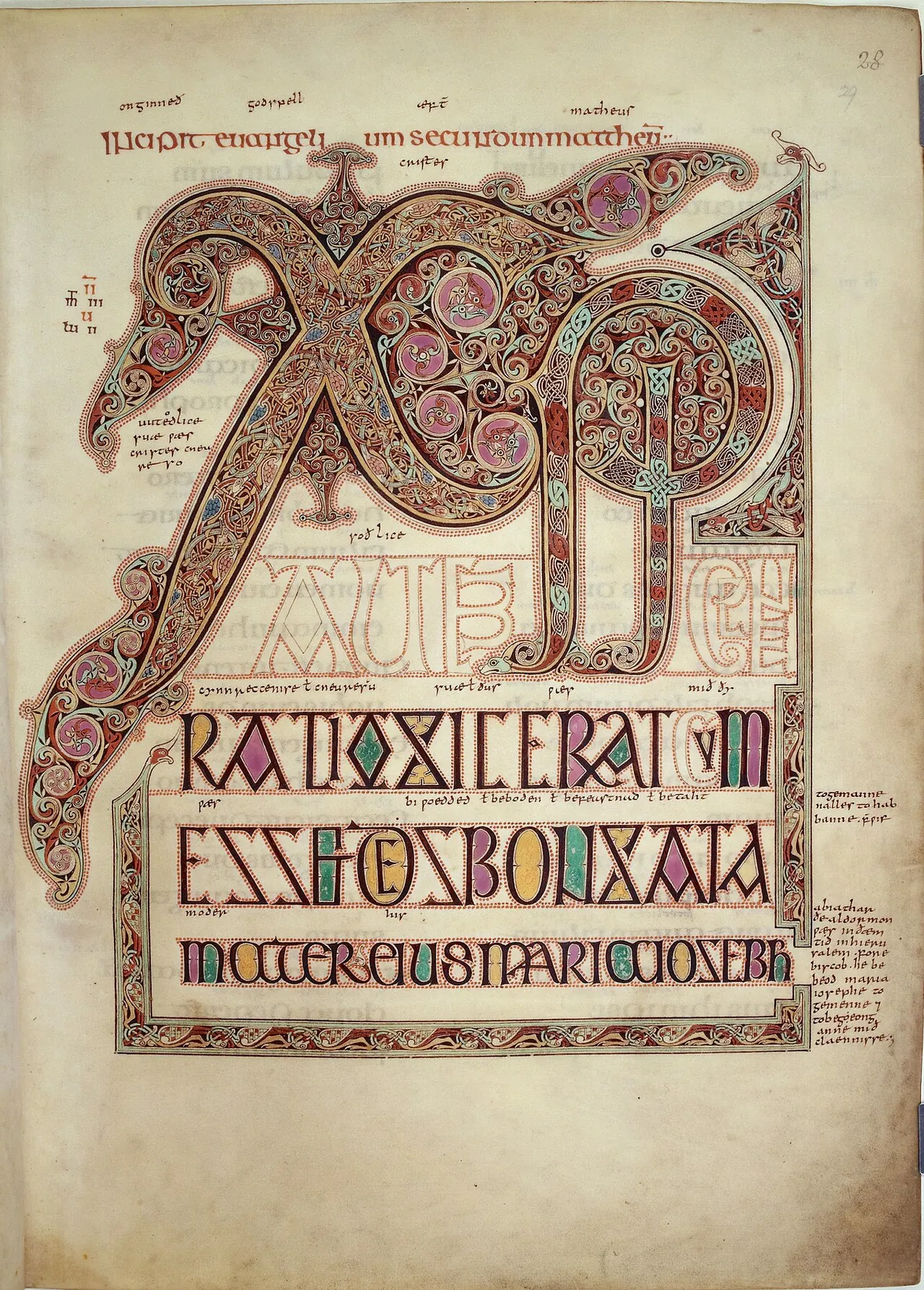
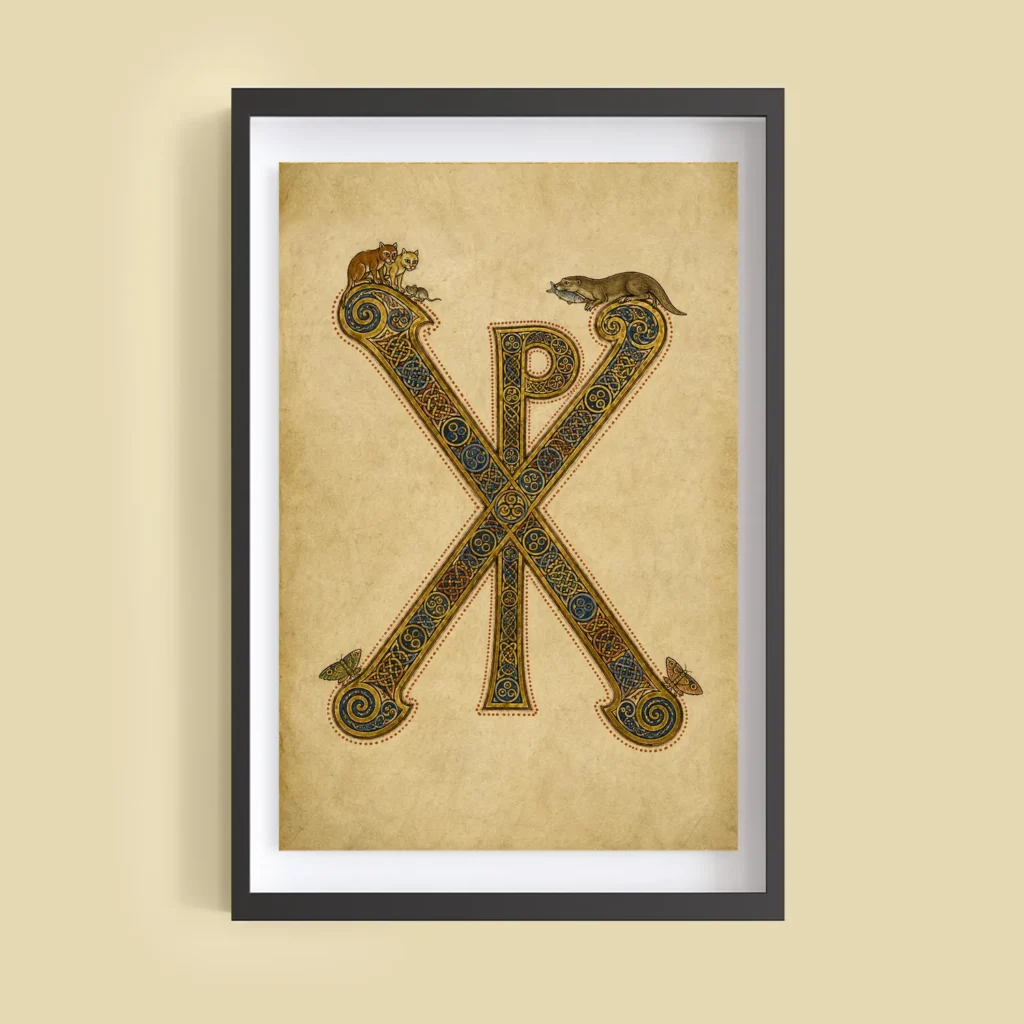
The monastery Aidan founded produced, around the year 700, the Lindisfarne Gospels. The page above is the Chi-Rho, the Greek monogram of the name of Christ, opening the account of the Nativity in Matthew. Every square centimetre is filled with spirals, interlace and thread-fine animal ornament, and it was made by one man, the bishop Eadfrith, working alone. It is in the British Library: https://www.bl.uk/
8. Saint Kilian (around 640 to 689)
Kilian left Ireland with eleven companions and reached Franconia, in what is now Bavaria, around 686. He converted Duke Gozbert of Wurzburg, and then made the mistake that killed him. He told the duke that his marriage to Gailana, his own brother’s widow, was unlawful and had to end. Gailana waited until Gozbert was away at war, then sent men to the place where Kilian and his companions Kolonat and Totnan were praying, and had all three beheaded. Wurzburg cathedral carries his name, and the Kiliani festival every July is still one of the largest in Franconia.
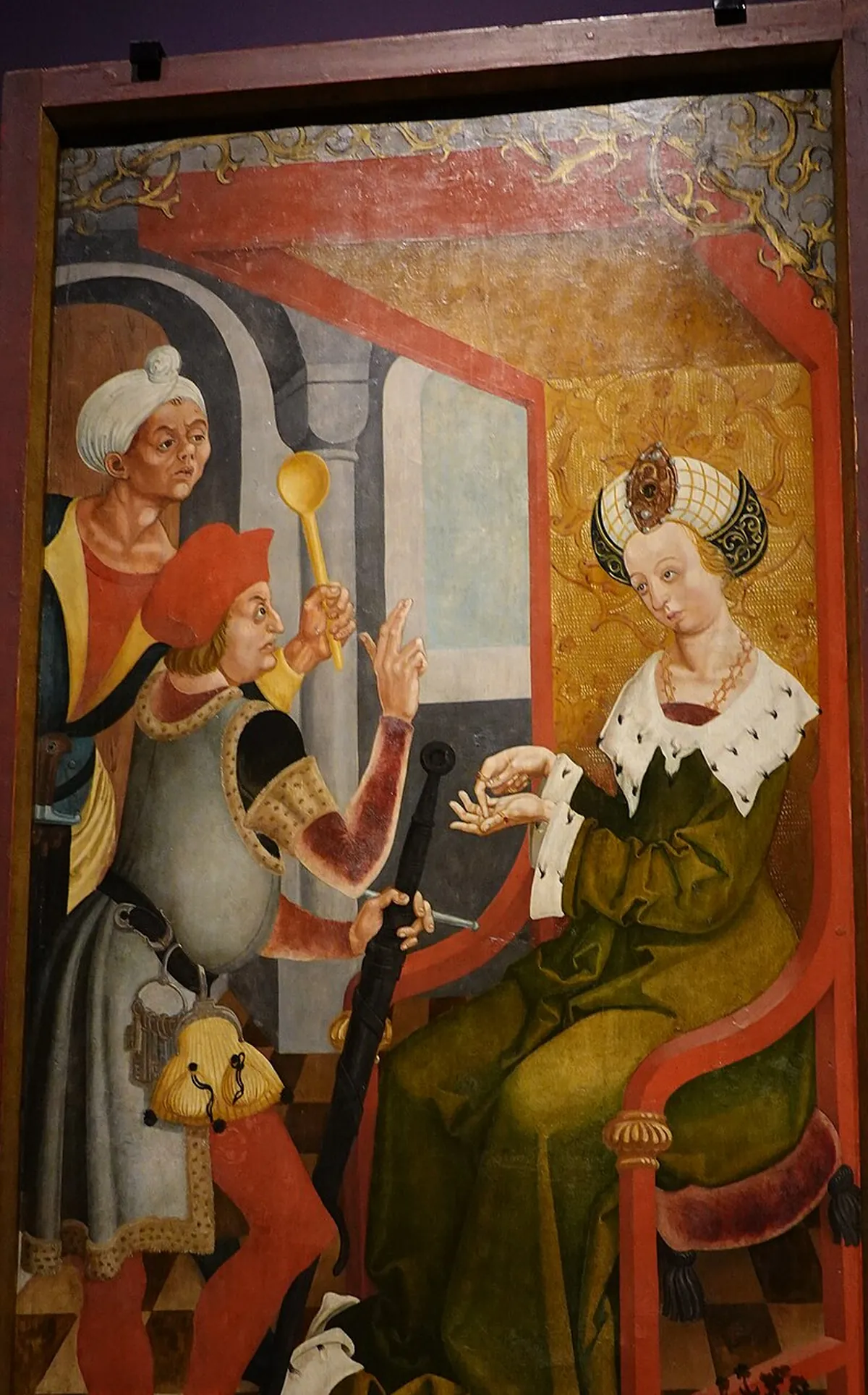
This panel is the moment of the commission. Gailana sits in her green gown and her elaborate headdress, coolly counting coins into the hand of a man with a sword; behind him a second figure raises a club. It is a painted wing of the Munnerstadt altarpiece, and its history is a small scandal of German art: the altarpiece was carved by Tilman Riemenschneider between 1490 and 1492 and left unpainted, as he preferred, and thirteen years later the town hired Albrecht Durer‘s Nuremberg contemporary Veit Stoss to paint and gild it. The wings are Stoss at his most theatrical. The panel is now in the Bayerisches Nationalmuseum in Munich: https://www.bayerisches-nationalmuseum.de/
9. Saint Fiacre (died around 670)
Fiacre crossed to Gaul looking for solitude and found a bishop of Meaux willing to give him land at Breuil. The grant, as the legend tells it, was as much ground as he could clear in a single day. He traced the boundary with the point of his staff and the trees fell over behind him, which did not endear him to a local woman who reported him for sorcery. He cleared his ground, built an oratory and a hospice, grew vegetables and herbs, and refused to let any woman enter his enclosure, a detail his medieval biographers dwelt on with more enthusiasm than the modern reader will share. He is the patron saint of gardeners.
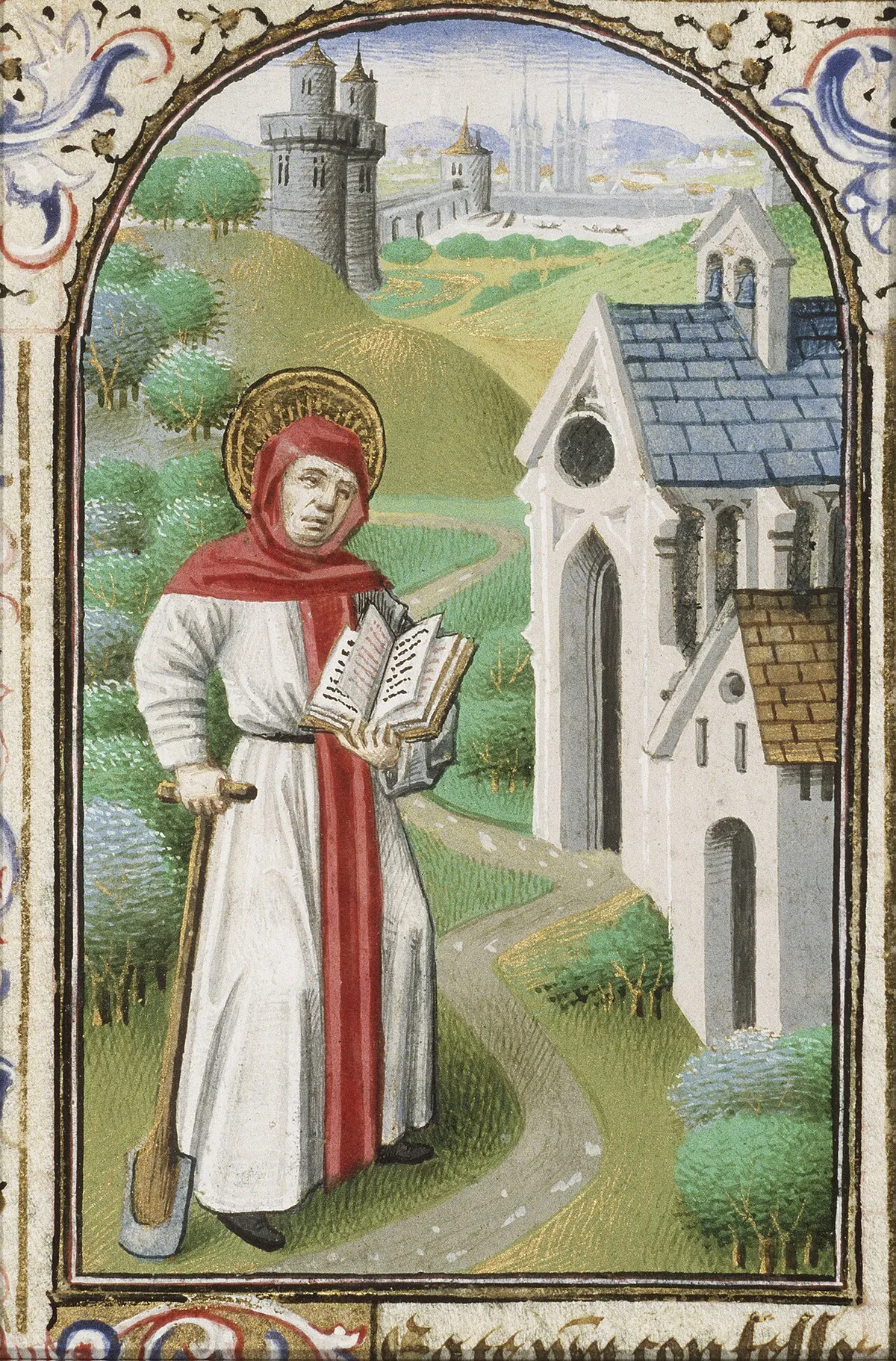
He is also, by a long detour, the reason a French cab is called a fiacre: the first hackney carriages in Paris were hired from an inn on the rue Saint-Martin that displayed his image. The miniature above comes from the Book of Hours of Simon de Varie, illuminated in 1455 by the Master of Jean Rolin II, and gives him both attributes, the book and the spade, with Meaux in the distance. It is in the Koninklijke Bibliotheek in The Hague: https://www.kb.nl/
10. Saint Dymphna (seventh century)
Dymphna was the daughter of an Irish king and a Christian mother. When her mother died, her father’s grief turned into something else, and he decided that the only woman fit to replace his wife was the daughter who looked exactly like her. Dymphna fled across the sea with her confessor Gerebernus and settled at Geel in Brabant. Her father found them. He had Gerebernus killed, and when Dymphna still refused him, he beheaded her himself. She was about fifteen.
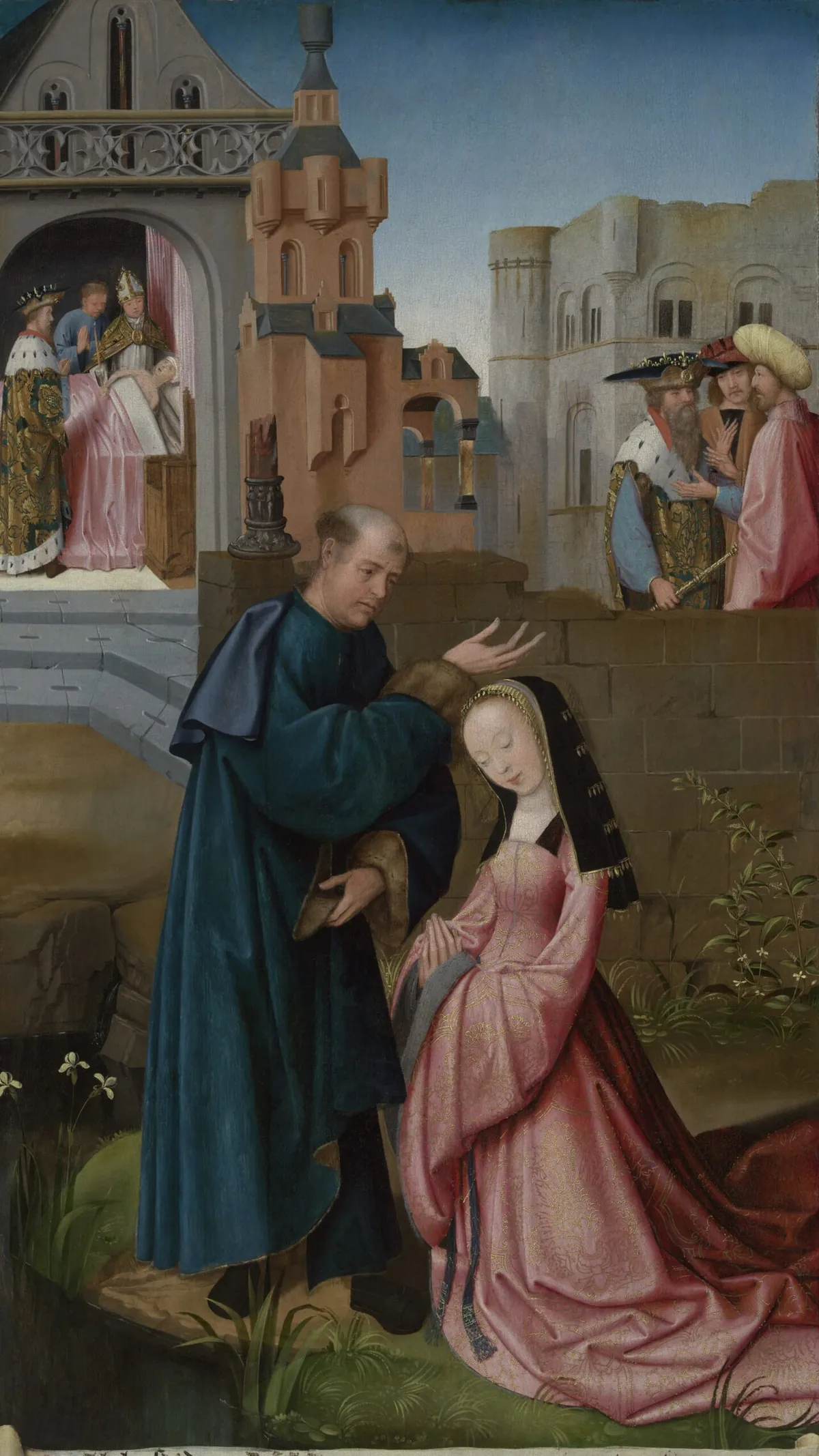
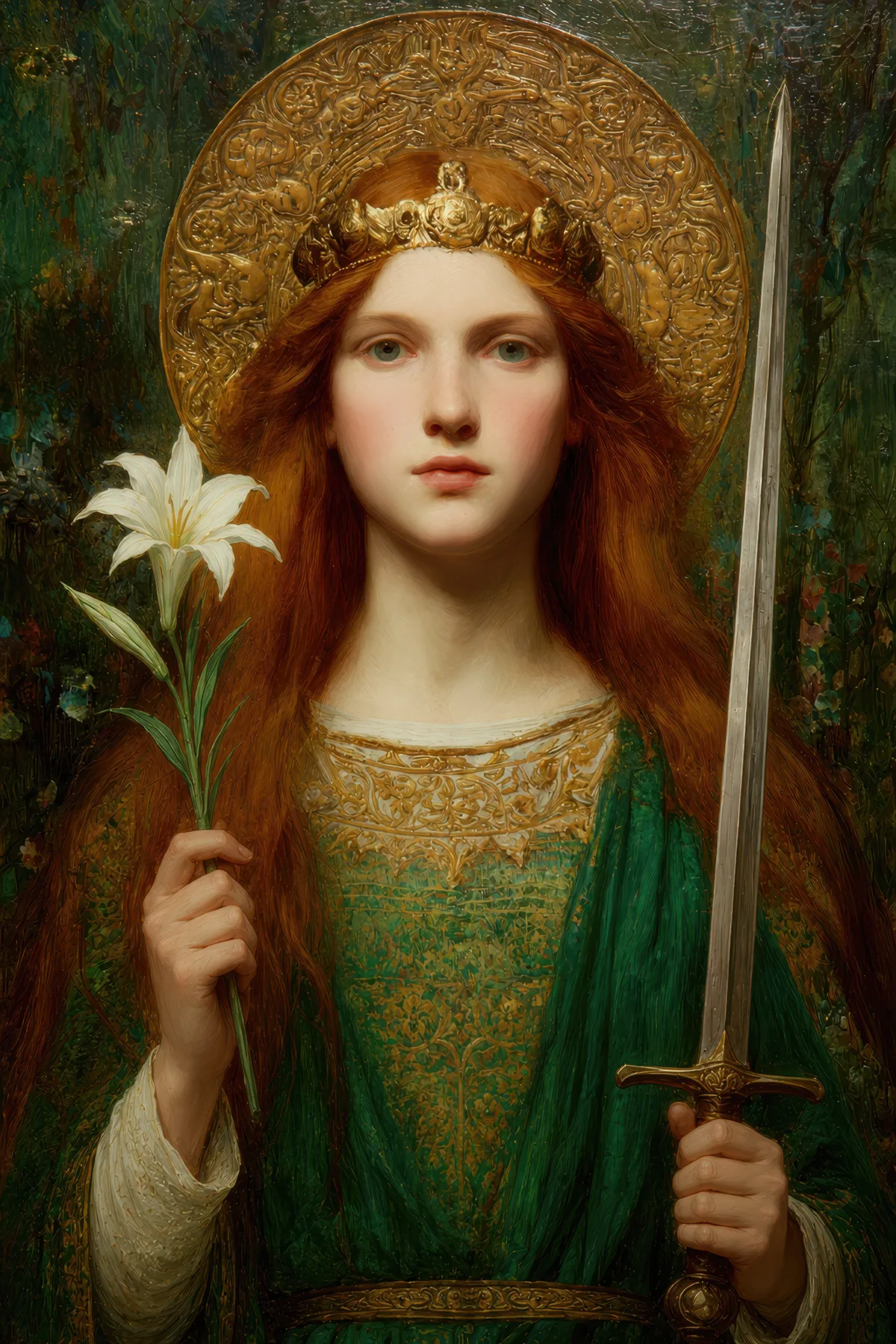
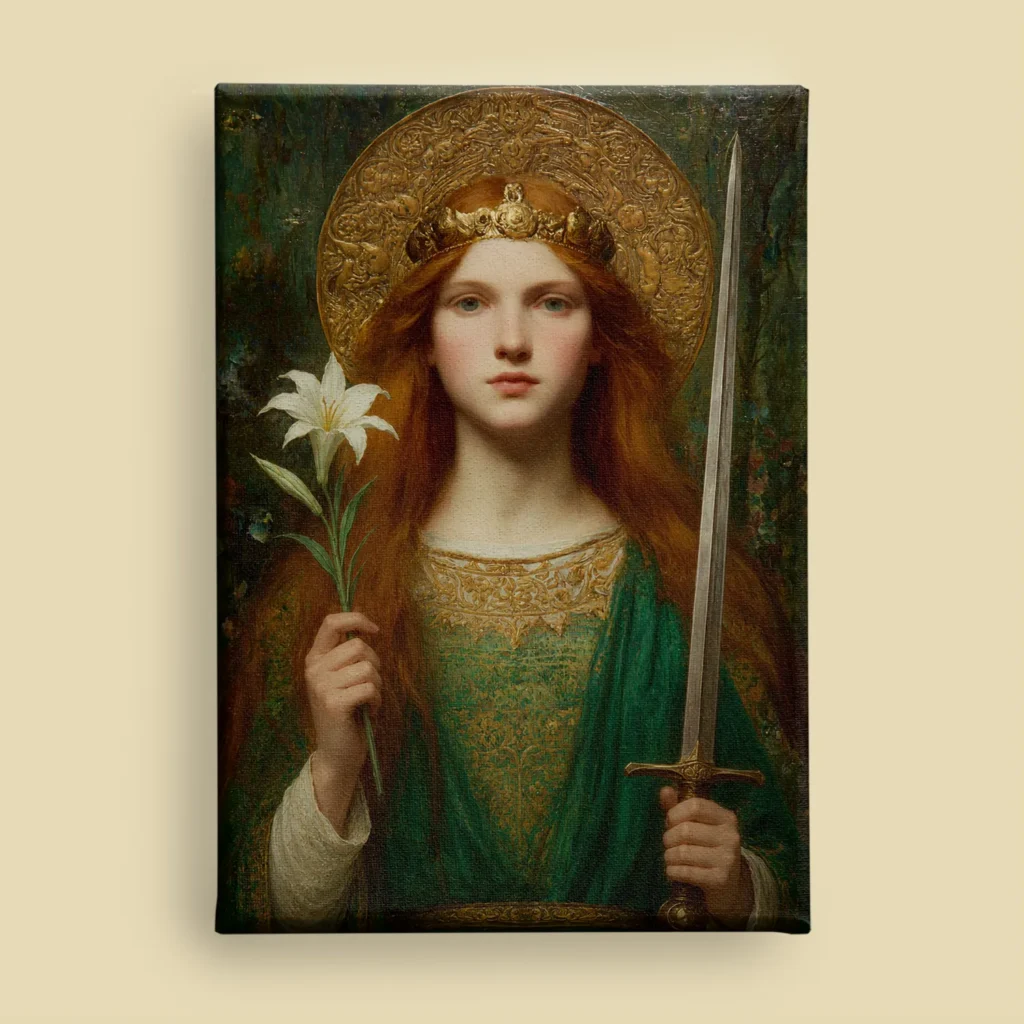
What happened next is the remarkable part. A cult grew at Geel around the healing of the mentally ill, and by the fourteenth century the town had run out of room. So the people of Geel took the sick into their own houses. That system of family boarding has been running for roughly seven hundred years and has never stopped: several hundred boarders live with Geel families today. Dymphna is the patron saint of anxiety, of mental illness and of those who care for them. The altarpiece is by Goswin van der Weyden, grandson of Rogier van der Weyden, painted in 1505 for the church at Geel. We have given her a page of her own: St Dymphna, Patron Saint of Anxiety, and a second on the prayers and novena said in her name. She is also the one saint here whose portrait we painted ourselves. The attributes are fixed and they are unusually blunt: the crown because she was a king’s daughter, the lily for the vow that cost her everything, and the sword her father used.
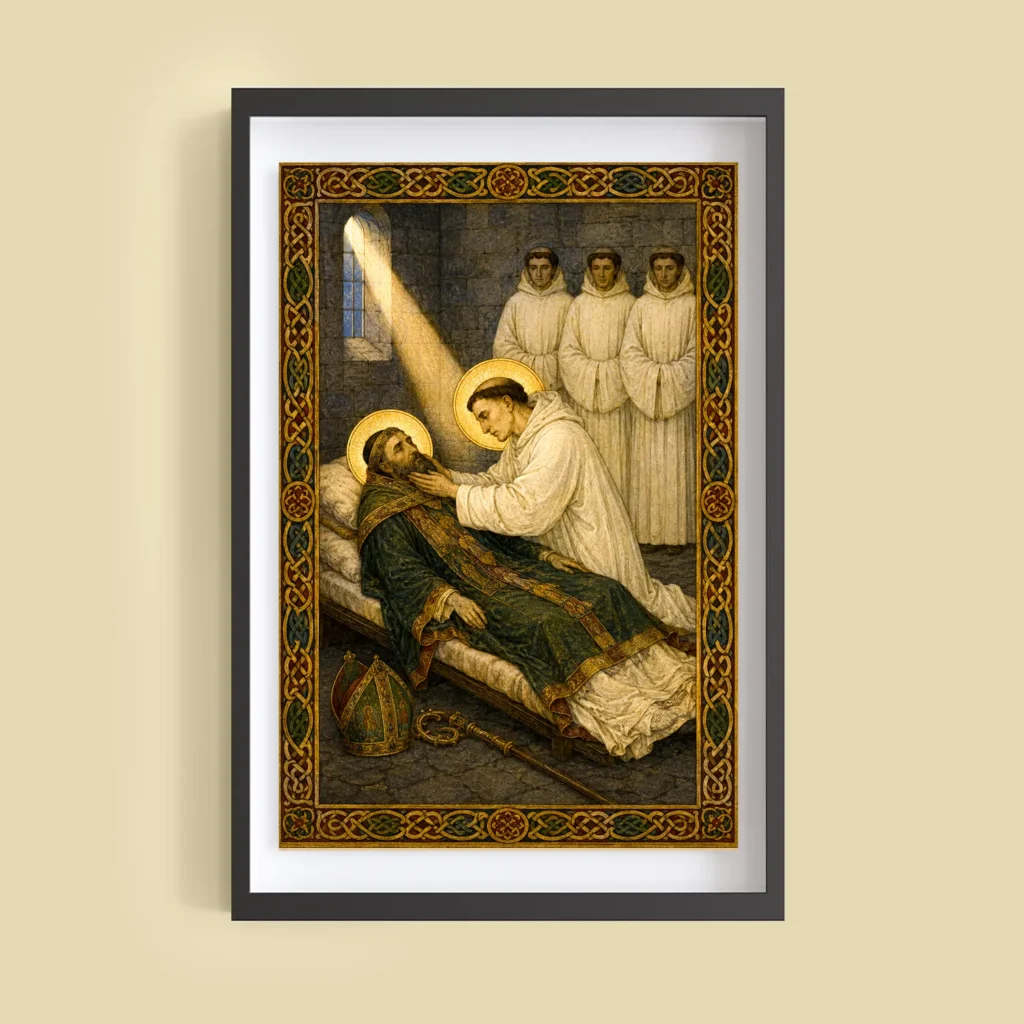
11. Saint Malachy (1094 to 1148)
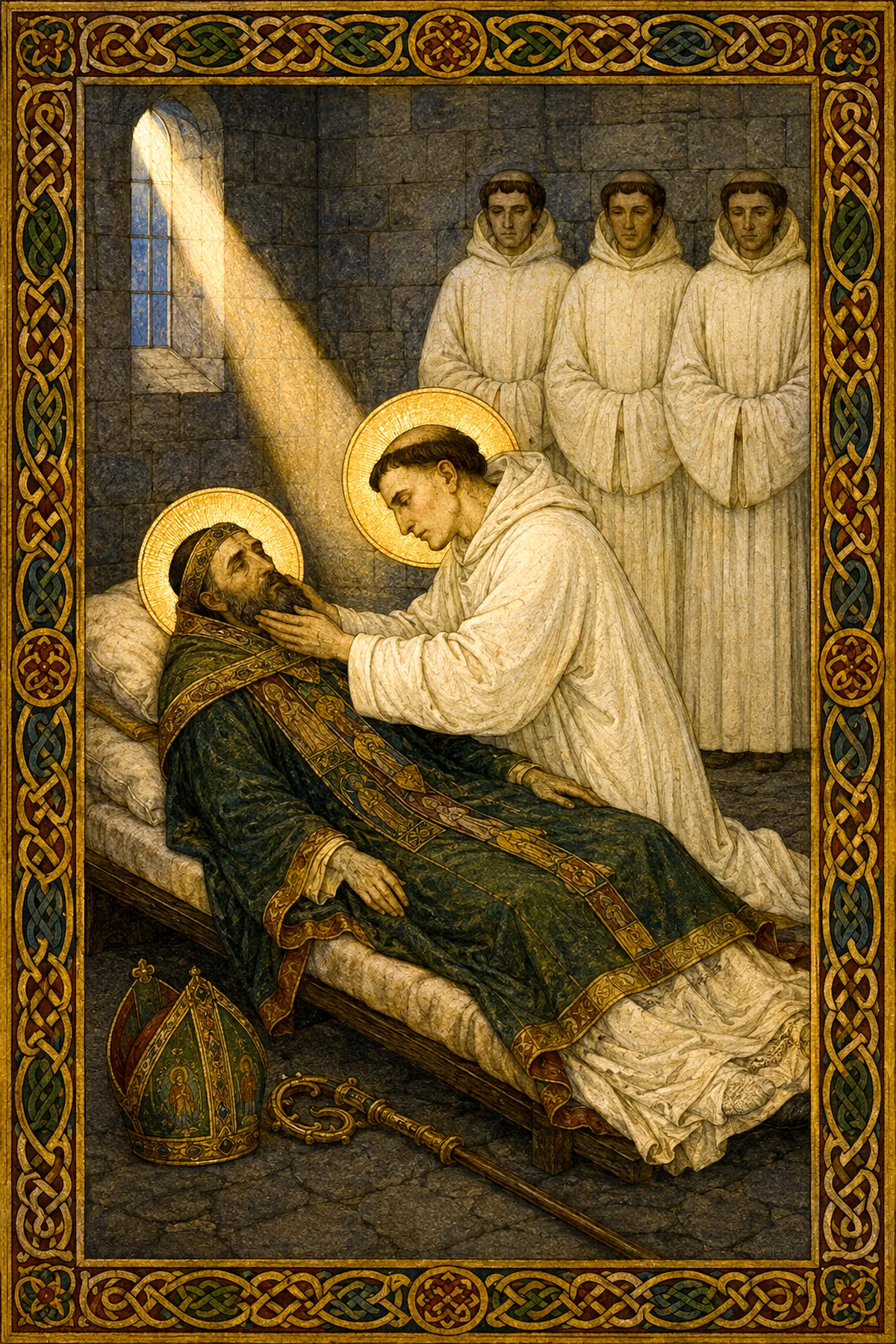
Malachy is the reformer. Archbishop of Armagh in a church that had drifted into hereditary abbacies and local custom, he spent his life dragging Irish practice back into line with Rome, and he did it without much bloodshed, which in twelfth century Armagh was an achievement. On a journey to Rome he stopped at Clairvaux, fell in love with the place, and asked to be allowed to stay. He was refused and sent home, but Cistercian monks went with him: Mellifont, the first Cistercian house in Ireland, was founded in 1142. He died at Clairvaux in 1148, on a second journey, in the arms of Bernard, who wrote his life and preached at his funeral. It is one of the warmest biographies of the Middle Ages. He is also the man to whom the Prophecy of the Popes is attributed: one hundred and twelve short Latin mottoes said to describe every pope from 1143 to the end. The document first appears in print in 1595, four hundred and fifty years after Malachy’s death, and the mottoes fit the popes remarkably well up to 1595 and poorly after it, which tells you most of what you need to know. Almost no historian defends the attribution. It remains, by a wide margin, the most searched thing about him. Like Columbanus, Malachy has left no old image at all: not a panel, not a miniature, not a print. The scene below was painted for this article, and it is the one every source agrees on.
12. Saint Oliver Plunkett (1625 to 1681)
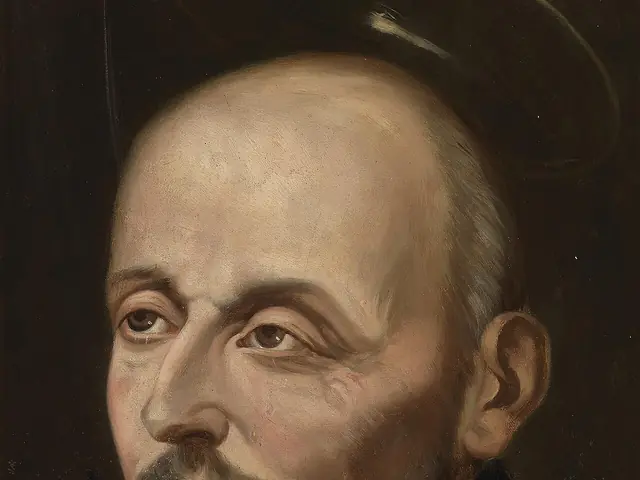
The last of the twelve, and the only one we can actually look in the face. Plunkett was Archbishop of Armagh during the years when being a Catholic bishop in Ireland was a crime. He ran schools, ordained priests, and kept his head down until the Popish Plot, Titus Oates’s invented conspiracy, swept England in 1678. Arrested and tried in Dundalk, where no jury would convict him, he was moved to London, where one would. He was hanged, drawn and quartered at Tyburn on 1 July 1681, the last Catholic martyr executed in England. He was canonised in 1975. His head is kept in Saint Peter’s Church in Drogheda, where anyone can go and see it.
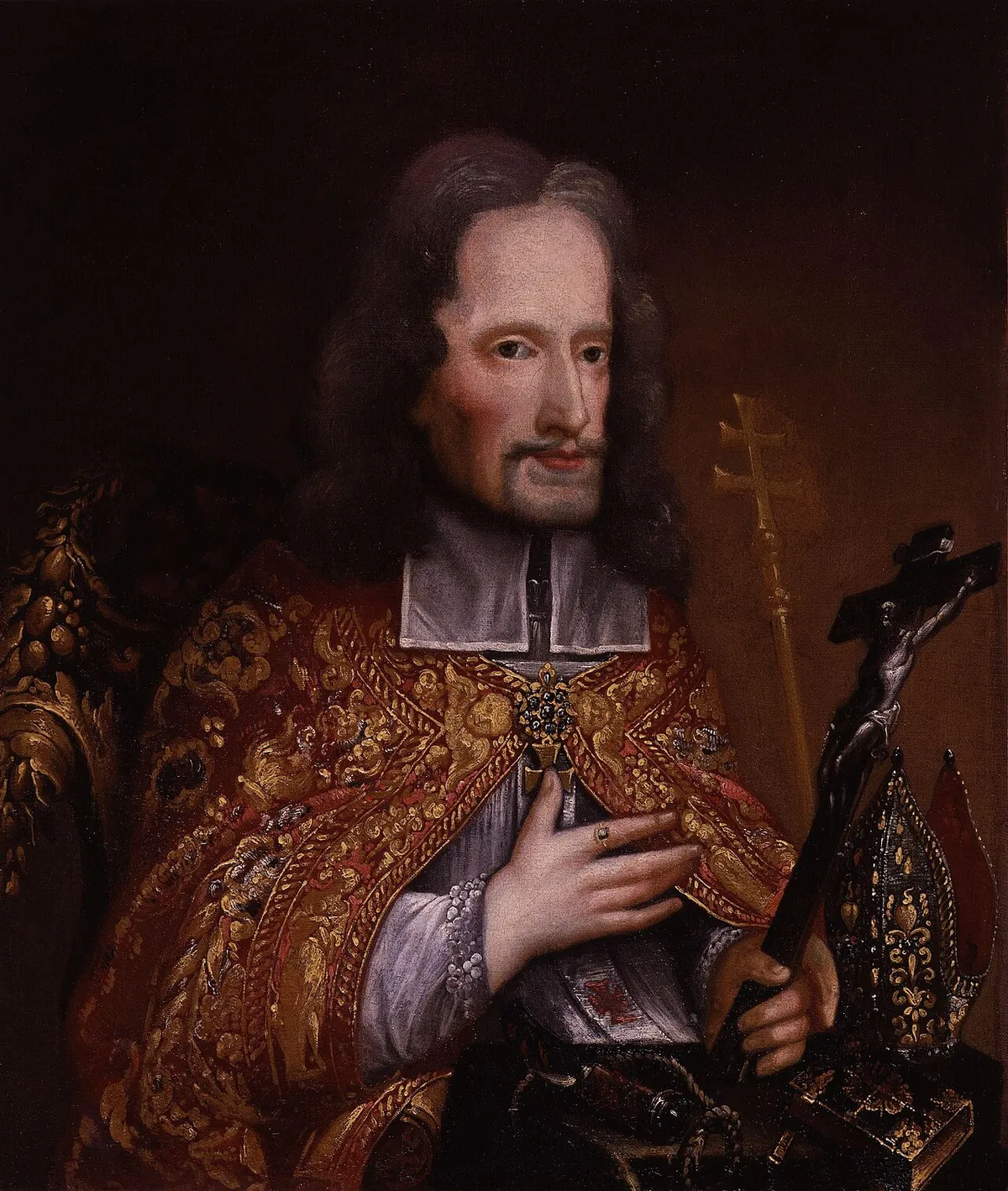
Edward Luttrell painted this portrait around the time of the trial. Whether he drew the archbishop from life or worked from another likeness is not settled, but Luttrell was in London, working, in exactly those years, and this is the only image in the whole article made by an artist who breathed the same air as his subject. Eleven saints imagined across centuries, and one man looking slightly to his left, tired, in a red and gold cope.
The twelve saints, their dates and their feast days
| Saint | Dates | Known for | Feast day |
|---|---|---|---|
| Patrick | around 385 to 461 | Apostle of Ireland, the Confessio | 17 March |
| Brigid of Kildare | around 451 to 525 | Abbess of Kildare, patron of Ireland | 1 February |
| Brendan the Navigator | around 484 to 577 | The Atlantic voyage, Clonfert | 16 May |
| Columba (Colum Cille) | 521 to 597 | Iona, the copied psalter | 9 June |
| Columbanus | around 543 to 615 | Luxeuil and Bobbio, monastic Europe | 23 November |
| Gall | around 550 to 646 | The abbey and library of St Gallen | 16 October |
| Aidan of Lindisfarne | died 651 | Northumbria, Lindisfarne | 31 August |
| Kilian | around 640 to 689 | Apostle of Franconia, martyr | 8 July |
| Fiacre | died around 670 | Hermit of Breuil, patron of gardeners | 30 August |
| Dymphna | seventh century | Geel, patron of mental illness | 15 May |
| Malachy | 1094 to 1148 | Reform of Armagh, Mellifont | 3 November |
| Oliver Plunkett | 1625 to 1681 | Martyr of Tyburn, canonised 1975 | 1 July |
Five facts worth keeping
- Patrick was not Irish and did not drive out any snakes. He was a Roman Briton, and Ireland has had no native snakes since the last ice age. The serpents in his images stand for paganism.
- Ireland’s three patron saints are Patrick, Brigid and Columba. Brigid is the only woman, and since 2023 her feast day is a national holiday.
- The Book of Kells contains the oldest surviving Virgin and Child in a Western manuscript. Folio 7v, made around 800 by the monastic family Columba founded.
- Six of these twelve saints died outside Ireland. Columbanus in Italy, Gall in Switzerland, Aidan in England, Kilian in Germany, Fiacre and Dymphna in what is now France and Belgium. The Irish church exported itself.
- Only one of the twelve was painted by a contemporary. Oliver Plunkett, in 1681. Everything else is a later imagination, a manuscript page, or a modern reconstruction.
Why the Irish saints are so hard to see
Set this article beside our 15 Spanish Saints and the Painters Who Gave Them Their Faces and the difference is stark. Teresa of Avila had Rubens. Ignatius of Loyola had Rubens too, and Ribera, and half the Baroque. Those saints lived in the sixteenth and seventeenth centuries, when Catholic Europe had both a reason to paint saints and the machinery to do it at scale. The Irish saints missed that window by a thousand years. They lived in a culture that put its whole visual genius into the manuscript page, and by the time oil paint reached northern Europe they were remote figures of legend, mostly venerated in the foreign towns where they had died. That is why the honest way to look at them is through Kells, Lindisfarne and St Gall, and through the handful of later works, Flemish, German and Scottish, made by artists who never saw Ireland at all. See also The Great Medieval Painters of Catholic Art for what came next.
Frequently asked questions about Irish saints
Who are the most famous Irish saints?
Saint Patrick is by a wide margin the best known, followed by Brigid of Kildare and Columba, who together are the three patron saints of Ireland. After them come Brendan the Navigator, famous for his Atlantic voyage, Columbanus, who founded monasteries across France, Switzerland and Italy, and Oliver Plunkett, the last Catholic martyr executed in England. Dymphna, patron saint of anxiety and mental illness, is now among the most searched of them all.
Who are the 12 saints of Ireland?
That phrase usually means the Twelve Apostles of Ireland, a traditional group of students who studied under Finnian of Clonard in the sixth century: Ciaran of Saighir, Ciaran of Clonmacnoise, Brendan of Birr, Brendan of Clonfert, Columba of Terryglass, Columba of Iona, Mobhi of Glasnevin, Ruadhan of Lorrha, Senan of Iniscathy, Ninnidh of Loch Erne, Lasserian mac Nadfraech and Canice of Aghaboe. It is a school class, not a ranking. The twelve in this article are a different selection, chosen across the whole span of Irish sanctity from Patrick in the fifth century to Oliver Plunkett in the seventeenth.
Who are the three patron saints of Ireland?
Patrick, Brigid of Kildare and Columba. Patrick is the apostle who brought Christianity to the island in the fifth century, Brigid founded the double monastery of Kildare, and Columba carried the Irish church to Scotland from Iona. Their feast days fall on 17 March, 1 February and 9 June.
Who is Ireland’s only female patron saint?
Brigid of Kildare. She is the only woman among the three patrons of Ireland, and since 2023 her feast day on 1 February has been a public holiday, the first Irish holiday named for a woman. Her cult absorbed a good deal of older material, including the name and some attributes of a pre-Christian goddess, which is one reason she is so deeply rooted in Irish life.
Why is Ireland called the land of saints and scholars?
Because between the sixth and the ninth centuries Irish monasteries were among the most productive centres of learning in Europe, at a time when much of the continent had lost that capacity. They copied and preserved classical and Christian texts, developed the insular style of illumination seen in the Book of Kells and the Lindisfarne Gospels, and sent monks abroad in numbers: Columbanus, Gall, Aidan, Kilian and Fiacre all died on the continent or in England.
Can you buy Irish saints art?
You can buy Irish saints art at jesuschrist.pictures, in our shop, as museum quality canvases and posters. Our catalogue covers the works reproduced in this article and the wider world of Christian painting they belong to, printed on demand and shipped worldwide. If you are looking for a particular saint or a particular painting, the shop is organised by subject and by period, and the saints have their own section.