The Great Medieval Painters of Catholic Art
The great medieval painters of Catholic art were a small group of extraordinary men who worked in central Italy during the thirteenth and fourteenth centuries, and who, in the space of roughly a hundred years, transformed the entire visual language of Christian devotion. Before them, sacred painting in the West had followed the Byzantine tradition for a thousand years: gold grounds, hieratic figures, images designed for contemplation rather than emotion. After them, painting could show a body that weighed something, a face that actually grieved, a room that you felt you could walk into. The Renaissance did not emerge from nowhere. It was built on the foundations these painters laid.

They worked in Siena and Florence, in Assisi and Padua, in Naples and Avignon. They painted for cathedral altars, civic government chambers, private chapels, and royal courts. They were rivals, contemporaries, and in some cases master and pupil. Cimabue trained Giotto. Duccio formed the entire Sienese school. Between them, six painters in particular define what it meant to make Christian art in the Trecento: the century that, more than any other, prepared the world for the Renaissance.
This guide introduces each of the six, explains what makes them essential, and points toward the dedicated articles that examine their work in depth. For a broader overview of how Christ was depicted across the medieval period, our article on medieval Jesus paintings provides the historical context in which all six of these masters operated.
The Six Masters of the Trecento
Cimabue (c. 1240 to c. 1302)

Cimabue stands at the very beginning of this story. Born in Florence around 1240, he is the first Italian painter to systematically break from the conventions of Byzantine art and move toward something more naturalistic and more human. His Crucifix at San Domenico in Arezzo, painted around 1265, shows Christ as a body that has actually died, pulled downward by its own weight. His great Maestà panels, now in the Uffizi and the Louvre, brought a new spatial complexity and emotional directness to a format that had existed for centuries.
Dante placed him in Purgatory alongside the great poets. Vasari called him “the first page of Italian art.” Those are both ways of saying the same thing: without Cimabue, there is no Giotto, and without Giotto, there is no Renaissance. The Louvre dedicated its first-ever exhibition to him in early 2025, built around a freshly restored Maestà that scholars have described as “the founding act of Western painting.”
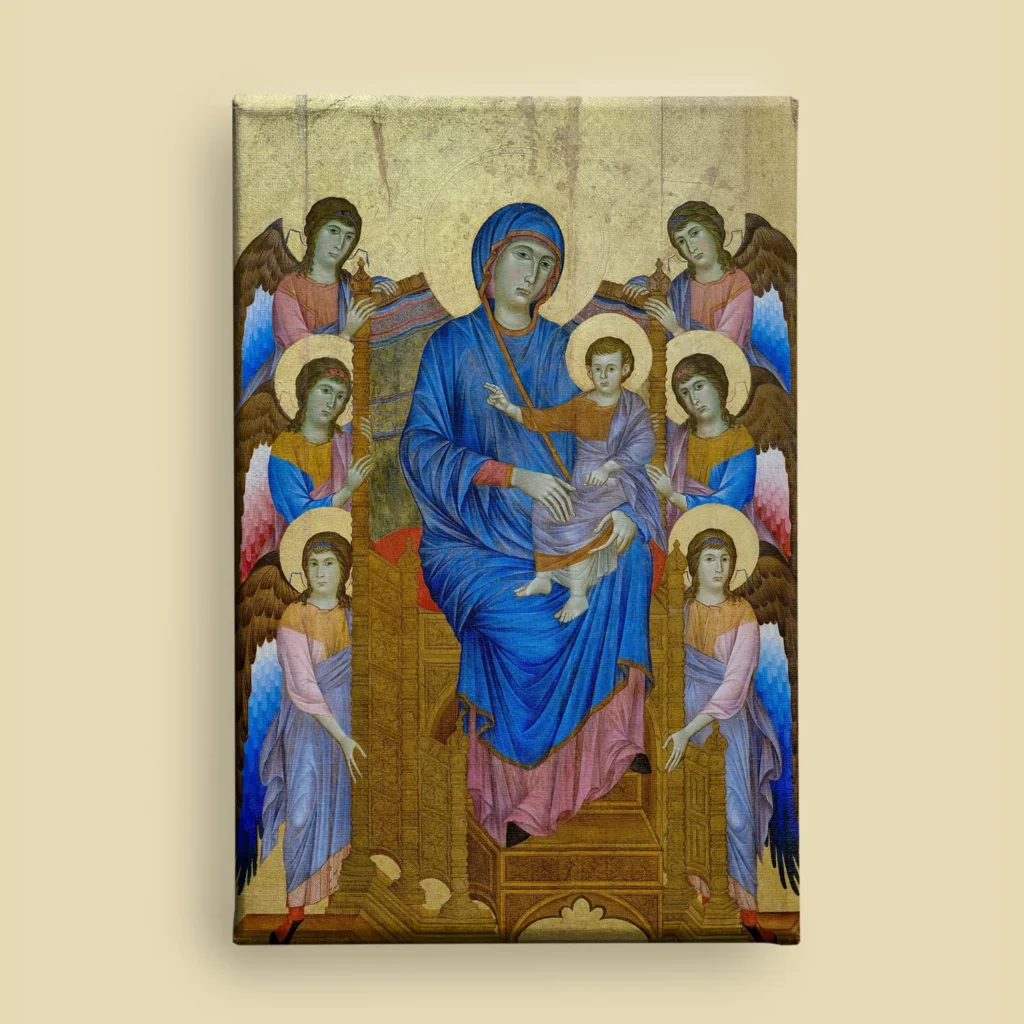
Read the full article on Cimabue’s most iconic paintings
Duccio di Buoninsegna (c. 1255 to c. 1318-1319)

Duccio was to Siena what Cimabue was to Florence: the defining figure of a local tradition that would shape European painting for two centuries. His Rucellai Madonna (1285), the largest surviving panel painting of the thirteenth century, hangs in the same room as Cimabue’s and Giotto’s Maestàs in the Uffizi. The comparison is one of the most instructive visual arguments in the history of art.
But Duccio’s true masterwork is the Maestà (1308-1311), painted for the high altar of Siena Cathedral. It was a double-sided altarpiece roughly five meters square, showing the Virgin enthroned on the front and forty-three scenes from the Passion and life of Christ on the back. When it was finished, the entire city of Siena processed through the streets to accompany it to the cathedral. The inscription at the base of the throne is both a dedication and a prayer: “Holy Mother of God, be thou the cause of peace for Siena and life to Duccio because he painted thee thus.”
Read the full article on the timeless masterworks of Duccio di Buoninsegna
Giotto di Bondone (c. 1267 to 1337)

Giotto is the central figure of this entire tradition, the painter who more than any other made the decisive break with the Byzantine past and invented the visual language that the Renaissance would inherit and develop. He was probably Cimabue’s pupil. Dante mentioned them both in the Purgatorio, noting that Giotto’s fame had eclipsed his master’s. That says everything about the magnitude of what he accomplished.
His greatest achievement is the fresco cycle of the Cappella degli Scrovegni in Padua (1304-1306), a small barrel-vaulted chapel covered on every surface with scenes from the lives of Joachim, Anna, the Virgin, and Christ. Every figure in this chapel has weight. Every face shows a real emotion. The Lamentation of Christ, in which the Virgin holds her son’s dead body and presses her face to his, is still one of the most devastating images in the history of painting. Standing inside the chapel today, it is difficult to remember that you are looking at plaster.
He also worked in Florence, where his frescoes in the Bardi and Peruzzi Chapels at Santa Croce represent his mature style, and in Assisi, where his association with the Life of Saint Francis cycle in the Upper Church of San Francesco established his reputation across the whole of Italy.
Read the full article on Giotto’s sacred masterworks and the birth of modern art
Simone Martini (c. 1284 to 1344)

Simone Martini is the most elegant and internationally influential painter of the entire group. Where Giotto was monumental and spatial, Simone was lyrical and linear. He carried the refined tradition of Duccio into something more courtly and Gothic, absorbing the influence of French manuscript illumination and ivory carving to create a painting style of extraordinary grace and luminosity.
He worked for the Republic of Siena, the Angevin court in Naples, Franciscan cardinals in Assisi, and the papal court in Avignon. His Maestà fresco (1315) in the Palazzo Pubblico in Siena is the defining image of Sienese civic identity. His Annunciation (1333), co-signed with his brother-in-law Lippo Memmi and now in the Uffizi, is the masterwork of the Sienese Gothic and one of the most beautiful panel paintings of the Middle Ages. He knew Petrarch personally. When Simone died in Avignon in 1344, Petrarch wrote two of his most celebrated sonnets in grief.
His fresco cycle in the Cappella di San Martino in the Lower Basilica of San Francesco in Assisi, depicting scenes from the life of Saint Martin of Tours, represents his most sustained expression as a fresco painter, a series of scenes of extraordinary spatial sophistication and courtly refinement.
Read the full article on Simone Martini’s most beautiful paintings and Gothic masterworks
Pietro Lorenzetti (c. 1280 to 1348)

The older of the two Lorenzetti brothers, Pietro was the most emotionally intense painter of his generation. He was drawn to grief, to suffering, to the full physical weight of the Passion. His Passion Cycle in the south transept of the Lower Basilica of San Francesco in Assisi, which includes the Crucifixion, the Deposition from the Cross, and the Entombment, is among the most powerful fresco painting of the entire Middle Ages. The Crucifixion is described by scholars as the most ambitious crowd composition produced before the Renaissance.
His final major work, the Birth of the Virgin (1342), now in the Museo dell’Opera del Duomo in Siena, is a domestic interior of startling spatial coherence: one of the earliest convincing depictions of a real room in Italian painting. He died in the plague of 1348, almost certainly along with his brother.
Read the full article on Pietro Lorenzetti’s sacred altarpieces and most beautiful paintings
Ambrogio Lorenzetti (c. 1290 to 1348)

The younger Lorenzetti was the intellectual of the group, the painter who most systematically thought through the problem of how painting could represent space. He was the first artist in the Sienese tradition to treat perspective as a system rather than an approximation. His Annunciation of 1344, now in the Pinacoteca Nazionale in Siena, was the first Italian panel painting to use a single vanishing point as the organizing principle of the entire composition.
He is best known today for his secular fresco cycle Good and Bad Government (1338-1339) in the Palazzo Pubblico in Siena, one of the most extraordinary paintings of the Middle Ages. But his sacred works, from the Maestà di Massa Marittima to the Triptych of San Procolo and the Presentation of Christ in the Temple, are equally significant. He too died in the plague of 1348.
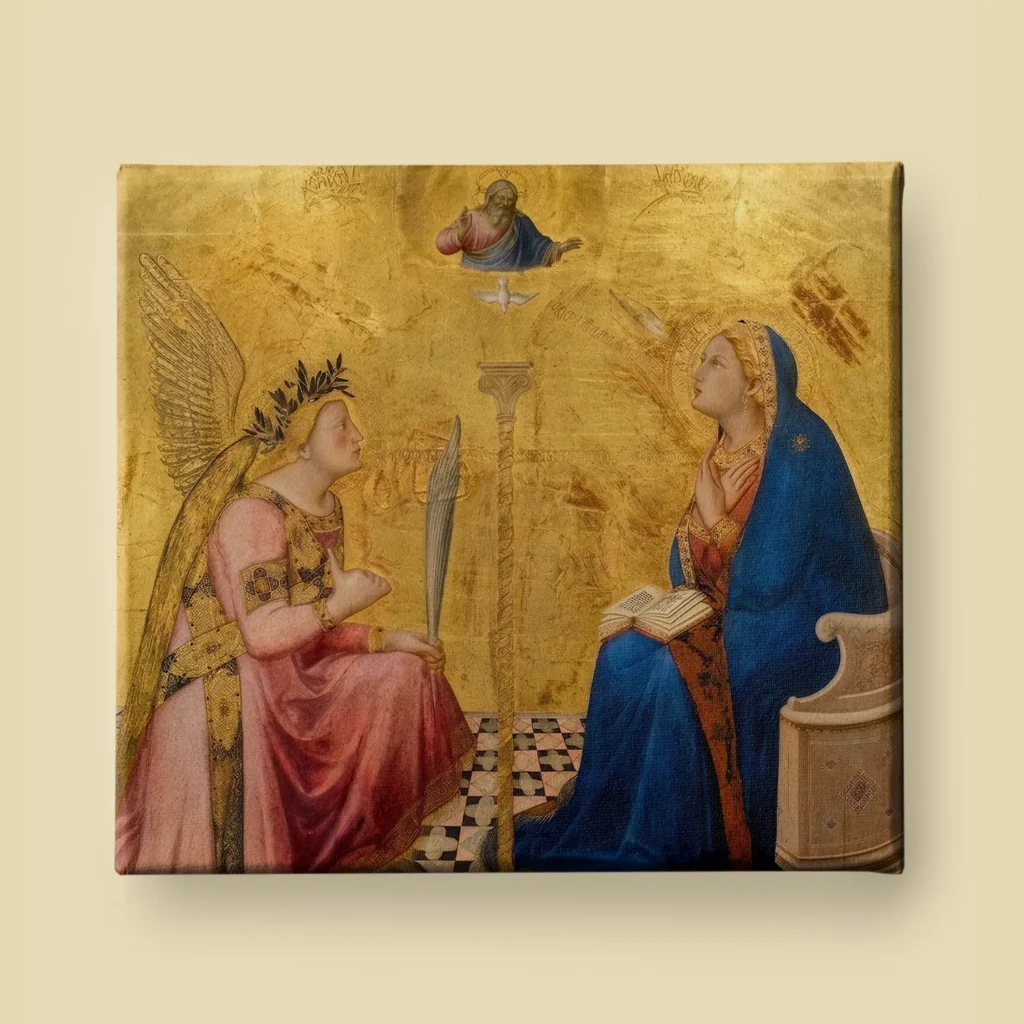
Read the full article on the sacred paintings of Ambrogio Lorenzetti
The Sacred Sites: Where to See Their Work Today
The paintings and frescoes of these six masters are concentrated in a handful of cities and churches that remain among the most important destinations for anyone interested in Christian art.
Assisi: The Basilica di San Francesco
The Basilica di San Francesco in Assisi is the single site most central to this entire tradition. Three of the six painters worked here: Giotto in the Upper Church with the Life of Saint Francis cycle; Pietro Lorenzetti in the south transept of the Lower Church with his Passion Cycle; and Simone Martini in the Cappella di San Martino in the Lower Church with his Life of Saint Martin cycle. Nowhere else can you see the work of multiple Trecento masters in direct spatial relationship, reading across the same walls.
The Upper Church and Lower Church have distinct artistic characters. The Upper Church, with Giotto’s narrative frescoes on the lower walls, is spacious, luminous, and narrative in tone. The Lower Church is darker, richer, and more devotional: the chapels are decorated with overlapping fresco programs by different hands across several generations, and the effect is one of accumulated sacred intensity rather than clear architectural sequence.
Siena: The Museo dell’Opera del Duomo and the Palazzo Pubblico
Siena holds more work by these painters than any other city. The Museo dell’Opera del Duomo contains Duccio’s Maestà in its dedicated sala, alongside Pietro Lorenzetti’s Birth of the Virgin. The Pinacoteca Nazionale holds the Carmine Altarpiece by Pietro Lorenzetti and the Annunciation by Ambrogio. The Palazzo Pubblico, still the seat of the city government, has Simone Martini’s Maestà fresco and Ambrogio Lorenzetti’s Good and Bad Government. These three buildings, all within walking distance of each other in the historic center, constitute the richest single concentration of Trecento painting anywhere in the world.
Florence: The Uffizi Gallery and Santa Croce
Room 2 of the Uffizi Gallery is one of the most instructive spaces in the history of art. Three enormous Maestà panels hang face to face: Cimabue’s Santa Trinita Maestà, Duccio’s Rucellai Madonna, and Giotto’s Ognissanti Madonna. Painted within roughly twenty years of each other, they show the transformation of medieval painting in real time, the same subject treated by three successive generations, each one responding to and surpassing the last.
The Basilica di Santa Croce holds Giotto’s Bardi and Peruzzi Chapel frescoes, his later masterworks in fresco, as well as the Crucifix by Cimabue that was devastated in the 1966 flood and now hangs in the sacristy as one of the most moving objects in Italian art history.
Padua: The Cappella degli Scrovegni
The Cappella degli Scrovegni is a UNESCO World Heritage Site and the most complete expression of Giotto’s genius. Entry is timed and limited to protect the frescoes, and the visit is preceded by a climate-controlled waiting room where temperature and humidity are equalized before the doors open. It is one of the few cases in art history where the experience of seeing a work is itself a deliberate ceremony, a preparation for what is inside. The effort is more than justified.
Summary of the Medieval Paintings feautured in this article
| Painter | Active | School | Key Works | Dedicated Article |
|---|---|---|---|---|
| Cimabue | c. 1265-1302 | Florentine | Santa Trinita Maestà, Crucifix of Santa Croce, Maestà de Pise | Read article |
| Duccio di Buoninsegna | c. 1278-1319 | Sienese | Rucellai Madonna, Maestà, Annunciation | Read article |
| Giotto di Bondone | c. 1290-1337 | Florentine | Scrovegni Chapel, Ognissanti Madonna, Bardi and Peruzzi Chapels | Read article |
| Simone Martini | c. 1315-1344 | Sienese | Maestà, Saint Louis of Toulouse, Annunciation, Orsini Polyptych | Read article |
| Pietro Lorenzetti | c. 1315-1348 | Sienese | Passion Cycle at Assisi, Carmine Altarpiece, Birth of the Virgin | Read article |
| Ambrogio Lorenzetti | c. 1319-1348 | Sienese | Maestà di Massa Marittima, Presentation in the Temple, Annunciation | Read article |
Questions and Answers
Who were the most important medieval Christian painters?
The most important medieval Christian painters of the Italian tradition are Cimabue, Duccio di Buoninsegna, Giotto di Bondone, Simone Martini, and the Lorenzetti brothers Pietro and Ambrogio. All six were active in the thirteenth and fourteenth centuries, primarily in Florence and Siena. Together they transformed sacred painting from the Byzantine tradition it had followed for a thousand years into the naturalistic, spatially coherent, and emotionally direct language that the Renaissance would inherit.
What is the Trecento?
The Trecento literally means “the three hundreds” in Italian, referring to the 1300s. In art history, it designates the fourteenth century in Italy, a period of extraordinary artistic achievement centered on Tuscany. The Trecento saw the emergence of the first great individual painter personalities in Western art, the development of panel painting and large-scale fresco as major art forms, and the foundational innovations in space, perspective, and emotional expression that prepared the ground for the Renaissance of the fifteenth century.
What is the difference between the Florentine and Sienese schools?
The Florentine school, represented primarily by Cimabue and Giotto, was characterized by spatial ambition, sculptural weight, and emotional directness. The Sienese school, represented by Duccio, Simone Martini, and the Lorenzetti brothers, tended toward greater elegance of line, luminosity of color, and refinement of surface. The two schools were not in competition: they were complementary traditions, each advancing the development of Christian painting in its own direction. Both were equally significant for the history of European art.
Where can I see medieval Christian paintings today?
The greatest concentrations of Trecento painting are in Siena (Museo dell’Opera del Duomo, Pinacoteca Nazionale, Palazzo Pubblico), Florence (Uffizi Gallery, Basilica di Santa Croce, Basilica di Santa Maria Novella), Assisi (Basilica di San Francesco, Upper and Lower Church), and Padua (Cappella degli Scrovegni). Each city offers a distinct experience: Siena is the richest single destination for panel painting; Assisi is the most important site for monumental fresco; Padua offers the most complete single work of the period in the Scrovegni Chapel.
Where can I buy a canvas reproduction of a medieval Christian painting?
You can buy a canvas reproduction of a medieval Christian painting at jesuschrist.pictures, in our shop. Our shop carries a curated collection of canvas reproductions of medieval and Renaissance sacred works, chosen for their devotional quality and historical significance.