St. Patrick’s Breastplate: The Full Prayer, the Hymn and Eight Paintings
On Easter morning, so the story goes, a king’s men lay in ambush on the road to Tara, waiting for a bishop and his monks. The night before, on the hill of Slane, Patrick had lit the Paschal fire in sight of the royal seat, on the one night when no fire was allowed to burn before the king’s. The men waited, and saw nothing pass but a herd of wild deer, with a fawn running behind. Patrick, says the old Irish preface, had been singing a prayer. That prayer is St. Patrick’s Breastplate, also called the Lorica of Saint Patrick and, in Irish, Faeth Fiada, the Deer’s Cry.
This page gives the Breastplate in full, in the classic translation of Kuno Meyer, then the famous hymn by Cecil Frances Alexander, “I bind unto myself today”, the story and meaning of the prayer, and a free printable prayer card. Each part of the prayer is illustrated by a great painting, from El Greco’s Holy Trinity to Caravaggio’s Supper at Emmaus.
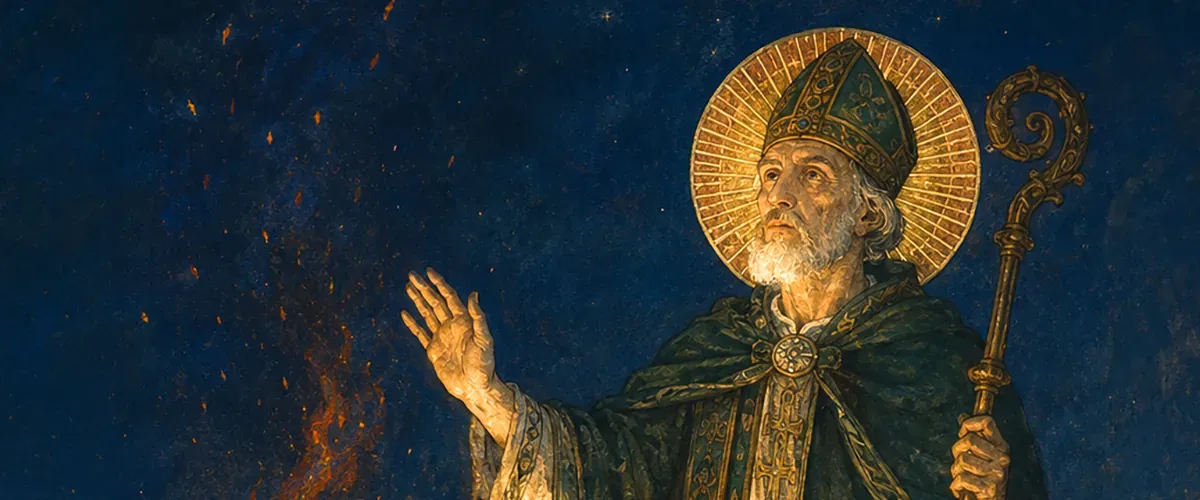
St. Patrick’s Breastplate: The Full Prayer
This is the translation from the Old Irish made by the German Celtic scholar Kuno Meyer and published in 1911, after the edition of Whitley Stokes and John Strachan. It is the version most often prayed:
I arise today Through a mighty strength, the invocation of the Trinity, Through belief in the threeness, Through confession of the oneness Of the Creator of Creation. I arise today Through the strength of Christ’s birth with His baptism, Through the strength of His crucifixion with His burial, Through the strength of His resurrection with His ascension, Through the strength of His descent for the judgment of Doom. I arise today Through the strength of the love of Cherubim, In obedience of angels, In the service of archangels, In hope of resurrection to meet with reward, In prayers of patriarchs, In predictions of prophets, In preachings of apostles, In faiths of confessors, In innocence of holy virgins, In deeds of righteous men. I arise today Through the strength of heaven: Light of sun, Radiance of moon, Splendour of fire, Speed of lightning, Swiftness of wind, Depth of sea, Stability of earth, Firmness of rock. I arise today Through God’s strength to pilot me: God’s might to uphold me, God’s wisdom to guide me, God’s eye to look before me, God’s ear to hear me, God’s word to speak for me, God’s hand to guard me, God’s way to lie before me, God’s shield to protect me, God’s host to save me From snares of devils, From temptations of vices, From every one who shall wish me ill, Afar and anear, Alone and in a multitude. I summon today all these powers between me and those evils, Against every cruel merciless power that may oppose my body and soul, Against incantations of false prophets, Against black laws of pagandom, Against false laws of heretics, Against craft of idolatry, Against spells of women and smiths and wizards, Against every knowledge that corrupts man’s body and soul. Christ to shield me today Against poison, against burning, Against drowning, against wounding, So that there may come to me abundance of reward. Christ with me, Christ before me, Christ behind me, Christ in me, Christ beneath me, Christ above me, Christ on my right, Christ on my left, Christ when I lie down, Christ when I sit down, Christ when I arise, Christ in the heart of every man who thinks of me, Christ in the mouth of every one who speaks of me, Christ in every eye that sees me, Christ in every ear that hears me. I arise today Through a mighty strength, the invocation of the Trinity, Through belief in the threeness, Through confession of the oneness Of the Creator of Creation.
The “spells of women and smiths and wizards” surprise modern readers. They belong to the world the prayer came from: in early Ireland, smiths were thought to work a kind of magic at the forge, and the prayer names every power that was feared, to set Christ against each one.
The Hymn: “I Bind Unto Myself Today”
In 1889 the Irish poet Cecil Frances Alexander, already famous for “All Things Bright and Beautiful” and “Once in Royal David’s City”, turned the Breastplate into a rhymed hymn for Saint Patrick’s Day. It is the version sung in churches, often to an Irish traditional melody arranged by Charles Villiers Stanford, with the “Christ be with me” verse set to a gentler tune:
I bind unto myself today The strong Name of the Trinity, By invocation of the same, The Three in One and One in Three. I bind this day to me for ever, By power of faith, Christ’s Incarnation; His baptism in Jordan river; His death on cross for my salvation; His bursting from the spiced tomb; His riding up the heavenly way; His coming at the day of doom; I bind unto myself today. I bind unto myself the power Of the great love of Cherubim; The sweet “Well done” in judgment hour; The service of the Seraphim, Confessors’ faith, Apostles’ word, The Patriarchs’ prayers, the Prophets’ scrolls, All good deeds done unto the Lord, And purity of virgin souls. I bind unto myself today The virtues of the starlit heaven, The glorious sun’s life-giving ray, The whiteness of the moon at even, The flashing of the lightning free, The whirling wind’s tempestuous shocks, The stable earth, the deep salt sea Around the old eternal rocks. I bind unto myself today The power of God to hold and lead, His eye to watch, His might to stay, His ear to hearken to my need, The wisdom of my God to teach, His hand to guide, His shield to ward, The Word of God to give me speech, His heavenly host to be my guard. Against the demon snares of sin, The vice that gives temptation force, The natural lusts that war within, The hostile men that mar my course; Or few or many, far or nigh, In every place, and in all hours, Against their fierce hostility, I bind to me these holy powers. Against all Satan’s spells and wiles, Against false words of heresy, Against the knowledge that defiles, Against the heart’s idolatry, Against the wizard’s evil craft, Against the death-wound and the burning, The choking wave, the poisoned shaft, Protect me, Christ, till Thy returning. Christ be with me, Christ within me, Christ behind me, Christ before me, Christ beside me, Christ to win me, Christ to comfort and restore me, Christ beneath me, Christ above me, Christ in quiet, Christ in danger, Christ in hearts of all that love me, Christ in mouth of friend and stranger. I bind unto myself the Name, The strong Name of the Trinity, By invocation of the same, The Three in One, and One in Three, Of Whom all nature hath creation, Eternal Father, Spirit, Word: Praise to the Lord of my salvation, Salvation is of Christ the Lord.
Why It Is Called the Deer’s Cry
The prayer reaches us through two manuscripts of the Liber Hymnorum, the Irish Book of Hymns, copied around the end of the eleventh century, with a short preface in Irish. Patrick, it says, sang this hymn “when the ambuscades were laid against him by King Loeguire (Leary) that he might not go to Tara to sow the faith”. To those lying in wait, he and his monks seemed to be wild deer, with a fawn following them, the boy Benen, Patrick’s young disciple. “And its name is Deer’s Cry.”
The scene follows the most famous episode of Saint Patrick‘s mission. On Holy Saturday, tradition places it in 433, Patrick kindled the Easter fire on the hill of Slane, in full view of Tara, on the night the High King’s druids had forbidden any fire but the king’s. The druids warned that if this fire were not put out that night, it would never be put out in Ireland. Loegaire summoned the stranger to Tara the next morning, and set his men on the road.
Is the prayer truly Patrick’s? The Old Irish of the text points to the eighth century, about three hundred years after him, and Kuno Meyer himself wrote that the hymn “in the form in which it has come down to us cannot be earlier than the eighth century”. It belongs to a whole family of early Irish and British prayers called loricae, from the Latin word for a soldier’s breastplate: prayers recited in the morning and “put on” like armour, naming every part of the body and every danger of the day. Whoever wrote it, it carries the faith of the Church Patrick founded, and Ireland has prayed it as his for more than a thousand years. For the saints who carried that faith after him, see our guide to the Irish saints.
The Breastplate in Eight Paintings
No famous painting shows the Deer’s Cry itself, but the great masters painted every power the prayer calls upon. Here they are, in the order of the words, after the saint himself.
1. The Saint: Saint Patrick, Bishop of Ireland, by Giovanni Battista Tiepolo (about 1746)
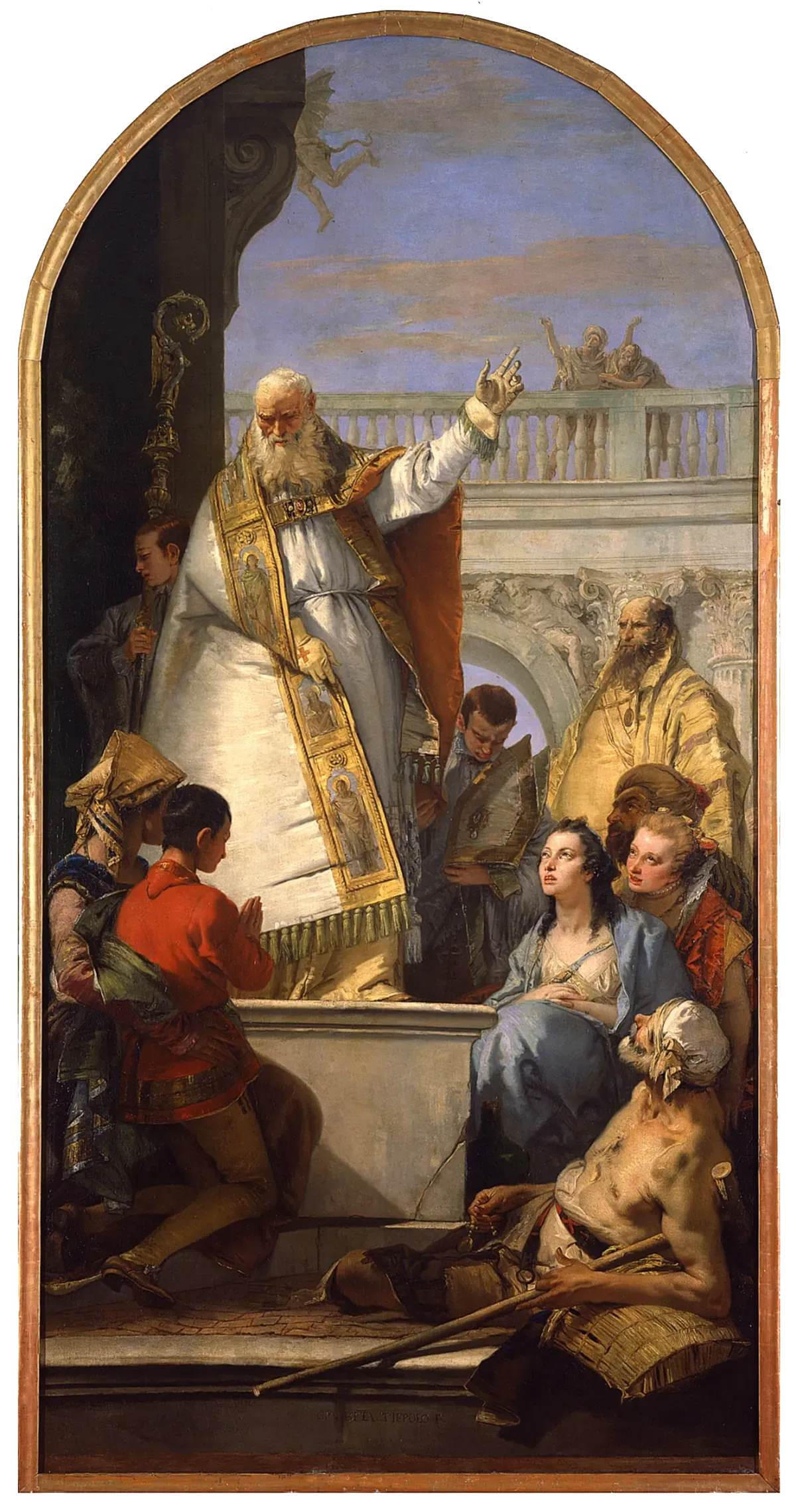
Old masters rarely painted Saint Patrick, and the finest example is by a Venetian. Giovanni Battista Tiepolo painted this tall altarpiece around 1746 for the church of San Giovanni di Verdara in Padua. Patrick, white-bearded, in a white alb, a gold stole embroidered with saints and a red cope, stands on a raised step, his crozier held by a young cleric behind him, and lifts his right hand over the people below: a young man kneeling with joined hands, a pale woman in blue who looks up at him as if just set free, an old cripple sitting with his crutches. At the top left, almost hidden against the cornice, a small winged demon is fleeing. Tiepolo shows him as the Irish remembered him and as the Breastplate prays, a bishop with power over sickness and the snares of devils. The painting is now in the Musei Civici of Padua.
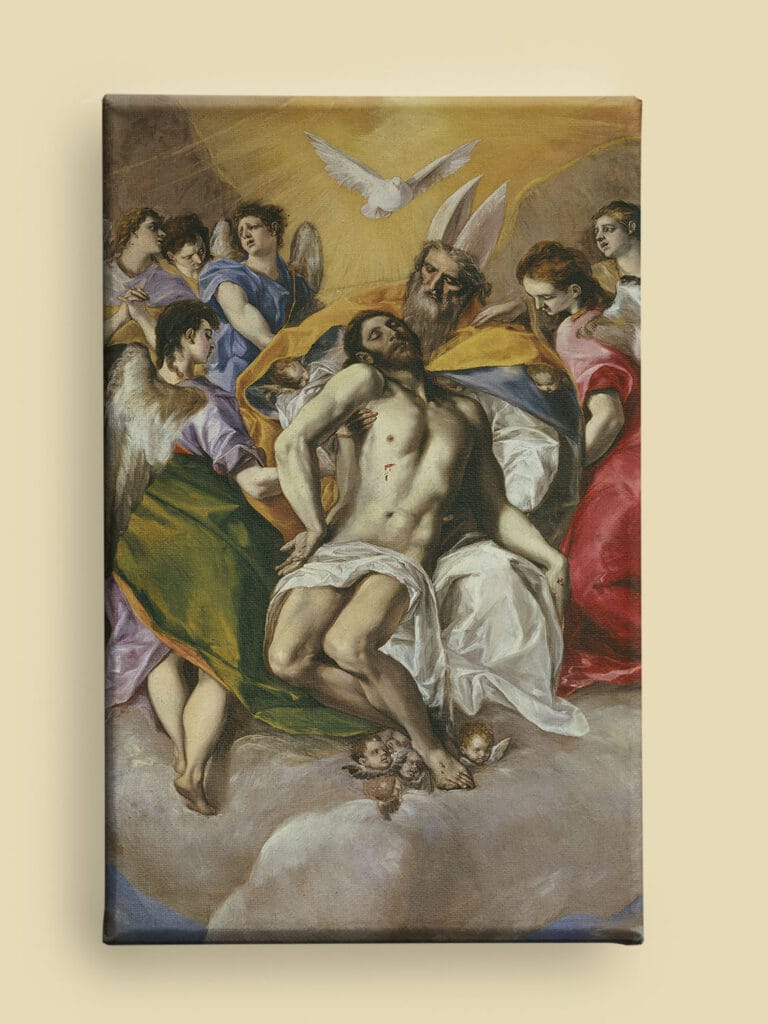
2. “Through a Mighty Strength, the Invocation of the Trinity”: The Holy Trinity by El Greco (1577 to 1579)

The Breastplate opens and closes with the Trinity, the mystery that tradition says Patrick explained with a shamrock. El Greco painted it soon after arriving in Toledo, for the high altar of the convent of Santo Domingo el Antiguo: God the Father, in a bishop’s white mitre, holds the dead body of his Son across his knees, while the dove of the Holy Spirit hovers in a burst of gold above them and angels crowd in, one of them grieving. It is a Trinity of sorrow and of strength at once, the “threeness” and the “oneness” of the prayer in a single embrace. The canvas is in the Prado. For another great image of the mystery, see Masaccio’s Holy Trinity.
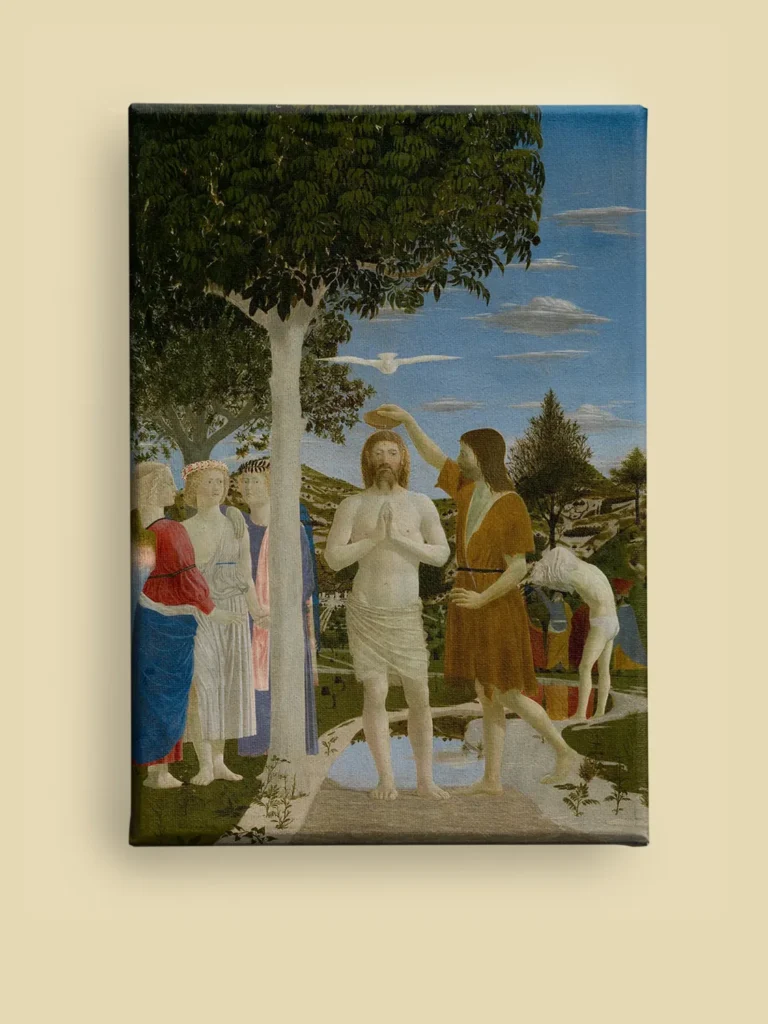
3. “Through the Strength of Christ’s Birth with His Baptism”: The Baptism of Christ by Piero della Francesca (1440s)
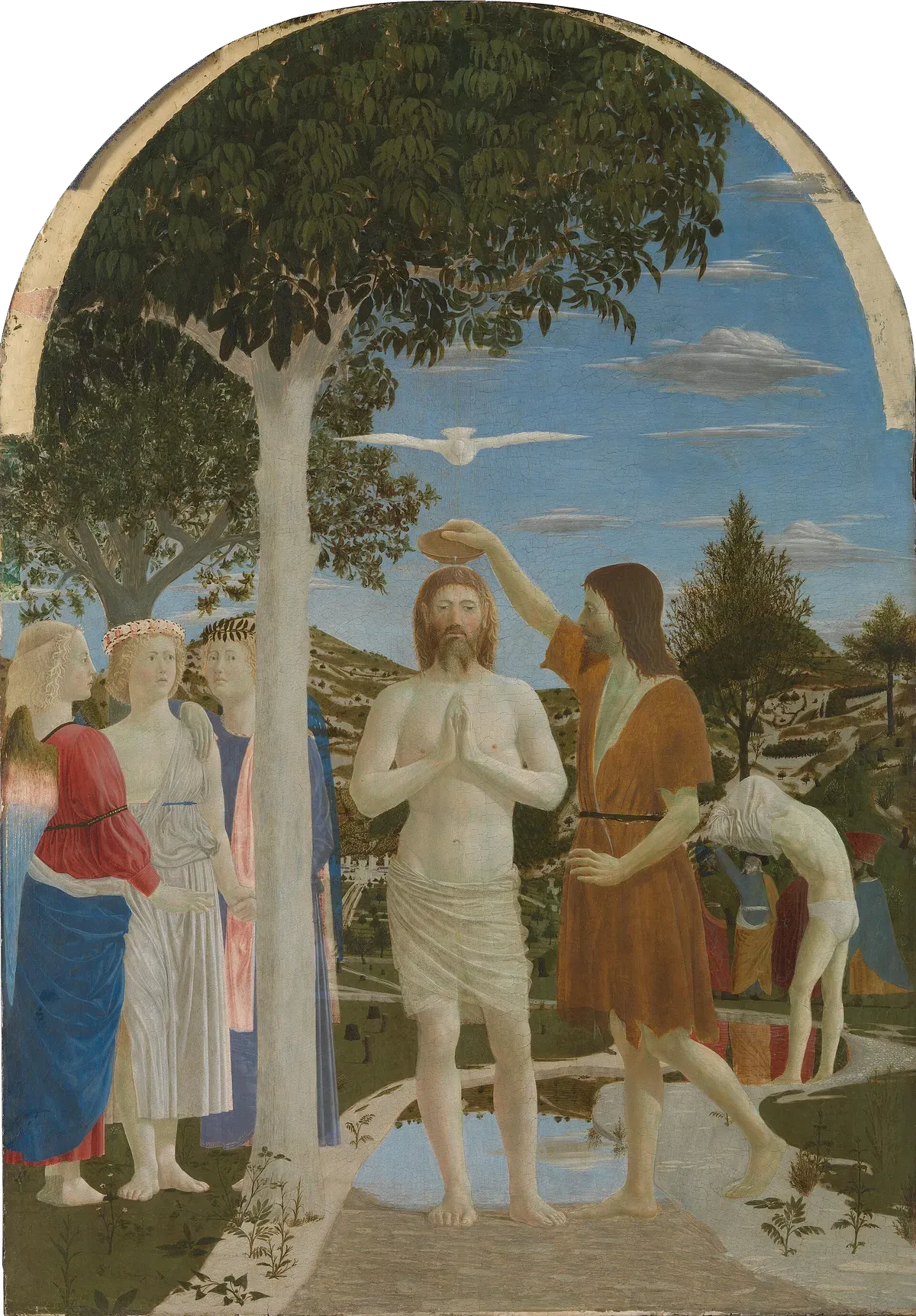
The second verse arms the one who prays with every moment of Christ’s life, and it begins at the river Jordan. Piero della Francesca painted the Baptism for a church in his home town, Sansepolcro, in the Tuscan hills, and set it in that very landscape. Christ stands still in a clear, shallow stream, hands joined, as John pours water over his head; the dove floats above him, flat and white like a cloud, and three angels watch from beside a walnut tree. Nothing moves, and the stillness is the point: it is the moment the Father’s voice declared, “This is my beloved Son”. The panel is in the National Gallery in London. More versions are gathered in our famous Baptism of Christ paintings.
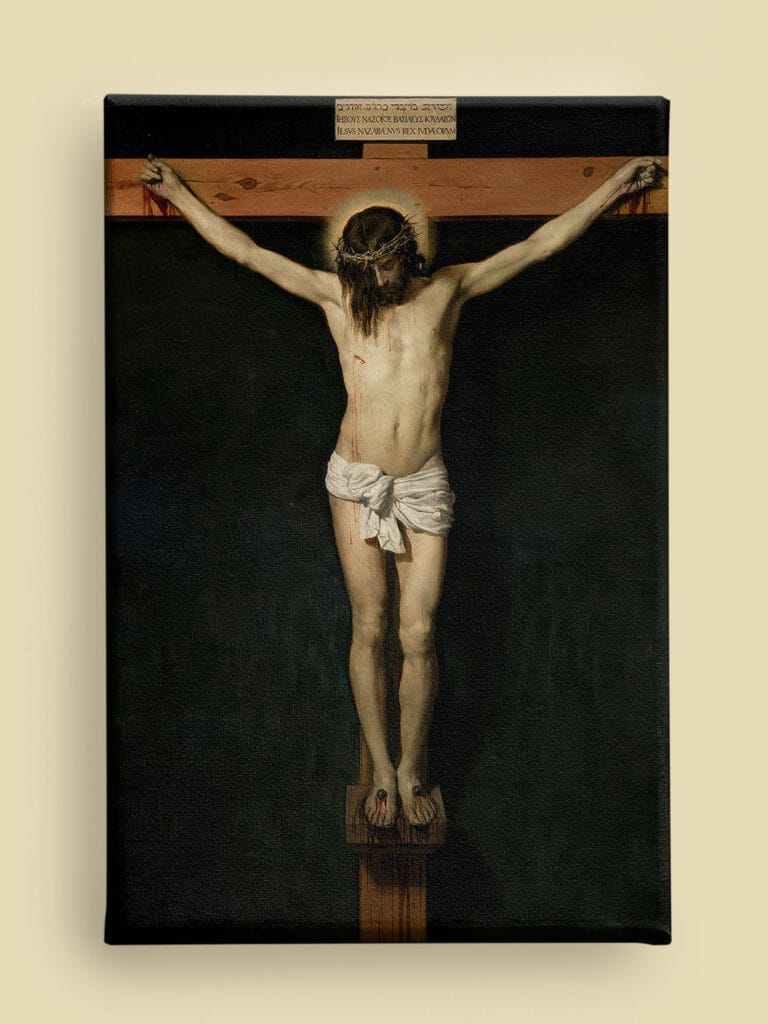
4. “Through the Strength of His Crucifixion with His Burial”: Christ Crucified by Diego Velazquez (about 1632)
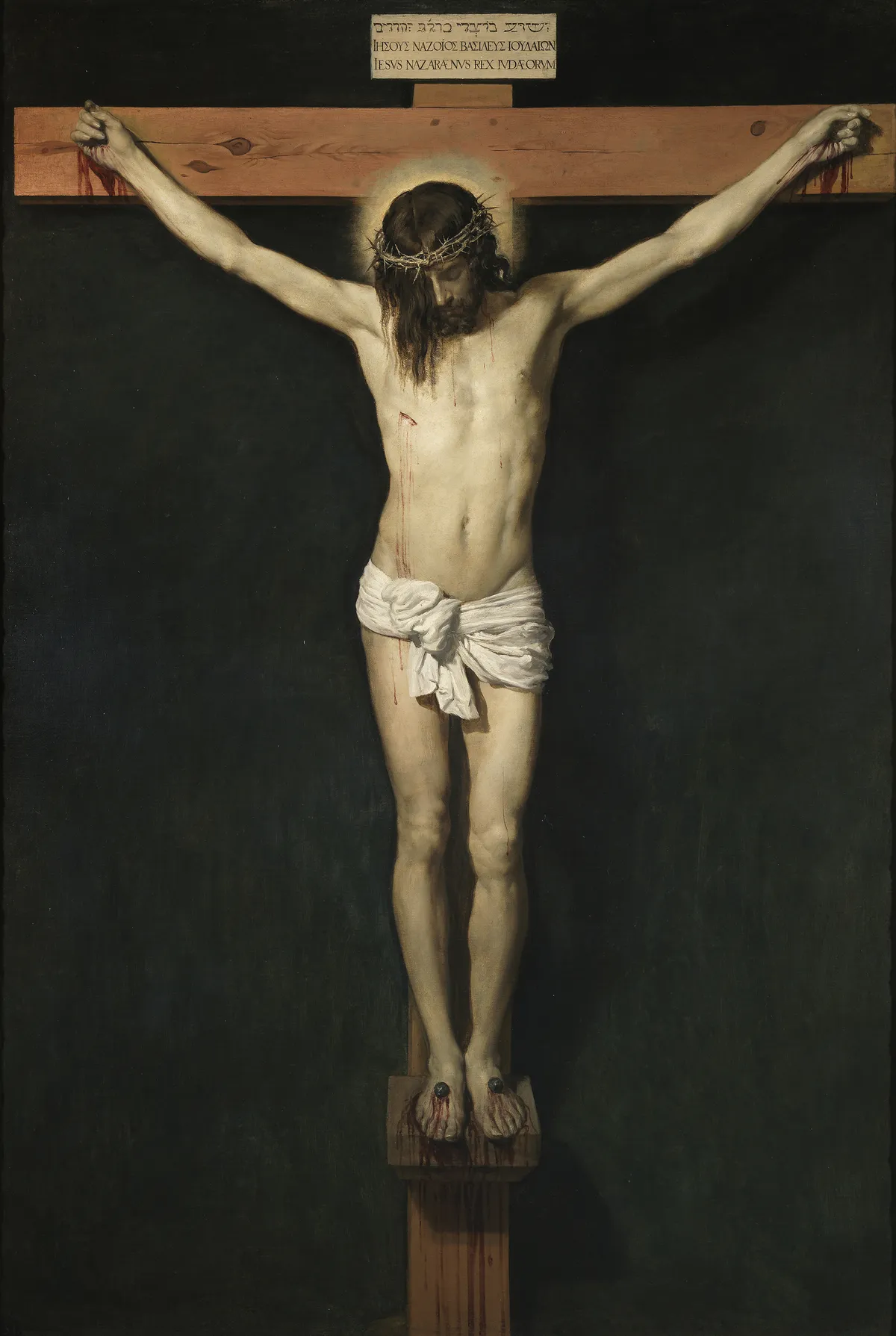
Velazquez painted his Christ alone against a dark ground, with no thieves, no crowd and no weeping women: just the body, nailed with four nails, the feet resting on a small support, the head fallen forward and half veiled by the hair. The calm of the figure is what the Breastplate asks for. The prayer does not dwell on the agony; it takes the strength of the Cross and the tomb and wears it. The canvas was painted for the convent of San Placido in Madrid and is now in the Prado. Read the full story of Velazquez’s Christ Crucified.
5. “Through the Strength of His Resurrection with His Ascension”: The Resurrection by Matthias Grunewald (1512 to 1516)

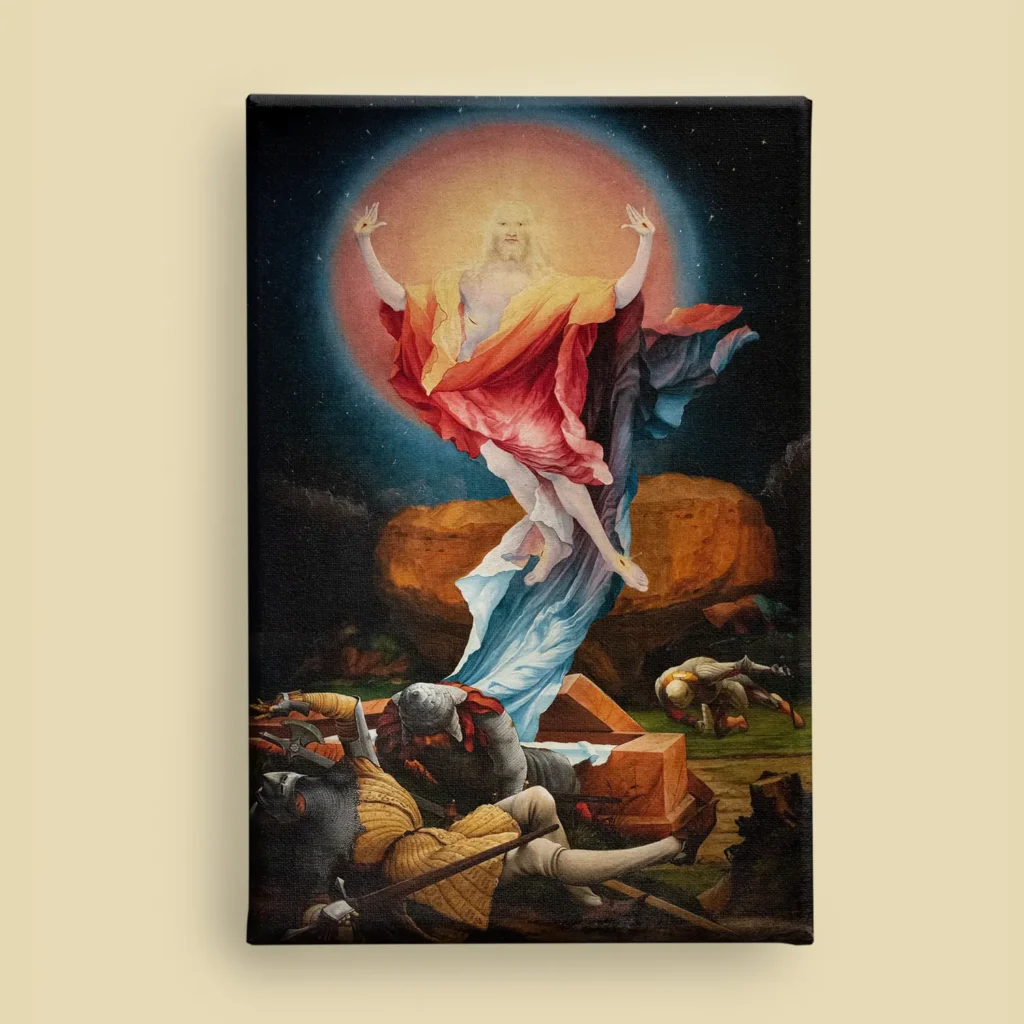
No painter made the Resurrection burst like Matthias Grunewald. On the Isenheim Altarpiece, painted for a monastery hospital where the monks cared for victims of a burning disease, Christ shoots up from the tomb inside an immense halo of yellow, orange and red, his shroud trailing behind him like a flame, his wounds shining, while the soldiers are hurled to the ground. Rising already, he seems about to ascend: the two mysteries of the Breastplate’s line are in one image. The altarpiece is in the Musee Unterlinden in Colmar. Discover the whole work in our article on the Isenheim Altarpiece.
6. “Through the Strength of His Descent for the Judgment of Doom”: The Last Judgment by Michelangelo (1536 to 1541)
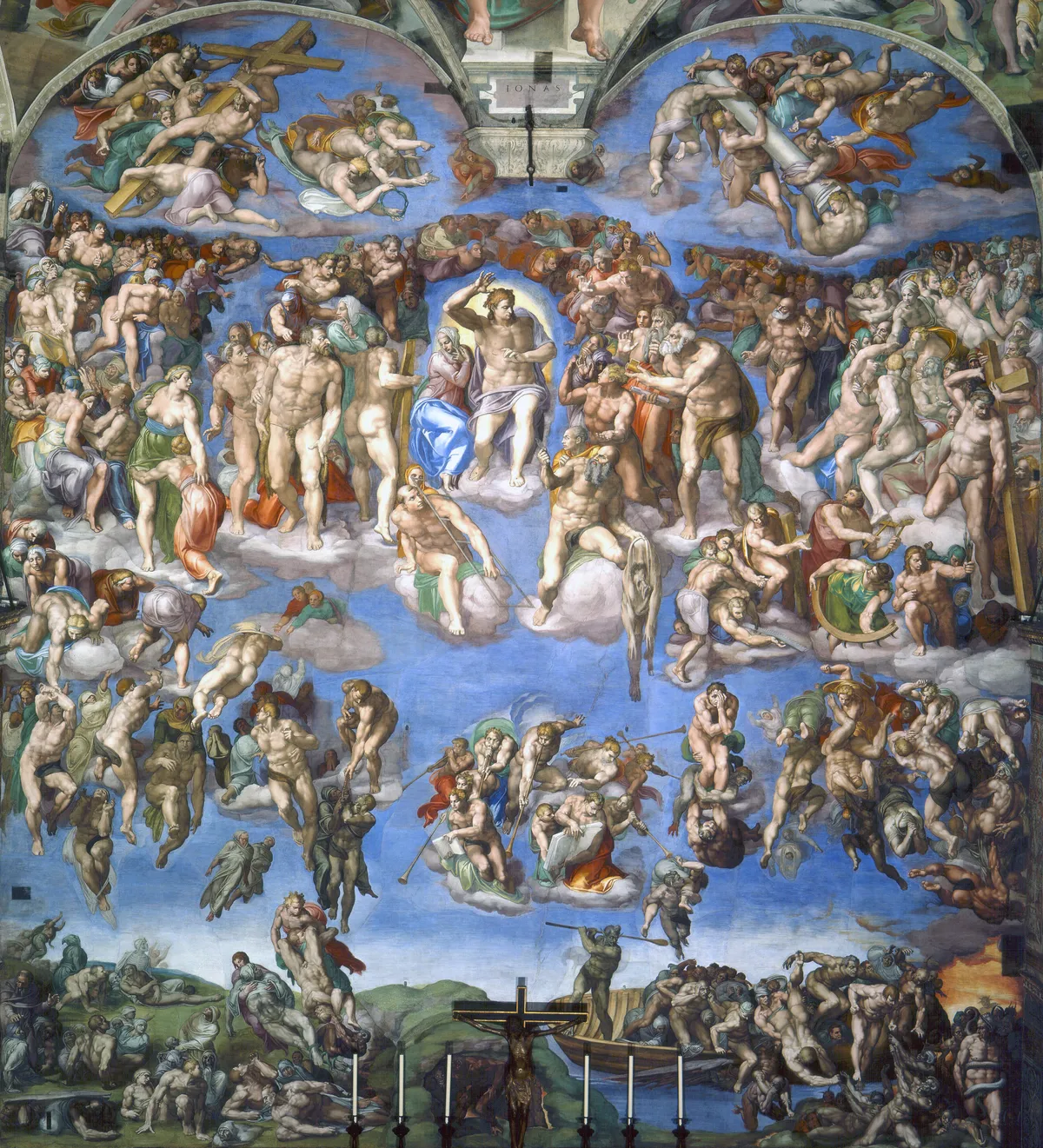
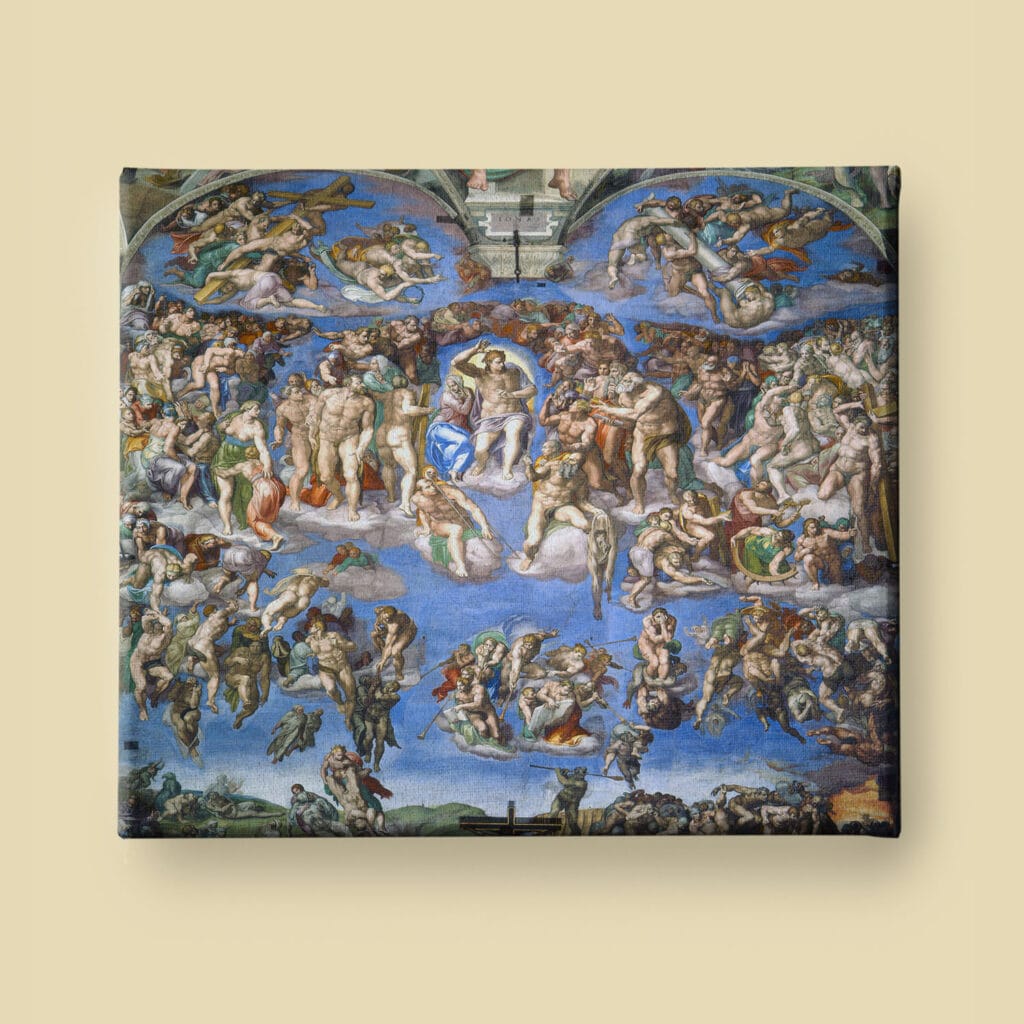
“Doom” is the old English word for judgment, and in medieval England a painting of the Last Judgment over the chancel arch was simply called a Doom. Michelangelo painted the greatest of them on the altar wall of the Sistine Chapel: Christ the Judge, young and powerful, raises his arm at the centre of a whirl of saints and martyrs, the dead climb out of their graves at the bottom left, and the damned are dragged down on the right. For the Breastplate, even this is a strength: the one who comes to judge is the one in whose power the believer rises each morning. Read more about Michelangelo’s Last Judgment.
7. “God’s Host to Save Me from Snares of Devils”: Saint Michael Vanquishing Satan by Raphael (1518)
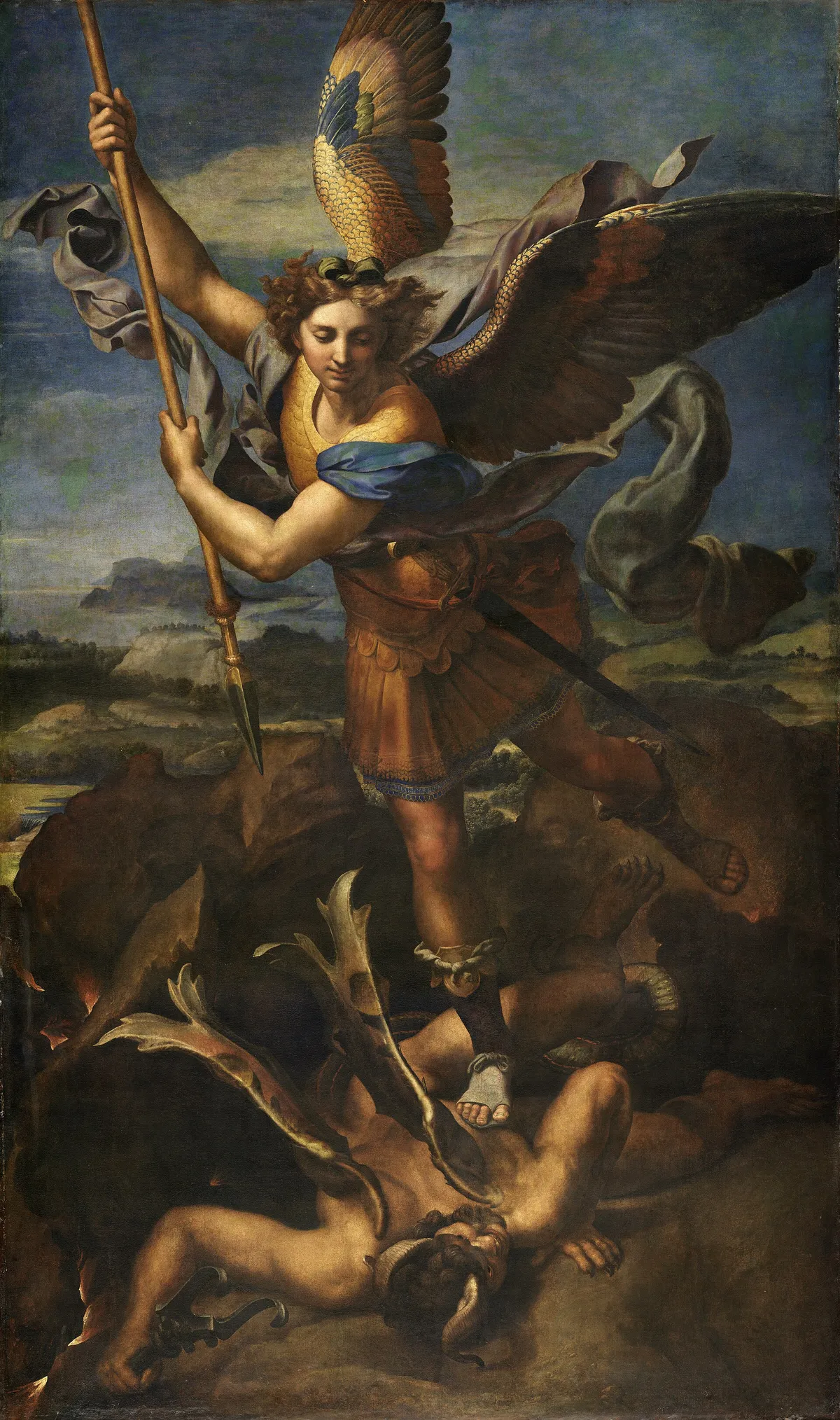
The prayer calls on “the service of archangels” and on “God’s host” to stand between the soul and every evil, and the captain of that host is Saint Michael. Raphael painted him in 1518 for Pope Leo X, who sent the picture as a gift to King Francis I of France. The archangel, in armour and with spread wings, lands on the back of a horned demon and raises his lance without effort or anger, his face perfectly calm. It is the image of the Breastplate’s confidence: the evil is real, and it is already beaten. The painting, transferred from panel to canvas in the eighteenth century, is in the Louvre. To pray to him directly, see our St. Michael the Archangel prayer.
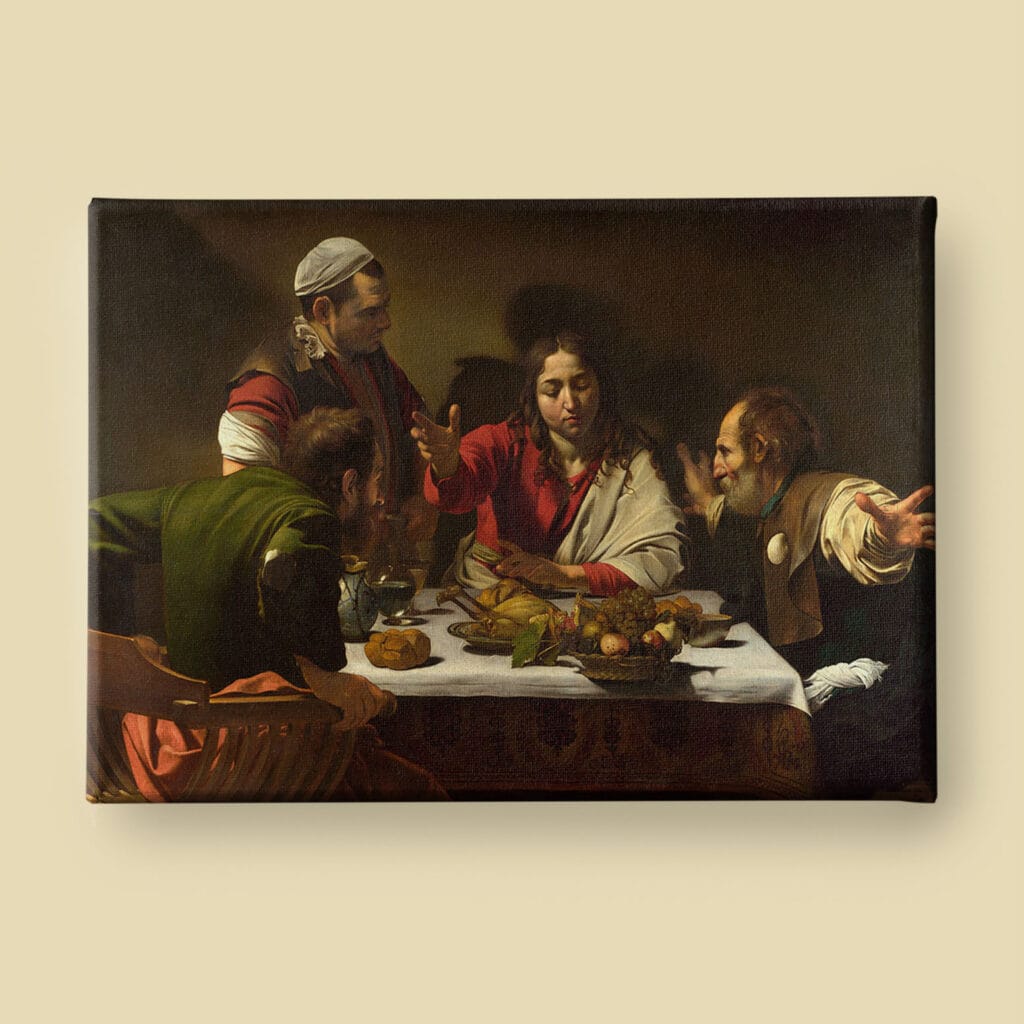
8. “Christ with Me, Christ Before Me”: The Supper at Emmaus by Caravaggio (1601)

The most loved lines of the Breastplate place Christ on every side, and “in the mouth of every one who speaks of me”. On the road to Emmaus, two disciples spoke of Jesus for hours while he walked beside them, unrecognised (Luke 24). Caravaggio painted the instant their eyes were opened, at the breaking of the bread: Christ, young and beardless, blesses the meal, one disciple throws his arms wide, the other grips the arms of his chair as if to rise, and the innkeeper looks on without understanding. Christ had been with them, before them and beside them all along. The canvas is in the National Gallery in London. Read the story of Caravaggio’s Supper at Emmaus.
What St. Patrick’s Breastplate Means
The prayer is built like a suit of armour put on piece by piece. It begins with the Trinity, the foundation of everything. Then it takes up the whole life of Christ, from his birth to his return, as a strength to rise in. Then the whole Church: angels, patriarchs, prophets, apostles, confessors, virgins and the just. Then the whole of creation, sun, moon, fire, lightning, wind, sea, earth and rock, not as powers to be worshipped, as the druids did, but as works of God that serve the one who prays.
Only then does it name the dangers, and they are of every kind: devils and vices, enemies near and far, false teaching, sorcery, poison, fire, drowning and wounds. And the answer to all of them is the great litany of Christ: before, behind, beneath, above, right, left, lying down, sitting, rising, and in every person met that day. The prayer ends where it began, with the Trinity, so that the whole day is enclosed in God.
How to Pray the Breastplate
- In the morning: it was made to be said on rising, and its refrain, “I arise today”, is meant literally.
- Before a journey or a difficult day: like Patrick on the road to Tara, many people pray it before travelling or facing danger.
- On Saint Patrick’s Day, March 17: say or sing it at home or after Mass, in the prayer or the hymn version.
- The short form: on busy days, pray only the passage “Christ with me, Christ before me, Christ behind me”, the heart of the prayer.
With children, start with the “Christ with me” passage and let them point in each direction as they say it: before, behind, beneath, above, right and left. It is the easiest way to learn it by heart, and the story of the deer on the road to Tara will make them want to hear the rest.
A Free Printable St. Patrick’s Breastplate Prayer Card
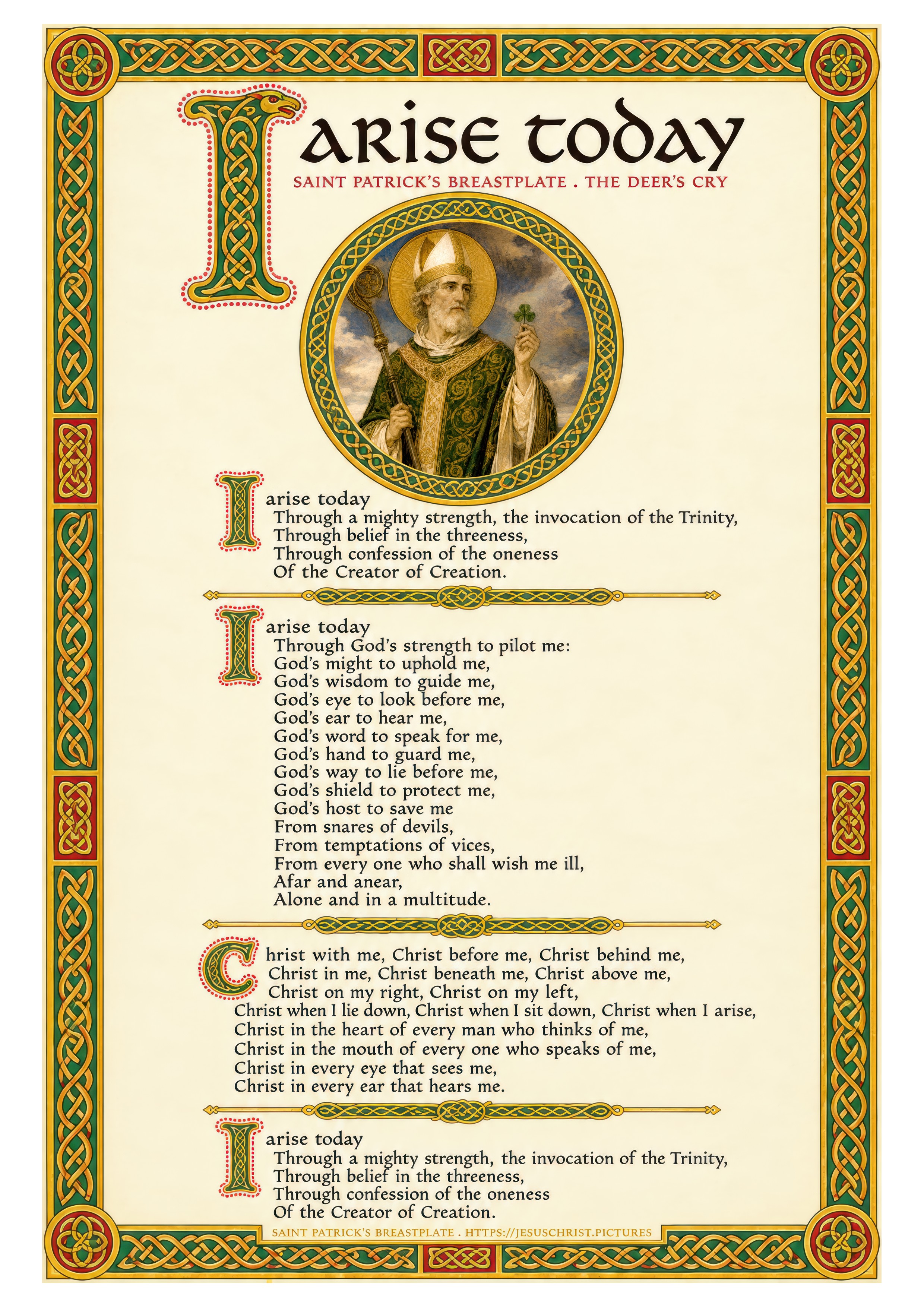
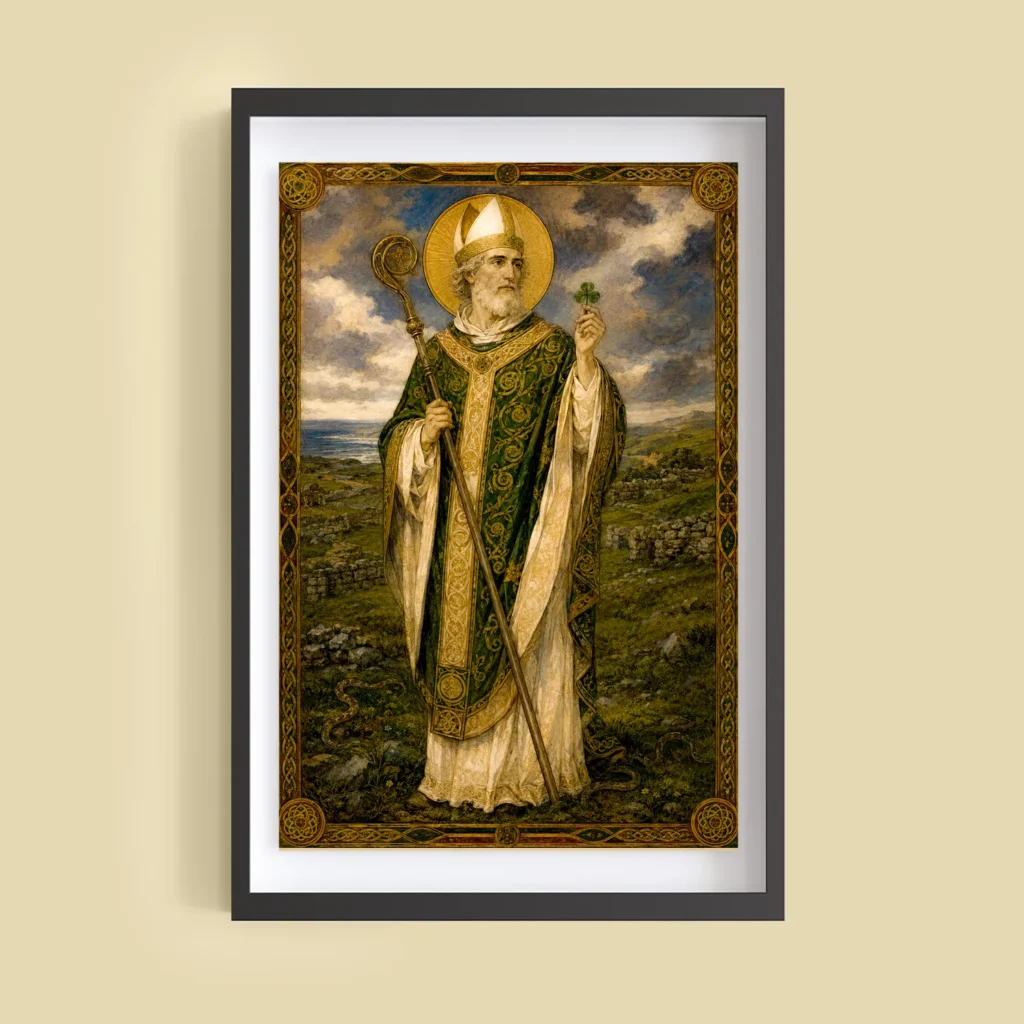
We have made the Breastplate into an illuminated prayer card in the Irish style of the Book of Kells: a border of Celtic knotwork, a great initial I ending in an animal head, and a round medallion of Saint Patrick with the crozier and the shamrock. The card keeps the four passages most often prayed, the opening, God’s strength, Christ on every side and the closing invocation of the Trinity, in Kuno Meyer’s translation.
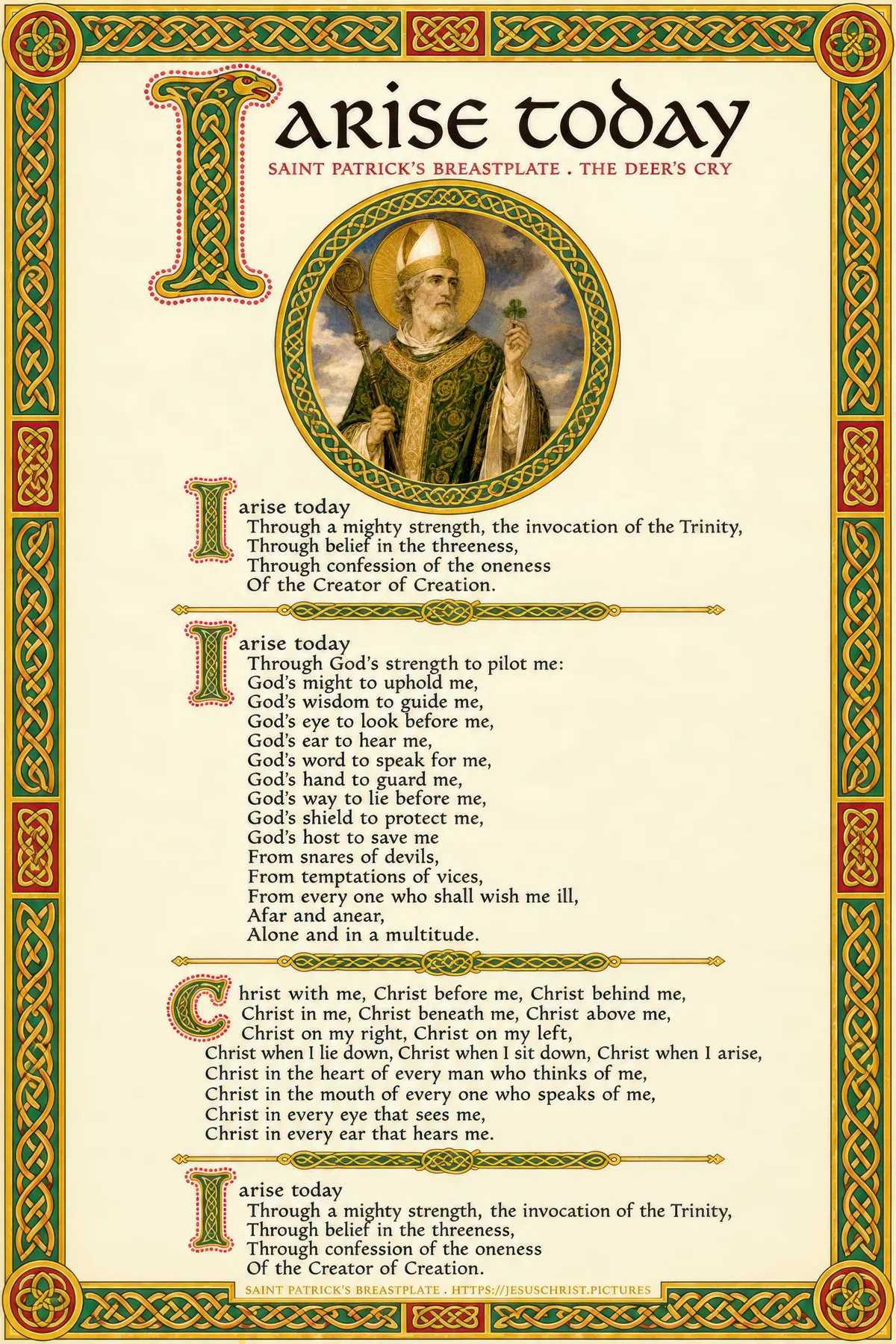
✦ Free Printable Prayer Card
Print it for your morning prayer, your missal or Saint Patrick’s Day. It is free, and there is nothing to fill in.
Download for US LetterDownload for A4
Also as a high resolution image.
More prayer cards, novenas and Scripture printables are gathered in our free Christian printables.
Conclusion
St. Patrick’s Breastplate was born, so Ireland says, on a road where armed men waited, and it has been prayed ever since by people setting out into a day they could not control. It asks for no miracle and no escape. It simply surrounds the one who prays with everything God has given, the Trinity, the life of Christ, the saints, the angels and creation itself, and then places Christ on every side. The painters gave each of those powers a face: El Greco the Trinity, Piero the Jordan, Velazquez the Cross, Grunewald the rising sun of Easter, Michelangelo the Judge, Raphael the archangel, Caravaggio the companion at the table. Tiepolo gave us the bishop who sang it on the road to Tara.
For more on the Apostle of Ireland, read our article on Saint Patrick, and for another great prayer of the early Church, the Anima Christi.
The Paintings in This Article
| Words of the prayer | Painting | Artist | Date | Medium | Location |
|---|---|---|---|---|---|
| The saint | Saint Patrick, Bishop of Ireland | Giovanni Battista Tiepolo | About 1746 | Oil on canvas | Musei Civici, Padua |
| The invocation of the Trinity | The Holy Trinity | El Greco | 1577 to 1579 | Oil on canvas | Museo del Prado, Madrid |
| Christ’s birth with His baptism | The Baptism of Christ | Piero della Francesca | 1440s | Tempera on panel | National Gallery, London |
| His crucifixion with His burial | Christ Crucified | Diego Velazquez | About 1632 | Oil on canvas | Museo del Prado, Madrid |
| His resurrection with His ascension | The Resurrection (Isenheim Altarpiece) | Matthias Grunewald | 1512 to 1516 | Oil on panel | Musee Unterlinden, Colmar |
| The judgment of Doom | The Last Judgment | Michelangelo | 1536 to 1541 | Fresco | Sistine Chapel, Vatican |
| God’s host against the snares of devils | Saint Michael Vanquishing Satan | Raphael | 1518 | Oil, transferred from panel to canvas | Louvre, Paris |
| Christ with me, Christ before me | The Supper at Emmaus | Caravaggio | 1601 | Oil on canvas | National Gallery, London |
Important Facts About St. Patrick’s Breastplate
- It is also called the Lorica of Saint Patrick, and in Irish Faeth Fiada, the Deer’s Cry.
- A lorica, Latin for breastplate, is a prayer for protection “put on” like armour in the morning.
- Tradition dates it to Easter 433, on Patrick’s road to Tara; scholars date the Old Irish text to around the eighth century.
- It survives in the Liber Hymnorum, the Irish Book of Hymns, copied around 1100.
- Kuno Meyer’s translation (1911) begins “I arise today”; Cecil Frances Alexander’s hymn (1889) begins “I bind unto myself today”.
- Its most famous passage is “Christ with me, Christ before me, Christ behind me”.
Frequently Asked Questions
Why is St. Patrick’s Breastplate called the Deer’s Cry?
Its Old Irish name is Faeth Fiada, usually translated “the Deer’s Cry”. According to the preface in the medieval manuscripts, Patrick sang it on his way to Tara when King Loegaire had set an ambush for him. The men lying in wait saw only a herd of wild deer pass by, with a fawn behind them, the boy Benen, and Patrick and his companions went through unharmed.
Did Saint Patrick really write the Breastplate?
Tradition attributes it to him and dates it to Easter 433, but scholars date the Old Irish text to around the eighth century, some three hundred years after Patrick. It may preserve an older prayer of his circle, but it cannot be proven to be his own words. His two authentic writings are the Confessio and the Letter to Coroticus.
What is the meaning of St. Patrick’s Breastplate?
A lorica, or breastplate, is a prayer “put on” like armour at the start of the day. The Breastplate surrounds the one who prays with the Trinity, the life of Christ, the angels and saints, the forces of creation and the protection of God, and ends by placing Christ on every side of the body and in every person met that day.
Is there a short version of St. Patrick’s Breastplate?
Yes. The passage most often prayed alone is “Christ with me, Christ before me, Christ behind me, Christ in me, Christ beneath me, Christ above me”, or in the hymn “Christ be with me, Christ within me”. Our free printable card keeps the four passages people pray most: the opening, God’s strength, Christ on every side, and the closing invocation of the Trinity.
What is a Catholic prayer for protection?
St. Patrick’s Breastplate is one of the oldest, alongside the St. Michael the Archangel prayer and the Guardian Angel prayer. The Breastplate is traditionally said in the morning, before the day’s dangers begin.
Is St. Patrick’s Breastplate Catholic or Protestant?
Both. The prayer comes from the early Irish Church, before any division, and is prayed by Catholics, especially on March 17. The hymn version by Cecil Frances Alexander was written in 1889 for the Church of Ireland and is sung in Anglican, Episcopal and many Catholic parishes.
Can you buy St. Patrick art?
You can buy Saint Patrick art at jesuschrist.pictures, in our shop: our original painting of Saint Patrick with the crozier and the shamrock is available as a giclee fine art poster, alongside canvas reproductions of the masterpieces in this article, from El Greco’s Holy Trinity to Caravaggio’s Supper at Emmaus.