15 El Greco Paintings That Still Feel Otherworldly
No painter in the history of Christian art has invented a religious language as personal, as strange, and as instantly recognisable as El Greco. The El Greco paintings that survive today belong to a man born in Crete, trained in Venice, refined in Rome, and finally settled in the imperial city of Toledo. He took the Byzantine icon, the colour of Titian, the muscularity of Michelangelo, and the silvery light of the Spanish meseta, and he fused them into a manner that no one else could have produced. His Christs and his saints are taller, thinner, and more flame-like than any earlier figures in Western art, and they have become, four centuries after his death, one of the great visual signatures of Catholic mysticism.
This article gathers fourteen of his most important religious works, the panels and altarpieces that took him from the Cretan icon tradition to the visionary world of his late Toledo years.

From Crete to Venice to Toledo
Domenikos Theotokopoulos was born in 1541 in Candia, the Venetian capital of Crete, and trained first in the local Cretan school of icon painting. By 1567 he had moved to Venice, where he absorbed the brushwork of Titian and the dramatic compositions of Tintoretto. Three years later he was in Rome, in the palace of Cardinal Alessandro Farnese, where he saw the late Michelangelo and quarrelled with the keepers of the Sistine Chapel about what he considered the unsuitability of the Last Judgement. By 1577 he had moved again, this time to Toledo, where he lived for the rest of his life.
His career splits into three periods: the early Cretan and Venetian years, the Roman years, and the long Toledan maturity. The transformation of his style across these decades is one of the most dramatic personal evolutions in the history of European painting.
The Disrobing of Christ
This is the painting that established El Greco in Toledo. Commissioned in 1577 for the sacristy of Toledo Cathedral, the Disrobing of Christ shows the moment before the Crucifixion when the soldiers tear Christ’s red robe from his shoulders. The composition is built on a tight crowd of grimacing faces that hem Christ in on every side, and the figure of Christ himself, the only calm face in the picture, looks up to heaven in patient submission.

The cathedral chapter quarrelled with El Greco over the price and the iconography, but the picture has remained in its place ever since. It still hangs in the sacristy of Toledo Cathedral.
The Holy Trinity
Painted in 1577 for the high altar of the Toledo church of Santo Domingo el Antiguo, the Holy Trinity shows God the Father holding the dead body of his Son, with the dove of the Holy Spirit between them and a chorus of angels weeping around them. The composition is openly inspired by Dürer and by Michelangelo’s Pietà, but El Greco gives it a flame-like elongation and a tonal silver that turns the scene into a moment of cosmic grief.


The painting is now in the Museo del Prado in Madrid.
The Adoration of the Name of Jesus
Painted around 1577 to 1580, this small but immensely ambitious panel is sometimes called the Dream of Philip II. The composition is divided in three: at the top the IHS monogram of Christ in glory, in the middle the assembled saints, popes, and king Philip II in adoration, and at the bottom the open mouth of Leviathan swallowing the damned. The picture was probably designed as a votive for the formation of the Holy League of 1571 against the Ottoman Empire.

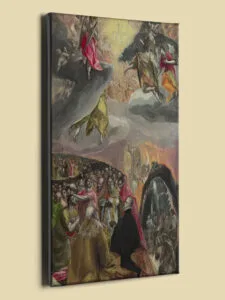
The painting is now at the National Gallery in London.
Christ Driving the Money Changers from the Temple (1571)
This early Roman version of the subject is one of El Greco’s most Italianate compositions. The figures are still solid and weighty, modelled in the Roman manner. Christ swings the whip across the panel while the merchants flee, and in the lower right corner the painter has included himself and three Renaissance masters he admired: Titian, Michelangelo, and Giulio Clovio.

The painting is at the Minneapolis Institute of Art.
Christ Driving the Money Changers from the Temple
A second, later version of the same subject shows how far El Greco had moved by the 1600s. The figures are now elongated and flame-like, the architecture flattened, the colour intensified into clashing notes of acid green and sulphurous yellow. The same composition has become unmistakably late El Greco.


The picture is also at the National Gallery in London.
La Crucifixión
Painted around 1597 for the chapel of the Hieronymite convent of Toledo, the Crucifixion shows Christ alone on the cross against a stormy sky, with the Virgin and John the Evangelist at the foot of the cross. The blood drops from his side are caught by angels in chalices, a eucharistic image typical of the Counter-Reformation. The whole figure is elongated, weightless, and bathed in El Greco’s characteristic silvery light.


The painting is at the Museo del Prado in Madrid.
The Agony in the Garden
One of the most dreamlike of all El Greco’s compositions, the Agony in the Garden shows Christ kneeling in prayer on the Mount of Olives while three sleeping disciples lie in a strange rocky pocket below him. An angel descends with the chalice of the Passion. The colour is dominated by deep blues and silvery whites, and the figures have the unmistakable late elongation that gives all of El Greco’s mature paintings their unique rhythm.

The painting is at the National Gallery in London. For a wider survey of the subject, see our article on Agony in the Garden paintings.
Adoration of the Shepherds
Painted around 1612 to 1614 for the chapel of San José in Toledo and for the painter’s own burial chapel in the church of Santo Domingo el Antiguo, this is one of El Greco’s most famous late compositions. The Virgin lifts the swaddling cloth from the Christ child while the shepherds and an ox bend over him in a flood of supernatural light. The colour is acid, the figures elongated, and the whole image suspended between earth and heaven.

The painting is at the Museo del Prado in Madrid.
The Last Supper
This early small panel of the Last Supper, painted in El Greco’s Italian years, shows the strong influence of Tintoretto. Christ is at the centre of a long table, the apostles ranged around him, and the composition is built on dramatic diagonal light. It is one of the few surviving Italian period works of the painter and offers a precious view of his style before the move to Spain.


The panel is now at the Museo de Bellas Artes de Granada.
The Miracle of Christ Healing the Blind
Painted in El Greco’s Venetian or early Roman years, this composition shows the Gospel scene of John 9, when Christ heals the man born blind. The architecture is classical, the figures still solid, the colour rich and dense. The picture preserves precious traces of the painter’s Italian training before his Spanish transformation.


The painting is at the Metropolitan Museum of Art in New York.
Saint Martin and the Beggar
The young Roman soldier turns on his white horse and cuts his cloak to share it with the freezing beggar. El Greco paints the saint in contemporary armour, with the silvery flesh tones and elongated proportions of his late Toledo style. The composition is a single tall vertical, with Saint Martin’s plumed helmet and the legs of his horse at top and bottom.

The painting is at the National Gallery of Art in Washington, originally from the Widener Collection.
Saint Peter and Saint Paul (Barcelona)
The two great apostles of the early Church stand side by side, Peter holding his keys, Paul his sword and the open book of his epistles. The composition is a study in two contrasted faces, the older Peter with his soft white beard and the more austere Paul with his hooded eyes. El Greco painted several variants of this paired image, and the version in Barcelona is one of the most concentrated.

The painting is at the Museu Nacional d’Art de Catalunya in Barcelona.
Saints Peter and Paul (Saint Petersburg)
The variant painting at the Hermitage shows the same two saints from a slightly different angle, with subtle changes in the colour and gesture. Peter’s red robe is more vivid, Paul’s hands more emphatically gesturing toward the open Scripture. The painting is one of the great holdings of El Greco outside Spain.

The painting is at the Hermitage Museum in Saint Petersburg.
The Penitent Mary Magdalene
The figure of Mary Magdalene, kneeling in the wilderness with her loose hair and her tearful eyes raised to heaven, is one of El Greco’s most personal subjects. The painting in Budapest is one of several versions he produced of the theme. The Magdalene’s pale skin against the dark red of her robe and the blue of the rocks creates the kind of clashing colour that El Greco loved.


The painting is at the Museum of Fine Arts in Budapest. For a wider survey, see our article on famous Mary Magdalene paintings.
For more context on El Greco’s Spanish contemporaries, see our articles on Diego Velázquez and on his teacher’s tradition through Titian. The wider Spanish Renaissance Jesus paintings tradition holds El Greco as its most visionary voice.
Summary Table of El Greco’s Religious Paintings
| Name | Artist | Date | Medium | Museum |
|---|---|---|---|---|
| The Disrobing of Christ | El Greco | 1577 to 1579 | Oil on canvas | Toledo Cathedral |
| The Holy Trinity | El Greco | 1577 to 1579 | Oil on canvas | Museo del Prado, Madrid |
| The Adoration of the Name of Jesus | El Greco | c. 1577 to 1580 | Oil on canvas | National Gallery, London |
| Christ Driving the Money Changers (1571) | El Greco | 1571 | Oil on canvas | Minneapolis Institute of Art |
| Christ Driving the Money Changers from the Temple | El Greco | c. 1600 | Oil on canvas | National Gallery, London |
| La Crucifixión | El Greco | c. 1597 to 1600 | Oil on canvas | Museo del Prado, Madrid |
| The Agony in the Garden | El Greco | c. 1590 | Oil on canvas | National Gallery, London |
| Adoration of the Shepherds | El Greco | c. 1612 to 1614 | Oil on canvas | Museo del Prado, Madrid |
| The Last Supper | El Greco | c. 1568 | Oil on panel | Museo de Bellas Artes de Granada |
| The Miracle of Christ Healing the Blind | El Greco | c. 1570 | Oil on canvas | Metropolitan Museum of Art, New York |
| Saint Martin and the Beggar | El Greco | c. 1597 to 1600 | Oil on canvas | National Gallery of Art, Washington |
| Saint Peter and Saint Paul | El Greco | c. 1605 to 1608 | Oil on canvas | Museu Nacional d’Art de Catalunya, Barcelona |
| Saints Peter and Paul | El Greco | c. 1587 to 1592 | Oil on canvas | Hermitage Museum, Saint Petersburg |
| The Penitent Mary Magdalene | El Greco | c. 1585 | Oil on canvas | Museum of Fine Arts, Budapest |
Conclusion
El Greco’s religious painting belongs to no national school and no easy century. He brought to Spain the gold ground of Crete, the colour of Venice, and the muscularity of Rome, and he turned all of it into the silvery, flame-like world of late sixteenth century Toledo. His Christ never quite touches the ground. His Madonna is always already a vision. His saints are not portraits but burning candles. For nearly two centuries after his death the Spanish public found this manner unbearable; in the twentieth century, Cézanne, Picasso, and Pollock all confessed to looking at him with awe. His religious paintings are now read as one of the central pillars of Catholic mystical art.
Important Facts About El Greco
- Domenikos Theotokopoulos, known to history as El Greco, was born in 1541 in Candia, the Venetian capital of Crete, and received his first training in the Cretan school of post-Byzantine icon painting.
- He moved to Venice around 1567 and studied in the orbit of Titian and Tintoretto, then continued to Rome in 1570, where he worked in the palace of Cardinal Alessandro Farnese and absorbed the late Michelangelo.
- El Greco is the central figure of late Spanish Mannerism, and his elongated figures, flame-like silhouettes, and silvery atmospheric light have made him one of the most personally recognisable masters of European religious painting.
- His most famous religious work is the Burial of the Count of Orgaz in the church of Santo Tomé in Toledo, painted in 1586 to 1588, while in the present article the most celebrated panels are the Disrobing of Christ in Toledo Cathedral and the Holy Trinity at the Prado.
- He died on 7 April 1614 in Toledo, where he had lived since 1577, and although his manner was almost forgotten in the seventeenth and eighteenth centuries, the late nineteenth and twentieth century rediscovery of his work transformed the modern history of European painting.
Questions and Answers About El Greco Paintings
What is El Greco’s most famous painting?
The single most celebrated work is the Burial of the Count of Orgaz, painted in 1586 to 1588 for the church of Santo Tomé in Toledo, where it still hangs. Among the panels covered in this article, the Holy Trinity and the Disrobing of Christ are his best known religious paintings. The two great View of Toledo landscapes at the Metropolitan and the Prado are his most famous non-religious subjects.
Where can I see El Greco paintings today?
The single richest collection is the Museo del Prado in Madrid, which holds the Holy Trinity, the Crucifixion, the Adoration of the Shepherds, and several apostles. Toledo Cathedral and the church of Santo Tomé in Toledo still preserve the great altarpieces commissioned for them. The National Gallery in London, the Metropolitan Museum in New York, and the Hermitage in Saint Petersburg also hold important works.
What style is El Greco associated with?
El Greco is the central late master of Spanish Mannerism, the manner that runs from Bronzino and Parmigianino to the eve of the Baroque. His personal style fuses the Cretan icon tradition, the colour of Venice, the muscular figure of Roman Michelangelo, and the silvery atmosphere of late sixteenth century Toledo. Modern critics often see him as the most original Mannerist of Western art.
Why are El Greco’s figures so elongated?
This stretching of the body, with figures sometimes seven or eight heads tall instead of the standard six, was a deliberate stylistic choice. It draws on the post-Byzantine icon tradition of El Greco’s Cretan training, on the late Mannerism of Parmigianino and Pontormo, and on his personal mystical reading of the human body as a flame rising toward God. For most of his contemporaries the elongation seemed grotesque; for modern viewers it is one of the most powerful expressions of religious feeling in Western art.
Was El Greco Catholic?
Yes, he was a devout Catholic of the Counter-Reformation. His writings, which survive in marginal annotations on his books of Vitruvius and Vasari, show a man deeply engaged with the theological debates of the late sixteenth century. He produced more than a hundred religious paintings, almost all of them for Spanish Catholic patrons.
How did El Greco get his nickname?
His Spanish patrons called him simply El Griego, the Greek, which became El Greco in common usage. The painter himself preferred to sign his works in Greek letters as Domenikos Theotokopoulos, often with the addition of the word Kres, meaning Cretan. The Spanish nickname became universal only after his death.
Where can I buy an El Greco painting reproduction?
You can buy them at jesuschrist.pictures: browse all the El Greco canvas prints in our shop, printed on museum-grade canvas and available in several sizes.


