Powerful Caravaggio Paintings That Still Shock Viewers
Caravaggio paintings changed the history of art more decisively than those of any other single painter since Giotto. Born Michelangelo Merisi in Milan in 1571, he worked in Rome from around 1592 until 1606, when a brawl in which he killed a man forced him to flee the city, and he spent the last four years of his life as a fugitive in Naples, Malta, Sicily, and Naples again, before dying in 1610 on his way back to Rome at the age of thirty-eight. In those forty-eight years he produced a body of work that transformed the entire subsequent tradition of European painting. His technique of tenebrism, the use of violent contrasts between bright light and deep shadow to give figures their presence and their drama, was absorbed by painters across Europe and became the dominant idiom of the Baroque period. But Caravaggio’s paintings are not merely technical achievements: they are among the most spiritually serious works of the seventeenth century, bringing the sacred subjects of Christian art into direct, sometimes shocking contact with the physical reality of human life.

Rome and the Revolution of Light
When Caravaggio arrived in Rome in the early 1590s, the dominant idiom of Italian painting was the Mannerism that had followed the deaths of the great High Renaissance masters, a style of artificial elegance, elongated figures, sophisticated color, and complex compositions that referred more to other paintings than to the world of observed experience. Caravaggio’s response to this tradition was radical: he looked at the world directly, painted from life models who were often peasants or street people rather than idealized types, and used the contrast of extreme light and deep shadow to give his figures a physical presence, a weight, a texture, a sense of occupying real space in real light, that was entirely new. His first major Roman commissions, the two paintings for the Contarelli Chapel in San Luigi dei Francesi, caused a sensation when they were unveiled in 1600 and established him overnight as the most discussed painter in Italy.
Crucifixion of Saint Peter
The Crucifixion of Saint Peter in the Cerasi Chapel of Santa Maria del Popolo in Rome, painted in 1600-1601, is one of the most radical treatments of a traditional subject in the history of art. Caravaggio shows not the moment of triumph, the old Peter ascending to his martyrdom with the dignity of a martyr, but the moment of labor: the workers straining to raise the heavy cross with the old man nailed to it, their effort physical and ordinary, their relationship to the sacred content of the scene entirely absent from their minds. The aged Peter’s face is turned away from the viewer; his arm is stretched upward with a gesture that might be prayer or simply the natural position of a man being hoisted. It is martyrdom without rhetoric, the sacred event embedded in the everyday physical world.

Death of the Virgin
The Death of the Virgin at the Louvre, painted around 1601-1606, was rejected by the Carmelite church for which it was made, according to the most persistent account, because Caravaggio used a drowned prostitute as the model for the Virgin’s body. Whether or not this is true, the painting’s approach to the subject was certainly unprecedented: the dead Mary is shown as a real dead woman, her body swollen and her limbs heavy, surrounded by the apostles in poses of genuine grief. The traditional distinction between sacred figure and ordinary human body is dissolved, and the result is simultaneously more disturbing and more moving than the idealized Assumptions and Dormitions of the previous tradition.

Ecce Homo
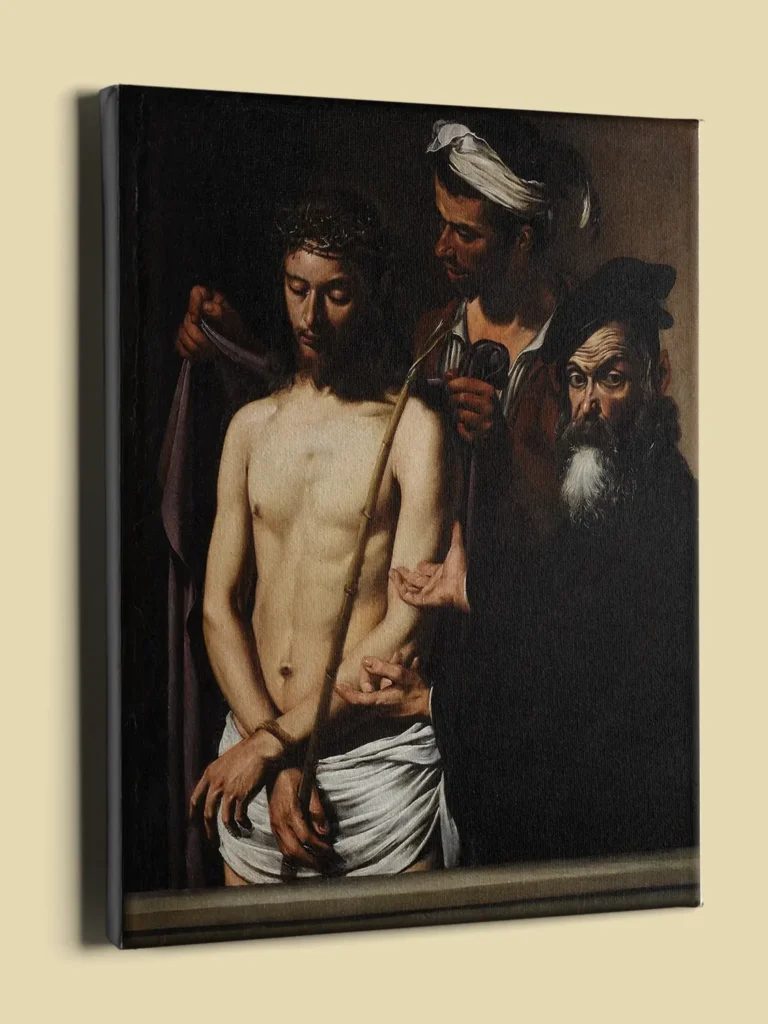
The Ecce Homo at the Palazzo Bianco in Genoa shows Pilate presenting the scourged Christ to the crowd. Caravaggio’s Christ is a figure of quiet suffering, the crown of thorns, the marks of the flagellation, the posture of a man exhausted by pain, while Pilate gestures toward him with a neutrality that is itself a kind of condemnation. The painting’s drama is in the contrast between the light that falls on Christ’s body and the darkness that surrounds the whole scene, and in the directness with which the suffering is depicted: not theatrical, not stylized, but observed with the same unflinching attention that Caravaggio brought to all his subjects.

Judith Beheading Holofernes
The Judith Beheading Holofernes at the Galleria Nazionale d’Arte Antica in Rome, painted around 1598-1599, shows the moment from the Book of Judith when the Israelite widow decapitates the Assyrian general Holofernes to save her city. Caravaggio’s treatment is direct to the point of horror: Judith’s face shows effort and perhaps distaste rather than triumph; the sword is halfway through the neck; Holofernes’s expression is caught between sleep and the beginning of the recognition of what is happening to him; and the old servant stands at Judith’s side with a basket, waiting. The painting’s confrontation with violence is characteristic of Caravaggio’s approach to the sacred: the event is shown as it would have looked, and the look is not comfortable.

Madonna of the Rosary
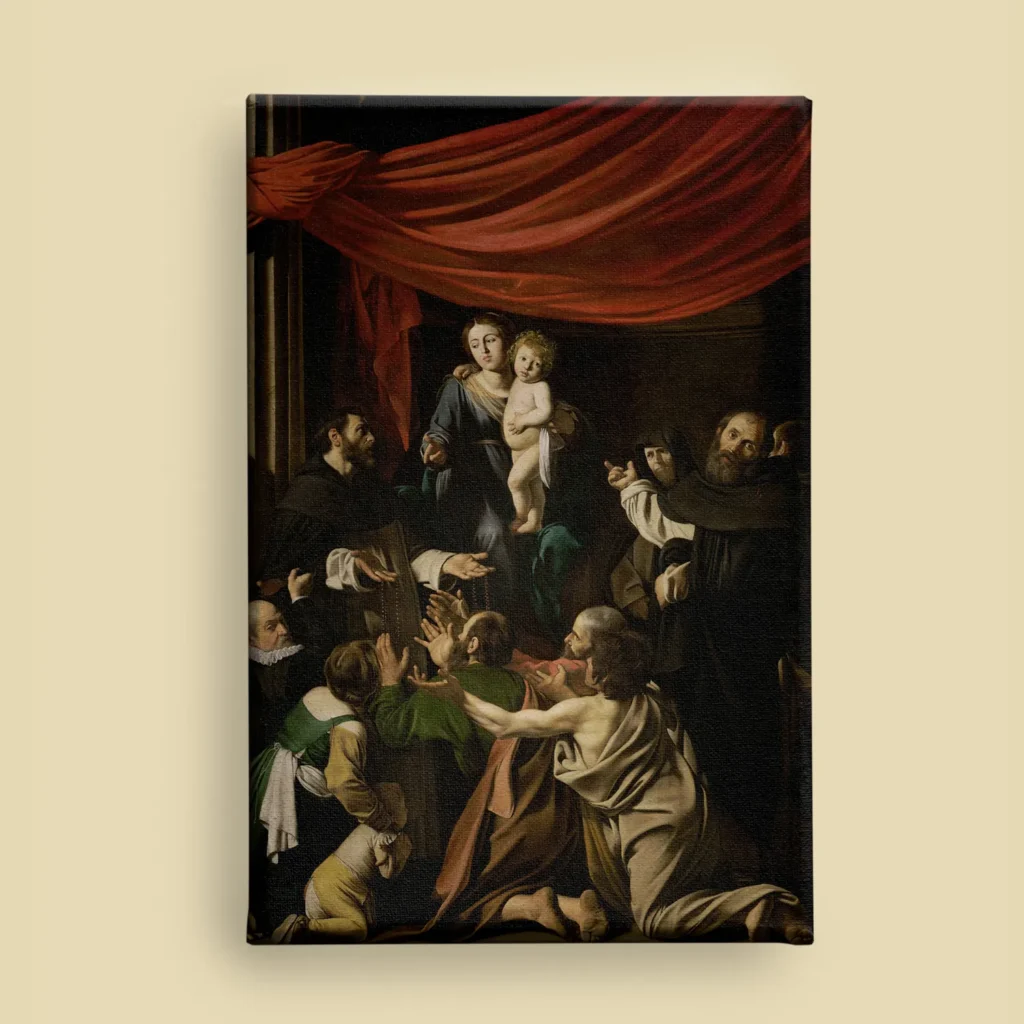
The Madonna of the Rosary at the Kunsthistorisches Museum in Vienna, painted around 1606-1607, is one of Caravaggio’s largest paintings and one of his most complex compositions. The Virgin and Child appear above a group of figures, Dominican friars, poor suppliants, donors, and the rosary beads pass from the Virgin to the friars to the people below. The painting was made for a Neapolitan church and shows Caravaggio engaging with the devotional culture of the Counter-Reformation in a way that is fully orthodox in its iconography while remaining entirely his own in its treatment: the suppliants are real poor people, the Virgin is a real woman, and the interaction between heaven and earth is shown as a transaction between genuine parties.

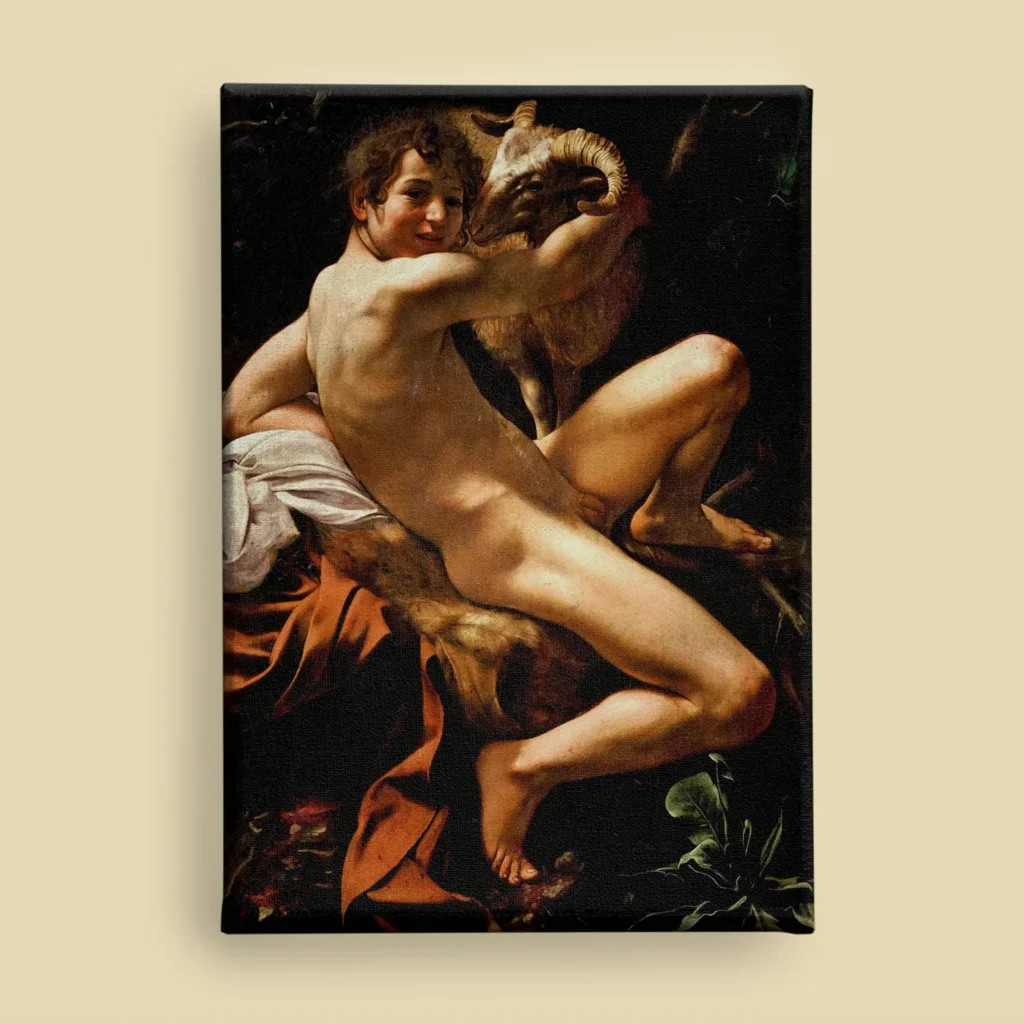
Saint John the Baptist (Youth with a Ram)
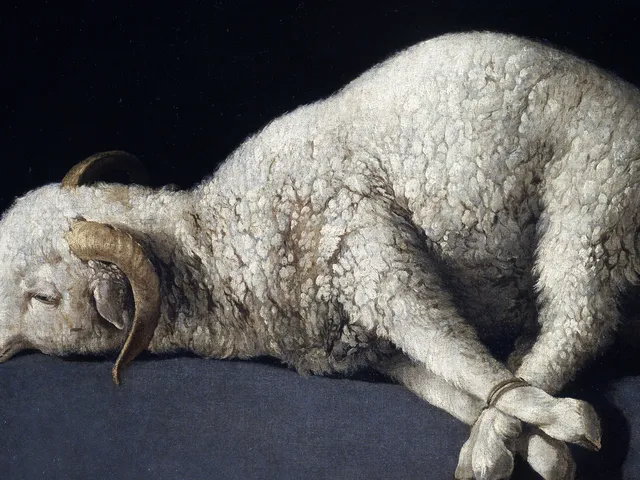
The Saint John the Baptist at the Capitoline Museums in Rome, painted around 1602, is one of the most discussed and most debated paintings in Caravaggio’s output. The young figure, a boy or young man, naked except for the red cloak that identifies him as the Baptist, sits in a relaxed and provocative pose, his arm around a ram, looking directly at the viewer. The identification as Saint John is conventional, the ram alludes to the “Lamb of God” that John proclaimed, but the treatment is unprecedented: the sensuous physicality of the figure, the directness of the gaze, and the absence of the usual Baptist attributes make this a painting that simultaneously fulfills and questions its religious category.

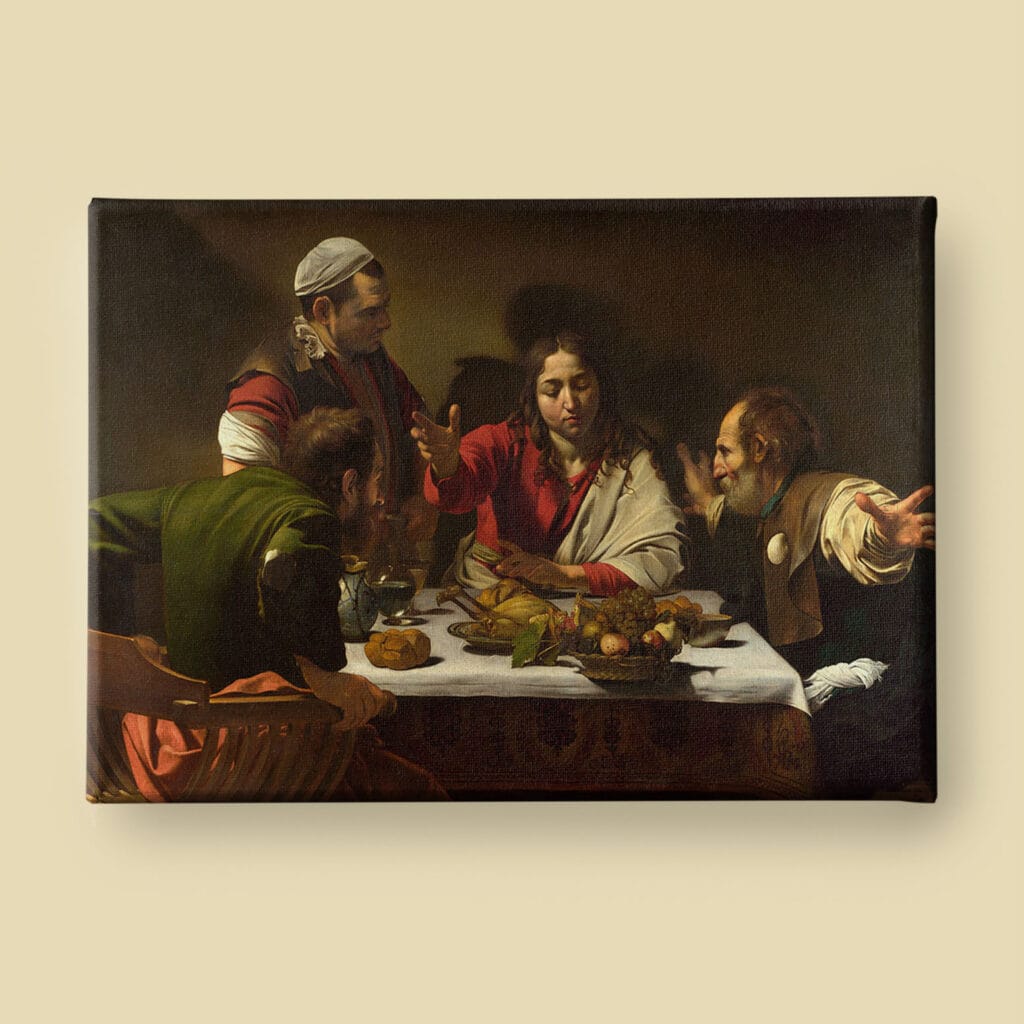
Supper at Emmaus
The Supper at Emmaus at the Pinacoteca di Brera in Milan (a later version; the earlier is in the National Gallery in London), painted around 1606, shows the moment from Luke’s Gospel when the risen Christ reveals himself to two disciples at a meal in Emmaus. The disciples’ recognition of the risen Lord, shown in the moment of its happening, the arms spread wide, the face turned toward the viewer in astonishment, is one of the most dramatically alive of all Caravaggio’s sacred narratives. Christ is shown not in glory but quietly, his face calm and his gesture simply that of the breaking of bread, and it is in this ordinariness of the divine presence that the painting’s theology lies.

The Beheading of Saint John the Baptist
The Beheading of Saint John the Baptist at St. John’s Co-Cathedral in Valletta, Malta, painted in 1608, is the largest painting Caravaggio ever made and the only one he signed, and he signed it in the blood of the Baptist, tracing his name in the red liquid spreading from the decapitated body. The composition is austere, the action almost anti-climactic: the executioner kneels over the fallen figure, reaching for the sword to complete the decapitation; Herodias’s servant holds the silver dish that will receive the head; the jailer points down; and two prisoners watch from a barred window above. The drama is in the scale and the darkness, not in theatrical gesture.

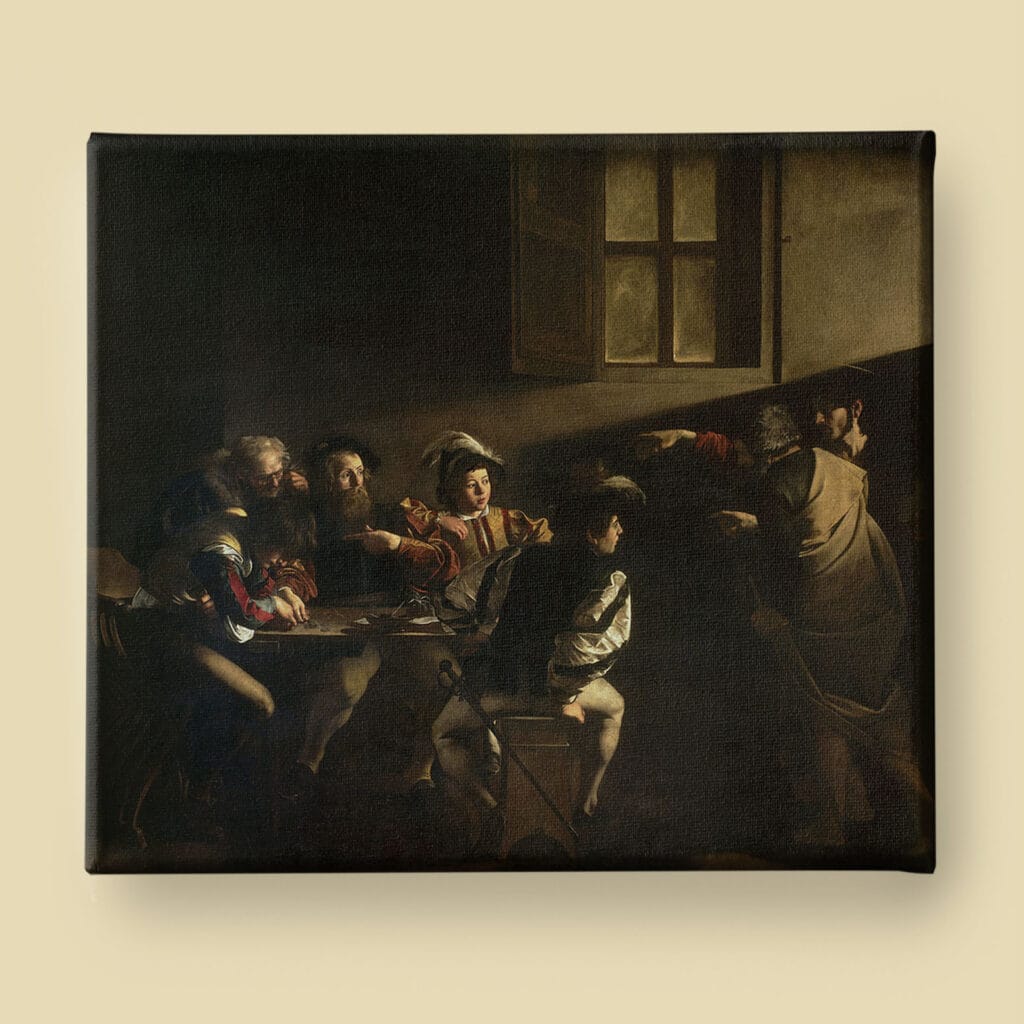
The Calling of Saint Matthew
The Calling of Saint Matthew in the Contarelli Chapel of San Luigi dei Francesi in Rome, painted in 1599-1600, is one of the most celebrated paintings of the Baroque period. The scene, Christ calling the tax collector Matthew from his counting table, is shown in a setting that looks like a contemporary Roman tavern. A group of young men gather around a table; Christ enters from the right with an arm extended in a gesture that recalls Michelangelo’s God creating Adam on the Sistine ceiling; and a shaft of light follows the gesture into the darkness. Which figure is Matthew is deliberately ambiguous, Caravaggio invites the viewer to experience the moment of calling as personal rather than historical.

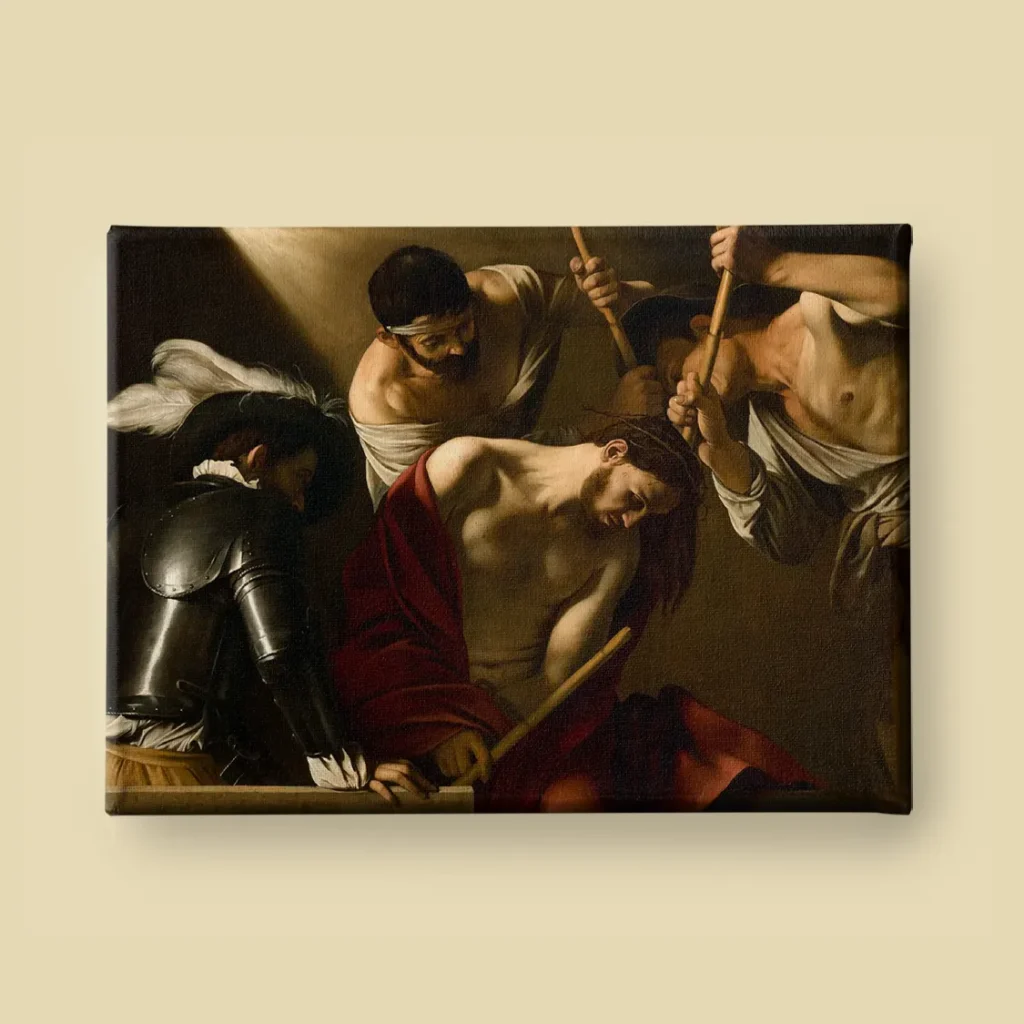
The Crowning with Thorns
The Crowning with Thorns at the Kunsthistorisches Museum in Vienna, painted around 1602-1603, shows the Roman soldiers’ mockery of Christ before his condemnation. Two soldiers press the crown of thorns onto Christ’s head with long sticks, while a third holds his shoulder. Caravaggio shows the physical action with his characteristic directness: the pressure of the sticks, the downward force of the crown, the posture of the figure subjected to this treatment. Christ’s expression is one of composure under duress, not theatrical suffering but the quiet of someone who has accepted what is happening, and it gives the painting its particular spiritual quality.

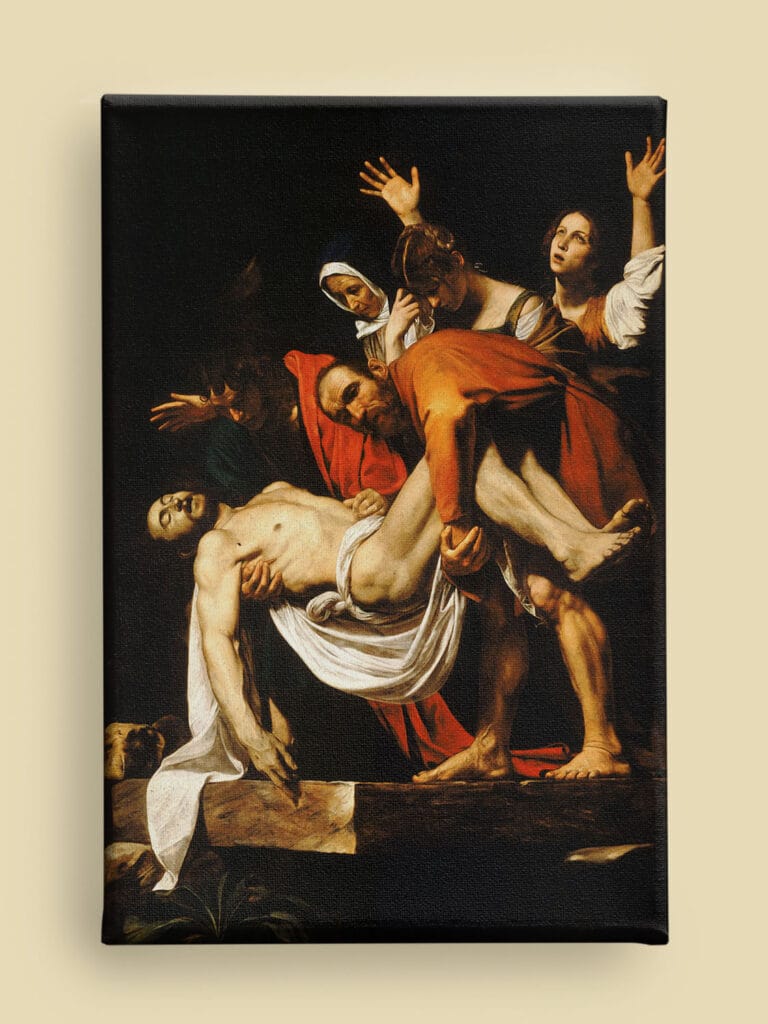
The Entombment of Christ
The Entombment of Christ at the Pinacoteca Vaticana, painted around 1602-1603, is Caravaggio’s most formally composed and most classically organized painting, a work that seems to have absorbed the lesson of antique relief sculpture in the arrangement of the figures across the picture plane. The body of Christ is lowered into the tomb by Nicodemus and John, while the Virgin, Mary Magdalene, and another Mary figure gesture and grieve above. The stone slab on which Nicodemus stands is presented to the viewer’s eye at an angle that brings it directly forward out of the picture, and the composition creates the powerful illusion that the body of Christ is being lowered not into a painted tomb but into the viewer’s physical space.

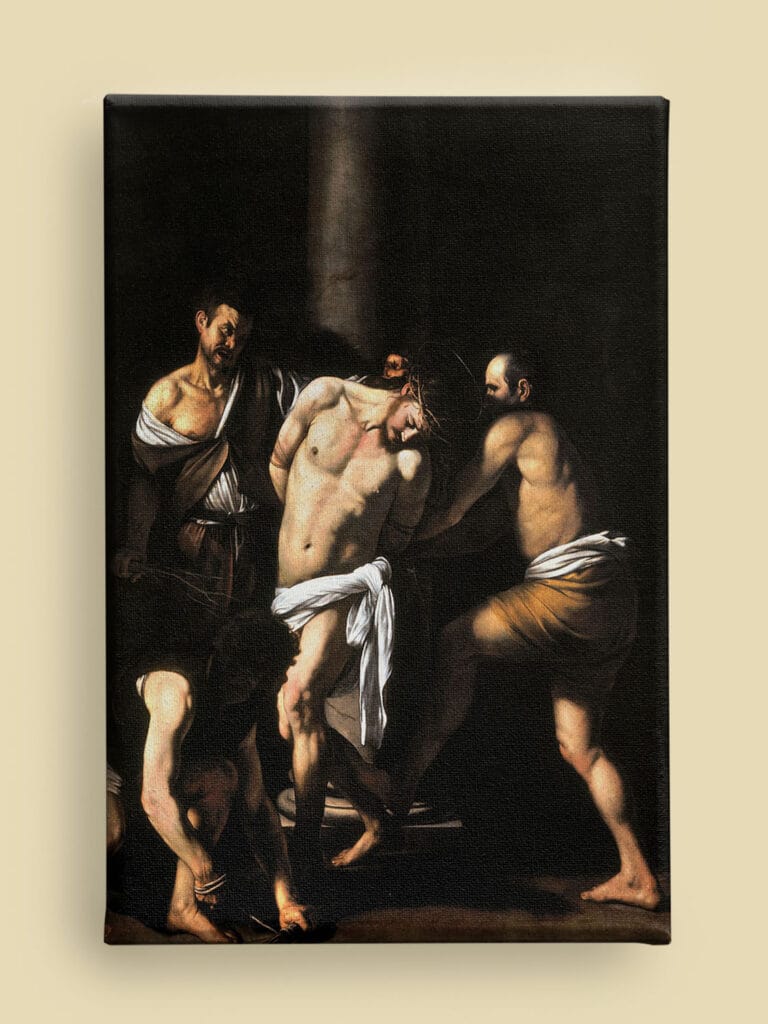
The Flagellation of Christ
The Flagellation of Christ at the Museo di Capodimonte in Naples, painted around 1607-1608, shows the Roman soldiers scourging Christ before his crucifixion. The figures are reduced to essentials: the column to which Christ is tied, the three tormentors in their varied attitudes of violence and preparation, the figure of Christ himself showing the physical reality of the beating he is enduring. The lighting is extreme even by Caravaggio’s standards, the figures emerge from almost total darkness, lit by a single source that makes the skin and the muscles luminous against the black background. It is one of the most powerful of all Passion paintings.

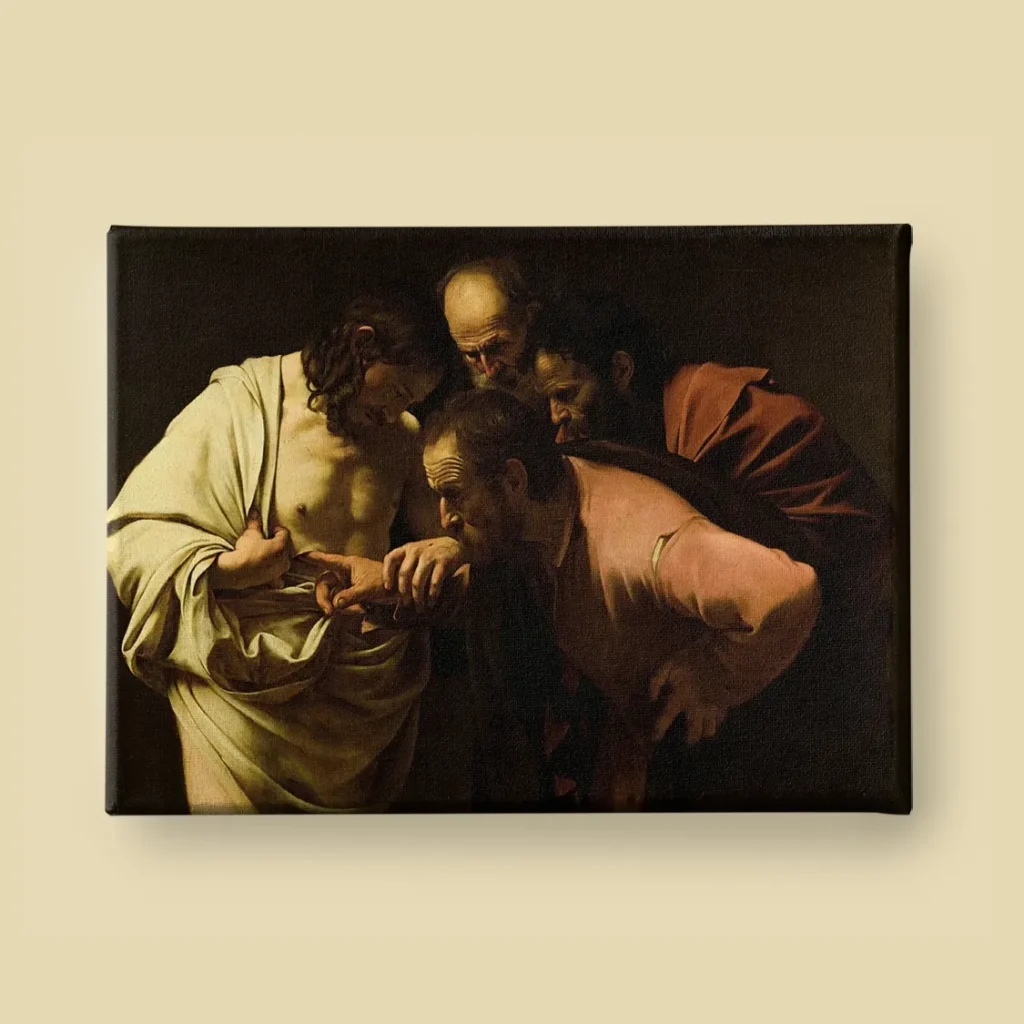
The Incredulity of Saint Thomas
The Incredulity of Saint Thomas at the Sanssouci Picture Gallery in Potsdam, painted around 1601-1602, shows the apostle Thomas placing his finger into the wound in Christ’s side, the act of tactile verification that the Gospel of John records as the occasion of Thomas’s declaration “My Lord and my God.” Caravaggio’s treatment is typically direct: Thomas’s finger is actually inside the wound, and the three other apostles press close to look, their faces showing a mixture of belief and the effort to understand what they are seeing. The risen Christ guides Thomas’s hand with a calm that contrasts with the disciples’ urgent attention.

The Martyrdom of Saint Matthew
The Martyrdom of Saint Matthew at San Luigi dei Francesi in Rome, facing the Calling of Saint Matthew in the same chapel, shows the execution of the apostle while celebrating Mass in Ethiopia. An assassin descends on the altar where Matthew lies, while the crowd scatters in panic, each figure running or falling in a different direction, creating a composition of centrifugal energy that contrasts with the calm of the Calling opposite. In the crowd, one young man looks outward at the viewer: this is Caravaggio himself, witnessing the martyrdom he painted.

The Taking of Christ
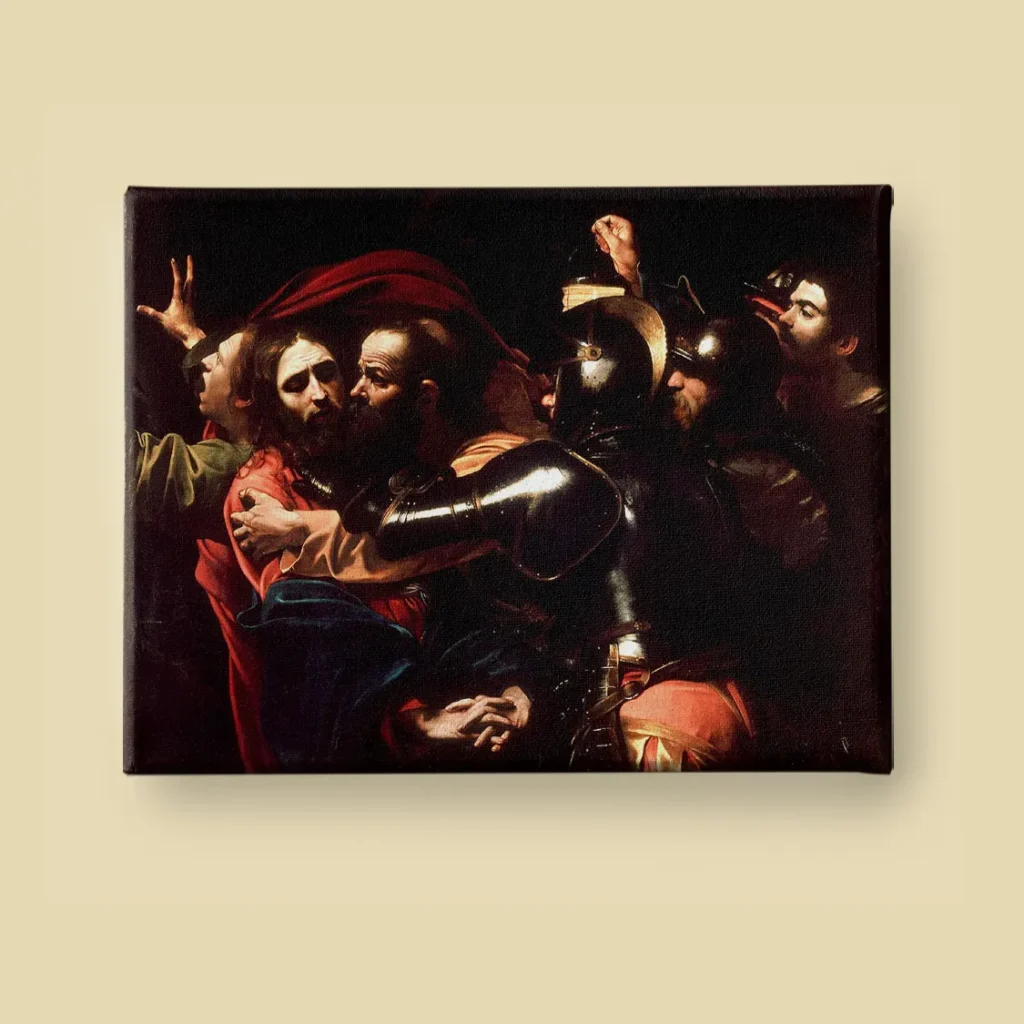
The Taking of Christ at the National Gallery of Ireland in Dublin, painted around 1602, shows the arrest of Christ in the Garden of Gethsemane, the moment when Judas kisses him in identification and the soldiers seize him. Caravaggio shows the scene with compressed intensity: Judas’s face pressed against Christ’s, the soldiers crowding in with armor gleaming in the torchlight, Christ’s hands clasped together, not in resistance but in prayer or acceptance. At the far right, a figure holds a lantern over the scene: another self-portrait, Caravaggio as witness and illuminator of the sacred drama.

Summary of Caravaggio’s Paintings
| Painting | Date | Location |
|---|---|---|
| Crucifixion of Saint Peter | 1600-01 | Cerasi Chapel, Santa Maria del Popolo, Rome |
| Death of the Virgin | c. 1601-06 | Louvre, Paris |
| Ecce Homo | c. 1605 | Palazzo Bianco, Genoa |
| Judith Beheading Holofernes | c. 1598-99 | Galleria Nazionale d’Arte Antica, Rome |
| Madonna of the Rosary | c. 1606-07 | Kunsthistorisches Museum, Vienna |
| Saint John the Baptist (Youth with a Ram) | c. 1602 | Capitoline Museums, Rome |
| Supper at Emmaus | c. 1606 | Pinacoteca di Brera, Milan |
| The Beheading of Saint John the Baptist | 1608 | St. John’s Co-Cathedral, Valletta |
| The Calling of Saint Matthew | 1599-1600 | San Luigi dei Francesi, Rome |
| The Crowning with Thorns | c. 1602-03 | Kunsthistorisches Museum, Vienna |
| The Entombment of Christ | c. 1602-03 | Pinacoteca Vaticana, Vatican |
| The Flagellation of Christ | c. 1607-08 | Museo di Capodimonte, Naples |
| The Incredulity of Saint Thomas | c. 1601-02 | Sanssouci Picture Gallery, Potsdam |
| The Martyrdom of Saint Matthew | 1599-1600 | San Luigi dei Francesi, Rome |
| The Taking of Christ | c. 1602 | National Gallery of Ireland, Dublin |
Important Facts about Caravaggio
- Born: 1571 in Milan as Michelangelo Merisi; moved to Rome around 1592, where his revolutionary approach to painting transformed the entire tradition of European art within a decade.
- Tenebrism: His technique of extreme chiaroscuro, brilliant light against deep shadow, with figures emerging from near-total darkness, became known as tenebrism and was imitated throughout Europe; the painters influenced by him are known as Caravaggisti.
- Realism: His radical naturalism, painting sacred subjects with working-class models in contemporary settings, without idealization, was both celebrated and controversial in his own time; several of his works were rejected by the churches that commissioned them before eventually being accepted.
- Fugitive years: After killing a man in a brawl in Rome in 1606, he fled and spent his last four years as a fugitive in Naples, Malta, and Sicily, continuing to paint major works throughout this period; he died in 1610, possibly of fever, on his way back to Rome.
- Influence: His influence on the subsequent history of painting, on Rubens, Velazquez, Rembrandt, and ultimately on the entire Baroque and beyond, is rivaled only by that of Raphael and Michelangelo; he is the painter whose revolution most directly shaped the visual culture of the seventeenth century.
Frequently Asked Questions about Caravaggio
What is tenebrism and why is it associated with Caravaggio?
Tenebrism (from the Italian tenebroso, “shadowy, murky”) is a style of painting characterized by violent contrasts between very bright light and areas of very deep shadow, with figures or objects emerging dramatically from a dark background. The technique was developed by Caravaggio and became his signature: figures are illuminated by a single strong light source, often from the upper left, while the surrounding space is in near-total darkness. The effect gives figures an extraordinary physical presence, they seem to exist in real space under real light, and it creates a dramatic intensity that serves the emotional requirements of the sacred subjects Caravaggio most often painted. The Caravaggisti, painters across Europe who imitated his technique, spread tenebrism to Spain, the Netherlands, France, and Germany in the first half of the seventeenth century.
Why were some of Caravaggio’s paintings rejected by the churches that commissioned them?
Several of Caravaggio’s works were initially rejected on grounds of indecorum, a failure to maintain the dignity appropriate to the sacred subjects depicted. The Death of the Virgin was rejected (according to the most persistent account) because the dead Mary looked too much like a real dead woman, possibly a drowned woman, rather than the idealized figure the tradition required. The first version of the Calling of Saint Matthew was rejected because Matthew’s saint’s feet pointed directly toward the viewer, an irreverence considered inappropriate. These rejections reflect the tension between Caravaggio’s radical naturalism and the expectations of his ecclesiastical patrons, who wanted sacred images that were devotionally effective but not disturbing to conventional piety.
How did Caravaggio influence subsequent painters?
Caravaggio’s influence operated through both his technique and his approach. His tenebrism was immediately imitated: a group of painters known as the Caravaggisti formed in Rome within years of his major works, and through them the technique spread to every country in Europe. Rubens, who was in Rome when Caravaggio was working there, absorbed his approach to dramatic narrative and physical presence. Velazquez studied the Caravaggisti in Spain and through them absorbed the lessons of Caravaggio himself. Rembrandt’s approach to light and shadow is ultimately rooted in the same revolution. More broadly, the principle that sacred subjects should be depicted with the full physical reality of ordinary human experience, without idealization, without ornamental grace, opened a path that Western painting has followed in various forms ever since.
What is the story behind Caravaggio’s signature on the Beheading of Saint John the Baptist?
The Beheading of Saint John the Baptist in St. John’s Co-Cathedral in Valletta is the only painting Caravaggio signed, and the manner of the signature is unique: he wrote “fra Michelangelo” (Brother Michelangelo, referring to his recent reception into the Knights of Malta) in what appears to be the blood flowing from the Baptist’s severed neck. The signature is simultaneously a devotional act, a painter signing his name in the blood of a martyr, and an assertion of identity at a moment when Caravaggio was seeking rehabilitation through his Maltese connections after the killing that had driven him from Rome. The co-Cathedral has kept the painting in situ since 1608.
Where can the major works of Caravaggio be seen?
The greatest concentration of Caravaggio’s work in a single location is the two chapels in Roman churches: the Contarelli Chapel in San Luigi dei Francesi (Calling of Matthew, Martyrdom of Matthew, and Inspiration of Matthew) and the Cerasi Chapel in Santa Maria del Popolo (Crucifixion of Peter and Conversion of Paul). The Pinacoteca Vaticana holds the Entombment. The Louvre has the Death of the Virgin. The Kunsthistorisches Museum in Vienna has the Rosary Madonna and the Crowning with Thorns. The Beheading of Saint John the Baptist is in Valletta, Malta. The Taking of Christ is in Dublin. The Flagellation is in Naples.
Where can I buy a Caravaggio painting reproduction?
You can buy them at jesuschrist.pictures: browse all the Caravaggio canvas prints in our shop, printed on museum-grade canvas and available in several sizes.