Michelangelo Paintings That Shook the Renaissance
Michelangelo paintings occupy a category all their own. Michelangelo di Lodovico Buonarroti Simoni spent most of his life insisting he was not a painter. He was a sculptor, he said, and everything else was a distraction. Yet the images he left on the walls and ceiling of the Sistine Chapel have outlasted every argument he made against his own brush. They did not merely decorate a chapel. They set the standard against which all religious painting since has been measured, and they did so through a faith that was, for Michelangelo, entirely personal and entirely serious.

A Painter Who Refused to Be One: The Early Panel Works
Before the Sistine Chapel, before Julius II and the papal commissions, Michelangelo was known almost exclusively as a sculptor. The few paintings he did produce in the years around 1497 to 1501 were panel works, small by the standards that would follow, and two of them remain unfinished to this day. That incompleteness is itself revealing. Michelangelo simply lost interest in paint once the sculptural problem of a composition was solved in his mind.
The Manchester Madonna, now at the National Gallery in London, is one of the most striking examples of this half-realized ambition. The Virgin sits reading, the Christ Child resting against her lap, while two angels flank the group on each side. One of the angels on the left is finished to a high degree; the two on the right are little more than sketched silhouettes, warm brown underpaint on unpainted wood. Scholars date the work to around 1497. The contrast is not carelessness but impatience: once the structural idea was clear, the execution became secondary. What is finished here is already extraordinary, the drapery modelled with sculptural weight, the Madonna’s face serene and utterly human.

The Entombment, also at the National Gallery, belongs to roughly the same period, around 1500 to 1501. Christ’s body is being carried toward the tomb by figures whose grief is concentrated entirely in posture and bearing. Two of the positions in the composition are barely blocked in, and the landscape behind remains largely unpainted. Despite its incompleteness, the work has a physical weight that is difficult to account for. The figures feel like they are carrying something genuinely heavy. This sense of bodily reality was not something Michelangelo learned from other painters. He learned it from stone.

Together, these two panels reveal a painter working from sculptural instinct, building figures from the inside out, treating the human body as the primary carrier of spiritual meaning. By the time Pope Julius II summoned him to Rome in 1508, that instinct was about to find its largest possible canvas.
The Sistine Chapel Commission: Four Years Against a Ceiling
Michelangelo’s first response to Julius’s proposal was refusal. He wrote that painting was not his art. He suspected a rival, possibly Bramante, had arranged the commission precisely to embarrass him. Julius was not the kind of man to accept a refusal, and Michelangelo was not the kind of man to do a job halfway. What followed, from 1508 to 1512, was one of the most ambitious painted programs in Western history.
The ceiling of the Sistine Chapel spans roughly 500 square meters. The original plan called for the twelve apostles in the spandrels and a decorative pattern across the vault. Michelangelo rejected it and proposed something far more complex: a full account of the Book of Genesis, from the separation of light and darkness to the story of Noah, flanked by Hebrew prophets and pagan sibyls who prefigured the coming of Christ, and below them the ancestors of Christ tracing the human lineage of the Incarnation. The result changed what painting could say about God, creation, and humanity.

Among the twelve prophets and sibyls placed around the edges of the ceiling, the Persian Sibyl stands out for the physical intensity of her pose. She sits bent forward over an open book, her muscular arms folding inward, her eyes close to the page. Michelangelo’s sibyls are not decorative allegories. They are searchers, readers, interpreters of a truth they can sense but not yet name. The Persian Sibyl is said in classical tradition to have prophesied the coming of a child born of a virgin. Here, painted in approximately 1509, she looks like someone on the edge of understanding something immense.

Stepping back to take in the full ceiling is an experience that resists description. The nine central panels move from the creation of the heavens to the drunkenness of Noah in a great sweep of sacred history, bracketed by figures of overwhelming physical and spiritual energy. What unified the whole was Michelangelo’s conviction, stated in his letters, that the ideal human body was itself a form of theological statement, that God had made man in his image, and that painting that image at its fullest was a form of worship. As we explore in our article on Italian Renaissance Jesus Paintings, no other work shaped the visual language of Christian devotion in the sixteenth century more completely.

The Creation of Adam: A Breath Between Two Fingers
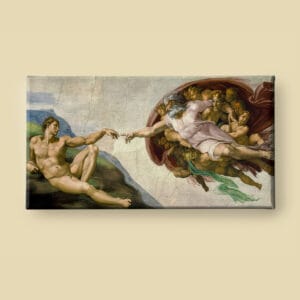
Of everything painted on the Sistine ceiling, the Creation of Adam has traveled furthest into collective human memory. Painted in approximately 1511 to 1512, it shows the moment just before God’s finger touches Adam’s outstretched hand. Adam reclines on a rocky slope, his body heavy and passive, the arm not yet fully alive. God speeds across the sky surrounded by angels, his right arm extended. The gap between the two fingers, barely a breath wide, has been interpreted for five centuries as the charged space between mortality and the divine, between what exists and what is about to become.
Michelangelo made one choice here that no predecessor had made: he showed God as old but vigorous, an ancient figure full of urgent physical energy. This was not the distant, abstract God of Byzantine imagery. It was a God who moved, who reached, who willed. And facing him, Adam’s body is not passive in a negative sense. It waits with the complete and perfect relaxation of something that has not yet been given the gift of tension. The moment of contact, when it comes, will change everything.

The Creation of Eve
Directly adjacent on the ceiling, the Creation of Eve tells a different story of origin. Adam sleeps while God gestures Eve upward from his side, her body rising in an attitude that resembles prayer. Where the Creation of Adam is charged with distance and longing, this scene is quieter, more enclosed. God stands close; the movement is inward rather than across a void. Eve rises not toward something distant but toward something she already participates in, drawn from Adam’s body as if she were always already present in him.
The theology here is not incidental. Michelangelo, deeply read in scripture and in the writings of the Platonist circle of the Medici court, understood Eve’s creation as a theological statement about unity within difference. The painting has none of the drama of the preceding panel. It is tender, almost domestic, by the standards of everything around it on the ceiling.

The Fall and Expulsion from Paradise
In the Fall and Expulsion from Paradise, Michelangelo compressed two distinct moments of the Genesis narrative into a single frame, with the Tree of Knowledge as the dividing line. On the left half, Adam and Eve reach toward the fruit offered by a serpent coiled around the tree, its upper body taking female form. On the right, an angel drives them from the Garden, their faces transformed by shame and anguish. Adam raises one arm in a gesture that is at once protection and supplication; Eve turns her face away from the angel’s sword.
This compositional decision, two moments in one panel, was bold and deliberate. It showed the Fall not as a static scene but as a before-and-after, a moral narrative made visible within a single painted space. The bodies of the expelled figures on the right are noticeably heavier, more burdened, than the reaching figures on the left. That physical change is theological: the weight of sin is made visible in the posture of the body. The story of Christ’s life that would follow centuries later is already present here as a consequence of what this panel depicts.

The Last Judgment: Twenty Years Later, a Different Michelangelo
Twenty years after finishing the ceiling, Michelangelo returned to the Sistine Chapel. The world had changed. The Reformation had fractured the Church. Rome had been sacked in 1527. Pope Clement VII, who had commissioned the new work before his death, had been succeeded by Paul III, who saw in Michelangelo’s return to the chapel an opportunity to make a statement of Catholic conviction. The result, painted from 1536 to 1541, was The Last Judgment.
It is not a comforting painting. The scale alone is overwhelming: the fresco covers the entire altar wall, 13.7 by 12 meters. At its center stands Christ, young and beardless, his right arm raised in a gesture of final verdict rather than blessing. Around him the dead rise from their graves, the elect ascend, and the damned are dragged downward. There are no neat hierarchies, no gilded thrones. The whole composition moves in a counterclockwise rotation, a cosmic turbulence. Near Saint Bartholomew, who holds the instrument of his own martyrdom, hangs a flayed skin. The face on that skin is Michelangelo’s own.

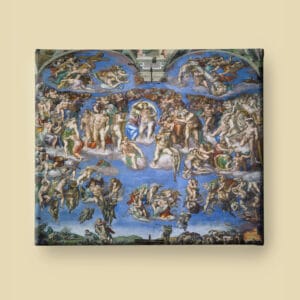
The fresco provoked controversy immediately. Cardinal Biagio da Cesena, the Papal Master of Ceremonies, called the nude figures more appropriate for a bathhouse than a sacred space. Michelangelo responded by painting his face onto Minos, the judge of the underworld, with ass’s ears. After Michelangelo’s death, Daniele da Volterra was commissioned to add draperies over some of the nudity, earning himself the immortal nickname Il Braghettone, the breeches painter. The retouching continued under later popes, and some of it remained until the twentieth century. The painting was restored between 1990 and 1994.
Seen today, The Last Judgment reads as Michelangelo’s most personal theological statement: not a vision of comfort, but of reckoning. Where the ceiling had celebrated creation and the promise of salvation, the altar wall confronted its viewer with the full weight of what that promise entailed. This was the Renaissance Jesus painting pushed to its moral limit. For Michelangelo, who in his later years was increasingly absorbed in his own sense of unworthiness before God, the subject was not academic.
Other painters of the Italian Renaissance engaged with the same scriptural material but arrived at very different places. Fra Angelico, a full generation earlier, brought to his Last Judgment a calm luminosity, a faith that seemed to rest in joy rather than anxiety. Raphael, Michelangelo’s great contemporary and rival in Rome, preferred grace and harmony. The contrast between their visions of the sacred is one of the defining conversations in Italian Renaissance art. Our article on Leonardo da Vinci paintings explores a third temperament entirely: the painter as philosopher, less interested in theological drama than in the mystery of human expression.
The Very Beginning: The Torment of Saint Anthony
It is worth ending at the beginning. Around 1487 to 1488, a twelve-year-old boy in Florence made a copy of a print. The print was an engraving by Martin Schongauer, a German master, showing Saint Anthony lifted into the air and tormented by a swarm of demons. The boy reproduced the composition in paint, but he did not simply copy it. He reportedly went to the fish market to study the scales and coloring of real fish, so that the demons’ scales would be accurate. He was already doing what he would do for the rest of his life: looking at the real world as carefully as possible in order to paint the sacred world more truly.

That boy was Michelangelo. The Torment of Saint Anthony, now at the Kimbell Art Museum in Fort Worth, Texas, is considered by many scholars to be his earliest surviving painting. He was twelve or thirteen years old when he made it. The demons are already more convincing than they are in Schongauer. The light on Saint Anthony’s face is already doing something more than the source material asked for. If you look closely at this small, early picture and then think of the Sistine ceiling made two decades later, the line between them is absolutely direct. What changed was scale, confidence, and the weight of a fully formed theology. The instinct was already there from the start.
Later painters in the Italian tradition, from Caravaggio to Tintoretto, inherited Michelangelo’s commitment to the body as theological statement even when they rejected his style. The muscular drama of the Sistine ceiling echoes in Caravaggio’s darkened rooms and in Tintoretto’s elongated, turbulent figures. Even Botticelli, who was a generation older and deeply different in temperament, can be read more clearly when placed in contrast to Michelangelo’s radical insistence on physical weight and moral gravity. The conversation between them, across time and across the walls of Florentine chapels and Roman basilicas, is still going on.
Summary of Michelangelo’s Major Paintings
| Painting | Date | Medium | Location |
|---|---|---|---|
| The Torment of Saint Anthony | c. 1487-1488 | Tempera on panel | Kimbell Art Museum, Fort Worth |
| Manchester Madonna | c. 1497 | Tempera on panel (unfinished) | National Gallery, London |
| The Entombment | c. 1500-1501 | Oil on panel (unfinished) | National Gallery, London |
| Sistine Chapel ceiling | 1508-1512 | Fresco | Vatican Museums, Rome |
| Sistine Chapel ceiling (Persian Sibyl) | c. 1509 | Fresco | Vatican Museums, Rome |
| The Creation of Adam | c. 1511-1512 | Fresco | Vatican Museums, Rome |
| The Creation of Eve | c. 1510 | Fresco | Vatican Museums, Rome |
| The Fall and Expulsion from Paradise | c. 1509-1510 | Fresco | Vatican Museums, Rome |
| The Last Judgment | 1536-1541 | Fresco | Vatican Museums, Rome |
Important Facts About Michelangelo
- Michelangelo di Lodovico Buonarroti Simoni was born on March 6, 1475, in Caprese, a small hill town in Tuscany, the second son of a local magistrate with a noble lineage but limited means.
- He trained first in the Florentine workshop of Domenico Ghirlandaio from 1488, then passed to the Medici Sculpture Garden under Bertoldo di Giovanni, where he came directly under the patronage of Lorenzo de’ Medici.
- Michelangelo is the central figure of the Italian High Renaissance and the bridge to Mannerism, known above all for his treatment of the human figure as the primary vehicle of spiritual and emotional truth, giving his painted bodies the weight and tension of carved stone.
- His most celebrated painted work is the ceiling of the Sistine Chapel in the Vatican, executed between 1508 and 1512 under Pope Julius II, covering over 500 square meters with scenes from Genesis and figures of prophets, sibyls, and the ancestors of Christ.
- He died on February 18, 1564, in Rome, at the age of eighty-eight, and his influence on Western painting, sculpture, and architecture has been continuous and decisive from the sixteenth century to the present day.
Questions and Answers About Michelangelo’s Paintings
What is the most famous painting by Michelangelo?
The Creation of Adam, part of the Sistine Chapel ceiling (c. 1511-1512), is generally considered Michelangelo’s most famous painting. The image of God’s finger reaching toward Adam’s outstretched hand has become one of the most reproduced images in the history of Western art. It is located in the Sistine Chapel at the Vatican Museums in Rome, where it can be seen today as part of the full ceiling program.
How long did it take Michelangelo to paint the Sistine Chapel?
The Sistine Chapel ceiling took approximately four years to complete, from 1508 to 1512. Michelangelo worked largely without assistants for the most demanding sections, painting in fresco directly onto wet plaster on a specially constructed scaffold. The altar wall fresco, The Last Judgment, was a separate commission painted from 1536 to 1541, taking five years. Michelangelo was sixty-six years old when he finished it.
What is the religious meaning of The Creation of Adam?
The painting illustrates the moment described in Genesis 2:7, when God breathes life into Adam. Michelangelo’s composition gives that moment a visual expression no earlier painter had attempted: the gap between the two fingers, barely closed, holds the entire theological weight of the scene. The fresco also suggests the Platonist idea, familiar from the Medici circle in Florence, that the soul is transmitted through the touch of divine intellect. God is surrounded by a group of figures, sometimes interpreted as angels or as unborn souls, contained in a shape that some anatomists have compared to the human brain.
Where can I see Michelangelo’s paintings?
The great majority of Michelangelo’s paintings are in Rome. The Sistine Chapel, including the ceiling and The Last Judgment, can be visited through the Vatican Museums, for which timed entry tickets are strongly recommended. The Manchester Madonna and The Entombment are at the National Gallery in London and are free to visit. The Torment of Saint Anthony is at the Kimbell Art Museum in Fort Worth, Texas. The Vatican also holds the two frescoes in the Pauline Chapel, The Conversion of Saul and The Crucifixion of Saint Peter, though access to the Pauline Chapel is more restricted.
How does Michelangelo compare to Raphael and Leonardo as a religious painter?
The three form a kind of triangle. Leonardo da Vinci approached sacred subjects as philosophical problems, interested in the inner life revealed through expression and gesture. Raphael sought grace, harmony, and an ideal beauty that made the sacred feel approachable and serene. Michelangelo’s approach was the most austere and the most confrontational: he used the body to express moral and spiritual weight, and his figures demand something from the viewer. Where Raphael invites, Michelangelo commands.
Did Michelangelo paint anything other than the Sistine Chapel?
Yes, though his panel paintings are few and two of the most significant are unfinished. The Manchester Madonna (c. 1497) and The Entombment (c. 1500-1501) are both at the National Gallery in London. The Doni Tondo (1507), a circular panel showing the Holy Family, is at the Uffizi Gallery in Florence and is the only finished panel painting universally agreed to be his. He also painted two frescoes in the Pauline Chapel at the Vatican, completed in his seventies. His reluctance to work in paint was consistent and lifelong; he always considered himself primarily a sculptor.
Can you buy Michelangelo paintings as canvas prints?
You can buy them at jesuschrist.pictures. All the Michelangelo canvas prints are gathered in our shop, printed on premium canvas and shipped worldwide.