Michelangelo’s Last Judgment: Heaven and Terror
The Last Judgment is the great fresco that fills the altar wall of the Sistine Chapel, painted by Michelangelo in the years after he had finished the famous ceiling. Worked between 1536 and 1541, it shows the second coming of Christ and the final judgment of every soul, the saved rising on one side and the damned falling on the other. The fresco is in the Sistine Chapel, Vatican Museums. Its medium is fresco, color laid into fresh plaster.
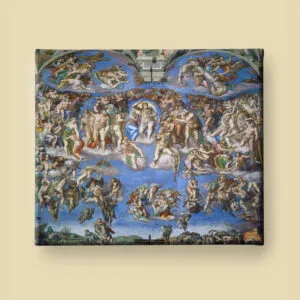
At first the wall reads as a single storm of bodies. Then the eye finds its center: a young, beardless Christ who lifts his right arm in a gesture that both calls the blessed upward and casts the guilty down. The Virgin Mary turns at his side, no longer interceding, since the time for mercy has passed. The whole vast scene turns around that one raised hand.
What makes the Last Judgment so overwhelming is its scale and its honesty. Michelangelo painted more than three hundred figures, most of them nude, caught in hope or terror. There is no calm architecture to hold them, only sky, cloud, and the pull of judgment. It is one of the most ambitious images of the end of time ever attempted.
The fresco belongs to Michelangelo’s late years, when his faith had darkened and deepened. Readers who want to follow his path as a painter can also read our article on Michelangelo’s paintings.
The History of the Last Judgment
The Last Judgment was commissioned by Pope Clement VII and carried out under his successor, Paul III. Michelangelo began work in 1536, more than twenty years after completing the Sistine ceiling and its famous Creation of Adam, and unveiled the wall in 1541. To make room for it he had earlier frescoes destroyed and two windows blocked, so that the entire end of the chapel became a single field for the scene.

The fresco was painted in true fresco, color applied to fresh plaster section by section. By this stage Michelangelo was in his sixties, and the physical effort of covering so large a wall, high above the altar, was immense. The Vatican Museums preserve the work today as the climax of the chapel, facing the congregation at the moment of worship.
The nudity of the figures caused conflict almost at once. After Michelangelo’s death in 1564, the painter Daniele da Volterra was asked to add draperies over the most exposed bodies, which earned him the nickname Il Braghettone, the breeches maker. A long cleaning, completed in 1994, recovered the strength of the original color.
The Meaning and Symbolism of the Last Judgment
Everything depends on the figure of Christ. Michelangelo breaks with tradition and shows him young and athletic, closer to a classical hero than to the bearded judge of medieval art. His raised arm is firm and final. Around him the saints press in, many holding the instruments of their martyrdom, a reminder that heaven was reached through suffering.

The most personal detail sits just below Christ. Saint Bartholomew, who was flayed alive, holds a knife in one hand and his own empty skin in the other. The face on that hanging skin has long been recognized as a self-portrait of Michelangelo, a quiet confession of the artist’s own fear before judgment.

The division of the wall is clear once the eye settles. On the left the dead rise from their graves and are drawn upward toward the light. On the right the damned are dragged down, resisting, into darkness. Between them sits the still point of Christ, who holds both movements in balance.
The Storm of Bodies and Michelangelo’s Design
There is almost no setting in the Last Judgment. Michelangelo removes the thrones, the buildings, and the neat registers that earlier painters had used, and replaces them with open sky. The figures themselves become the architecture. They rise and fall in great curving currents, so that the wall seems to turn slowly around Christ like a wheel.
This is the work of a sculptor who thinks in bodies. Every figure is modeled with weight and muscle, twisting in space, seen from below and above at once. The crowding is deliberate. It presses the drama against the surface and gives the scene its sense of a single, unstoppable event.
Trumpets, Books, and the End of Time
Near the center, just above the altar, a group of angels sounds the trumpets that wake the dead, following the vision in the Book of Revelation. Two of them hold open books, one small and one large. The small book records the deeds of the saved, the large one the heavier account of the damned.

Lower still, on the right, Michelangelo borrows from Dante. The ferryman Charon drives the damned from his boat toward hell, and Minos, judge of the underworld, stands wrapped in a serpent. The figure of Minos was said to carry the face of Biagio da Cesena, a papal official who had complained that the fresco was indecent. Michelangelo answered the criticism with paint.
The Scandal of the Nudes
No fresco of its age caused a louder quarrel. When the wall was unveiled in 1541, the sea of bare bodies on the altar wall of the pope’s own chapel shocked as many viewers as it amazed. The writer Pietro Aretino declared that such nakedness belonged in a bathhouse rather than a sanctuary, and the papal master of ceremonies Biagio da Cesena called it a work fit for a tavern. Michelangelo answered in paint, giving Minos, the judge of the underworld, the face of Biagio, fitted with the ears of a donkey and a serpent coiled around him. When Biagio begged Pope Paul III to have the portrait removed, the pope is said to have joked that his authority did not reach into hell, so the likeness stayed.
The argument outlived the artist. The Council of Trent, closing in 1563, condemned anything lascivious in sacred images, and within months the order came to clothe the figures. The painter Daniele da Volterra was charged with adding loincloths and veils over the most exposed bodies, a task that earned him the mocking name Il Braghettone, the breeches maker, and similar coverings were added in waves for generations afterward. Only the long restoration completed in 1994 lifted some of the later additions while keeping the historic ones, so that the wall we stand before today still carries the visible marks of its own scandal.
A Turning Point at the End of the Renaissance
The Last Judgment is not a comfortable picture, and it was never meant to be. It places the viewer at the altar, beneath the gaze of a Christ who decides every fate, and it refuses to soften the terror of that moment. Few works of Christian art ask so directly what will become of the soul.
It is also a turning point in the history of art. The serene balance of the High Renaissance gives way here to tension, movement, and unease, the qualities that would shape the art of the decades that followed. The fresco stands as a bridge between two ages, and as the final word of the chapel where Michelangelo had already changed painting once before.
Conclusion
In the Last Judgment Michelangelo gathered the whole drama of salvation onto a single wall. Christ, the Virgin, the saints, the rising and the falling, all turn around one raised hand and one fixed gaze. It is grand and frightening at the same time, exactly as the subject demands.
More than four centuries later the fresco still stops visitors at the door of the Sistine Chapel. It shows an old master facing the last questions of his faith, and giving them a form that no one who stands before the altar can easily forget.
Artwork Information
| Artwork | Artist | Date | Medium | Current Location |
|---|---|---|---|---|
| The Last Judgment | Michelangelo | 1536 to 1541 | Fresco | Sistine Chapel, Vatican Museums |
Five Facts About the Last Judgment
- The Last Judgment is a fresco by Michelangelo on the altar wall of the Sistine Chapel, in the Vatican Museums.
- It was painted between 1536 and 1541, more than twenty years after Michelangelo finished the Sistine Chapel ceiling.
- The scene shows the second coming of Christ and the final judgment of humanity, with more than three hundred figures.
- The face on the flayed skin held by Saint Bartholomew is widely seen as a hidden self-portrait of Michelangelo.
- After the artist’s death, Daniele da Volterra was hired to paint draperies over the nude figures, earning the nickname Il Braghettone, the breeches maker.
FAQ
Why is the Last Judgment controversial?
The fresco showed almost every figure nude, including the saints and Christ, which many in the Counter-Reformation Church found improper for the pope’s own chapel. The dispute led, after Michelangelo’s death, to draperies being painted over many of the bodies.
Did Michelangelo paint himself in the Last Judgment?
Yes. The face on the flayed skin held by Saint Bartholomew is widely read as a self-portrait of Michelangelo, a quiet sign of the artist’s own fear before judgment.
What is the meaning of the Last Judgment?
It shows the second coming of Christ and the final judgment of all souls. The saved rise on one side and the damned fall on the other, while Christ’s raised arm marks the decisive, irreversible moment.
How old was Michelangelo when he painted the Last Judgment?
He was about sixty-one when he began in 1536 and around sixty-six when the wall was unveiled in 1541, more than twenty years after he finished the Sistine ceiling.
When was the Last Judgment painted?
Michelangelo painted it between 1536 and 1541, on the altar wall of the Sistine Chapel.
Where is the Last Judgment today?
The Last Judgment covers the altar wall of the Sistine Chapel, in the Vatican Museums.
What is the flayed skin in the Last Judgment?
It is the attribute of Saint Bartholomew, who was martyred by being flayed alive. Michelangelo painted the saint holding his own empty skin, and gave that skin his own features.
Can you buy a reproduction of Michelangelo’s Last Judgment?
You can buy a reproduction of Michelangelo’s Last Judgment at jesuschrist.pictures: see the canvas reproduction in our shop, printed on museum-grade canvas and available in several sizes.