How Baroque Flemish Masters Painted Jesus with Emotion and Light
Introduction: Context and Meaning in Flemish Baroque Jesus Paintings
In 17th-century Flanders, religious painting entered a golden age of emotional depth and visual power. The Flemish Baroque period, rich in color, movement, and theatrical contrast, gave rise to some of the most moving depictions of Jesus Christ in Catholic art history. Painters such as Peter Paul Rubens, Anthony van Dyck, and Jacob Jordaens channeled their technical mastery into sacred subjects, turning biblical episodes into compelling visual narratives that resonated both publicly and privately.
More than decorative commissions, these works were theological statements, visual homilies that spoke to faith, sacrifice, and divine presence. Often commissioned by churches or devout patrons, Flemish Baroque Jesus paintings fused devotion with drama, making the sacred tangible and emotionally immediate. As you explore this tradition, consider how it builds upon earlier artistic movements such as medieval Jesus paintings and Byzantine Jesus paintings.
The Beauty and Spirit of Flemish Baroque Art
Flemish Baroque art is characterized by its rich textures, dynamic compositions, and intense emotional expressiveness. Rooted in the Catholic Counter-Reformation, the style emerged as a response to both religious fervor and artistic innovation. Artists used theatricality and vivid naturalism to communicate not only stories from Scripture but also the spiritual realities behind them.
In Jesus paintings from this period, one finds a profound sense of immediacy. The viewer is not a distant observer but a participant in the unfolding divine drama. By embracing movement, light, and gesture, Flemish painters infused sacred narratives with a lifelike intensity that made them resonate powerfully in churches, chapels, and homes.
Why Jesus Paintings Mattered in Flemish Baroque Art
Jesus was not only the central figure of Christian theology. He became the heart of Baroque visual storytelling. Flemish artists sought to portray Christ not as a remote ideal, but as both suffering servant and divine redeemer. Their works balanced theological depth with emotional accessibility, inviting the viewer into a personal encounter with the sacred.
These paintings served several purposes. In churches, they inspired worship and reinforced doctrinal truths. In private settings, they fostered intimate meditation and devotion. Beyond their religious function, they also reflected contemporary values, beliefs, and artistic aspirations. Their composition, iconography, and technical innovation left a lasting legacy in the evolution of Catholic art.
Flemish Artists Who Shaped Jesus Iconography
Flemish Baroque painting reached its highest spiritual and artistic expression in the hands of masters like Peter Paul Rubens, Anthony van Dyck, and Jacob Jordaens. Each brought a unique sensibility to religious art, particularly in their depictions of Jesus Christ. Their works combined technical brilliance, narrative intensity, and deep theological insight, creating a visual theology that resonated both in public churches and private devotion.
Peter Paul Rubens
Rubens is without question the central figure in Flemish Baroque painting. His depictions of Jesus are marked by dynamic movement, emotional intensity, and the dramatic use of chiaroscuro. Rubens had a gift for visual storytelling : his large-scale altarpieces communicated theological truths with persuasive clarity.
One of his most celebrated works is The Elevation of the Cross (1610–1611), housed in the Cathedral of Our Lady in Antwerp. The canvas captures the weight and agony of Christ’s suffering, the tension in the figures reflecting the spiritual and physical burden of the crucifixion.

Equally poignant is The Descent from the Cross (1612–1614), which balances sorrow and reverence, drawing the viewer into a moment of profound mourning.

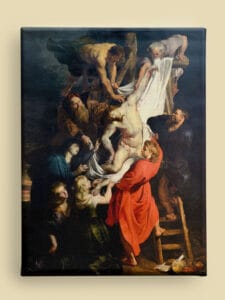
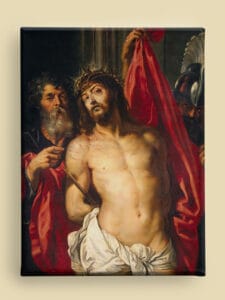
Rubens’ Ecce Homo (c. 1620) is another masterful painting, emphasizing Christ’s humility and silent endurance. These works are not merely scenes, they are emotional encounters, painted to evoke both empathy and awe.

Anthony van Dyck
A pupil of Rubens, Van Dyck developed a softer, more refined religious style, especially in his portraits of Christ. His brushwork and sensitivity to expression brought a new tenderness to Jesus iconography.
In Christ on the Cross (1622), Van Dyck presents a quietly dramatic image of sacrifice, Jesus’s head bowed in serene acceptance. The pain is understated, yet deeply moving.

His Lamentation over the Dead Christ (1629), held at the Prado, immerses the viewer in the intimacy of grief, with mourners embracing the lifeless body of Jesus. Every gesture and tear seems genuine, offering a profoundly human reading of divine suffering.

Jacob Jordaens
Though less focused on religious subjects than Rubens or Van Dyck, Jordaens nonetheless created several impactful depictions of Jesus, often infused with earthy vitality and rich color. His The Adoration of the Shepherds (1655) is a grand scene full of theatricality and awe, capturing the reverence paid to the Christ Child.
His works are often notable for their warm palette and engaging facial expressions, bringing sacred stories into a relatable visual language for Flemish viewers.

Themes and Symbolism in Flemish Baroque Jesus Paintings
Flemish Baroque painters did more than depict biblical events, they infused their canvases with a rich visual language of symbols and theological motifs. These symbols weren’t just artistic flourishes; they were deliberate, catechetical tools designed to deepen the viewer’s engagement with Christ’s message.
Religious Icons and Motifs
Symbolism played a central role in how Jesus was portrayed. Flemish Baroque artists frequently incorporated visual shorthand for theological truths:
| Icon | Meaning |
|---|---|
| The Lamb of God | Represents Christ’s sacrificial role and innocence (John 1:29) |
| The Crown of Thorns | A sign of redemptive suffering, often used in scenes of the Passion |
| The Sacred Heart | Though not doctrinally formalized until later, this motif was foreshadowed in devotional images of Christ’s love and sacrifice |
| The Eucharist | Symbolized in bread, chalices, or Last Supper imagery, underscoring Christ’s continuing presence |
These elements served to invite reflection, reminding viewers that Jesus was both redeemer and companion, divine and human. They reflect the same theological currents found in earlier Gothic Jesus paintings and developed further in Italian Baroque Jesus paintings.
Depiction of Emotions and Spiritual Connection
Emotion was the vehicle for theology in the Flemish Baroque. Artists didn’t just illustrate Christ’s life : they asked viewers to feel it. Through expressions, postures, and lighting, painters built a bridge between the sacred narrative and the viewer’s lived experience.
| Emotion | Artistic Expression |
|---|---|
| Compassion | Gentle gestures, soft light, and Christ’s gaze directed outward |
| Suffering | Gritty realism in wounds, strained muscles, and anguished faces |
| Joy | Resurrection scenes filled with upward motion, open arms, and bright illumination |
By evoking such responses, Flemish Baroque Jesus paintings accomplished what the Counter-Reformation Church intended: to stir the heart as much as the mind. These deeply affective works continue to resonate, especially when studied alongside other traditions like Renaissance Jesus paintings and Medieval Jesus paintings.
Techniques and Style of Flemish Baroque Jesus Paintings
Flemish Baroque artists didn’t just paint, they orchestrated. Each work was the result of masterful technique, designed to captivate both the senses and the soul. Their paintings of Jesus merged theological gravity with painterly innovation, producing artworks that were both devotional and visually arresting.
Use of Light and Shadow
The hallmark of Flemish Baroque technique is its controlled use of light and shadow (chiaroscuro) not merely for realism, but to guide spiritual insight. Artists like Rubens and Van Dyck used directional light to emphasize Jesus as the central figure, drawing attention to His face, wounds, or gesture in moments of healing or sacrifice.
| Technique | Purpose |
|---|---|
| Chiaroscuro | Creates dramatic tension; highlights spiritual symbolism |
| Selective Lighting | Focuses the eye on the divine presence of Christ |
| Shadow Contrast | Evokes mystery and depth, reflecting spiritual struggle |
This emphasis on contrast helped these works transcend the canvas, elevating biblical scenes into powerful, meditative experiences.
Realism and Dramatic Expression
Unlike earlier styles that leaned on abstraction or symbolic simplification, Flemish Baroque Jesus paintings aimed for emotional veracity. Muscles are tensed, tears are visible, and garments ripple with movement. These weren’t idealized figures, they were living witnesses to sacred moments.
| Stylistic Element | Description |
|---|---|
| Anatomical Accuracy | Reflects Christ’s physical suffering and human vulnerability |
| Facial Expression | Conveys inner turmoil, compassion, or divine authority |
| Gesture and Movement | Adds dynamism and brings theological meaning to life |
This realism was essential to making the divine immediate and intimate, an approach that influenced not only later Baroque art, but also the Romantic and even Realist traditions of the 19th century. You’ll find echoes of this method in Spanish Baroque Jesus paintings and other emotionally charged works of the period.
Leading Masters of Flemish Baroque Jesus Paintings
Flemish Baroque painting flourished in the 17th century thanks to a generation of visionary artists who shaped the visual language of Catholic devotion. At the heart of this movement were Peter Paul Rubens, Anthony van Dyck, and Jacob Jordaens. Each brought a unique interpretation of Jesus (ranging from heroic grandeur to intimate sorrow) using powerful brushwork, vibrant color, and emotional storytelling.
These artists didn’t merely depict biblical events; they invited viewers to engage spiritually. Their masterpieces became focal points of altars, chapels, and private devotion across Europe, showcasing a deep understanding of both theology and human emotion.
Flemish Baroque art owes much of its vitality to this trio, whose works elevated the representation of Christ to new emotional and theological heights. Let’s take a closer look at how each artist contributed to this sacred visual tradition.
Preservation and Influence of Flemish Baroque Paintings
Flemish Baroque Jesus paintings are not only a legacy of religious devotion but also masterpieces of European cultural heritage. Today, preserving these works involves highly specialized conservation efforts that respect the material and spiritual integrity of each piece.
Conservation Efforts of Masterpieces
Maintaining these centuries-old treasures is a delicate task. Institutions like the Royal Museum of Fine Arts in Antwerp and the Prado Museum in Madrid are at the forefront of this work. Methods include surface cleaning, structural stabilization, and environmental control to prevent deterioration from light, humidity, and pollution.
| Conservation Technique | Purpose |
|---|---|
| Surface Cleaning | Removes dirt, soot, and aged varnish to restore visual clarity |
| Reinforcement | Strengthens the canvas or wooden panel against cracking and tension |
| Climate Control | Protects paintings from mold, fading, and warping |
| Non-invasive Imaging | Infrared and X-ray scans allow scholars to understand techniques and previous restorations |
These efforts help ensure that future generations can continue to learn from and be inspired by Flemish religious art.
Legacy and Impact on Christian Art
The dramatic storytelling, emotional range, and technical brilliance of Flemish Baroque Jesus paintings deeply influenced Christian visual culture across Europe. Italian Baroque painters such as Caravaggio and Guido Reni echoed these themes with their own regional voice, while Spanish Baroque artists including Zurbarán and Murillo followed with similarly intense religious compositions.
The Flemish tradition also contributed to the evolution of religious imagery in later periods such as the Rococo and Neoclassical, proving the enduring relevance of its spiritual and artistic vision.
Conclusion
Flemish Baroque Jesus paintings stand among the most powerful expressions of sacred art in history. Through the genius of painters like Rubens, Van Dyck, and Jordaens, these artworks convey not only theological truths but also deeply personal encounters with Christ’s humanity and divinity. Their dynamic compositions, rich color palettes, and emotional honesty create a space where faith, beauty, and storytelling meet.
These masterpieces remain vital today, not only as historical artifacts but as enduring testaments to the human longing for redemption, compassion, and divine presence. Whether viewed in grand cathedrals or quiet museums, they continue to inspire awe, reflection, and reverence.
Flemish Baroque Jesus Paintings Featured in This Article
| Painting | Artist | Date | Location |
|---|---|---|---|
| The Elevation of the Cross | Peter Paul Rubens | 1610–1611 | Cathedral of Our Lady, Antwerp |
| The Descent from the Cross | Peter Paul Rubens | 1612–1614 | Cathedral of Our Lady, Antwerp |
| Christ on the Cross | Anthony van Dyck | 1620 | Museo del Prado, Madrid |
| The Lamentation over the Dead Christ | Anthony van Dyck | c. 1629 | Museo del Prado, Madrid |
| The Adoration of the Shepherds | Jacob Jordaens | c. 1618–1620 | Royal Museum of Fine Arts, Antwerp |
Frequently Asked Questions: Flemish Baroque Jesus Paintings
What defines Flemish Baroque Jesus paintings?
These artworks are marked by emotional intensity, dynamic compositions, and dramatic use of light and shadow (chiaroscuro). They focus on the human experience of Christ’s suffering and redemption.
Who were the major artists in this movement?
Key figures include Peter Paul Rubens, Anthony van Dyck, and Jacob Jordaens, along with other important names like Gerard Seghers and Gaspar de Crayer.
What themes were commonly portrayed?
Themes include the Passion, Crucifixion, Resurrection, the Sacred Heart, and moments of compassion or healing. These works emphasized the emotional and spiritual closeness between Christ and the believer.
Where can I see Flemish Baroque Jesus paintings today?
They are featured in major museums like the Royal Museum of Fine Arts (Antwerp), the Museo del Prado (Madrid), and the Rijksmuseum (Amsterdam), as well as in cathedrals across Belgium.
How did Flemish Baroque influence other art movements?
The movement influenced Italian and Spanish Baroque painters and contributed to later styles such as Rococo and Neoclassicism through its emotional realism and narrative power.
Why are these paintings still relevant today?
They offer a timeless encounter with themes of suffering, love, and redemption, bridging historical faith with contemporary reflection through the power of visual art.
Where can I buy Flemish Baroque Jesus paintings prints?
You can buy Flemish Baroque Jesus paintings prints at jesuschrist.pictures, in our shop: the canvas reproduction comes in several sizes, ready to hang.