Saint Patrick: The Slave Who Came Back
Saint Patrick was not Irish, and he did not choose Ireland. He was a Roman Briton, the son of a deacon and the grandson of a priest, and he first crossed the Irish Sea in the hold of a slave ship at about sixteen years old. Everything that made him the patron saint of Ireland began with a crime committed against him. That is not a modern revision. It is what he says himself, in the two short letters that survive in his own hand, the only words of any fifth century Irish figure that we can actually read. They are awkward, defensive, and unlike almost anything else from the period. This is the story they tell, and the art that came a thousand years later to fill the silence.
The boy who was stolen
Patrick was born somewhere on the western coast of Roman Britain, probably in the last decades of the fourth century, in a village he calls Bannavem Taburniae that nobody has been able to locate. His father Calpornius was a deacon and a decurion, a member of the local council; his grandfather Potitus was a priest. The family had land, a villa and servants. He was, by his own confession, not remotely religious. “I did not know the true God,” he writes, and he admits that he and thousands like him were taken precisely because they had turned away from what they had been taught. Irish raiders came, as they often did in the last decades of Roman Britain, and carried him off with a great many others. He was sold in the west of Ireland and set to herd animals. The tradition puts him on Slemish in County Antrim; the Confessio simply says the woods and the mountain. He was there for six years, and it was there that the change happened. He describes it plainly: he prayed constantly, a hundred prayers in the day and nearly as many at night, in snow and frost and rain, and he felt no harm from it because, he says, the Spirit was fervent in him.
The voice, and two hundred miles
At the end of six years he heard a voice in sleep telling him that he was going home, and that his ship was ready. He ran. The port was two hundred miles away, in a country where an escaped slave was a dead man, and he had no one. He got there, was refused passage, prayed, and was called back by the crew. What follows in the Confessio is one of the strangest passages in early Christian writing: a hungry journey through a deserted country with pagan sailors who taunt him to pray to his God for food, a herd of pigs that appears on the road, and a night of what he calls an assault, in which he is crushed by a weight and calls out to the sun until he is released. He tells it without explaining it, which is one of the reasons scholars treat him as a real man and not a literary construction. He reached Britain, and his family. And then he had a second dream, in which a man named Victoricus brought him letters from Ireland, and he heard the voice of the people by the western sea, crying out for him to come and walk among them again.
The return nobody expected
He trained, and was made a bishop, and went back to the country that had enslaved him. That is the whole of it, and it is why the story has lasted: not the snakes, not the shamrock, but a man who volunteered to spend his life among his own kidnappers. We do not know how long his mission lasted or how much of Ireland it reached. The tradition credits him with the conversion of the island; the honest answer is that Christianity was already present in the south before he arrived, and that Patrick worked mainly in the north and west. What is certain is that he baptised in great numbers, ordained clergy, and lived under permanent threat: he mentions being held captive again, robbed of everything, and expecting to be killed or sold. He also, unusually for a bishop of his age, refused money. He returned the gifts that converts threw on the altar, paid the local kings for protection out of his own pocket, and made a point of taking nothing, so that no one could say he had come to Ireland to get rich.
The two letters, and the accusation
Everything above comes from the Confessio, and the Confessio is not a memoir. It is a defence. Late in life Patrick was attacked by senior clergy in Britain, who dug up a sin he had confessed privately to a close friend before he was ordained, something he had done at about fifteen, before his captivity, and used it to question his fitness to be a bishop. The friend who had heard it in confidence was the one who repeated it. Patrick never names the sin. He writes the Confessio to answer the charge, and the pain in it is fifteen centuries old and still legible. The second letter is fiercer. Soldiers of a British warlord called Coroticus raided the Irish coast, killed a group of Patrick’s converts still in their white baptismal robes, and carried the rest off to sell to the Picts. Patrick wrote to excommunicate them, and to demand the captives back. It is a furious document, and it contains something remarkable: a Christian bishop denouncing the slave trade outright, on the grounds that the enslaved are members of Christ. It is among the earliest surviving Christian texts to do so, and the man who wrote it had been a slave himself.
Both letters survive because Irish monks copied them. The Confessio is preserved in the Book of Armagh, written around 807 and now at Trinity College Dublin.
The Paschal fire, the snakes and the shamrock
None of the famous scenes are in Patrick’s own writing. They come from the Lives written two or three centuries later, when Armagh needed a founder worth the primacy it was claiming. The best of them is the Paschal fire. In Muirchu’s seventh century Life, Patrick lights the Easter fire on the hill of Slane on the night when, by royal law, no fire may burn before the king’s own at Tara across the valley. The king sees it, and his druids tell him that if that flame is not put out tonight it will never be put out in Ireland. It is a superb piece of storytelling. It is not history. The snakes are later still, and they are impossible: Ireland has had no snakes since the last ice age, a fact that was known to naturalists long before it was inconvenient for the legend. The serpents fleeing his crozier stand for paganism, and they entered the story in the twelfth century. The shamrock is later again. There is no medieval source for Patrick using a three-leaved plant to explain the Trinity. The first written record of the custom dates from the eighteenth century. It is a good teaching image and a terrible historical claim, and it has become the single most reproduced thing about him.
What Patrick looks like, and why
There is no portrait of Patrick, in the sense of an image made by anyone who saw him, and there never will be. Ireland in the fifth century did not paint people. What we have instead is a thousand years of invention, and it divides into three clear phases. The first is the reliquary. Irish art of the eleventh and twelfth centuries did not depict the saint; it enshrined what he had touched. The Shrine of Saint Patrick’s Bell was made around 1100 to house an iron handbell already believed to be his, and it is one of the masterpieces of Irish metalwork: bronze plated with gold, covered in filigree interlace, set with rock crystal.
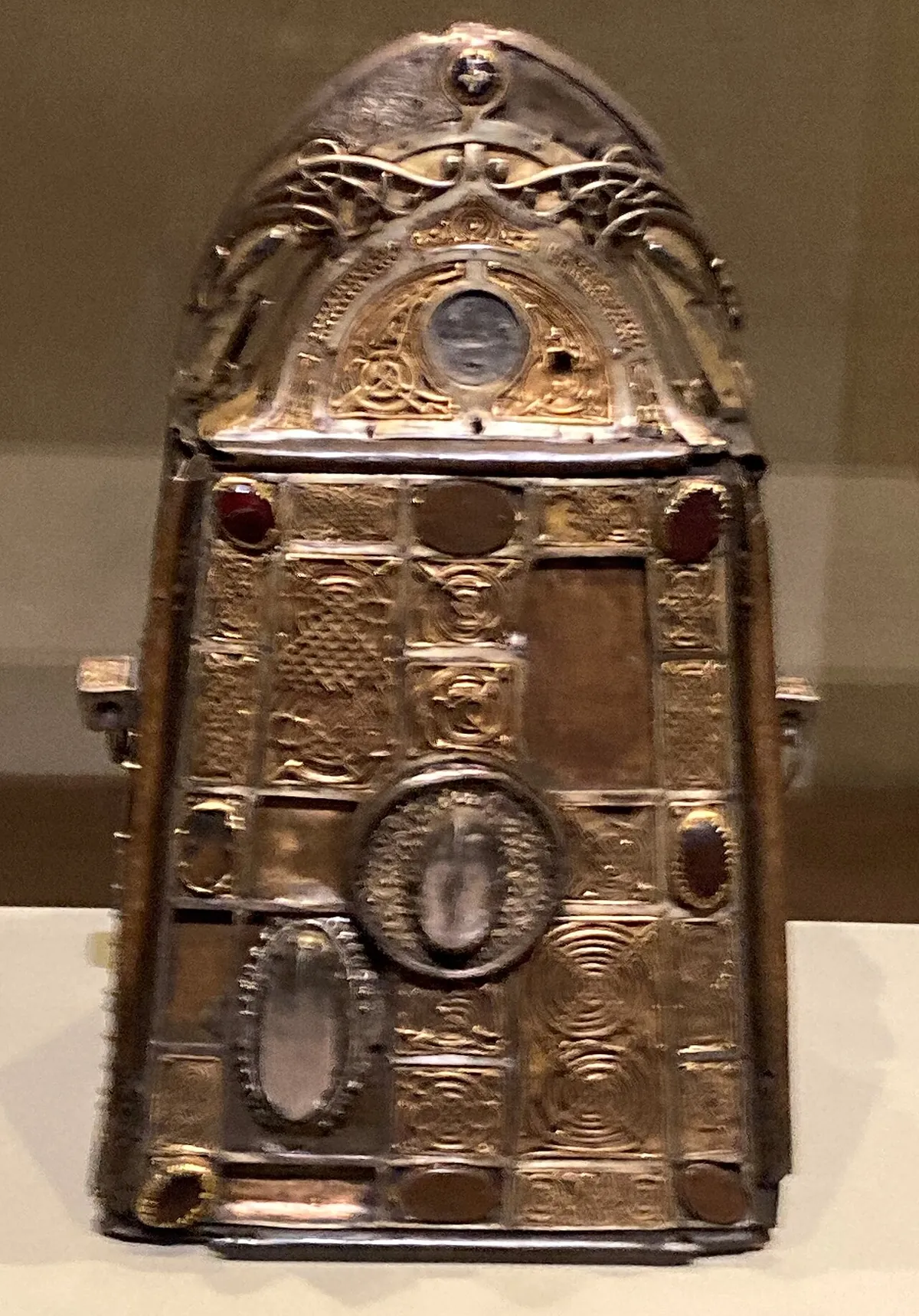
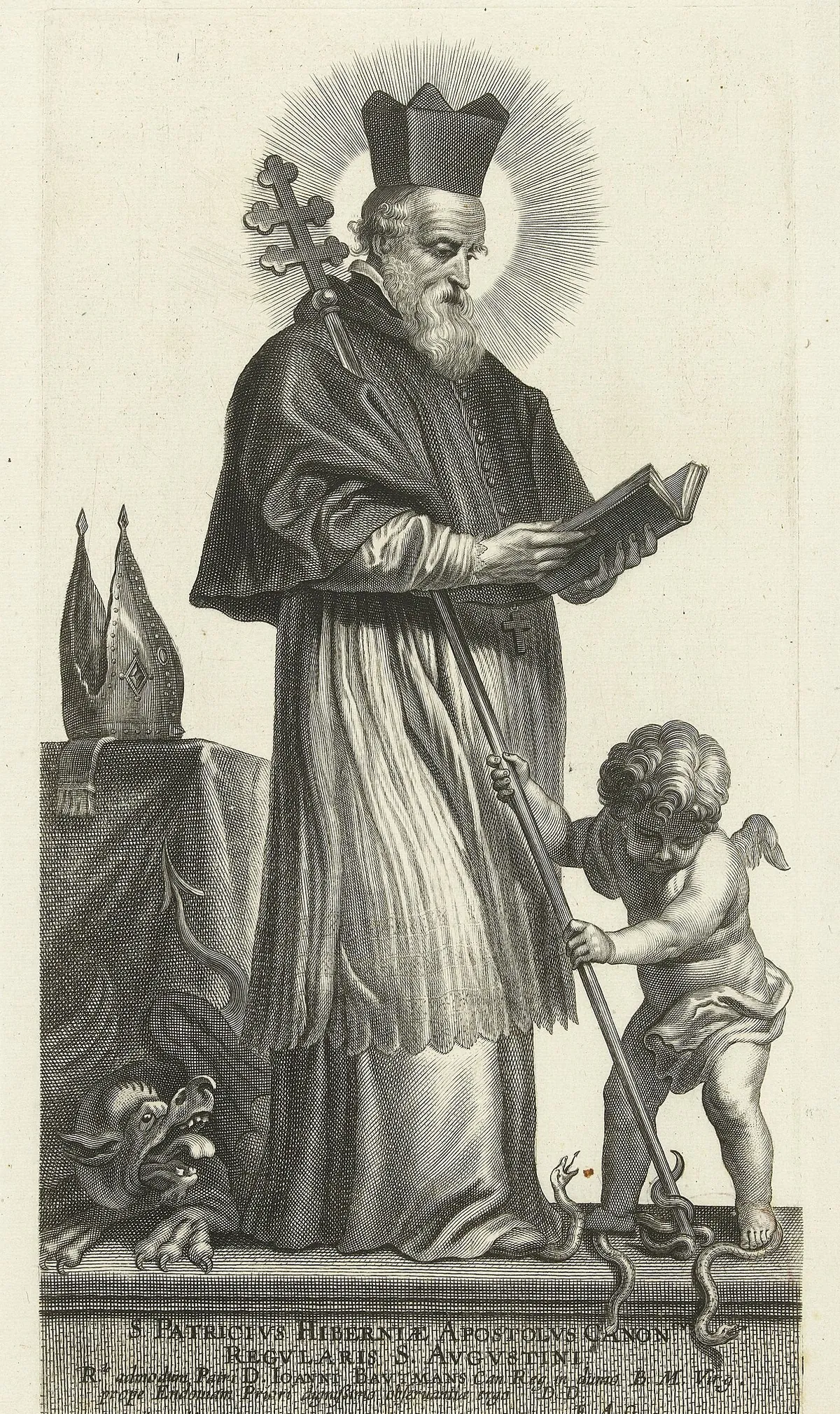
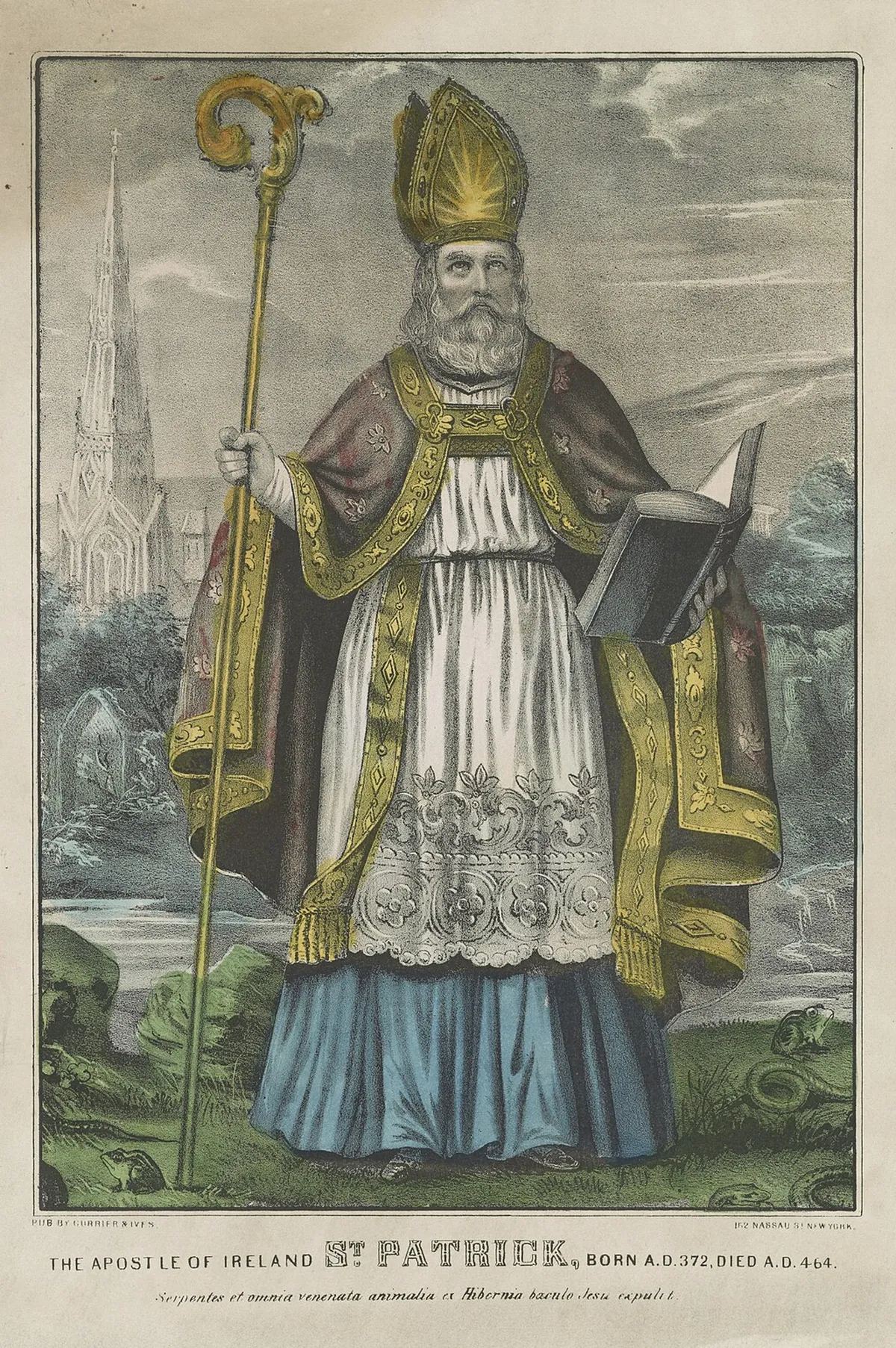
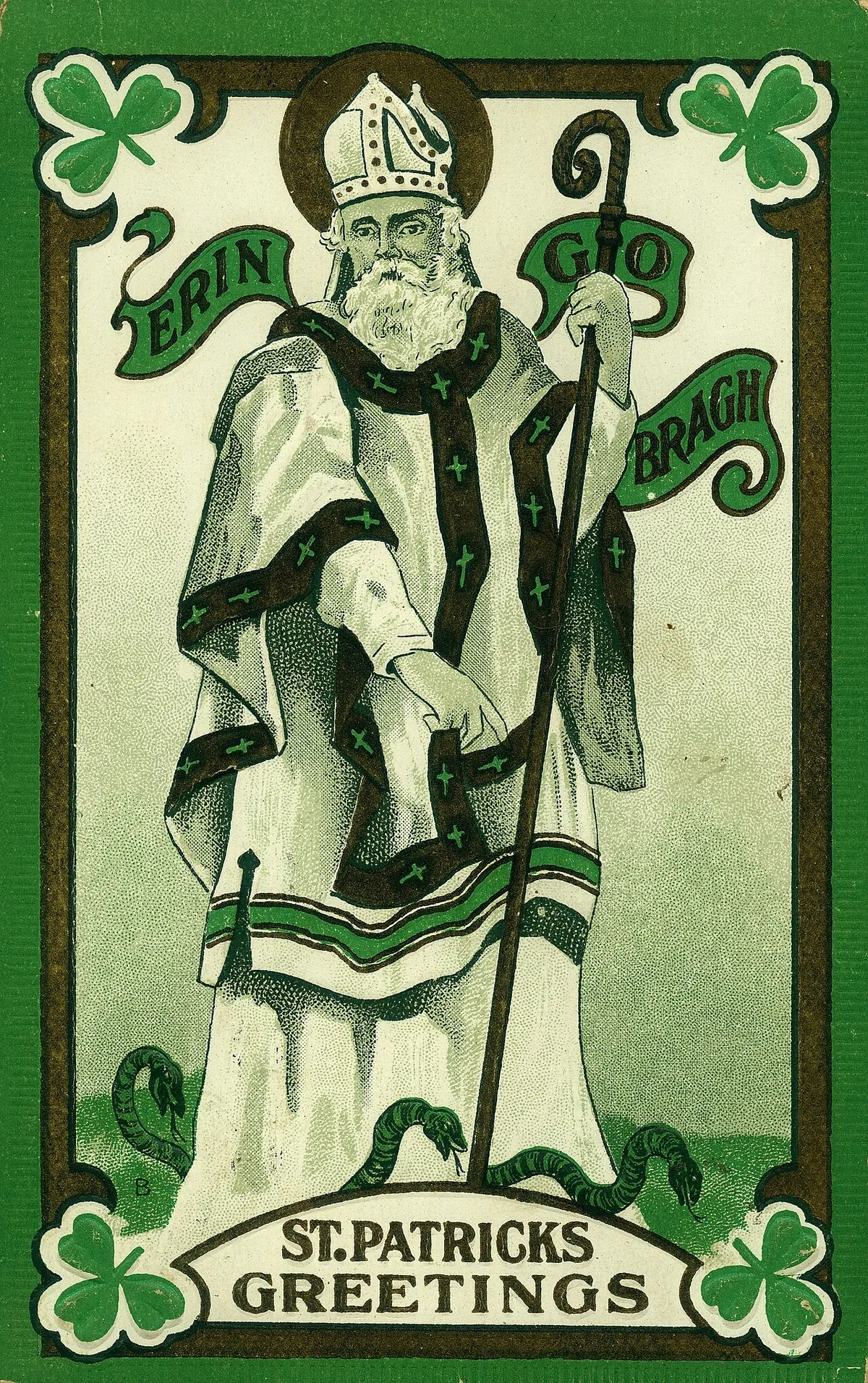
The second phase is continental and baroque. By the seventeenth century Irish colleges were scattered across Catholic Europe, and Patrick acquired the visual grammar of any other bishop: mitre, cope, crozier, serpents underfoot. The Borrekens engraving above was cut in Antwerp after a design by Erasmus Quellinus, a painter trained in the workshop of Peter Paul Rubens, and it is the finest old image of him that exists. The third phase is emigration. Currier and Ives printed the lithograph above in New York between 1857 and 1872, for a market of Irish families who had left after the Famine, and it is where the modern Patrick comes from: white beard, gold mitre, green under the cope, snakes and frogs retreating across the grass. By 1909 he is on a greeting card.
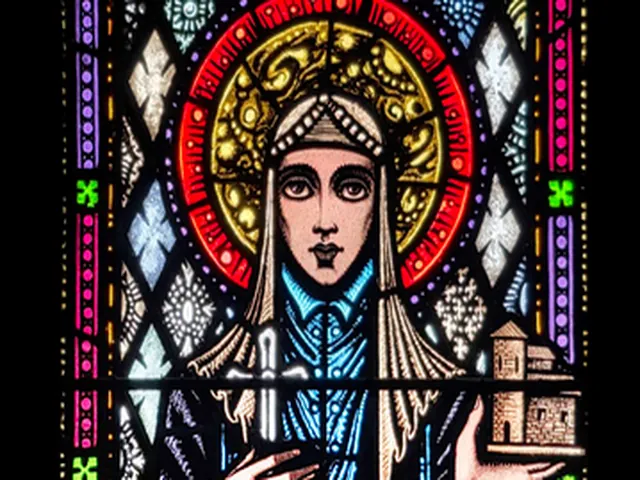
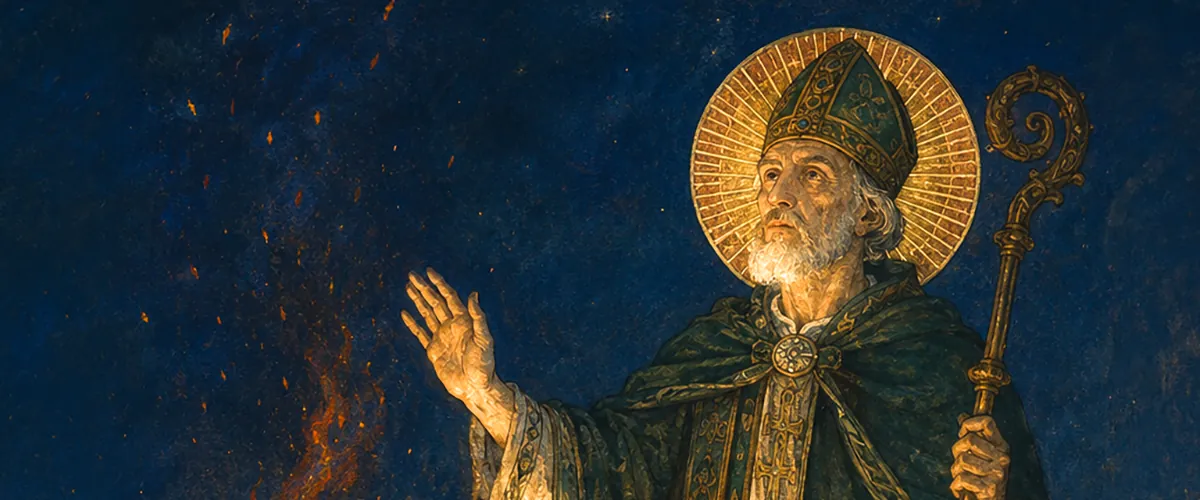
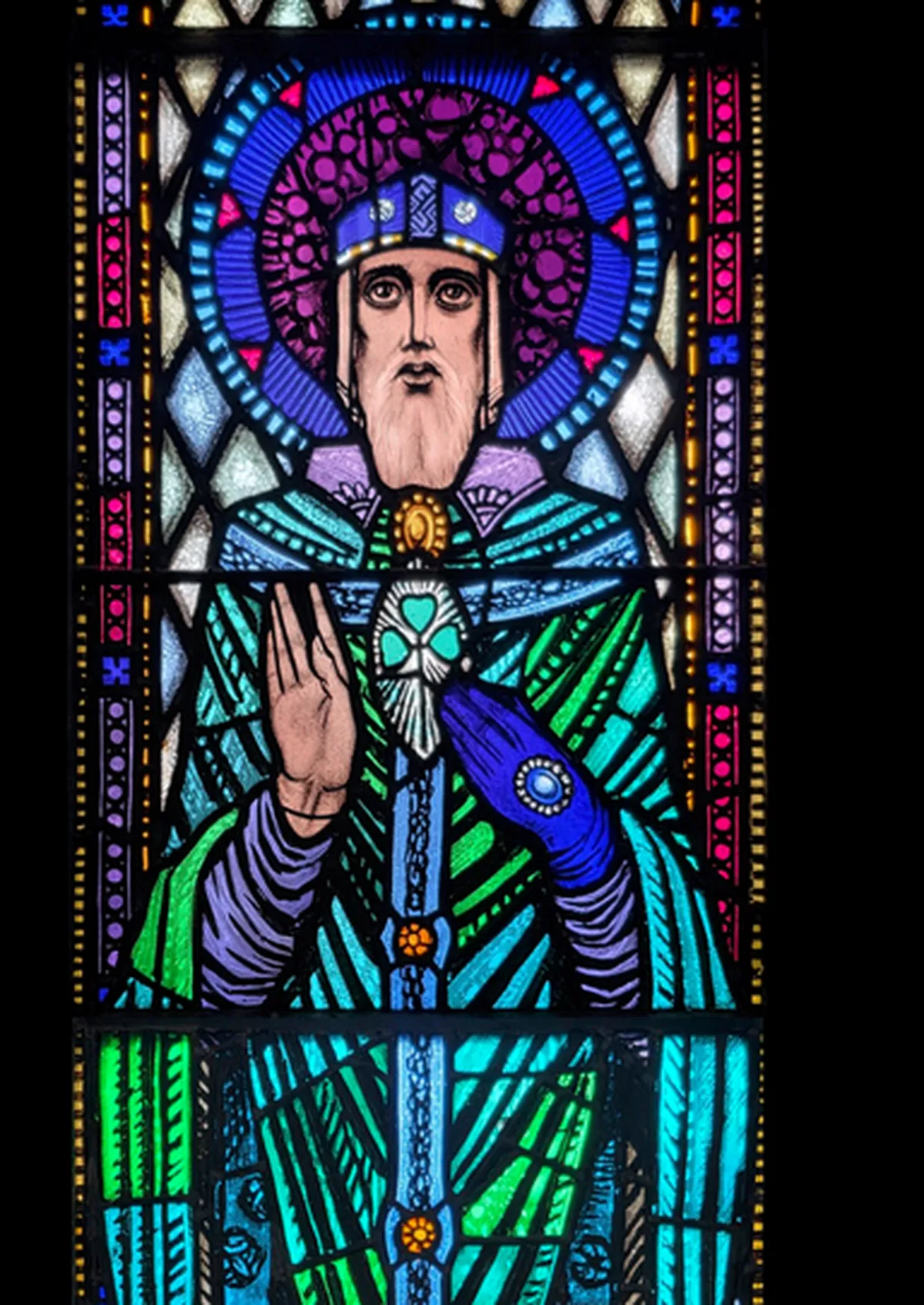
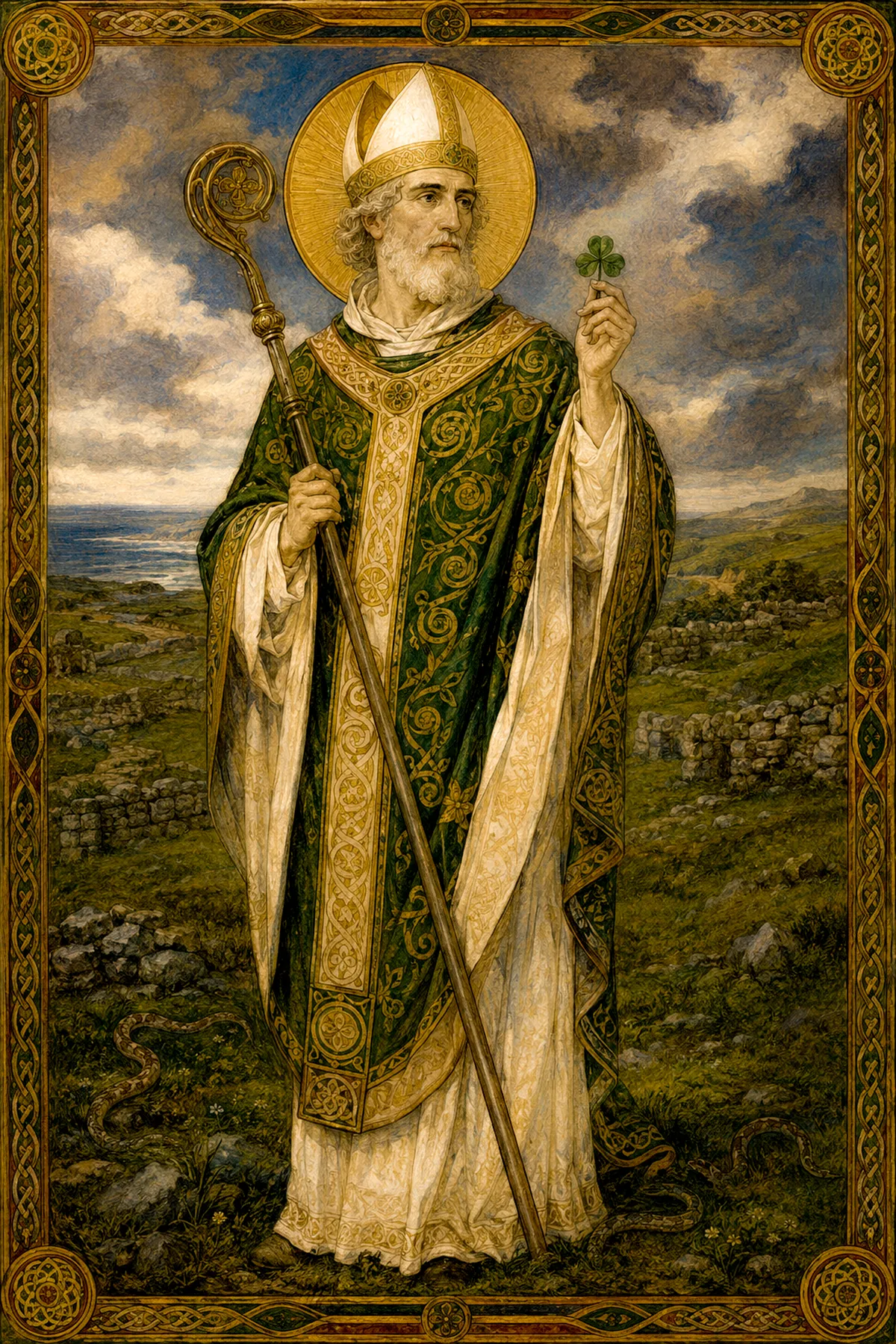
And then, in the twentieth century, Ireland finally made its own. Harry Clarke, the greatest stained glass artist the country has produced, gave Patrick the window in Saint Mary’s at Ballinrobe: a violet halo, a blue and silver mitre, a white shamrock, and a face that owes nothing to Antwerp or New York. It took fifteen hundred years for an Irish artist to paint the man in his own idiom. There is a fourth phase, and this page is part of it. No old painting of Patrick exists at the standard the subject deserves, so the panel below was made for this article in the same Celtic Revival idiom that Duncan and Clarke worked in: the bishop on a hillside above the Atlantic, the crozier in one hand and a three-leaved shamrock raised in the other, the serpents already leaving through the grass. It is a new work rather than a historical one, and it is offered as such.
Where he is now
Patrick died, by tradition, on 17 March, in a year usually given as 461, though the chronology is contested and some scholars push his mission decades later. He was buried at Downpatrick in County Down, where a large granite slab in the churchyard of Down Cathedral marks the traditional spot; the slab was placed there in 1900. He was never formally canonised. There was no process for it in the fifth century, and by the time Rome had one he had been venerated for six hundred years. He is the patron saint of Ireland, and, through Irish missionaries, of Nigeria too.
Saint Patrick Paintings Featured in This Article
| Work | Artist | Date | Museum |
|---|---|---|---|
| Saint Patrick, Apostle of Ireland | Mattheus Borrekens after Erasmus Quellinus | mid 17th century | Rijksmuseum, Amsterdam |
| The Apostle of Ireland St. Patrick | Currier and Ives | 1857 to 1872 | Library of Congress, Washington |
| Shrine of Saint Patrick’s Bell | Irish metalworkers, Armagh | around 1100 | National Museum of Ireland, Dublin |
| Saint Patrick, stained glass | Harry Clarke | 20th century | Saint Mary’s Church, Ballinrobe |
| Erin Go Braugh. St. Patrick’s Greetings | Unknown | around 1909 | Library of Congress, Washington |
Important facts about Saint Patrick
- He was British, not Irish. A Roman Briton, taken to Ireland by raiders at about sixteen and enslaved for six years.
- Two of his own writings survive. The Confessio and the Letter to the Soldiers of Coroticus, the earliest documents we have from Ireland.
- He denounced slavery. The letter to Coroticus is among the earliest surviving Christian condemnations of the slave trade, written by a former slave.
- The snakes and the shamrock are later additions. The snakes appear in twelfth century Lives, the shamrock only in the eighteenth century.
- He was never canonised. His cult predates the papal process by six hundred years. His feast day is 17 March, the traditional date of his death.
Patrick belongs to a wider story: the Irish monks who followed him carried the faith across Europe, and their houses produced the manuscripts that hold the whole visual memory of early Ireland. The twelve of them, and the art each one was given or denied, are gathered in 12 Irish Saints and the Art They Left Behind. He shares the patronage of Ireland with Saint Brigid of Kildare, the only woman of the three, whose feast falls six weeks before his. For the same subject seen from Spain, where the saints had Rubens and Ribera to paint them, see our 15 Spanish Saints and the Painters Who Gave Them Their Faces. For the world of the manuscripts themselves, see The Great Medieval Painters of Catholic Art. Another Irish saint who left the island and never came back, Saint Dymphna, has her own page here.
Frequently asked questions about Saint Patrick
What is Saint Patrick known for?
Saint Patrick is known as the Apostle of Ireland, the missionary bishop who brought Christianity to much of the island in the fifth century. He is also the author of the two earliest surviving documents written in Ireland, the Confessio and the Letter to the Soldiers of Coroticus. Popularly he is known for driving the snakes out of Ireland and for using the shamrock to explain the Trinity, but neither story appears before the Middle Ages.
Was Saint Patrick Irish?
No. Patrick was born in Roman Britain, the son of a deacon named Calpornius, and he came to Ireland the first time as a captive after Irish raiders seized him at about sixteen. He spent six years there as a slave, escaped, went home, and later returned by choice as a bishop. The name Maewyn Succat is sometimes given as his birth name, but it comes from much later tradition and cannot be verified.
What was Saint Patrick accused of?
Late in his life, senior clergy in Britain challenged his fitness to be a bishop by raising a sin he had committed at about fifteen, before his captivity, and had confessed privately to a close friend. That friend later repeated it. Patrick never says what the sin was. The Confessio is his answer to the accusation, which is why it reads as a defence rather than a memoir.
Was Saint Patrick against slavery?
Yes, and he said so in writing. In the Letter to the Soldiers of Coroticus he excommunicated a British warlord’s men for killing newly baptised Christians and selling the survivors into slavery among the Picts, and he demanded the captives be returned. It is among the earliest surviving Christian texts to condemn the slave trade directly, and it was written by a man who had been enslaved for six years himself.
Why do we celebrate Saint Patrick on March 17?
Because 17 March is the traditional date of his death, and feast days in the Christian calendar mark the day a saint died rather than the day they were born. The date has been observed in Ireland since at least the ninth century and became a public holiday there in 1903. The custom of wearing green, and the advice to avoid orange, comes from much later Irish political history rather than from anything to do with Patrick.
Can you buy Saint Patrick art?
You can buy Saint Patrick art at jesuschrist.pictures, in our shop, as museum quality canvases and posters. Our catalogue covers the works reproduced on this page and the wider world of Christian painting they belong to, printed on demand and shipped worldwide. The shop is organised by subject and by period, and the saints have a section of their own.