Regina Caeli Prayer: The Queen of Heaven in Latin, English and Seven Paintings
For fifty days every year, the Church stops saying the Angelus. From Easter Sunday to Pentecost, at morning, noon and evening, Catholics stand instead of kneeling and greet the Mother of God with a short burst of joy: Regina Caeli, laetare, alleluia, O Queen of heaven, rejoice. It is one of the oldest and shortest prayers to Mary, four lines and four alleluias, and it says everything about Easter in a single sentence: the Son she bore has risen, as He said.
This page gives the Regina Caeli prayer in Latin and in its traditional English translation, with the prayer that follows it, its history and its meaning line by line, and a free printable prayer card. Each line is illustrated by a great painting, from Velazquez’s Coronation of the Virgin to El Greco’s Pentecost.
The Regina Caeli Prayer in Latin and English
This is the Latin text with the English translation of the Manual of Prayers published in 1888 by order of the Third Plenary Council of Baltimore, the official prayer book of the Catholic Church in the United States:
Regina Caeli, laetare! Alleluia. Quia quem meruisti portare, Alleluia, Resurrexit sicut dixit. Alleluia. Ora pro nobis Deum. Alleluia. V. Gaude et laetare, Virgo Maria. Alleluia. R. Quia surrexit Dominus vere. Alleluia. Oremus. Deus, qui per resurrectionem Filii tui Domini nostri Jesu Christi mundum laetificare dignatus es; praesta, quaesumus, ut per ejus Genitricem Virginem Mariam perpetuae capiamus gaudia vitae. Per eundem Christum Dominum nostrum. Amen.
O Queen of heaven, rejoice! Alleluia. For He whom thou didst merit to bear, Alleluia, Hath arisen, as He said, Alleluia. Pray for us to God. Alleluia. V. Rejoice and be glad, O Virgin Mary. Alleluia. R. For the Lord hath risen indeed. Alleluia. Let us pray. O God, who, through the Resurrection of Thy Son our Lord Jesus Christ, didst vouchsafe to fill the world with joy; grant, we beseech Thee, that, through His Virgin Mother, Mary, we may lay hold on the joys of everlasting life. Through the same Christ our Lord. Amen.
Modern liturgical books use a newer translation (“The Son whom you merited to bear, alleluia, has risen as he said”). The words change, the prayer does not. The older version above is the one generations of American Catholics learned by heart, and the one on our printable card. The four lines in bold are the antiphon itself; the versicle (V.) and response (R.) and the closing prayer are added when it is said in place of the Angelus.
Where the Regina Caeli Comes From
Nobody knows who wrote the Regina Caeli. The text first appears in manuscripts of the twelfth century, and by the middle of the thirteenth the Franciscans were singing it after Compline, the last prayer of the day, throughout the Easter season. With the Alma Redemptoris Mater, the Ave Regina Caelorum and the Salve Regina, it became one of the four great Marian antiphons, each sung in its own season of the year: the Regina Caeli belongs to Easter.
A later legend gives it a more dramatic birth. In 590 a plague was killing Rome, and the new pope, Gregory the Great, led the people in procession through the city carrying an image of the Virgin. As they crossed the Tiber, the story goes, angels were heard singing the first three lines, “Queen of heaven, rejoice, alleluia; for He whom thou didst merit to bear, alleluia, hath arisen, as He said, alleluia”, and Gregory answered with the fourth: “Pray for us to God, alleluia.” Above the tomb of the emperor Hadrian, Saint Michael was seen sheathing his sword, and the plague ended. The building has been called Castel Sant’Angelo, the Castle of the Holy Angel, ever since. The legend cannot be older than the prayer, but it shows how the prayer was understood: as the joy of Easter answering the fear of death.
In 1742 Pope Benedict XIV directed that the Regina Caeli be said in place of the Angelus during the Easter season, and the old prayer books add that it is said standing. That is how it is still prayed today, and it is the prayer the pope leads from his window in Saint Peter’s Square at noon on the Sundays of Easter.
The Regina Caeli in Seven Paintings
Each line of the prayer has been painted by a great master. Here are seven of them, in the order of the words.
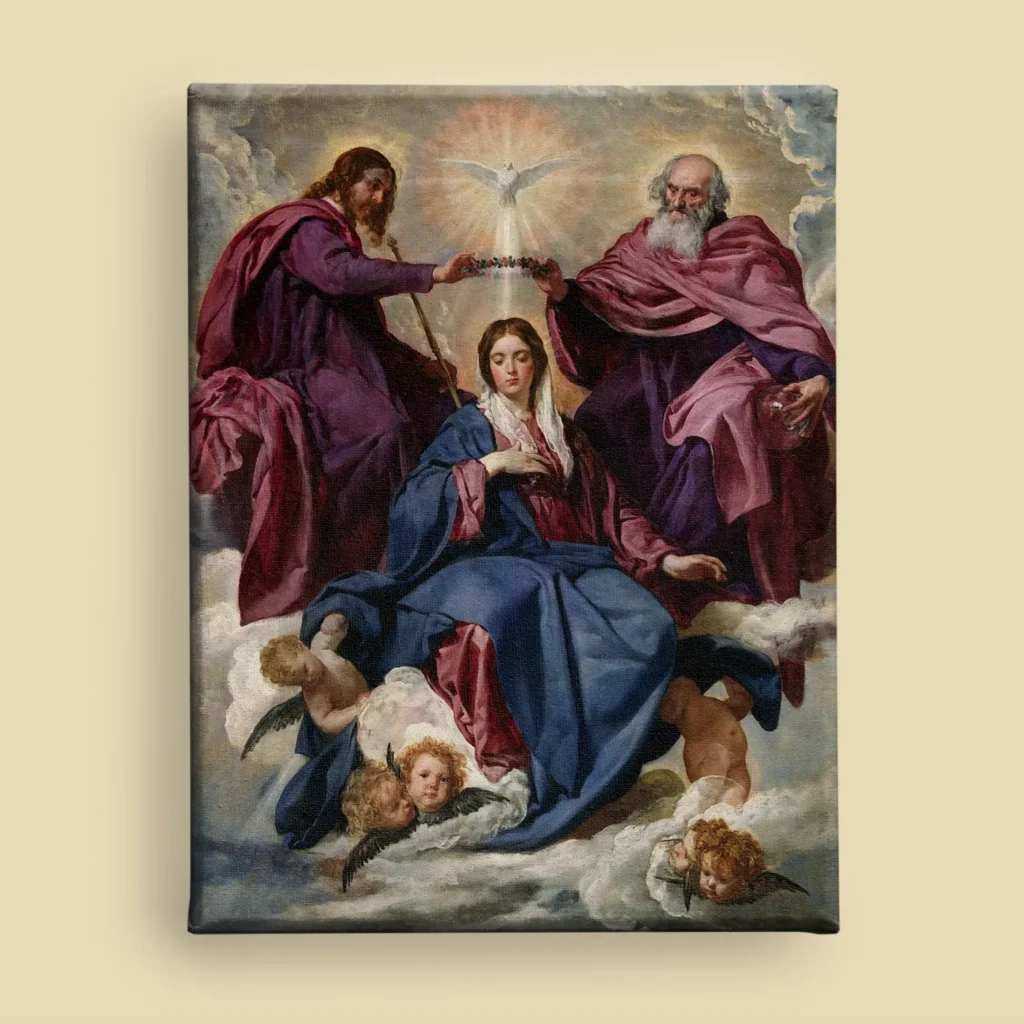
1. “Regina Caeli, Laetare”: The Coronation of the Virgin by Diego Velazquez (about 1635 to 1636)
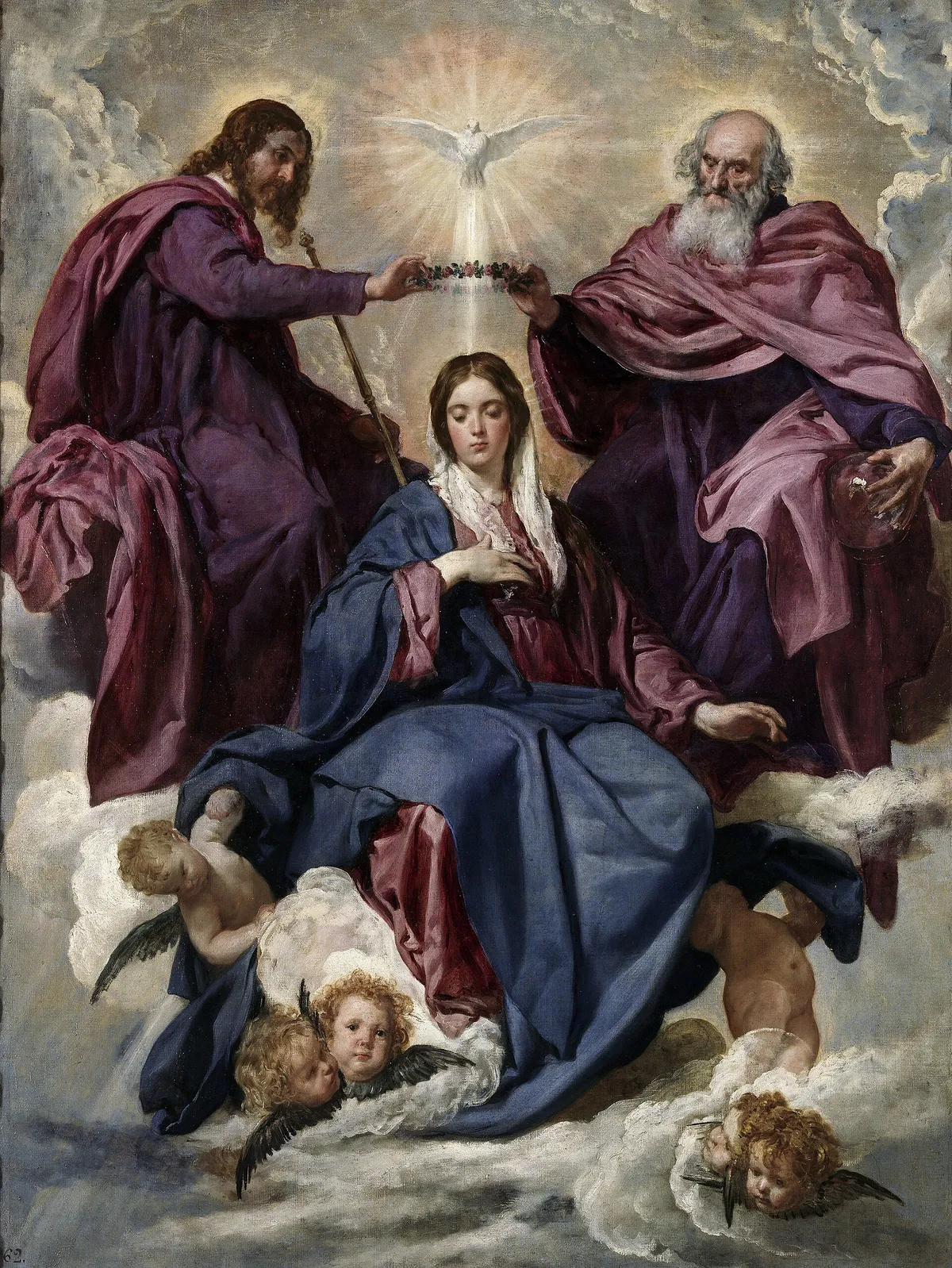
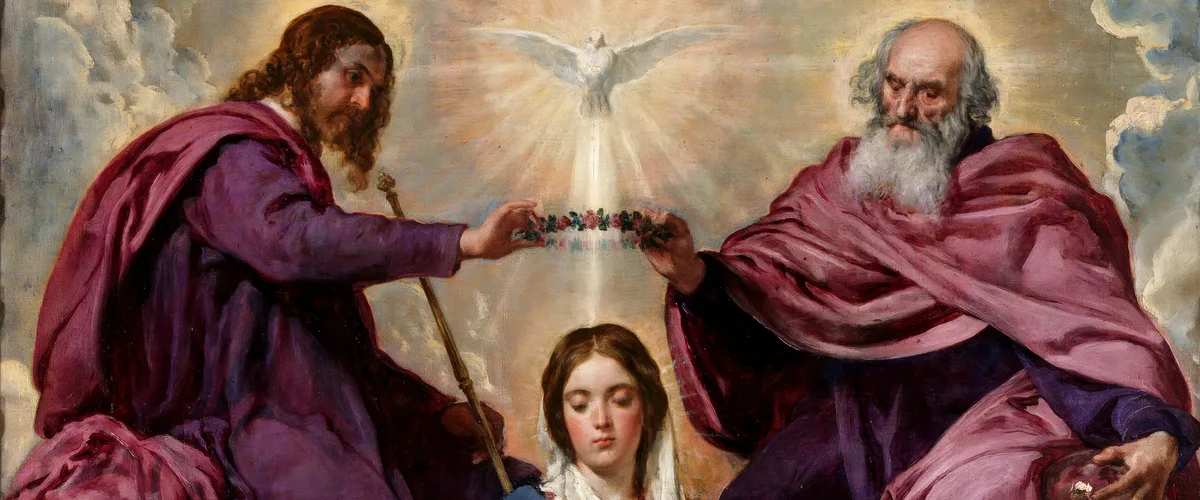
The prayer begins by calling Mary a queen, and no painter crowned her more gently than Velazquez. Christ and God the Father, in robes of crimson and violet, hold a crown of flowers above her head, the dove of the Holy Spirit blazes between them, and Mary, seated on the clouds, lowers her eyes and lays her hand on her heart. The whole group forms the shape of a heart. Velazquez probably painted it for the oratory of Queen Isabel of Bourbon in the royal palace of Madrid, a queen’s picture of the Queen of Heaven, and it is today in the Prado. It is the painting in the medallion of our printable card.
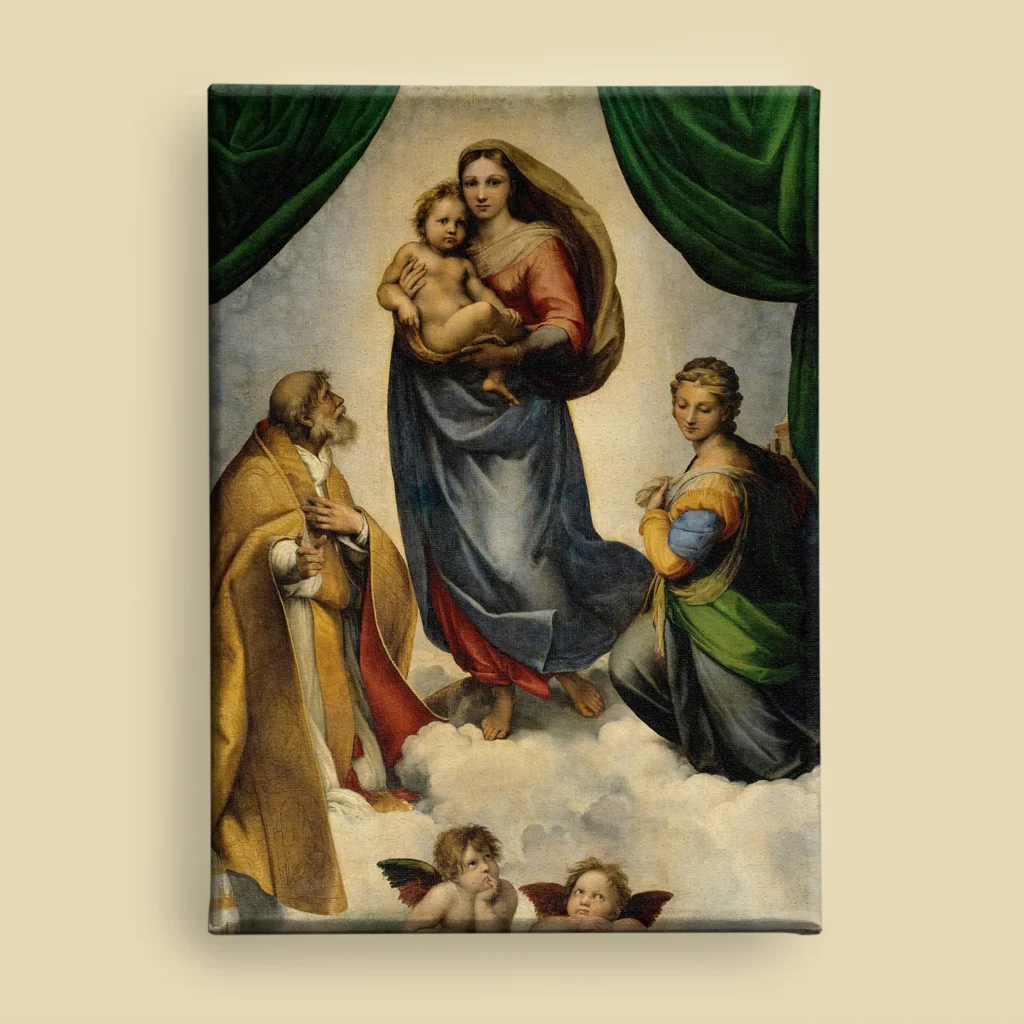
2. “Quia Quem Meruisti Portare”: The Sistine Madonna by Raphael (1512 to 1513)

“He whom thou didst merit to bear”: the second line turns from the queen to the mother. Raphael painted her walking toward us on the clouds, barefoot, carrying the Child as if she were bringing him into the world a second time, while the curtains open on either side and Saint Sixtus and Saint Barbara kneel at her feet. She is very young, and her face is grave: she knows what the Child she carries will suffer. The two cherubs leaning on the ledge below have become the most reproduced angels in the world. The altarpiece, painted for the church of San Sisto in Piacenza, is in the Gemaldegalerie Alte Meister in Dresden. Read the full story of the Sistine Madonna and its famous angels.
3. “Resurrexit Sicut Dixit”: The Resurrection by Piero della Francesca (about 1463 to 1465)

“He hath arisen, as He said.” This is the heart of the prayer, and Piero della Francesca painted it as a fact, not a miracle. Christ stands upright, one foot on the edge of the tomb, the banner of victory in his hand, and looks straight at us, while four Roman soldiers sleep below. Behind him the trees on the left are bare and those on the right are in leaf: winter has turned to spring. Piero painted the fresco for the town hall of his native Sansepolcro, where it still is, in the Museo Civico. The English writer Aldous Huxley called it the best picture in the world. More versions are gathered in our famous Resurrection paintings.
4. “Gaude et Laetare, Virgo Maria”: Christ Appearing to His Mother by Juan de Flandes (about 1496)
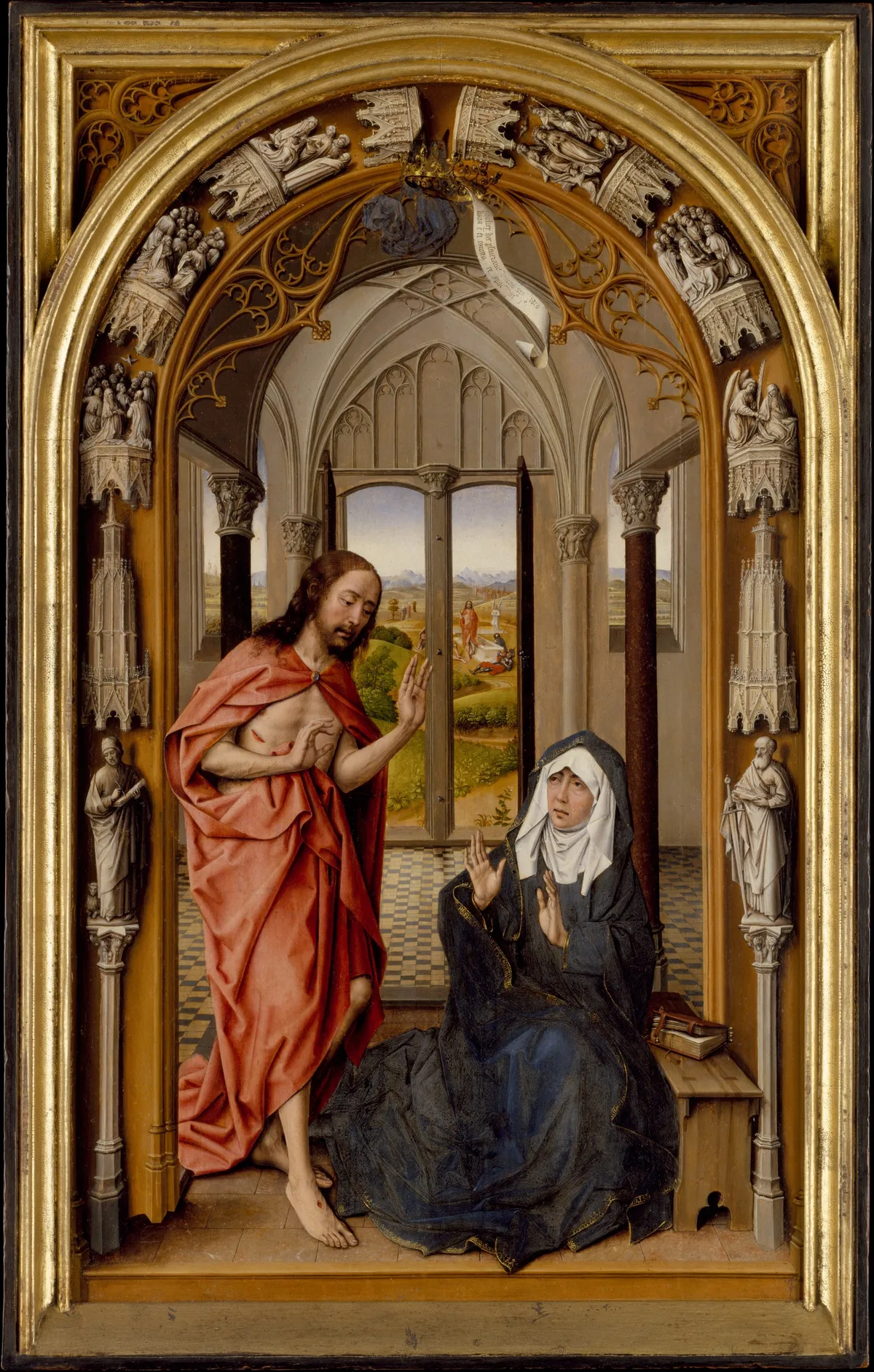
The Gospels do not tell of the risen Christ visiting his Mother, but Christian tradition never doubted that he went to her first, and the response of the Regina Caeli is that meeting in words: “Rejoice and be glad, O Virgin Mary, for the Lord hath risen indeed.” Juan de Flandes, a Flemish painter at the court of Queen Isabella of Castile, shows Mary kneeling at her prayer desk when her Son appears, in a red mantle, his wounds open, his hand raised in blessing. The composition, with its carved Gothic arch, follows the model of the Miraflores Altarpiece of Rogier van der Weyden, painted half a century earlier. The panel is in the Metropolitan Museum of Art in New York.
5. “Ora Pro Nobis Deum”: The Procession of Saint Gregory, Tres Riches Heures du Duc de Berry (about 1411 to 1416)
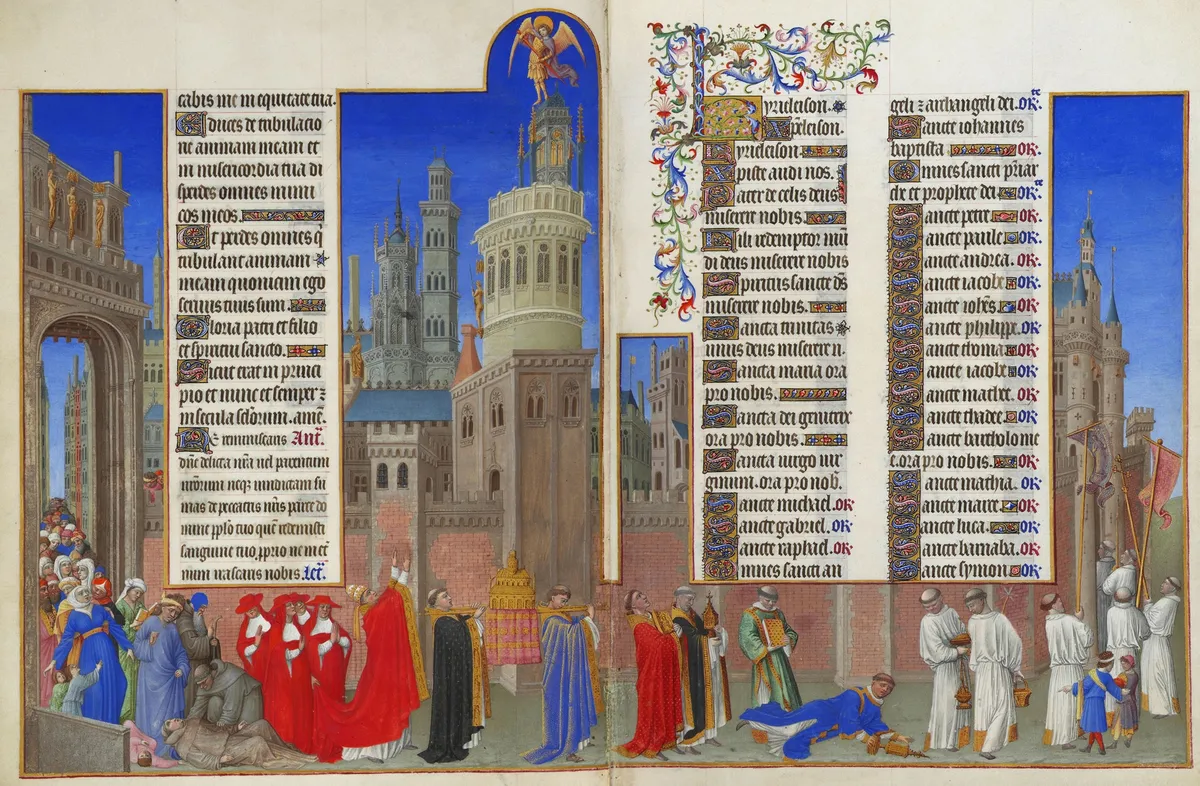
This is the legend of the prayer, painted across a double page of the most famous book of hours ever made, the Tres Riches Heures of the Duke of Berry, illuminated by the Limbourg brothers. Pope Gregory, in red, walks with his cardinals and clergy behind a golden reliquary through the streets of Rome, while along the way people fall dead from the plague. At the top of the tower, above the text of the litany, the angel stands on the summit of Hadrian’s tomb and puts away his sword. The pages illustrate the Great Litany, the prayer of the procession, and they hang today in the Musee Conde at Chantilly, north of Paris. For more of these jewels, see our guide to medieval manuscript art.
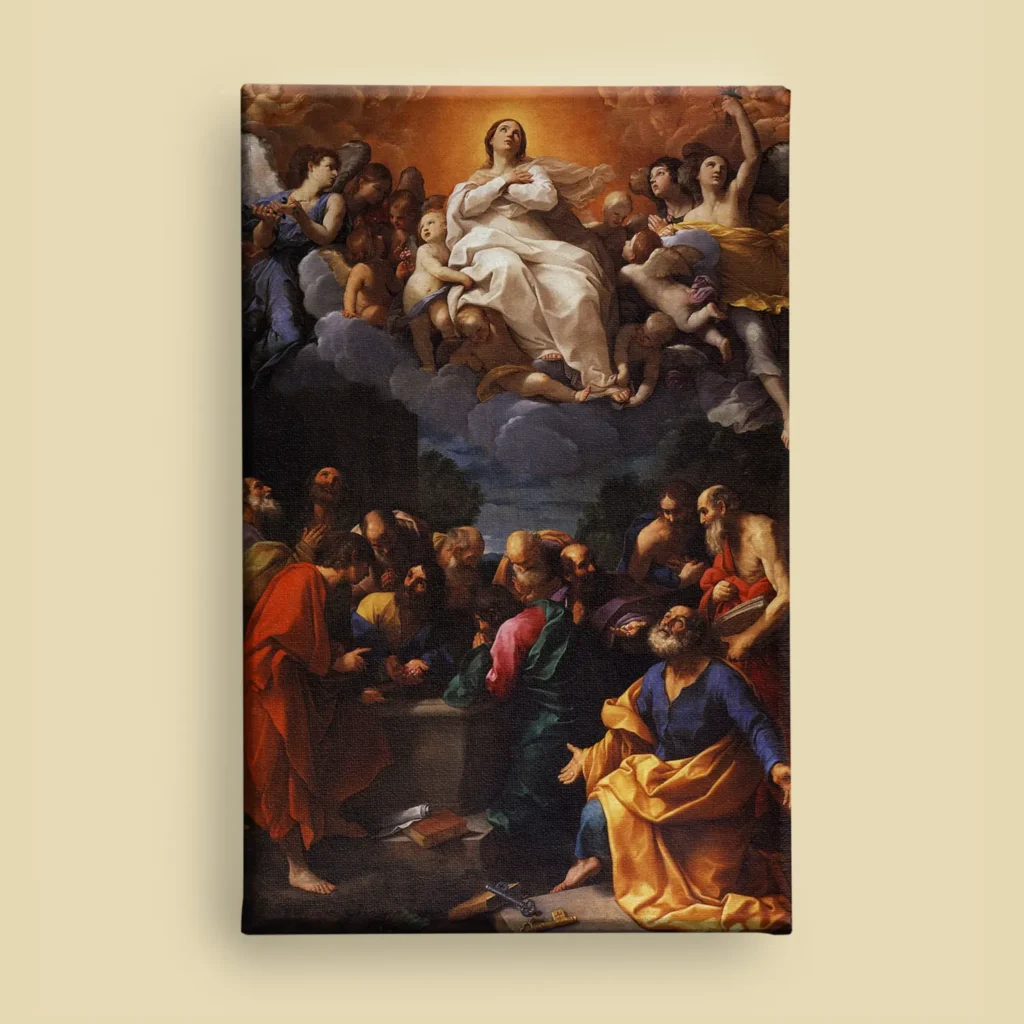
6. “The Joys of Everlasting Life”: The Assumption of the Virgin by Guido Reni (17th century)

The prayer that follows the antiphon asks to “lay hold on the joys of everlasting life” through Mary, and Mary is the first to have been given them in full, body and soul. Guido Reni painted her Assumption as a slow, gentle rising: the Virgin, her hands on her heart and her eyes raised, is carried up by angels into a golden light, while the apostles crowd around the empty tomb below, some reaching up, some turning to one another in wonder. The Easter joy of the Regina Caeli is the joy of the Resurrection, and the Assumption is its first fruit. Discover more images of the scene in our Assumption of the Virgin paintings.
7. “From Easter to Pentecost”: The Pentecost by El Greco (about 1600)
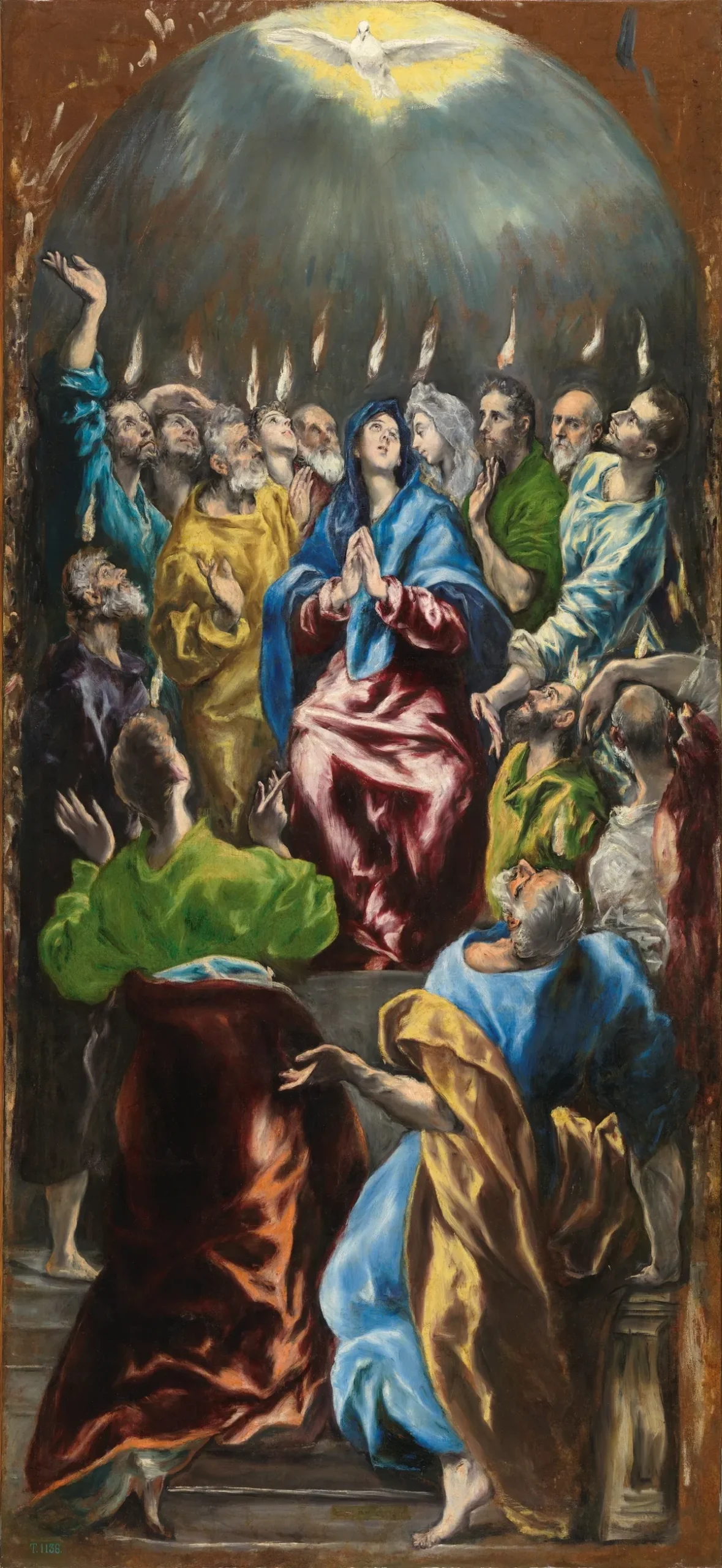
The Regina Caeli is said for fifty days, and the last day is Pentecost. El Greco painted the moment as a burst of flame: the dove of the Holy Spirit blazes at the top of the canvas, tongues of fire settle on the heads of the apostles, and the men throw up their arms, cry out or fall back. At the centre, calm and seated, is Mary, the only one not startled, because the Spirit had already come upon her at the Annunciation. The tall canvas, painted for the altarpiece of a Madrid college, is in the Prado. The next morning the Church goes back to the Angelus until the next Easter.
What the Regina Caeli Means, Line by Line
O Queen of heaven, rejoice! Alleluia. The prayer does not ask Mary for anything at first: it congratulates her. Of all people, she is the one who has most reason to rejoice at Easter.
For He whom thou didst merit to bear, Alleluia. Mary’s greatness comes from her Son. “Merit” here means that God made her worthy to carry him, the same thought as in the Magnificat: “He that is mighty hath done great things to me.”
Hath arisen, as He said, Alleluia. “As He said”: three times Jesus had told his disciples he would rise on the third day. The prayer insists that Easter is a promise kept.
Pray for us to God. Alleluia. Only at the end does the prayer ask, and what it asks is prayer. The Mother who stood at the Cross and saw the empty tomb is asked to bring her children into the same joy.
Rejoice and be glad, O Virgin Mary, for the Lord hath risen indeed. The response repeats the greeting the apostles exchanged on Easter evening, “The Lord is risen indeed” (Luke 24:34), still the Easter greeting of Eastern Christians.
How to Pray the Regina Caeli
- Three times a day in the Easter season: at morning, noon and evening, from Easter Sunday to Pentecost, in place of the Angelus.
- Standing: as the old prayer books direct, the Regina Caeli is said standing, the posture of the Resurrection.
- In Latin or English: the Latin is short and easy to learn, and it is the version sung in churches to its Gregorian melody; many families say the antiphon in Latin and the prayer in English.
- At night: it is also the antiphon sung at the end of Compline, the last prayer of the day, throughout the Easter season, as the Hail Holy Queen is for much of the rest of the year.
With children, start with the four alleluias: they love to answer “Alleluia” at the end of each line while an adult says the rest. The Regina Caeli is also a natural prayer to end an Easter afternoon of coloring with our Easter coloring pages.
A Free Printable Regina Caeli Prayer Card
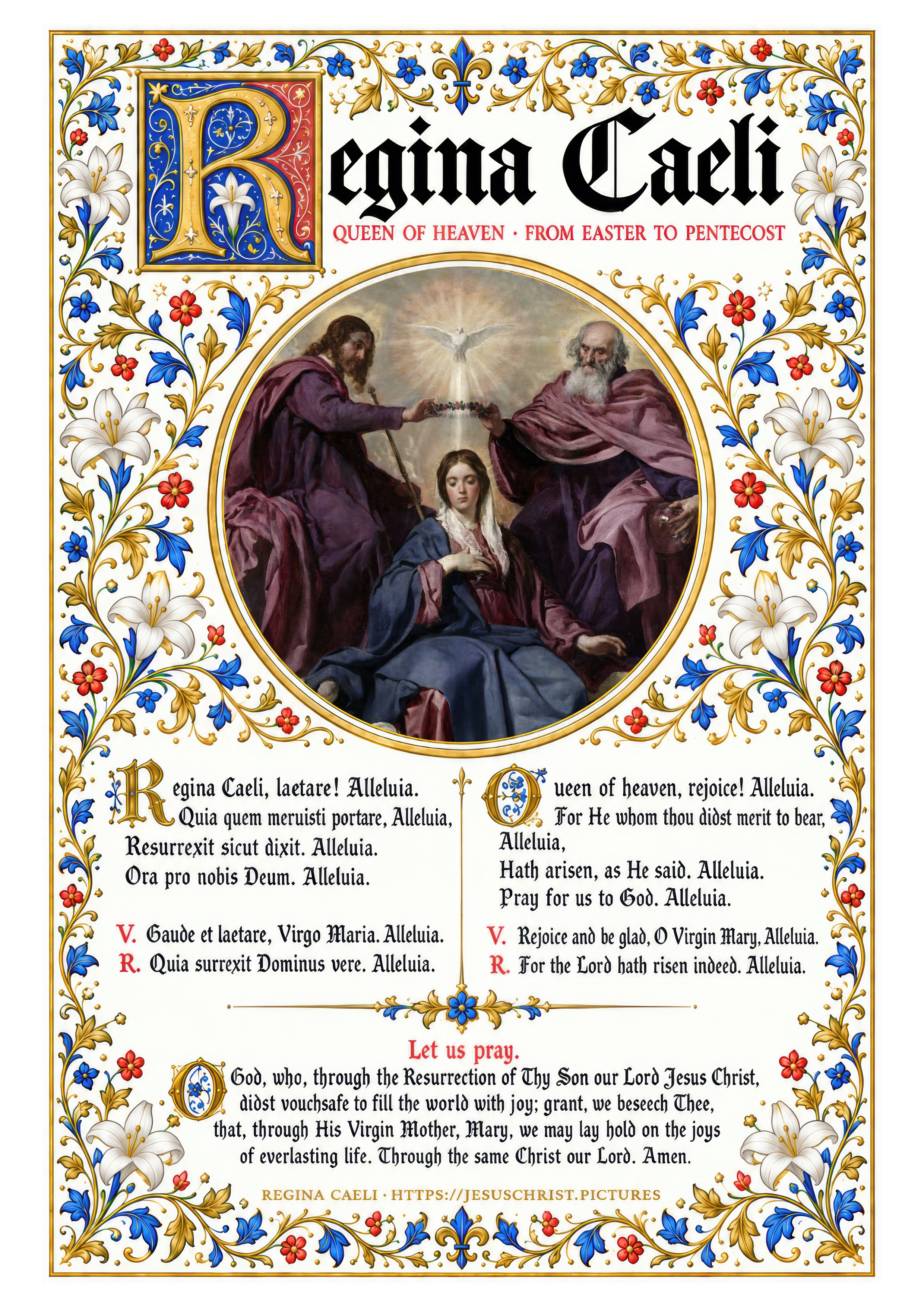
We have made the Regina Caeli into an illuminated prayer card in the style of a French book of hours: a great gold initial R, white Easter lilies in the border, Velazquez’s Coronation of the Virgin in a round medallion, and the prayer in Latin and English side by side, with the closing prayer below.
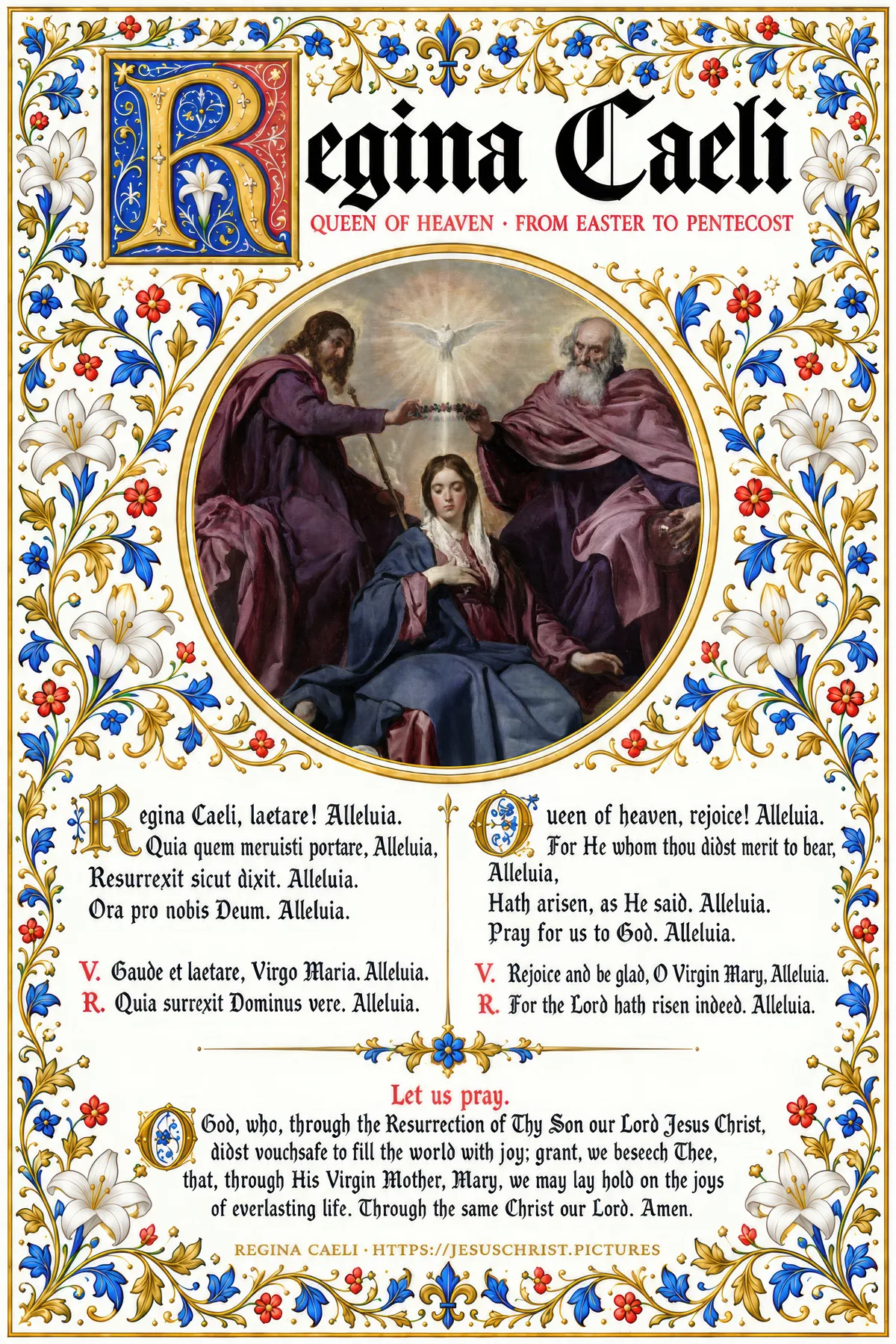
✦ Free Printable Prayer Card
Print it for the Easter season, for your prayer corner, your kitchen wall or your missal. It is free, and there is nothing to fill in.
Download for US LetterDownload for A4
Also as a high resolution image.
More prayer cards, novenas and Scripture printables are gathered in our free Christian printables. For the end of the Easter octave, see also our Divine Mercy novena.
Conclusion
The Regina Caeli is the shortest of the great prayers to Mary, and the most joyful. It asks almost nothing, and gives Easter a voice three times a day for fifty days: the Son she bore has risen, as He said. The painters gave each of its lines a face. Velazquez crowned her, Raphael gave her the Child, Piero raised him from the tomb, Juan de Flandes brought him back to her, the Limbourg brothers painted the angels’ song over Rome, Guido Reni carried her into the joy she prays for, and El Greco set her among the apostles on the day the prayer ends. Alleluia.
For more images of the Mother of God, see our guide to Marian iconography and our selection of beautiful Virgin Mary paintings.
The Paintings in This Article
| Words of the prayer | Painting | Artist | Date | Medium | Location |
|---|---|---|---|---|---|
| Regina Caeli, laetare | The Coronation of the Virgin | Diego Velazquez | About 1635 to 1636 | Oil on canvas | Museo del Prado, Madrid |
| Quia quem meruisti portare | The Sistine Madonna | Raphael | 1512 to 1513 | Oil on canvas | Gemaldegalerie Alte Meister, Dresden |
| Resurrexit sicut dixit | The Resurrection | Piero della Francesca | About 1463 to 1465 | Fresco | Museo Civico, Sansepolcro |
| Gaude et laetare, Virgo Maria | Christ Appearing to His Mother | Juan de Flandes | About 1496 | Oil on panel | The Metropolitan Museum of Art, New York |
| Ora pro nobis Deum | The Procession of Saint Gregory (Tres Riches Heures) | The Limbourg brothers | About 1411 to 1416 | Illumination on vellum | Musee Conde, Chantilly |
| The joys of everlasting life | The Assumption of the Virgin | Guido Reni | 17th century | Oil on canvas | See our Guido Reni page |
| From Easter to Pentecost | The Pentecost | El Greco | About 1600 | Oil on canvas | Museo del Prado, Madrid |
Important Facts About the Regina Caeli
- Its name means “Queen of Heaven” in Latin; it is also spelled Regina Coeli.
- It is one of the four great Marian antiphons, with the Alma Redemptoris Mater, the Ave Regina Caelorum and the Salve Regina.
- It is said from Easter Sunday to Pentecost in place of the Angelus, at morning, noon and evening, standing.
- Its author is unknown; the text first appears in the twelfth century.
- A later legend links it to the procession of Pope Gregory the Great during the plague of 590 in Rome.
- The traditional American English text is that of the Manual of Prayers of 1888: “O Queen of heaven, rejoice! Alleluia.”
Frequently Asked Questions
What is the Regina Caeli prayer?
The Regina Caeli, or Regina Coeli (“Queen of Heaven”), is a short Latin hymn to the Virgin Mary rejoicing in the Resurrection of her Son. It is one of the four great Marian antiphons of the Church, and during the Easter season it replaces the Angelus as the prayer said morning, noon and evening.
When is the Regina Caeli prayed?
From Easter Sunday until Pentecost Sunday, in place of the Angelus, traditionally at 6 in the morning, at noon and at 6 in the evening. It is also sung at the end of Compline, the Church’s night prayer, throughout the Easter season. The day after Pentecost the Angelus returns.
What are the words of the Regina Caeli in English?
O Queen of heaven, rejoice! Alleluia. For He whom thou didst merit to bear, Alleluia, hath arisen, as He said, Alleluia. Pray for us to God. Alleluia. V. Rejoice and be glad, O Virgin Mary. Alleluia. R. For the Lord hath risen indeed. Alleluia. Then follows the prayer: O God, who, through the Resurrection of Thy Son our Lord Jesus Christ, didst vouchsafe to fill the world with joy; grant, we beseech Thee, that, through His Virgin Mother, Mary, we may lay hold on the joys of everlasting life. Through the same Christ our Lord. Amen.
What is the origin of the Regina Caeli?
The text first appears in manuscripts of the twelfth century, and by the thirteenth the Franciscans were singing it after Compline throughout Eastertide. Its author is unknown. A later legend says that angels sang its first three lines over Rome during the procession led by Pope Gregory the Great in 590, and that Gregory answered with the fourth: “Ora pro nobis Deum”.
Is it Regina Caeli or Regina Coeli?
Both spellings are correct. “Caeli” is the classical Latin form, used in today’s liturgical books; “Coeli” (or “Cœli”) is the medieval spelling found in older prayer books. The prayer is the same.
Why is the Regina Caeli said standing?
The old prayer books direct that it be said standing, not kneeling, like all the prayers of the Easter season. Standing is the posture of the Resurrection: the Church kneels in penance and stands in joy.
Can you buy Regina Caeli art?
You can buy Regina Caeli art at jesuschrist.pictures, in our shop: the paintings that illustrate this prayer, such as Velazquez’s Coronation of the Virgin, Raphael’s Sistine Madonna and Guido Reni’s Assumption of the Virgin, are available as canvas reproductions, alongside many other images of the Queen of Heaven.