The Quiet Christ in Diego Velázquez Paintings
Diego Velázquez is so closely identified with the royal portraiture of Philip IV that his religious work is sometimes forgotten. And yet some of his earliest and most haunting paintings are sacred: a Crucifixion of perfect quietness, a Christ at the column visited by the soul of the faithful, a kitchen scene in which the gospel of Martha and Mary unfolds behind the back of an old cook. The Diego Velázquez paintings on religious subjects are few, but they are among the most concentrated and original images of the Spanish Baroque.
This article gathers eight of them, drawn from the early Sevillian years and from the great Madrid period that followed.

From Seville to the Court of Philip IV
Velázquez was born in Seville in early June 1599 and baptised on 6 June, the eldest of seven children of Juan Rodríguez de Silva, a notary’s son of Portuguese origin, and Jerónima Velázquez, from whose family he took the surname by which he is known. He trained from 1611 in the workshop of Francisco Pacheco, the painter and theorist whose daughter Juana he later married. By 1623 he had moved to Madrid and entered the service of Philip IV, becoming the king’s principal painter and one of the most powerful officers of the royal household.
His religious painting is concentrated in two periods. The first is his Sevillian apprenticeship, when he produced kitchen scenes, devotional figures, and tenebrist saints in the manner of his master Pacheco. The second is his early Madrid years, when he absorbed the influence of Rubens and Italian art and produced the great Christ Crucified and the Coronation of the Virgin for the royal apartments.
Christ Crucified
Painted around 1632 for the convent of San Plácido in Madrid, this is the single most influential Spanish image of the dead Christ. Velázquez paints the body alone against a dark ground, the head fallen forward, the hair falling on one side of the face. Four nails fix the limbs to the wood, not the three that Counter-Reformation iconography preferred. The blood is restrained, the modelling is silvery, and the silence around the body is total. Miguel de Unamuno would devote a whole long poem to this picture three centuries later.

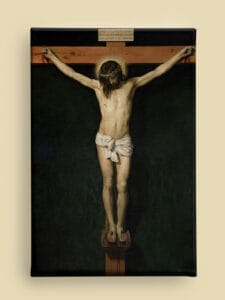
The painting hangs at the Museo del Prado in Madrid. For a wider context of the subject, see our article on famous Crucifixion paintings.
The Coronation of the Virgin
Painted around 1645 for the oratory of Queen Isabella in the Alcázar of Madrid, this large altarpiece shows the Virgin in the moment of her crowning by the Trinity. God the Father and Christ extend a crimson crown over her head while the dove of the Holy Spirit hovers above. Velázquez handles the rich royal colours, ruby red, deep gold, sky blue, with a restraint that recalls his portraits of Philip IV. The composition forms a perfect triangular hierarchy of heaven and earth.

The painting is at the Museo del Prado, having been transferred from the royal collection.
Christ in the House of Martha and Mary
One of the earliest and most original of Velázquez’s religious paintings, this canvas of 1618 shows a Sevillian kitchen with a young servant pounding garlic at a table while an older woman points to a small framed scene set into the wall. In that scene, almost like a window, we see Christ seated in the next room with Martha and Mary at his feet. The painter has fused gospel and bodegón, sacred scene and Spanish still life, in a single picture.

The painting is at the National Gallery in London, which acquired it in 1898 as one of the most important early Velázquez panels outside Spain.
The Supper at Emmaus
Probably painted around 1622 to 1623 in the last Seville years, this small but powerful picture shows the moment from Luke’s Gospel when the risen Christ breaks bread with the two disciples at the inn and is recognised by them. Velázquez paints the scene in his Sevillian tenebrist manner, with a single source of light raking across the table. The cloth, the bread, the earthenware jug, all are painted with the bodegón sharpness of his apprentice years. Christ blesses with his right hand, and the disciple on the right throws his hands up in astonishment.

The painting is now at the Metropolitan Museum of Art in New York. For a wider survey, see our article on iconic Supper at Emmaus paintings.
Christ Contemplated by the Christian Soul
Painted around 1626 to 1628, this picture is one of the most unusual Spanish images of Christ at the column. The flagellated Christ lies bound to the pillar in the foreground, and beside him a small child, the personification of the Christian soul, gazes upward while an angel points from the saviour to the soul, urging contemplation of the passion. Velázquez paints the Christ with the same restraint as his Crucifixion, refusing the usual Spanish drama of blood and pain.

The painting is now at the National Gallery in London.
Saint Anthony Abbot and Saint Paul the First Hermit
Painted around 1635 for the Pardo royal palace, this is one of Velázquez’s rare landscape compositions. Saint Anthony the Great visits Saint Paul of Thebes in his desert cave, where the two old hermits share a loaf of bread brought by the raven of God’s providence. Behind them, the same two figures are visible in earlier scenes from the legend, with the raven flying in. The landscape opens out toward the horizon in cool silvery greens and blues that recall Velázquez’s Italian voyage of 1629 to 1631.

The painting hangs at the Museo del Prado, originally from the Royal Palace of Madrid.
Saint John the Baptist in the Wilderness
This small panel shows the Baptist alone in the desert, seated on the rocks, his reed cross in his hand, his hairy garment falling around him. The figure is full of the silvery modelling and atmospheric softness of late Velázquez. Some scholars have proposed the picture as a workshop production with autograph passages; others accept it as an autograph small panel of around 1650.

The painting is now in the collection of the Art Institute of Chicago.
Saint Paul
Painted around 1620, this half-length figure of Saint Paul is one of the most refined of Velázquez’s Sevillian apostles. The saint is shown holding his sword and looking up to heaven, his red robe falling in heavy folds across his shoulder. The light is dramatic and the modelling assured. The picture belongs to a series of apostles painted in the same years and is one of the best surviving examples.

The painting is at the Museu Nacional d’Art de Catalunya in Barcelona.
For wider context, see our articles on Velázquez’s master Francisco de Zurbarán‘s great Sevillian contemporary, on his pupil Bartolomé Esteban Murillo, and on the great Spanish painter of Naples Jusepe de Ribera. The wider tradition of Baroque Jesus paintings holds Velázquez as one of its most disciplined voices.
Summary Table of Diego Velázquez’s Religious Paintings
| Name | Artist | Date | Medium | Museum |
|---|---|---|---|---|
| Christ Crucified | Diego Velázquez | c. 1632 | Oil on canvas | Museo del Prado, Madrid |
| The Coronation of the Virgin | Diego Velázquez | c. 1641 to 1644 | Oil on canvas | Museo del Prado, Madrid |
| Christ in the House of Martha and Mary | Diego Velázquez | 1618 | Oil on canvas | National Gallery, London |
| The Supper at Emmaus | Diego Velázquez | c. 1622 to 1623 | Oil on canvas | Metropolitan Museum of Art, New York |
| Christ Contemplated by the Christian Soul | Diego Velázquez | c. 1626 to 1628 | Oil on canvas | National Gallery, London |
| Saint Anthony Abbot and Saint Paul the First Hermit | Diego Velázquez | c. 1635 | Oil on canvas | Museo del Prado, Madrid |
| Saint John the Baptist in the Wilderness | Diego Velázquez | c. 1650 | Oil on canvas | Art Institute of Chicago |
| Saint Paul | Diego Velázquez | c. 1620 | Oil on canvas | Museu Nacional d’Art de Catalunya, Barcelona |
Conclusion
Velázquez was not a painter of altarpieces in the way Murillo or Zurbarán were. His sacred output is small, and yet it contains the single most studied Crucifixion of the Spanish Baroque, one of the most original kitchen scenes ever painted, and a Coronation of the Virgin that is the calm royal counterpart to his portrait of Philip IV. The quiet of his sacred painting is the same quiet that we feel in Las Meninas. It is the quiet of a painter who knew that the work of the eye, patiently exercised, could carry both flesh and faith.
Important Facts About Diego Velázquez
- Diego Rodríguez de Silva y Velázquez was baptised on 6 June 1599 in Seville, the eldest of seven children of Juan Rodríguez de Silva, a Portuguese-descended notary’s son, and Jerónima Velázquez, from whom he took the surname he used for the rest of his life.
- He trained from 1611 in the workshop of Francisco Pacheco in Seville, painter and theorist of the Sevillian school, whose daughter Juana he married in 1618 and whose academic ideas shaped his early Catholic devotional painting.
- Velázquez is the towering figure of the Spanish Golden Age and is celebrated for his refined naturalism, his loose handling of paint, and the silvery atmospheric light that earned him the admiration of Manet and the Impressionists two centuries later.
- His most famous religious painting is Christ Crucified, completed around 1632 for the convent of San Plácido in Madrid and now displayed at the Museo del Prado, the central image of dead Christ in Spanish Baroque art.
- He died on 6 August 1660 in Madrid, principal painter to King Philip IV and chamberlain of the royal household, and his style shaped Spanish painting through Goya, Manet, and the great twentieth century masters of modern art.
Questions and Answers About Diego Velázquez Paintings
What is Velázquez’s most famous painting?
His most celebrated work is Las Meninas of 1656 at the Museo del Prado, often called the supreme masterpiece of Spanish painting. Among his religious works, Christ Crucified at the same museum is by far the most reproduced, followed by Christ in the House of Martha and Mary at the National Gallery in London.
Where can I see Velázquez paintings today?
The single richest collection by far is at the Museo del Prado in Madrid, which holds about half of his surviving production, including all the major royal portraits and Christ Crucified. The National Gallery in London, the Metropolitan Museum in New York, the Kunsthistorisches Museum in Vienna, and the Boston Museum of Fine Arts hold the most important works outside Spain.
What style is Velázquez associated with?
Velázquez is the central figure of the Spanish Baroque and one of the great founders of the modern tradition of painterly realism. His mature manner, with its loose brushwork, silvery atmospheric light, and observed psychology, prepared the way for Goya, Manet, Whistler, and the Impressionists. His religious painting belongs to the early phase of this development, before the Italian voyage of 1629 transformed his palette.
Did Velázquez paint many religious subjects?
No, surprisingly few for a Spanish master of his stature. The court duties and the portraiture of Philip IV took most of his time. But what little religious painting he did is of the highest quality. The Crucifixion of 1632, the Coronation of the Virgin of 1645, and the early kitchen scenes of Sevillian life are among the most studied sacred images of seventeenth century Europe.
How did Velázquez paint his Crucifixion?
The Christ of San Plácido is painted with the four-nail iconography defended by Velázquez’s father-in-law Francisco Pacheco against the three-nail tradition of the Italian masters. The head falls forward, the hair drops on one side of the face, the body is silvery and dead. The dark background gives nothing away, and the whole image is built on a hush that is unlike any other Spanish Crucifixion of its century.
Who was Velázquez’s master?
From 1611, the young Velázquez trained under Francisco Pacheco in Seville. Pacheco was not only a painter but a theorist, censor for the Inquisition, and the leading defender of Sevillian academic art. Velázquez married Pacheco’s daughter Juana in 1618, and the older man’s writings on iconography, including the rule of the four nails of the Crucifixion, shaped the young painter’s religious work in lasting ways.
Where can I buy a Diego Velázquez painting reproduction?
You can buy them at jesuschrist.pictures: browse all the Diego Velázquez canvas prints in our shop, printed on museum-grade canvas and available in several sizes.


