The San Damiano Cross: Meaning and History
The San Damiano Cross is one of the most recognised crucifixes in the world, the painted icon cross before which a young man named Francis of Assisi knelt and prayed in the year 1205. According to his earliest biographers, as he prayed in the small ruined chapel of San Damiano outside the town walls, the figure of Christ on this very cross spoke to him: “Francis, go and repair my house, which as you see is falling into ruin.”
That moment changed the course of Christian history. From it came the whole Franciscan movement, and the cross itself became one of the great treasures of the faith. This article explains what the San Damiano Cross is, the meaning of every figure painted on it, the story of how it spoke to Saint Francis, and where it is kept today. For the prayer most closely linked to the saint, see our article on the Prayer of Saint Francis. It should not be confused with the later prayer before a crucifix, the prayer of the five wounds said after Communion.
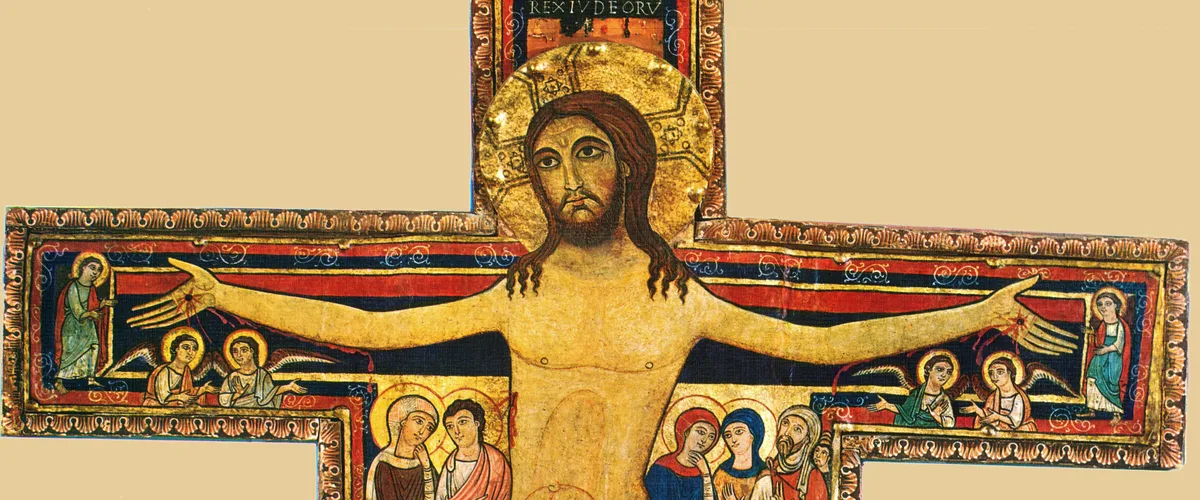
The Cross That Spoke to Saint Francis
In 1205 Francis was still searching for his path, a wealthy young man who had begun to turn away from his old life. Praying in the crumbling church of San Damiano, he heard the crucified Christ tell him to rebuild the house that was falling down. Francis took the words literally at first. He sold cloth from his father’s shop to pay for repairs to the little chapel, a step that led to a bitter break with his family.
Only later did he understand the deeper meaning. The “house” Christ wanted rebuilt was not one chapel but the whole Church, which Francis would renew through a movement of poverty, simplicity, and love. The San Damiano Cross stands at the very beginning of that story, the image through which a single life, and then countless others, was turned toward God.
What Kind of Cross Is It?
The San Damiano Cross is not a sculpture but a painted icon cross, a type the Italians call a croce dipinta. It was made by an unknown Umbrian artist in the twelfth century, probably with the help of Syrian or Byzantine influences, which is why it looks more like an Eastern icon than a Western crucifix.
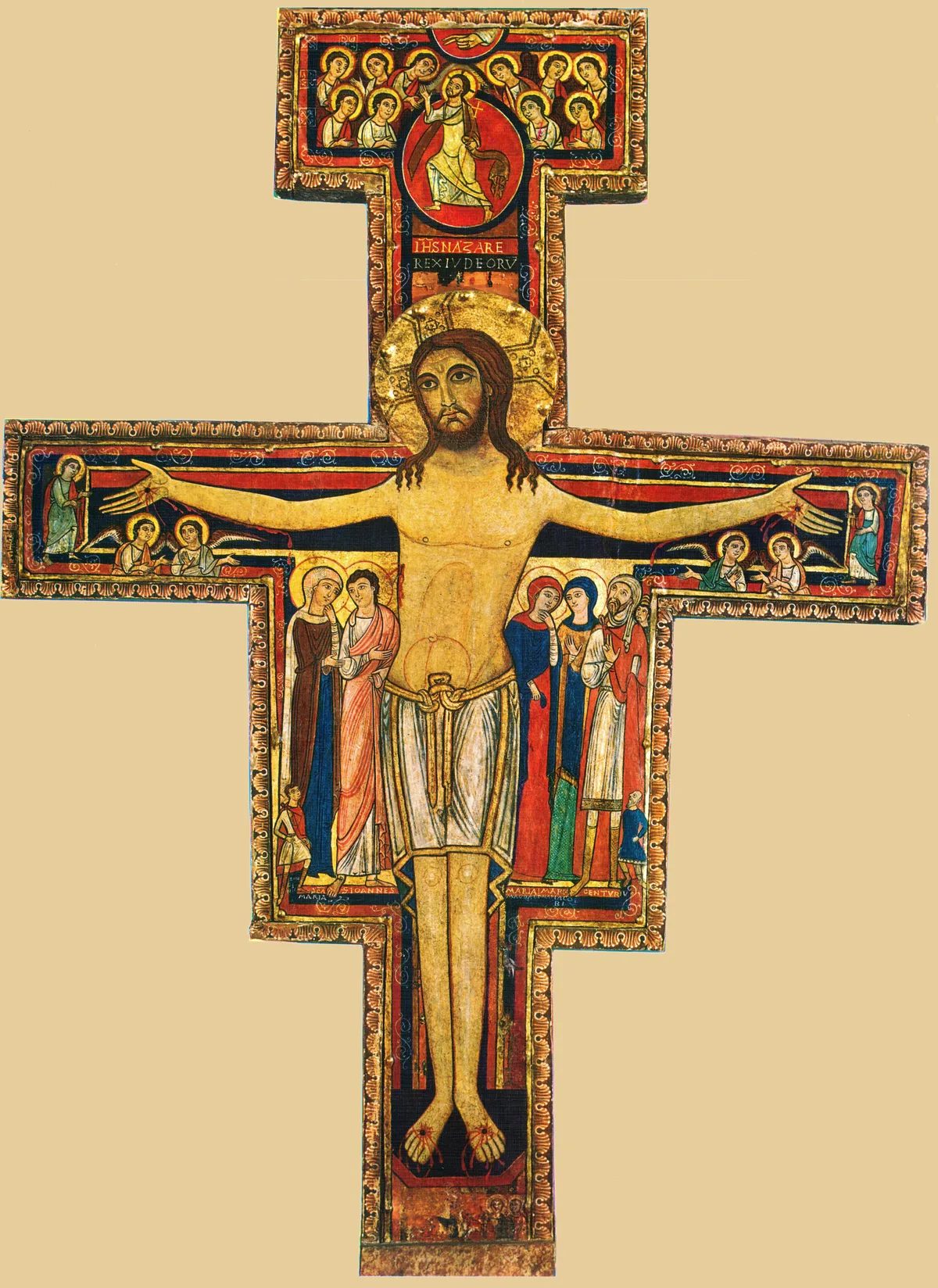
Its most striking feature is that Christ is shown alive. His eyes are open, his head is upright, and his body shows no agony. This is the Christus triumphans, Christ triumphant, who reigns from the cross rather than simply suffering on it. The wounds are there, and blood flows from his hands, feet, and side, but the mood is one of victory and peace. The whole cross is filled with figures and light, more a window into the meaning of the Crucifixion than a record of its pain.
The Figures on the San Damiano Cross
Almost every part of the San Damiano Cross carries meaning. Standing close beside the large figure of Christ are the main witnesses of the Crucifixion. On his right are the Virgin Mary and Saint John the Evangelist; on his left are Mary Magdalene, Mary the mother of James, and the centurion who confessed that Jesus was the Son of God.
Smaller figures fill the rest. The soldiers Longinus, who pierced Christ’s side with a lance, and Stephaton, who offered him the sponge, are shown by his arms. At the top, the risen Christ climbs toward heaven, welcomed by a circle of angels, and above him the hand of God the Father reaches down in blessing. A small rooster near Christ’s knee recalls Peter’s denial and the dawn of the Resurrection, and the patron saints of the region kneel at the foot. Read this way, the cross tells the whole story of salvation, from death to glory, in a single image.
Saint Francis and the Crucified Christ
For the rest of his life Francis remained marked by what happened at San Damiano. His devotion to the Passion of Christ became the heart of Franciscan spirituality, and near the end of his life, while praying on Mount La Verna, he received the stigmata, the wounds of Christ in his own body.

Painters returned again and again to this image of Francis lost in prayer before the crucified Lord. Zurbaran’s Saint Francis in Meditation shows him kneeling in the dark, holding a skull, entirely absorbed in the mystery of death and eternal life. To discover this great Spanish painter of monks and saints, read our article on Francisco de Zurbaran’s paintings.

Giovanni Bellini’s Saint Francis in the Desert shows the other side of the same soul, the saint stepping out into the light of creation, arms open, at peace with God and the world. Together these paintings capture what the San Damiano Cross set in motion, a life poured out in love for the crucified and risen Christ.
Where Is the San Damiano Cross Today?
The cross no longer hangs in the chapel of San Damiano. After Saint Francis died, the Poor Clares, the order founded by his friend Saint Clare, kept the cross with them when they moved into Assisi. Today the original San Damiano Cross is preserved in the Basilica of Saint Clare, Santa Chiara, in Assisi, where pilgrims come to pray before it.
A faithful copy now hangs in the chapel of San Damiano itself, in the place where Francis first heard Christ speak. The image has since been reproduced around the world, in churches, homes, and religious houses, and the simple Franciscan greeting “Peace and all good” is often spoken before it.
The San Damiano Cross and Saint Francis in Art
| Work | Artist | Date | Location |
|---|---|---|---|
| The San Damiano Cross | Unknown Umbrian master | 12th century | Basilica of Saint Clare, Assisi |
| Saint Francis in Meditation | Francisco de Zurbaran | c. 1635-1639 | National Gallery, London |
| Saint Francis in the Desert | Giovanni Bellini | c. 1476-1478 | Frick Collection, New York |
Conclusion
The San Damiano Cross is far more than a relic of the Middle Ages. It is the image that called Saint Francis and, through him, helped renew the whole Church. In its calm, open-eyed Christ it holds together the two truths at the centre of the faith, that the Lord truly died and that he truly rose, reigning from the cross in glory.
That is why people still pray before it eight centuries later. The same Christ who told Francis to rebuild his house still speaks from this cross to anyone who kneels before it. To follow the Crucifixion through the great painters, see our gallery of famous Crucifixion paintings, or explore the wider tradition in our guide to famous Christian paintings.
Key Facts About the San Damiano Cross
- It is a twelfth-century Umbrian icon crucifix, a painted cross showing Christ alive and reigning rather than suffering.
- According to tradition, Christ spoke from it to Saint Francis of Assisi in 1205, telling him to repair his house.
- It is filled with figures, including the Virgin Mary, Saint John, Mary Magdalene, the centurion, and the soldiers of the Passion.
- At the top the risen Christ ascends to heaven, welcomed by angels and blessed by the hand of God the Father.
- The original is kept today in the Basilica of Saint Clare in Assisi, while a copy hangs in the chapel of San Damiano.
Frequently Asked Questions
What is the meaning of the San Damiano Cross?
The San Damiano Cross shows Christ alive and triumphant on the cross, his eyes open and his body at peace, surrounded by the witnesses of the Crucifixion and the angels of the Resurrection. It is meant to hold death and victory together in one image, presenting Christ as both the suffering Saviour and the risen Lord who reigns from the cross.
What is the history of the San Damiano Cross?
The cross was painted by an unknown Umbrian artist in the twelfth century and hung in the small church of San Damiano near Assisi. There, in 1205, the young Francis heard Christ tell him to repair his house. After the saint’s death the Poor Clares kept the cross, and it is now preserved in the Basilica of Saint Clare in Assisi.
Who are the figures depicted on the San Damiano Cross?
Beside the large figure of Christ stand the Virgin Mary, Saint John the Evangelist, Mary Magdalene, Mary the mother of James, and the centurion who confessed Christ. The soldiers Longinus and Stephaton appear by his arms, the risen Christ ascends at the top among angels, and the hand of God the Father blesses from above.
What is the difference between the Tau cross and the San Damiano Cross?
The Tau cross is a plain cross shaped like the Greek letter T, a simple sign of penance and salvation that Saint Francis loved and used as his signature. The San Damiano Cross is a large painted icon crucifix covered with figures of Christ and the witnesses of the Passion. Both are deeply Franciscan, but one is a bare symbol and the other a rich devotional image.
Where is the San Damiano Cross located today?
The original San Damiano Cross is kept in the Basilica of Saint Clare, the Basilica di Santa Chiara, in Assisi, Italy. A faithful copy now hangs in the chapel of San Damiano itself, in the spot where Saint Francis first prayed before it.
Can you buy a San Damiano Cross as a print or canvas?
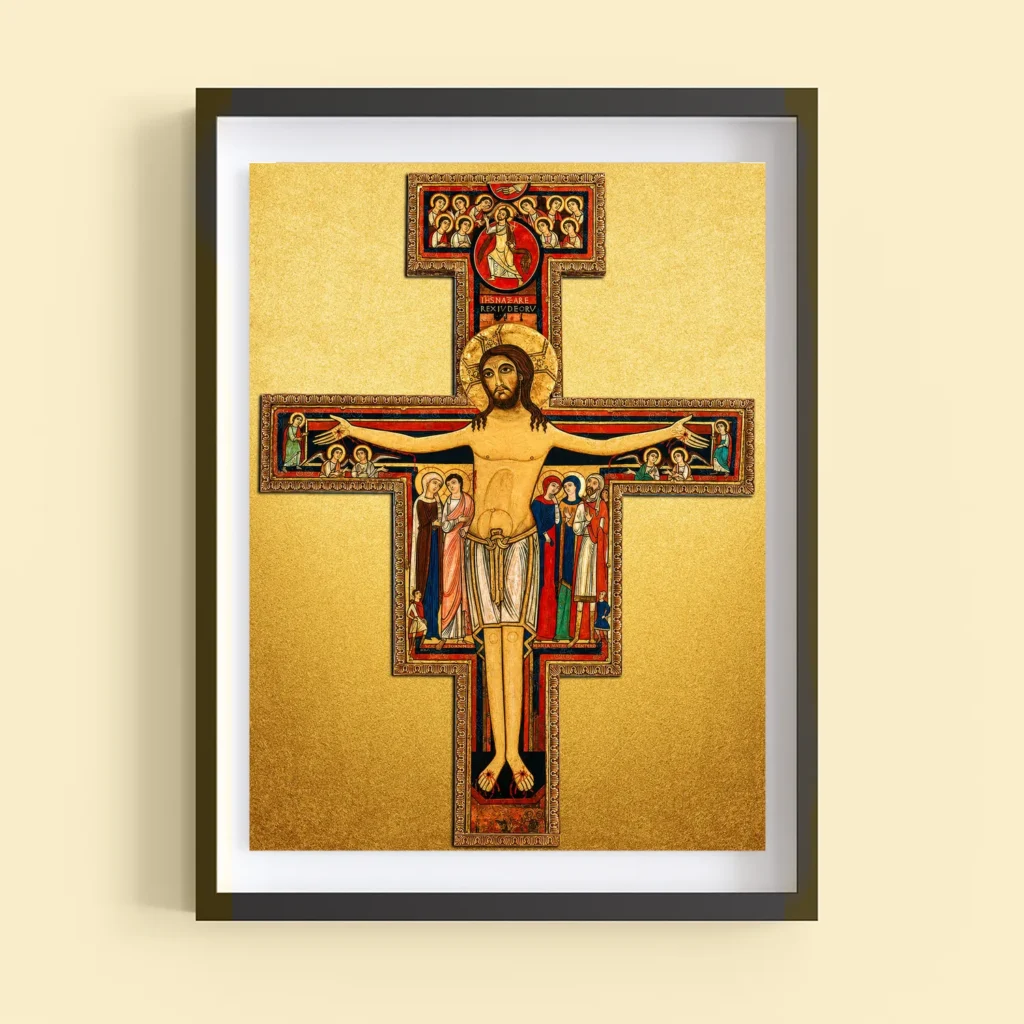
You can buy the San Damiano Cross at jesuschrist.pictures, in our shop, where it is offered as a faithful reproduction on canvas and as a poster. A good reproduction lets you bring this famous icon crucifix into a home, a chapel, or a place of prayer.


