Caravaggio’s Supper at Emmaus, Christ Revealed
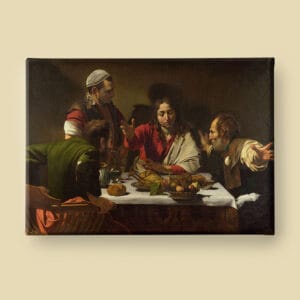
Supper at Emmaus is one of the most dramatic religious paintings of the Baroque, made by Caravaggio in 1601. It captures the exact moment when two disciples realize that the stranger sharing their meal is the risen Christ. The painting is in the National Gallery in London. Its medium is oil on canvas.
The scene comes from the Gospel of Luke. After the crucifixion, two followers walking to the village of Emmaus meet a stranger and invite him to eat. Only when he blesses and breaks the bread do they suddenly see that it is Jesus, alive again. Caravaggio paints that single instant of shock.
Everything explodes outward from the table. One disciple grips his chair as if to leap up, the other throws his arms wide, and a basket of fruit teeters on the very edge, about to fall into our space. With light, gesture, and a few everyday objects, Caravaggio makes the miracle feel like something happening in the room with us. Readers who want to see more of the artist can also read our article on Caravaggio’s paintings.
The History of the Supper at Emmaus
Caravaggio painted the Supper at Emmaus for the Roman nobleman Ciriaco Mattei, at the height of his fame, soon after the great success of his paintings for the Contarelli Chapel. It belongs to the years when he was turning religious art upside down, setting sacred stories among ordinary people in plain, dark rooms.

He returned to the subject again in 1606, in a second, more sombre version now in Milan. But the London painting, the earlier of the two, is the more theatrical, built entirely around the burst of recognition. Readers can explore other treatments of the scene in our gallery of Supper at Emmaus paintings.
The Moment of Recognition
At the center sits Christ, his hand raised in blessing over the bread. Caravaggio paints him beardless and youthful, his face smooth and calm, very different from the usual bearded Christ. This is part of the point. The disciples had walked and talked with him for hours without knowing him, and only the familiar gesture of the blessing opens their eyes.

A shadow falls on the wall behind his head, almost like a halo, the only sign of the divine in an otherwise ordinary room. There are no angels and no golden light, only a young man at a table, and the slow dawning of an impossible truth.
The Shock of the Disciples
The two disciples react with their whole bodies. On the right, an older man, a scallop shell pinned to his chest to mark him as a pilgrim, flings his arms out wide, one hand thrust so far forward it seems to break through the surface of the painting. On the left, the other grips the arms of his chair, half risen, frozen in the act of standing.

Caravaggio uses bold foreshortening to pull the viewer into the scene. The reaching hands seem to enter our own space, so that we are no longer watching the miracle from outside but sitting at the table as it happens.
The Still Life on the Table
For all its drama, the painting is also famous for its quiet still life. A roast bird, a loaf of bread, a glass of wine, and a basket of fruit are laid out with astonishing care. The basket sits right at the edge of the table, tipping toward us, so that it too seems about to enter our world.

The fruit carries meaning. Some of it is past its best, a reminder of mortality, and the shadow cast by the basket has been seen as the shape of a fish, an ancient secret sign for Christ. Caravaggio hides these quiet symbols inside an ordinary meal.
The Drama of a Single Instant
The Supper at Emmaus shows Caravaggio’s genius for catching a story at its turning point. Rather than tell the whole journey to Emmaus, he freezes the one second in which everything changes, and builds the entire painting around it.
That instinct for the decisive moment, lit by a hard, raking light, became one of his great gifts to European art. Painters across the continent learned from him how to make a sacred scene feel sudden, physical, and real.
Conclusion
In the Supper at Emmaus Caravaggio turned a quiet Gospel story into a burst of pure drama. A blessing, a flung arm, a tipping basket, and a shadow on the wall are all he needs to show the risen Christ breaking into the ordinary world.
Still hanging in the National Gallery, the painting keeps its power to startle. It places the viewer at the table, in the very moment of recognition, and asks whether we too would know him.
Artwork Information
| Artwork | Artist | Date | Medium | Current Location |
|---|---|---|---|---|
| Supper at Emmaus | Caravaggio | 1601 | Oil on canvas | The National Gallery, London |
Five Facts About the Supper at Emmaus
- Supper at Emmaus was painted by Caravaggio in 1601, in the Baroque style.
- It shows the moment from Luke’s Gospel when two disciples recognize the risen Christ as he blesses the bread.
- Caravaggio shows Christ beardless and youthful, and freezes the disciples in shock, arms flung wide.
- A basket of fruit tips over the very edge of the table, seeming to fall into the viewer’s space.
- It hangs in the National Gallery in London and was painted for the Roman nobleman Ciriaco Mattei.
FAQ
What does Caravaggio’s Supper at Emmaus depict?
It depicts the moment from the Gospel of Luke when two disciples, sharing a meal at Emmaus, suddenly recognize the risen Christ as he blesses and breaks the bread.
What does the Supper at Emmaus symbolize?
It is about recognition and the presence of Christ in the breaking of bread, a scene long linked to the Eucharist. The blessing reveals what the disciples could not see during hours of conversation.
Why is Christ shown without a beard?
Caravaggio paints Christ young and beardless to suggest how changed he was after the resurrection, so that the disciples did not know him until the familiar gesture of the blessing.
What is the basket of fruit in the painting?
It is a carefully painted still life set at the edge of the table, tipping toward the viewer. Some of the fruit is overripe, a hint of mortality, and the basket’s shadow has been read as the shape of a fish, an early symbol for Christ.
Where is Caravaggio’s Supper at Emmaus?
It is in the National Gallery in London.
When did Caravaggio paint the Supper at Emmaus?
He painted this version in 1601, at the height of his career in Rome.
Did Caravaggio paint more than one Supper at Emmaus?
Yes. He painted a second, more sombre version in 1606, now in the Brera in Milan. The earlier London painting is the more dramatic of the two.
Where can I buy a reproduction of Caravaggio’s Supper at Emmaus?
You can buy a reproduction of Caravaggio’s Supper at Emmaus at jesuschrist.pictures. The canvas reproduction is in our shop, printed on premium canvas and shipped worldwide.


