Iconic Raphael Paintings Every Art Lover Should Know
Raphael paintings are the standard against which all other Renaissance art has been measured for five centuries. Born Raffaello Sanzio in Urbino in 1483, he died in Rome at thirty-seven, having in that short lifetime produced a body of work that seemed to his contemporaries, and has seemed to many since, to embody everything that painting could accomplish: clarity of form, harmony of composition, beauty of color, psychological truth, and a grace of execution that made the most difficult things appear effortless. He trained under Perugino in Umbria, learned from Leonardo and Michelangelo in Florence, and arrived in Rome in 1508 to begin work for Pope Julius II on the Vatican Stanze, the frescoed apartments that remain among the greatest achievements in the history of Western art. His sacred paintings, from the intimate Madonna del Prato to the monumental Transfiguration, show a painter who understood the spiritual content of his subjects as well as he understood their formal requirements.

From Urbino to Rome: A Career of Continuous Growth
Raphael’s development was uniquely rapid and uniquely systematic. He absorbed the Umbrian tradition of his master Perugino with extraordinary completeness, then traveled to Florence around 1504 and spent the next four years studying Leonardo and Michelangelo, learning from Leonardo the compositional freedom of the pyramid grouping and the quality of the sfumato, and from Michelangelo the monumental power of the figure. When he arrived in Rome in 1508 and began the Vatican Stanze, he was already twenty-five and already, by any ordinary standard, a fully formed master. But the Roman experience pushed him further still: the scale of the commissions, the ambition of the programme, and the intellectual environment of Julius II’s court demanded a new order of compositional thinking, and Raphael met the demand.
He died on Good Friday 1520, on his thirty-seventh birthday, having spent only twelve years in Rome. The shock in the city was enormous: he was the most celebrated painter in Italy, the inheritor of Michelangelo’s mantle in the papal court, and his death left the greatest fresco cycle of the period, the Transfiguration, unfinished on the easel.
Disputation of the Holy Sacrament
The Disputation of the Holy Sacrament (Disputà) in the Stanza della Segnatura in the Vatican, painted around 1509-1510, is the first of the great Vatican frescoes and establishes the program that would govern the whole cycle. The fresco shows the Church Triumphant, Christ, the Virgin, and the saints in heaven, and the Church Militant, theologians and Fathers of the Church on earth, united in their veneration of the consecrated host, which occupies the center of the composition on the altar. The arrangement of figures across a vast semicircular space, each individual yet part of a coherent whole, is one of the supreme achievements of compositional organization in the history of painting.

Madonna del Prato
The Madonna del Prato at the Kunsthistorisches Museum in Vienna, painted around 1505-1506, is one of the masterpieces of Raphael’s Florentine period and a perfect demonstration of what he learned from Leonardo. The three figures, the Virgin, the Christ child, and the young John the Baptist, are arranged in the pyramid composition that Leonardo had developed, and the spacious green meadow (the “prato” of the title) sets them in a landscape of tranquil beauty. The infant Christ takes the cross from the Baptist’s hands, accepting the instrument of his Passion with a gravity that is entirely natural in a child of that age, and the Virgin watches with a composed knowledge of what it means. It is a painting in which theological content and human warmth are perfectly balanced.

Madonna di Foligno
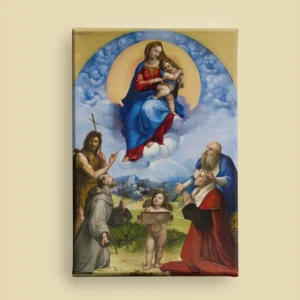
The Madonna di Foligno at the Pinacoteca Vaticana, painted around 1511-1512, is one of Raphael’s most complex and most ambitious altarpieces. The Virgin and Child appear in glory in the upper zone, surrounded by putti, while below them the donor Sigismondo de’ Conti kneels in thanksgiving, introduced by Saint Jerome; to the left, Saints Francis and John the Baptist complete the composition. The format, a heavenly vision appearing to earthly figures, allows Raphael to combine the formal language of the devotional altarpiece with the more dynamic spatial composition he was developing in the Vatican Stanze. The luminous cloud on which the Virgin appears, and the putti who surround her, became among the most frequently imitated motifs of the next century.

Resurrection of Christ
The early panel depicting the Resurrection of Christ, painted around 1499-1502 during Raphael’s period with Perugino, shows the young master working in his teacher’s manner. The risen Christ floats above the tomb, and the soldiers below react with surprise and fear in the poses that Perugino had established for the subject. The painting is important as a demonstration of Raphael’s formation under Perugino before his independent development, and it shows the Umbrian tradition at its most refined: clear color, serene spatial composition, and a grace of figure that Raphael would carry forward and surpass in his Roman period.


Saint George and the Dragon
The small panel of Saint George and the Dragon at the National Gallery of Art in Washington, painted around 1505, was probably a diplomatic gift from Guidobaldo da Montefeltro, Duke of Urbino, to King Henry VII of England. The tiny scale of the panel, it is barely larger than a book, contrasts with the dynamism of the composition: the horse rears, the lance descends toward the dragon, and the princess kneels in prayer in the background. Raphael handles the subject with a complete mastery of compositional energy that is remarkable for a painter still in his early twenties.

Saint John the Baptist in the Desert
This panel at the Louvre, showing the young John the Baptist in the desert landscape where he lived before his public ministry, is one of Raphael’s most purely beautiful figures. The Baptist is shown in the wilderness, holding the reed cross and pointing upward, toward the Christ whose coming he announced. The figure’s grace and the quality of the light that models it reflect Raphael’s full mastery of the Florentine tradition, and the landscape behind is handled with the atmospheric delicacy that he learned from Leonardo.


School of Athens
The School of Athens in the Stanza della Segnatura, painted opposite the Disputà around 1509-1511, is the companion fresco in which the highest achievements of philosophy are shown in parallel with the highest achievements of theology. The great philosophers of antiquity, Plato and Aristotle at the center, Socrates, Pythagoras, Euclid, and others around them, gather in a vast architectural setting inspired by Bramante’s designs for the new Saint Peter’s Basilica. The painting is both a celebration of classical learning and a demonstration of Raphael’s own mastery of composition, perspective, and portraiture: the faces of the philosophers are portraits of contemporaries, Plato with the features of Leonardo, Heraclitus with those of Michelangelo.

Sistine Madonna
The Sistine Madonna at the Gemaldegalerie in Dresden, painted around 1512 for the church of San Sisto in Piacenza, is one of the most recognized images in Western art and the source of the most frequently reproduced detail in painting history, the two putti at the bottom of the canvas who rest their chins on their hands and look upward with a mixture of curiosity and pensiveness. But the painting as a whole is a masterpiece of a different order: the Virgin holds the Christ child and steps forward from behind a curtain as if walking out of heaven toward the viewer, accompanied by Saint Sixtus and Saint Barbara. The sense of movement, the quality of the Madonna’s gaze, and the completeness of the pictorial illusion are remarkable.


The Holy Family
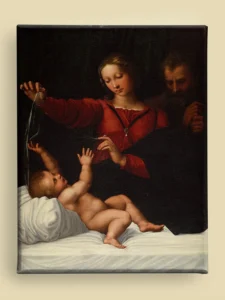
The Holy Family at the Museo del Prado in Madrid, also known as the Pearl (La Perla), was one of the most admired works in the Spanish royal collection for centuries. The composition shows the Virgin and Child with Saint Joseph and other figures in the intimate, tender arrangement that Raphael excelled at. The figures are drawn together in the pyramid composition he had perfected, and the quality of the light and the modeling of the flesh show the full development of his technique. Philip IV of Spain is said to have called it “the pearl of his collection.”

Here is another version of Raphael’s Holy Family
The Marriage of the Virgin
The Marriage of the Virgin at the Pinacoteca di Brera in Milan, painted in 1504, is the work that marks Raphael’s independence from Perugino. The subject, the marriage of Mary and Joseph in the presence of the Temple in Jerusalem, was also painted by Perugino, and comparing the two versions shows exactly how Raphael had absorbed and surpassed his master. Both share the semicircular arrangement of figures and the centrally placed temple, but Raphael’s composition is more dynamic, his figures more varied and more psychologically alive, and the perspective of the foreground pavement more sophisticated. It is the moment at which the pupil definitively passes the teacher.

The Procession to Calvary
The Procession to Calvary at the Museo del Prado in Madrid, also known as Lo Spasimo di Sicilia, painted around 1516-1517, shows Christ falling under the weight of the cross on the road to Golgotha. The central figure of the fallen Christ, his body bent under the burden, his face turned toward the viewer with a look of exhausted suffering, is one of the most powerful figures in Raphael’s entire output. The Virgin rushes toward her son from the left in a paroxysm of grief, and the soldiers and crowd fill the rest of the composition. The painting was famous in its own time and was reproduced and copied for centuries.


Transfiguration
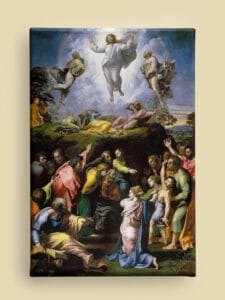
The Transfiguration at the Pinacoteca Vaticana, Raphael’s last painting, was left unfinished at his death in 1520 and completed by his assistants. The upper zone shows Christ transfigured on Mount Tabor, floating in radiant light between Moses and Elijah, with the three apostles prostrated below, a vision of divine glory as the most dramatic episode in the Gospels. The lower zone, added by Raphael to the original commission, shows the other apostles unable to heal a possessed boy: a scene of human helplessness that contrasts deliberately with the divine power above. The Transfiguration remained beside Raphael’s body as he lay in state, and it is perhaps the greatest single statement in paint of what the High Renaissance could accomplish.

Summary of Raphael’s Paintings
| Painting | Date | Location |
|---|---|---|
| Disputation of the Holy Sacrament | c. 1509-10 | Vatican Museums, Vatican City |
| Madonna del Prato | c. 1505-06 | Kunsthistorisches Museum, Vienna |
| Madonna di Foligno | c. 1511-12 | Pinacoteca Vaticana, Vatican |
| Resurrection of Christ | c. 1499-1502 | Sao Paulo Museum of Art |
| Saint George and the Dragon | c. 1505 | National Gallery of Art, Washington |
| Saint John the Baptist in the Desert | c. 1516 | Louvre, Paris |
| School of Athens | c. 1509-11 | Vatican Museums, Vatican City |
| Sistine Madonna | c. 1512 | Gemaldegalerie Alte Meister, Dresden |
| The Holy Family (La Perla) | c. 1518 | Museo del Prado, Madrid |
| The Marriage of the Virgin | 1504 | Pinacoteca di Brera, Milan |
| The Procession to Calvary | c. 1516-17 | Museo del Prado, Madrid |
| Transfiguration | c. 1518-20 | Pinacoteca Vaticana, Vatican |
Important Facts about Raphael
- Born: 1483 in Urbino, the son of the painter Giovanni Santi; trained under Pietro Perugino in Perugia, then moved to Florence around 1504 to study Leonardo and Michelangelo.
- Vatican Stanze: Called to Rome in 1508 by Pope Julius II to paint the Vatican Stanze, the papal apartments, he produced there the Disputà, the School of Athens, the Liberation of Saint Peter, and other frescoes that are the supreme achievement of High Renaissance painting in Italy.
- Synthesis: His particular genius was for synthesis: he absorbed everything around him, the Umbrian grace of Perugino, the compositional freedom of Leonardo, the sculptural power of Michelangelo, and unified these diverse influences in a style of such apparent ease and completeness that it defined the standard of European academic painting for three centuries.
- Workshop: His Roman workshop was the largest and most productive of any painter of his generation; he trained an entire generation of Italian painters, including Giulio Romano, Perin del Vaga, and Polidoro da Caravaggio, and his influence on the subsequent history of art exceeded that of any other single Renaissance painter.
- Death: Died on Good Friday, April 6, 1520, his thirty-seventh birthday, in Rome; the cause of death is not certainly known. He was buried in the Pantheon, and the city mourned him as it had mourned no other artist in living memory.
Frequently Asked Questions about Raphael
Why is Raphael considered the perfect Renaissance painter?
The description of Raphael as the “perfect” Renaissance painter reflects not a judgment about individual genius, Michelangelo was considered by many to surpass him in power and originality, but a judgment about the completeness of his art. Raphael possessed in full measure every quality that the Renaissance theory of painting valued: ideal beauty, compositional clarity, narrative expressiveness, psychological truth, grace of execution, and the capacity to work at any scale from the intimate devotional panel to the monumental fresco. No other painter of the period combined all these qualities in equal degree. He was not the most powerful or the most original painter of the Renaissance, but he was perhaps the most complete.
What is the relationship between the Disputà and the School of Athens?
The two frescoes face each other across the Stanza della Segnatura and were conceived as companions in a programmatic decoration that celebrated the highest achievements of the human mind. The Disputà represents Theology, the knowledge of divine things, while the School of Athens represents Philosophy, the knowledge of natural things. Together they express the Renaissance conviction, most fully articulated by the Neoplatonist Ficino, that reason and faith, classical wisdom and Christian revelation, are not opposed but complementary paths to truth. The two frescoes are mirror images of each other in compositional terms: both use a vast semicircular space populated with individualized figures gathered around a central axis, one heavenly and one terrestrial.
Why did Raphael die so young?
Raphael died on April 6, 1520, his thirty-seventh birthday, after a short illness. The ancient sources say he fell ill after “an excess of amorous pleasures,” but this is almost certainly a moralistic interpretation rather than a medical diagnosis. The actual cause of his death is unknown. Giorgio Vasari reports a fever; some modern historians have suggested pneumonia, others a form of exhaustion from overwork. At the time of his death he was directing the most productive workshop in Rome, designing and supervising the execution of the Vatican Logge decorations, working on the Transfiguration, and managing an enormous range of other architectural and artistic projects. The combination of these demands on a man of thirty-seven may have left him vulnerable to whatever illness struck him.
What is the significance of the Sistine Madonna’s cherubs?
The two winged putti at the base of the Sistine Madonna, resting their chins on their hands and gazing upward with expressions of contemplative curiosity, have become the most reproduced detail in the history of Western painting. They appear on postcards, calendars, posters, and commercial products in numbers that dwarf the circulation of any other image from the Renaissance. Their popularity rests on the quality of observation that Raphael brings to the depiction of children: these are not generically cute cherubs but specific, individual figures with a genuine psychological life, absorbed in looking at something above them with the attentive intelligence of real children watching something they don’t quite understand.
Where can the major works of Raphael be seen?
The Vatican Museums in Rome hold the greatest concentration, including the Stanze frescoes and the Transfiguration. The Uffizi Gallery in Florence has several early and middle-period works. The Prado in Madrid holds the Holy Family (La Perla) and the Procession to Calvary. The Gemaldegalerie in Dresden has the Sistine Madonna. The Louvre in Paris has important panels including the Saint George and the Dragon. The Kunsthistorisches Museum in Vienna has the Madonna del Prato. The Pinacoteca di Brera in Milan has the Marriage of the Virgin.
Where can I buy Raphael paintings reproductions?
You can buy them at jesuschrist.pictures: browse all the Raphael canvas prints in our shop, printed on museum-grade canvas and available in several sizes.


