Famous Correggio Paintings of Heaven and Tenderness
Correggio paintings stand as one of the great surprises of the Italian Renaissance. Born Antonio Allegri around 1489 in the small town of Correggio in Emilia-Romagna, from which he took the name by which history knows him, he worked far from the great centers of Italian art, yet developed a style of extraordinary originality and influence. His soft, warm light, his figures of tender grace, his astonishing illusionistic ceiling fresco in Parma Cathedral all anticipated the Baroque by nearly a century. He was, in the words of many later critics, a painter born before his time, a master whose particular vision of sacred light and human tenderness was not fully absorbed until Rubens, Guercino, and the great painters of the seventeenth century took it as their model.

The Master of Parma
Correggio trained in Mantua, probably under Francesco Bonsignori, and in his early career he absorbed the influence of Mantegna’s sculptural precision and Leonardo da Vinci‘s sfumato. But what he made of these influences was entirely his own. He settled in Parma around 1520 and spent most of his productive life there, receiving commissions for large church decorations, the frescoes for the Camera di San Paolo, the dome of San Giovanni Evangelista, and finally the great Assumption in Parma Cathedral, as well as for the altarpieces and devotional panels that secured his reputation across Italy.
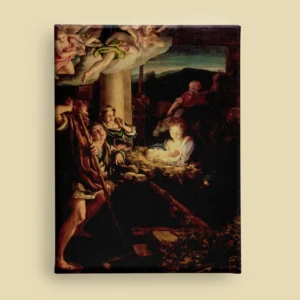
His figures have a softness and warmth that distinguishes them from the harder, more linear style of Florence. His Madonnas smile with a natural tenderness; his angels play with the unselfconscious delight of real children; his nocturnal light, most famously in The Holy Night, radiates from the body of the Christ child with a warmth that floods the surrounding figures. It is an art of physical grace in the service of spiritual feeling, and its influence on later painting was immense.
The Assumption of the Virgin
The fresco covering the dome of Parma Cathedral, painted between 1526 and 1530, is Correggio’s most ambitious and most celebrated work. Looking up into the dome, the viewer sees the Virgin being carried upward into heaven in a swirling vortex of angels, apostles, and light, figures painted with extreme foreshortening from directly below, their bodies twisting in every direction against a sky of warm gold. The composition had no precedent in Italian painting: it was the first fully illusionistic dome fresco, abolishing the solid surface of the ceiling and replacing it with an apparent opening to the sky. When the sculptor Titian saw it, he is said to have declared that if the dome could be turned upside down and filled with gold, it would not be worth as much as the painting. The copy shown here gives an impression of the fresco’s structure, though no reproduction can convey the effect of looking up into it.

The Holy Night
The Holy Night (La Notte) in the Gemäldegalerie Alte Meister in Dresden is among the most influential nocturnal paintings in the history of art. The scene is the Nativity: the infant Jesus lies in the manger, his body radiating a warm light that illuminates the figures gathered around him. The Virgin bends over the child in adoration; shepherds and angels cluster at the edges of the light; at the left, a woman shields her eyes from the radiance of the divine infant. In the sky above the stable, more angels appear in a golden glow. What Correggio achieves here, the child as the source of light, the surrounding darkness defined by and against that light, was entirely new in Italian painting and became a model for generations of later artists, from Honthorst to Georges de La Tour to Rembrandt.

Noli me tangere
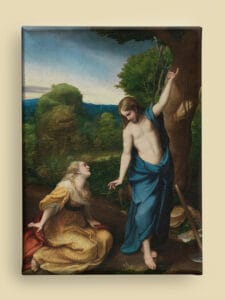
The Noli me tangere at the Museo del Prado in Madrid shows the risen Christ appearing to Mary Magdalene in the garden on Easter morning. Correggio’s version is among the most tender and human of all treatments of this subject. Christ is shown as if just risen, his body still soft with the warmth of life, drawing back gently but not coldly. The Magdalene kneels before him, her gesture of recognition and restraint natural and unforced. Behind them, a luminous landscape opens into Correggio’s characteristic warm distance. The scene breathes with the feeling of an encounter between two people who know each other well, momentarily separated by something larger than either of them.

Madonna Altarpieces
Madonna with St. Francis
The Madonna with St. Francis, painted around 1514–1515 and now in the Gemäldegalerie Alte Meister in Dresden, is Correggio’s earliest surviving large altarpiece. The Virgin and Child appear in a luminous sky above a landscape, while Saints Francis, John the Baptist, Jerome, and Anthony of Padua gather below in adoration. The composition shows the influence of Raphael and the Venetians, but the handling of light and the warmth of the figures already announce Correggio’s distinctive manner. The smiling Christ child, reaching toward the viewer, is one of his earliest great characterizations of the divine child’s playful humanity.

Madonna of Saint George
Painted around 1530–1532 and now in the Gemäldegalerie Alte Meister in Dresden, the Madonna of Saint George presents the Virgin and Child enthroned with Saints George, Geminianus, Peter Martyr, and John the Baptist. The saints are arranged with the natural ease that Correggio brought to all his sacred gatherings, they do not stand in formal attendance but occupy their shared space with a comfortable, living presence. The Christ child plays at the Virgin’s knee with the unselfconscious delight of a real child, his divinity apparent not in formal gesture but in the quality of light that surrounds him.

Mystic Marriage of Saint Catherine with Saint Sebastian
This altarpiece in the Louvre, painted around 1526–1527, shows the mystical marriage of Saint Catherine of Alexandria to the Christ child: the infant Jesus places a ring on the saint’s finger, sealing her spiritual betrothal to him. Saint Sebastian, the young Roman soldier martyred for his faith, stands at the right. The scene is bathed in Correggio’s characteristic warm light, the figures gathered in a circle of tender intimacy that is entirely characteristic of his approach to sacred narrative, not ceremonial and formal but warm, close, personal.

Passion and Devotional Works
Lamentation over the Dead Christ
The Lamentation over the Dead Christ in the Galleria Nazionale di Parma was painted around 1524. The lifeless body of Christ is surrounded by the grief of the Virgin, Mary Magdalene, and other mourners. Where Mantegna would have rendered this scene with sculptural hardness and Pontormo with Mannerist intensity, Correggio brings to it his characteristic softness and warmth: the grief is real and physical, but the light that falls on Christ’s body has the same warmth as the light that surrounds his living figures in other paintings. It is a meditation on the body of God, and its tenderness is deeply characteristic.

Head of Christ
This intimate devotional fragment at the J. Paul Getty Museum in Los Angeles shows the face of Christ in a detail that may have been part of a larger composition. The handling of the face, the soft modeling, the warm light, the expression of composed, inward suffering, is among the most personal expressions of Christ’s humanity in Correggio’s work. Small devotional images of this kind were produced for private prayer, and the intimacy of this one is typical of Correggio’s ability to bring sacred subjects into the register of personal feeling.

Martyrdom of Four Saints
The Martyrdom of Four Saints in the Galleria Nazionale di Parma, painted around 1524, is one of Correggio’s most dramatic and unusual compositions. The scene of martyrdom, saints being put to death for their faith, is handled not with the sculptural gravity of Mantegna or the fierce energy of Caravaggio but with the same soft, enveloping warmth that Correggio brings to gentler subjects. The figures twist and reach in the Mannerist manner, but the light that bathes them is Correggio’s own, and it gives the scene of suffering an unexpected tenderness.

Saints Peter, Martha, Mary Magdalen, and Leonard
This polyptych panel at the Metropolitan Museum of Art in New York, painted around 1514–1515, shows four saints in Correggio’s early manner, still close to the Florentine High Renaissance in its formal clarity but already showing the warmth and softness of light that would define his mature work. The figures are individualized with the care of a portrait painter, each face registering a different quality of devotional attention.

Summary of Correggio’s Paintings
| Painting | Date | Location |
|---|---|---|
| Assumption of the Virgin (fresco) | 1526–30 | Parma Cathedral |
| Head of Christ | c. 1525–30 | J. Paul Getty Museum, Los Angeles |
| Lamentation over the Dead Christ | c. 1524 | Galleria Nazionale di Parma |
| Madonna of Saint George | c. 1530–32 | Gemäldegalerie Alte Meister, Dresden |
| Madonna with St. Francis | c. 1514–15 | Gemäldegalerie Alte Meister, Dresden |
| Martyrdom of Four Saints | c. 1524 | Galleria Nazionale di Parma |
| Mystic Marriage of Saint Catherine with Saint Sebastian | c. 1526–27 | Louvre, Paris |
| Noli me tangere | c. 1525 | Museo del Prado, Madrid |
| Saints Peter, Martha, Mary Magdalen, and Leonard | c. 1514–15 | Metropolitan Museum of Art, New York |
| The Holy Night | c. 1529–30 | Gemäldegalerie Alte Meister, Dresden |
Important Facts about Correggio
- Born: Around 1489 in Correggio, Emilia-Romagna; trained locally and in Mantua, probably under Francesco Bonsignori, absorbing the influence of Mantegna and Leonardo da Vinci.
- Training: Largely self-formed outside the main centers of Italian art, drawing on Mantegna’s sculptural foreshortening, Leonardo’s sfumato, and Raphael’s compositional grace to develop a wholly personal synthesis.
- Style: Distinguished by soft, warm light, extreme illusionistic foreshortening in dome frescoes, tender and physically warm treatment of sacred figures, and a palette that anticipates the warmth of Baroque painting by nearly a century.
- Major work: The fresco of the Assumption of the Virgin in the dome of Parma Cathedral (1526–1530) is the first fully illusionistic dome fresco in the history of art and the direct ancestor of every Baroque ceiling painted in the following century and a half.
- Death: Died 5 March 1534 in Correggio, aged around forty-five, of fever. He spent most of his life in or near Parma, rarely traveling to the major Italian centers, and was not widely celebrated until after his death.
Frequently Asked Questions about Correggio
Why is Correggio sometimes called a “pre-Baroque” painter?
Correggio anticipated several key features of Baroque painting, soft, warm light emerging from a single source; extreme illusionistic foreshortening in ceiling frescoes; figures of tender physical warmth; emotional directness, decades before the Baroque style emerged in Rome around 1600. Painters like Rubens, Lanfranco, and Guido Reni studied his work carefully and drew directly on his solutions. Calling him pre-Baroque is a way of acknowledging that his innovations were too advanced for his own time and only found their full development in the century after his death.
What makes The Holy Night so influential?
The painting solved a problem that had occupied painters for generations: how to represent the supernatural light of the divine infant in the dark of the Nativity scene. Correggio’s solution, making the child himself the source of warm, radiant light that illuminates the surrounding figures, was simple, technically brilliant, and profoundly devotionally effective. The image of the child as the light of the world, made visible as actual illumination, became the model for nocturnal Nativity scenes across Europe for the next two centuries.
Did Correggio influence later painters?
Enormously. His influence was felt most directly in Parma (Parmigianino was his most gifted immediate follower) and in the Baroque tradition of Rome, where painters like Lanfranco adapted his illusionistic dome fresco technique to decorate the great Roman churches. Rubens, who studied Italian painting carefully during his years in Italy, was deeply influenced by Correggio’s warmth and softness. Later still, French Rococo painters, Fragonard, Boucher, absorbed his lightness of touch and his figures’ sensuous grace.
Where can I see Correggio’s major works?
The Assumption fresco is in Parma Cathedral and can be seen in situ, which is the only way to fully appreciate its illusionistic effect. The Gemäldegalerie Alte Meister in Dresden holds several major altarpieces, including The Holy Night and the Madonna with St. Francis. The Louvre has the Mystic Marriage of Saint Catherine. The Prado in Madrid holds the Noli me tangere. And the Galleria Nazionale di Parma has significant works including the Lamentation.
What is the Mystic Marriage of Saint Catherine?
The Mystic Marriage is a type of devotional image, popular from the late medieval period onward, that depicts Saint Catherine of Alexandria, a fourth-century martyr, in a vision in which the infant Jesus places a ring on her finger as a sign of her spiritual union with him. The subject allowed painters to combine the intimacy of the Madonna and Child with a narrative of martyrdom and mystical love. Correggio’s version, with its warm light and tender figures, is among the most beautiful treatments of the subject in the entire tradition.
Where can I buy a canvas reproduction of a Correggio painting?
You can buy them at jesuschrist.pictures. All the canvas canvas prints are gathered in our shop, printed on premium canvas and shipped worldwide.


