The 12 Most Famous Christian Paintings in History
The most famous Christian paintings in history are not simply beautiful objects. They are visual acts of faith, shaped by theology, devotion, and the extraordinary gift of artists who believed that paint on a surface could bring viewers closer to God. From the frescoed walls of a chapel in Padua to the vaults of the Sistine Chapel, from a London cathedral to the surrealist imagination of a twentieth-century Catalan, these twelve works have defined how billions of people picture Christ, the Virgin Mary, and the mysteries of salvation.
This selection spans seven centuries and six countries. Each painting has earned its place not through chance, but through the depth of its theological vision, the power of its composition, and its lasting hold on the Christian imagination. We have arranged them in chronological order, from the Gothic frescoes of medieval Italy to the nuclear mysticism of the postwar years.
1. The Lamentation of Christ by Giotto (c. 1304–1306)
Before Raphael, before Leonardo, there was Giotto. The Lamentation of Christ, painted on the walls of the Scrovegni Chapel in Padua, is where Western religious painting effectively begins. The scene is heartbreaking in its simplicity: the body of Christ rests on the ground, surrounded by mourning figures, while angels weep openly in the sky above. What makes this fresco revolutionary is Giotto’s refusal to paint symbols. He painted grief. Real, physical, human grief. The faces are individual, the gestures specific, the sorrow unmistakable. No painter before him had done this.
Seven centuries on, the Scrovegni Chapel remains one of the great pilgrimage destinations for anyone serious about Christian art. To understand the tradition Giotto came from and transformed, see our series on the great medieval Christian painters.


2. The Last Supper by Leonardo da Vinci (1495–1498)
There is a strong argument that The Last Supper is the most analyzed painting in the world. Leonardo spent three years on the refectory wall of Santa Maria delle Grazie in Milan, working not in traditional fresco but in tempera and oil on a dry wall, a decision that caused the image to begin deteriorating within his own lifetime. The painting captures the exact moment Christ says “one of you will betray me.” Every apostle reacts differently. Judas clutches his money bag. Peter grabs a knife. John, the youngest, seems almost to faint. At the center, calm amid the storm, Christ sits with his arms open in a gesture that is at once an offering and an acceptance.
The Last Supper has been copied, parodied, and reproduced more than almost any other image in human history. That familiarity risks blinding us to how radical it was. We have explored the full story of this masterpiece in our dedicated article on The Last Supper by Leonardo da Vinci. For a broader view of how artists across centuries depicted this sacred meal, see our article on the 13 most famous Last Supper paintings.


3. Salvator Mundi by Leonardo da Vinci (c. 1499–1510)
Christ raises his right hand in blessing. His left hand holds a crystal orb, symbol of the cosmos he sustains. The gaze is direct, calm, and impossibly knowing. This is Salvator Mundi, the Savior of the World, painted by Leonardo around the turn of the sixteenth century and lost to history for over two hundred years before its dramatic rediscovery and reattribution in the 2000s.
In November 2017, it sold at Christie’s for $450.3 million, the highest price ever paid for a painting at auction. Its current location remains officially undisclosed. The mystery surrounding the work, its long disappearance, the debates over attribution, the record-breaking sale, has only deepened its cultural presence. As a theological image it is precise and powerful: Christ as cosmic ruler, tender and sovereign at once. The full story is told in our article on the Salvator Mundi by Leonardo da Vinci.


4. The Creation of Adam by Michelangelo (1508–1512)
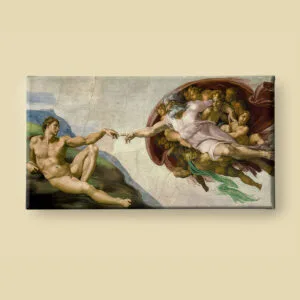
Of all the scenes on the Sistine Chapel ceiling, it is this one that lodged itself permanently in the visual memory of the world. God, borne aloft by a swirling group of angels, extends his finger toward Adam. Adam reclines, still half-formed, reaching back. The two fingers almost touch. In that gap: creation, breath, consciousness, the divine gift of life itself.
Michelangelo painted the ceiling over four grueling years, working on scaffolding in conditions he documented bitterly in poetry. The ceiling nearly destroyed his eyesight. The result is among the greatest artistic achievements in human history, and the Creation of Adam its most iconic detail. For a broader look at Michelangelo’s sacred vision, see our article on Michelangelo’s paintings.

5. Transfiguration by Raphael (1516–1520)
Raphael was thirty-two when he began the Transfiguration and thirty-seven when he died, leaving it unfinished. His workshop completed the lower section, which depicts the disciples failing to cure an epileptic boy, a deliberate counterpoint to the divine radiance above. In the upper half, Christ hovers in a blaze of white light between Moses and Elijah, witnessed by the astonished apostles Peter, James, and John. The contrast between human helplessness below and divine glory above gives the painting its extraordinary theological tension.
The Transfiguration now hangs in the Vatican Pinacoteca. At Raphael’s death in 1520, it was carried at the head of his funeral procession. Those who bore it wept. You can explore more of his sacred work in our dedicated article on Raphael’s paintings, and see how other artists depicted this mystery in our article on famous Transfiguration paintings.


6. The Last Judgment by Michelangelo (1536–1541)
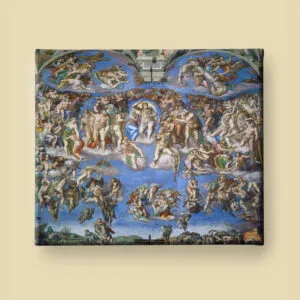
Twenty-five years after finishing the ceiling, Michelangelo returned to the Sistine Chapel to paint the altar wall. The result is overwhelming. A colossal Christ, muscular and implacable, presides over the resurrection of the dead and the condemnation of sinners. The saved rise toward heaven. The damned are dragged downward by demons. Saints display the instruments of their martyrdom. Charon beats the condemned with his oar. Across nearly fourteen meters of wall, close to four hundred figures jostle in a torrent of flesh and judgment.
When it was unveiled in 1541, it shocked Rome. The papal master of ceremonies Biagio da Cesena, who had called the work “shameless,” found himself depicted as Minos in hell, ears bound by a serpent. Michelangelo’s reply was literally eternal. No subsequent artist attempting the Last Judgment has escaped this painting’s shadow.

7. The Calling of Saint Matthew by Caravaggio (1599–1600)
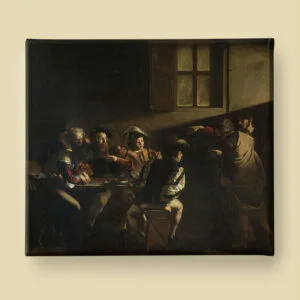
Caravaggio changed everything. Where Renaissance painters constructed ideal worlds of beauty and celestial harmony, he walked into the street, found ordinary faces, and placed Christ among them. In The Calling of Saint Matthew, Jesus enters a tavern. A shaft of light cuts across the dim room. Matthew, a tax collector, sits at a table counting coins with his companions. Christ points at him. Matthew points at himself, incredulous: me? The gesture is so natural, so psychologically true, that it stops viewers in their tracks four hundred years later.
The painting has never moved. It hangs in the Contarelli Chapel of San Luigi dei Francesi in Rome, exactly where Caravaggio placed it. Standing in that dim chapel and watching the light fall across Matthew’s face is one of the great experiences available to any lover of Christian art. For more of his work, see our article on Caravaggio’s paintings.

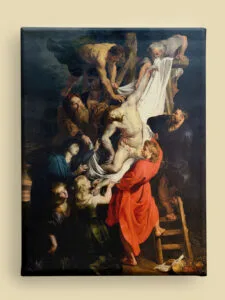
8. The Descent from the Cross by Peter Paul Rubens (1611–1614)
Rubens painted the Descent from the Cross as the central panel of a triptych for the Cathedral of Our Lady in Antwerp, and it has never left. The body of Christ, drained of color, is being lowered from the cross by a group of figures straining under his weight. The white linen shroud catches the light and draws the eye down through the composition to where the Virgin reaches up to receive her son. The tenderness of that gesture, the physical reality of death, the grief of the witnesses, Rubens marshals all of it with absolute command. A few years earlier Rubens had brought the same command to a pair of vast Jesuit altarpieces, one for Saint Ignatius of Loyola and one for Saint Francis Xavier, both now in Vienna.
This is Baroque painting at its finest: emotional force disciplined by supreme technical mastery. Entire generations of Flemish faithful came to Antwerp Cathedral to kneel before this triptych. It remains one of the most visited works of sacred art in northern Europe.

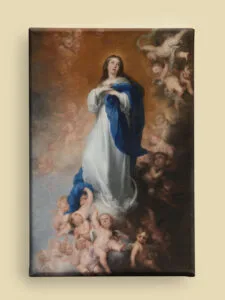
9. The Immaculate Conception by Bartolomé Esteban Murillo (c. 1678)
Murillo painted the Immaculate Conception around twenty times over his career. The version now at the Museo del Prado in Madrid, commissioned for the Hospital de los Venerables Sacerdotes in Seville and known as the Immaculate Conception of Los Venerables, is among the most luminous Marian images ever created. The Virgin rises on a crescent moon, her hands crossed over her chest, her gaze lifted toward heaven in an expression of pure surrender and grace. A warm golden light emanates from above. Angels hover in the clouds around her.
The painting’s story is dramatic: looted by Marshal Soult during the Napoleonic invasion of Spain in 1813, sold to the Louvre in 1852 for the largest sum ever paid for a painting at that time, it finally returned to Spain in 1941. Where other Baroque painters could be theatrical, Murillo is tender. His Virgins feel genuinely approachable, which explains why his images of Mary spread across the Catholic world and never really left it. For more beautiful Marian works, see our article on the most beautiful Virgin Mary paintings.

10. The Light of the World by William Holman Hunt (1851–1853 and 1900–1904)
Christ stands at an overgrown door in the night, holding a lantern, waiting to knock. The door has no handle on the outside: it can only be opened from within. Hunt painted this image twice. The first, smaller version is at Keble College, Oxford. The large replica he completed in his seventies, working nearly blind, now hangs in St Paul’s Cathedral in London. The symbolism is direct but not simple. The overgrown vegetation around the door suggests a heart long neglected. The lantern evokes both Scripture and conscience. Christ does not force entry. He waits.
When the large version toured Australia, New Zealand, South Africa, and Canada in 1905 and 1906, hundreds of thousands came to see it. It may be the most universally loved image of Christ in the English-speaking Protestant world, and one of the most theologically precise images of the Christian life ever painted.


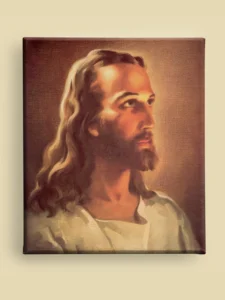
11. Head of Christ by Warner Sallman (1940)
No painting on this list has been reproduced more times. Warner Sallman’s Head of Christ, painted in oil in 1940 for an American religious publisher, went on to be printed on over five hundred million cards, posters, calendars, and Bible covers. During the Second World War, American military chaplains distributed it to soldiers on both fronts. It became the defining image of Jesus for an entire generation of Protestant and Catholic Americans: a gentle, side-lit face, soft brown hair, a gaze that is distant but unmistakably compassionate.
Art historians have debated it endlessly. Some find it sentimental; others argue that its accessibility is precisely its strength. What cannot be debated is its cultural impact. For hundreds of millions of people in the twentieth century, this was what Jesus looked like. The original oil painting is held at the Jessie C. Wilson Galleries, Anderson University, Indiana.

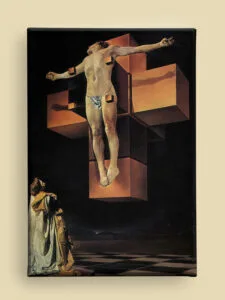
12. Crucifixion (Corpus Hypercubus) by Salvador Dalí (1954)
In 1954, Dalí submitted a crucifixion unlike anything the Church had previously encountered. Christ is suspended not on a wooden cross but on an unfolded hypercube, a four-dimensional geometric form floating in space. There is no crown of thorns, no blood, no nails. The figure is luminous, idealized, weightless. Below, Gala, Dalí’s wife and muse, gazes up at the body in the role of the Virgin. The landscape behind her is drawn from Port Lligat, Dalí’s home on the Catalan coast.
Dalí called his approach “nuclear mysticism”: the conviction that modern science and Christian faith were not in conflict but were different languages describing the same transcendent reality. The painting now hangs in the Metropolitan Museum of Art in New York, where it is one of the most visited works in the collection. You can read more about Dalí’s remarkable sacred vision in our dedicated article on Dalí’s Surrealist Jesus paintings.

Summary of the 12 Most Famous Christian Paintings Featured in This Article
| Painting | Artist | Date | Medium | Location |
|---|---|---|---|---|
| The Lamentation of Christ | Giotto | c. 1304–1306 | Fresco | Scrovegni Chapel, Padua |
| The Last Supper | Leonardo da Vinci | 1495–1498 | Tempera and oil on plaster | Santa Maria delle Grazie, Milan |
| Salvator Mundi | Leonardo da Vinci | c. 1499–1510 | Oil on walnut panel | Location undisclosed |
| The Creation of Adam | Michelangelo | 1508–1512 | Fresco | Sistine Chapel, Vatican City |
| Transfiguration | Raphael | 1516–1520 | Oil on panel | Vatican Pinacoteca, Rome |
| The Last Judgment | Michelangelo | 1536–1541 | Fresco | Sistine Chapel, Vatican City |
| The Calling of Saint Matthew | Caravaggio | 1599–1600 | Oil on canvas | San Luigi dei Francesi, Rome |
| The Descent from the Cross | Peter Paul Rubens | 1611–1614 | Oil on panel | Cathedral of Our Lady, Antwerp |
| The Immaculate Conception (Los Venerables) | Bartolomé Esteban Murillo | c. 1678 | Oil on canvas | Museo del Prado, Madrid |
| The Light of the World | William Holman Hunt | 1851–1853 / 1900–1904 | Oil on canvas | St Paul’s Cathedral, London |
| Head of Christ | Warner Sallman | 1940 | Oil on canvas | Jessie C. Wilson Galleries, Anderson University, Indiana |
| Crucifixion (Corpus Hypercubus) | Salvador Dalí | 1954 | Oil on canvas | The Metropolitan Museum of Art, New York |
One of the Bible’s greatest underdog victories has its own gallery of masterpieces; explore our guide to David and Goliath paintings.
Conclusion
Seven centuries separate Giotto’s weeping angels from Dalí’s hypercubic cross. The paintings on this list share almost nothing in terms of style, technique, or cultural context. What they share is something harder to define: the capacity to stop a viewer in their tracks and make them feel, however briefly, in the presence of something larger than themselves. That is what Christian painting at its greatest has always done.
These are not simply famous works. They are visual theology, painted prayers, images that entire civilizations used to understand who Christ is and what his life means. Whether you encounter them in a museum, a cathedral, or a canvas reproduction at home, they reward slow, serious attention.
To go further, you might explore our articles on Renaissance Jesus paintings, Baroque Jesus paintings, and the full Life of Christ in 20 paintings.
Frequently Asked Questions
What is the most famous Christian painting in history?
Most art historians would point to The Last Supper by Leonardo da Vinci. Painted between 1495 and 1498 on the refectory wall of Santa Maria delle Grazie in Milan, it has been reproduced, studied, and referenced more than any other work of Christian art. The Sistine Chapel, and particularly The Creation of Adam, would be a close second, though it is worth noting that the Sistine Chapel ceiling is a cycle of many scenes, not a single painting.
What is the most famous painting of the Virgin Mary?
Murillo’s Immaculate Conception paintings are among the most widely venerated Marian images in the Catholic world, and Raphael’s Sistine Madonna, with its famous pair of contemplative cherubs, is one of the most reproduced paintings of any kind. For those in the Orthodox and Byzantine traditions, icons such as the Theotokos of Vladimir carry immense and centuries-old devotional weight. Our article on the most beautiful Virgin Mary paintings explores many of these works in depth.
What is the oldest painting on this list?
The oldest is Giotto’s Lamentation of Christ, painted around 1304 to 1306 in the Scrovegni Chapel in Padua. It marks a genuine turning point in Western art, where human emotion and spatial depth began to replace the flat, gold-ground formalism of Byzantine tradition. To understand the world Giotto came from, see our series on Giotto’s paintings and the great medieval Christian painters.
Which of these paintings is the most valuable?
By auction price, the Salvator Mundi by Leonardo da Vinci holds the record by an extraordinary margin. It sold at Christie’s in November 2017 for $450.3 million, making it the most expensive painting ever sold at public auction. Its current location is officially undisclosed, which has itself become part of the painting’s remarkable story.
Where can I see these paintings in person?
Several are permanently accessible to the public. The Last Judgment and the Creation of Adam are in the Sistine Chapel, Vatican City. The Calling of Saint Matthew has never moved from its original chapel in San Luigi dei Francesi, Rome. The Descent from the Cross remains in Antwerp Cathedral. Corpus Hypercubus is at the Metropolitan Museum of Art in New York. The Light of the World’s large version hangs in St Paul’s Cathedral in London, and Murillo’s Immaculate Conception of Los Venerables is at the Museo del Prado in Madrid. Giotto’s Lamentation requires a visit to the Scrovegni Chapel in Padua, for which advance reservations are essential.
Are there other great Christian paintings not on this list?
Many. This list focuses on the twelve paintings that have had the greatest cultural reach and devotional impact across the broadest audiences. But the history of Christian art is vast and endlessly rich. Our articles on famous Crucifixion paintings, famous Nativity paintings, and famous Annunciation paintings cover many of the works that could equally have appeared here.
Where can I buy reproductions of these famous Christian paintings?
You can buy reproductions of these famous Christian paintings at jesuschrist.pictures, in our shop. Several works from this list are available as high-quality canvas reproductions in our shop, including The Lamentation of Christ by Giotto, The Last Supper by Leonardo da Vinci, Salvator Mundi, The Creation of Adam and The Last Judgment by Michelangelo, Transfiguration by Raphael, The Calling of Saint Matthew by Caravaggio, The Descent from the Cross by Rubens, The Immaculate Conception by Murillo, The Light of the World by Holman Hunt, Head of Christ by Sallman, and Corpus Hypercubus by Dalí.