12 Modern Christian Paintings That Changed Sacred Art
Modern Christian paintings are often treated as a contradiction in terms, as if the nineteenth and twentieth centuries were too secular, too skeptical, too broken by war and ideology to produce genuine sacred art. The twelve works on this list prove otherwise. From the Russian Academic painters who spent decades on single canvases to the Post-Impressionists who found in Christ a figure of radical human solidarity, from the pre-Raphaelites and late Romantics to Chagall and Dalí, the modern period produced some of the most searching and original sacred paintings in the entire history of Christianity. These are the very works gathered, alongside new digital reinterpretations, in our modern Jesus art gallery. These twelve works, arranged chronologically from 1857 to 1955, tell that story.
For the broader tradition these painters were inheriting and transforming, see our articles on Baroque Christian paintings and Renaissance Christian paintings.
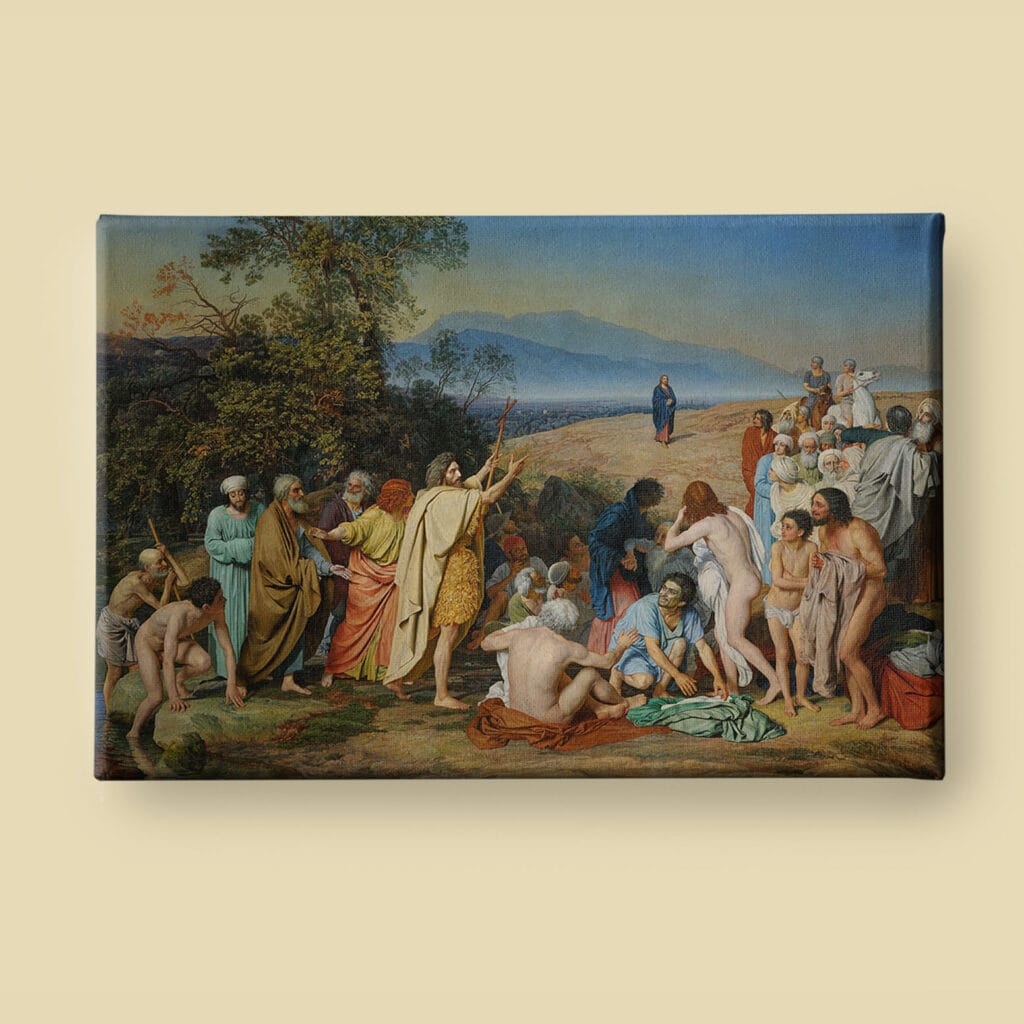
1. The Appearance of Christ Before the People by Alexander Ivanov (1837-1857)
Alexander Ivanov spent twenty years on this painting. He began it in Rome in 1837 and completed it in 1857, the year he finally returned to Russia and died, aged forty-seven, within weeks of the canvas arriving in Saint Petersburg. The Appearance of Christ Before the People shows the moment John the Baptist, standing at the Jordan River, points toward the distant approaching figure of Christ for the first time: “Behold the Lamb of God.” The crowd around John reacts with everything from terror to wonder to indifference. In the foreground, a slave’s chains are falling away. In the middle ground, a man with a striking resemblance to Nikolai Gogol watches from a steep riverbank.
The painting is enormous, 540 by 750 centimeters, and it takes a few minutes standing before it to understand what Ivanov was attempting. This is not a devotional image. It is an essay on the nature of faith itself: what happens to different kinds of human beings when they encounter the sacred for the first time? The painting is at the State Tretyakov Gallery in Moscow.

2. Ecce Homo by Antonio Ciseri (1871-1891)
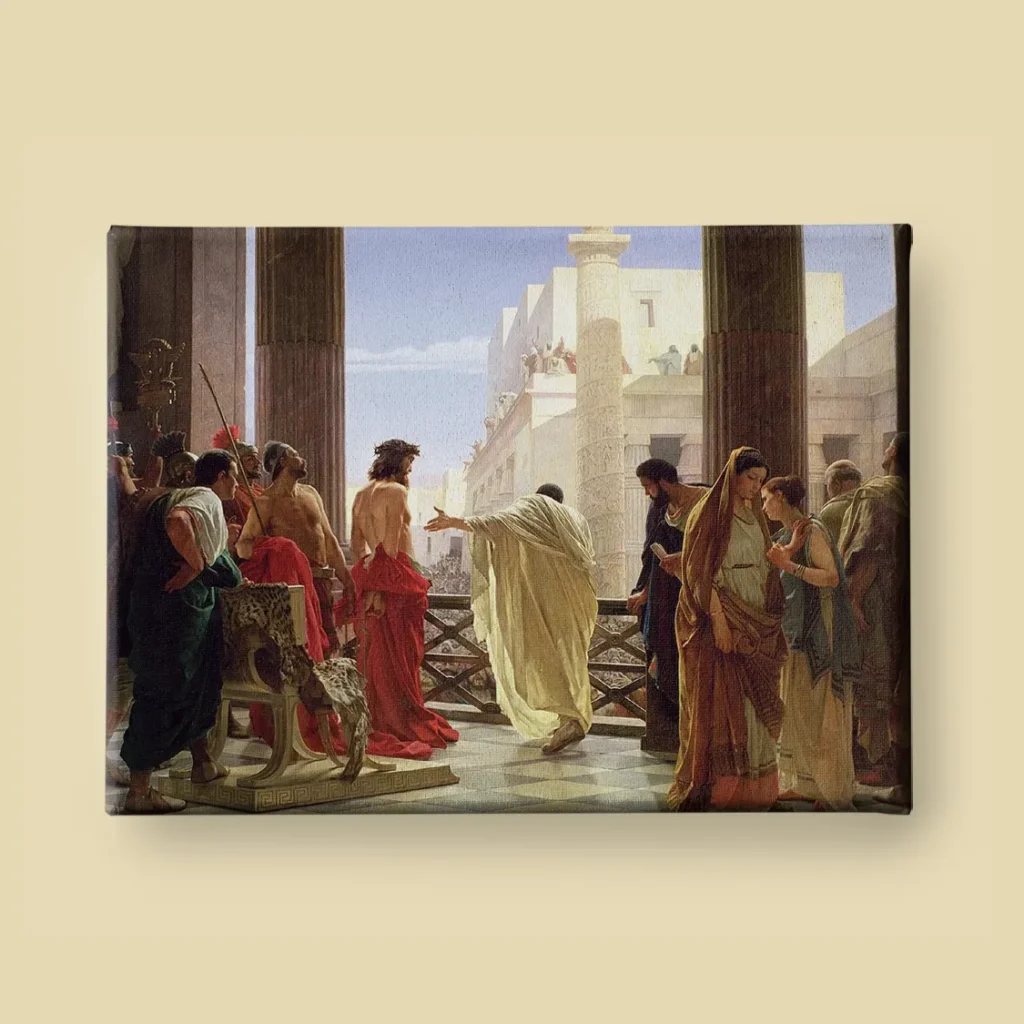
Ciseri spent twenty years on this painting too, beginning it in 1871 and completing it only in 1891, the last year of his life. The parallel with Ivanov is not coincidental: both men understood that certain sacred subjects demanded a kind of lifelong attention that cannot be rushed. Ciseri’s Ecce Homo shows Pontius Pilate presenting the scourged Christ to the crowd from the steps of the Praetorium. The perspective is unusual: we see the scene from behind, looking over the shoulders of Pilate’s retinue toward the crowd below and the city beyond. Christ is turned away from us, his back to the viewer, his white robe bright against the stone.
This reversal of the traditional composition is quietly revolutionary. By hiding Christ’s face, Ciseri forces the viewer to read the scene through the reactions of the witnesses: the soldier gesturing forward, the woman in the foreground covering her face, the crowd below rendered as an anonymous mass of judgment. The painting feels almost photographic, which was deliberate: Ciseri was one of the first painters to use photography as a compositional reference. It is at the Galleria d’Arte Moderna in the Palazzo Pitti, Florence.

3. Christ in Gethsemane by Carl Bloch (1873)
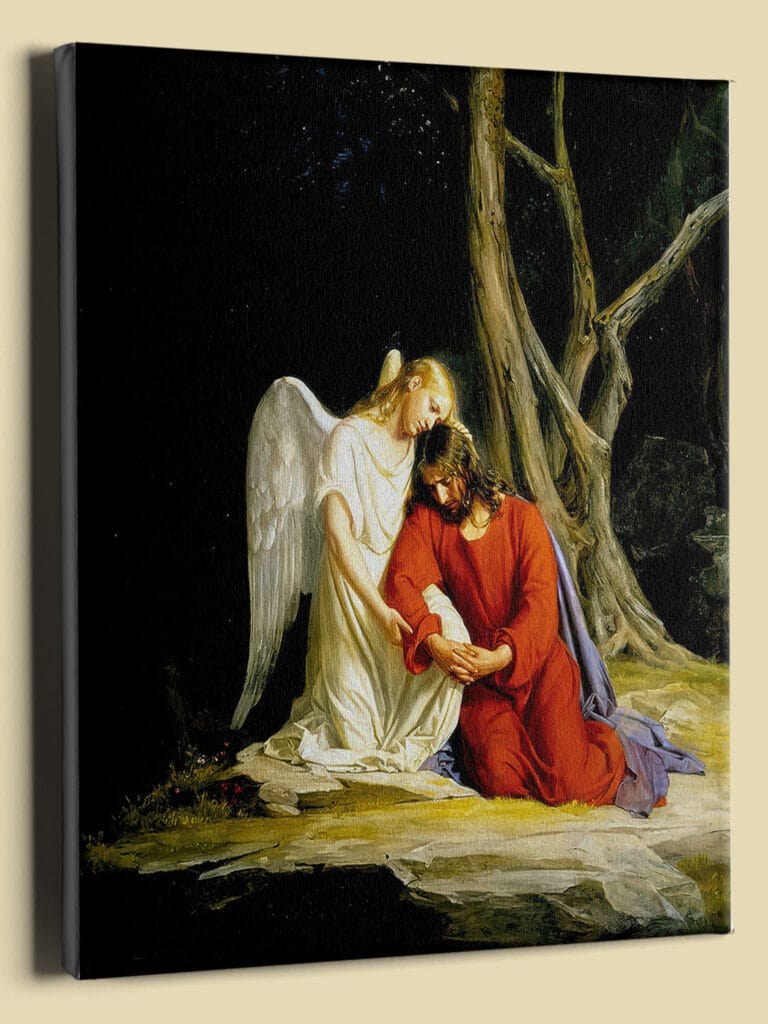
Carl Bloch was a Danish painter who spent most of his working life producing a cycle of paintings for the chapel of Frederiksborg Castle in Denmark, and in doing so created what became, across the nineteenth and twentieth centuries, the most widely reproduced corpus of sacred paintings in the Protestant world. His Christ in Gethsemane, painted in 1873, shows Christ kneeling in prayer in the Garden of Olives as an angel descends to strengthen him. The light is nocturnal and intimate, the setting specific and real, the suffering visible but not theatrical. There is no crowd, no drama: just a man on his knees in the dark before an enormous act of submission.
The painting’s influence on Protestant devotional culture in America and Scandinavia has been vast and lasting. Reproductions of Bloch’s Gethsemane hung in Sunday school rooms, hospitals, and private homes across the English-speaking world for over a century. The original is at the Museum of National History at Frederiksborg Castle in Hillerød, Denmark. For a wider view of this subject, see our article on famous Agony in the Garden paintings.

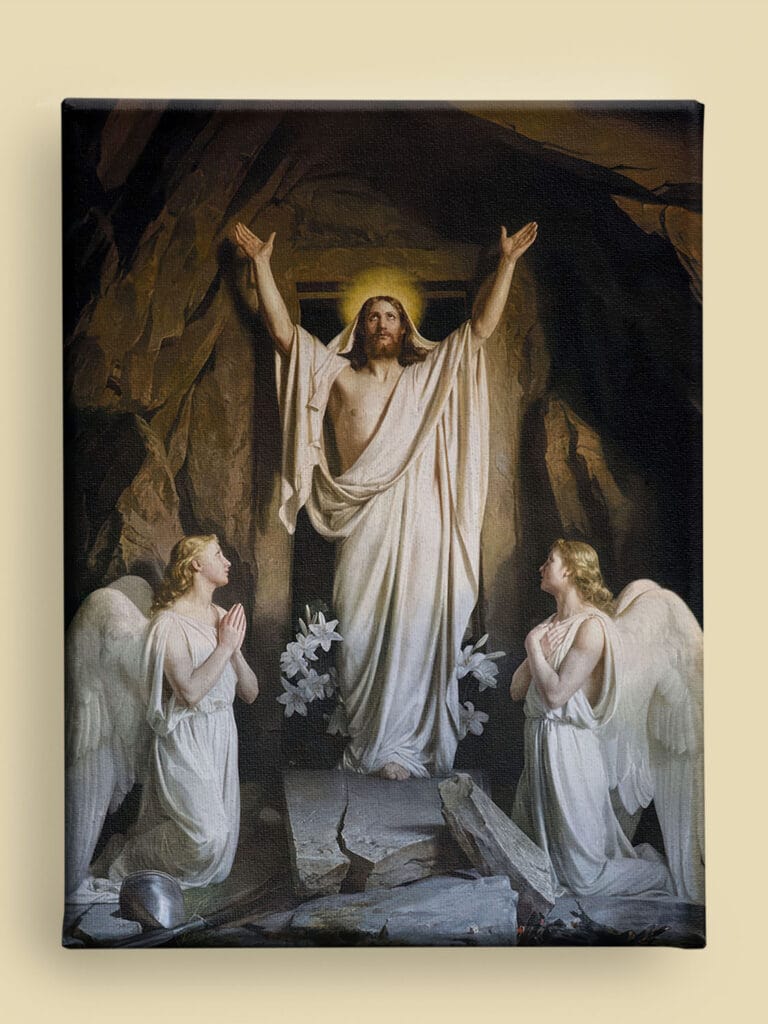
4. The Resurrection by Carl Bloch (c. 1875)
Also from the Frederiksborg series, Bloch’s Resurrection shows the moment of the empty tomb: the stone rolled away, the linen burial cloths lying folded, the Risen Christ standing in a flood of morning light that fills the right half of the canvas and bleaches out everything it touches. Mary Magdalene kneels to the left, shielding her eyes. The composition is still, almost silent, as if the moment of resurrection has not yet fully registered in the air around it.
Bloch’s theological emphasis, here as throughout the Frederiksborg cycle, is on light rather than power. The Resurrection is not an explosion or a triumph: it is a dawn. Something has changed, quietly and completely, while the world was asleep. For more on the history of this subject across the centuries, see our article on famous Resurrection paintings, and for more of Bloch’s work, see our article on Realist Jesus paintings.

5. Christ Before Pilate by Mihály Munkácsy (1881)
When Munkácsy exhibited Christ Before Pilate in Paris in 1881, it caused a sensation. Over half a million people came to see it. The Hungarian painter, working on a canvas nearly five meters wide, had placed the trial of Jesus in a space of almost theatrical intensity: a large hall, a crowd pressing in from every direction, Pilate seated to one side with an expression of visible discomfort, and Christ standing at the center, bound but entirely composed, surrounded by accusers who are smaller and less present than he is in every way that matters.
The painting toured the world for years, drawing crowds in New York, Boston, and other major cities before returning to Hungary. It is now at the Déri Museum in Debrecen, Hungary, where it remains one of the most visited works of art in the country. Munkácsy went on to paint two companion works, Golgotha (1884) and Ecce Homo (1896), completing one of the great Passion cycles of the nineteenth century.

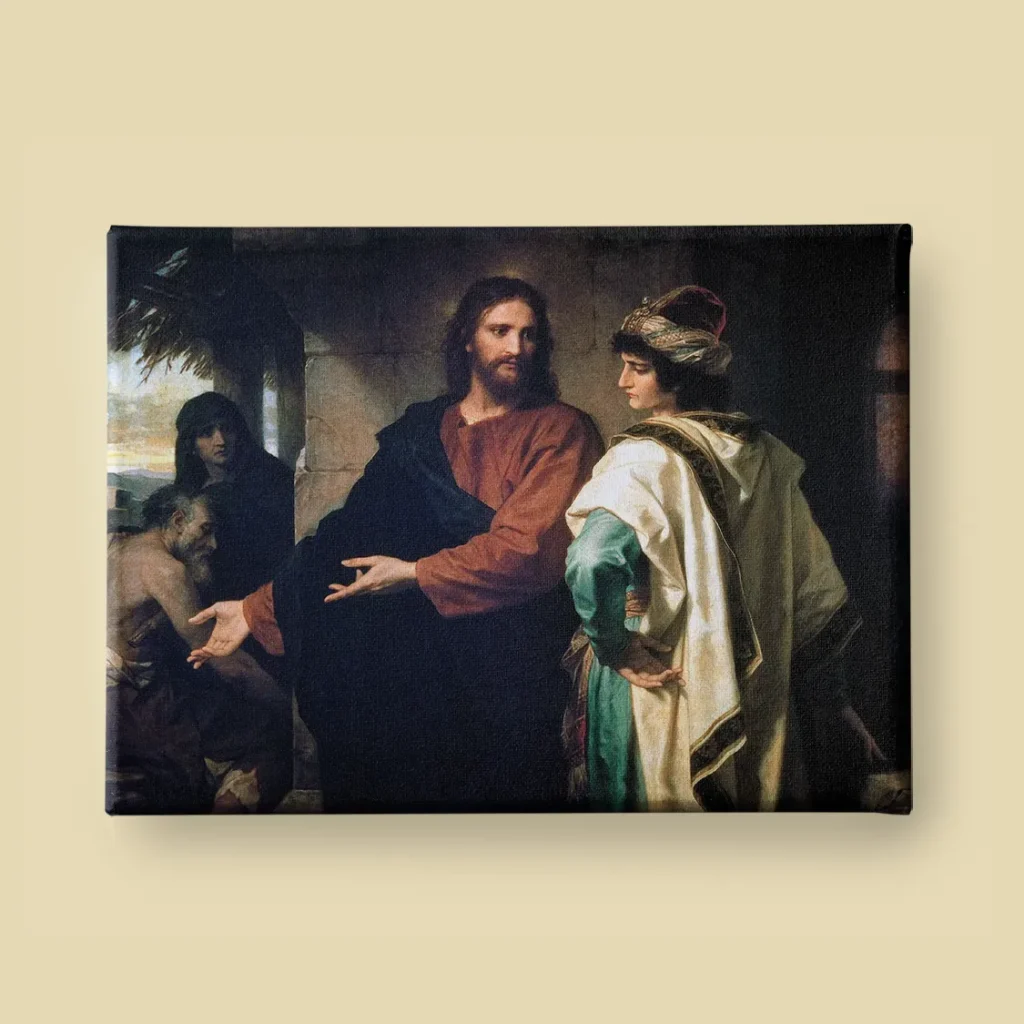
6. Christ and the Rich Young Ruler by Heinrich Hofmann (1889)
Heinrich Hofmann was a German Academic painter whose depictions of Christ became, through mass reproduction, among the most familiar images in the Protestant imagination. Christ and the Rich Young Ruler, painted in 1889, shows a seated Christ looking with gentle directness at a young man who has asked what he must do to inherit eternal life. The answer, as the Gospels record, is the one thing the young man cannot bring himself to do: give away everything he has. Christ’s expression contains no condemnation, only an invitation and the knowledge that it will be refused.
Hofmann gave Christ a face of calm authority that was very different from the suffering figures of the Baroque tradition: this is a teacher, not a victim, and the painting’s influence on how generations of Christians imagined their encounters with Jesus in prayer was considerable. The original painting is at Riverside Church in New York. For more on Hofmann’s most famous image, see our article on Realist Jesus paintings.

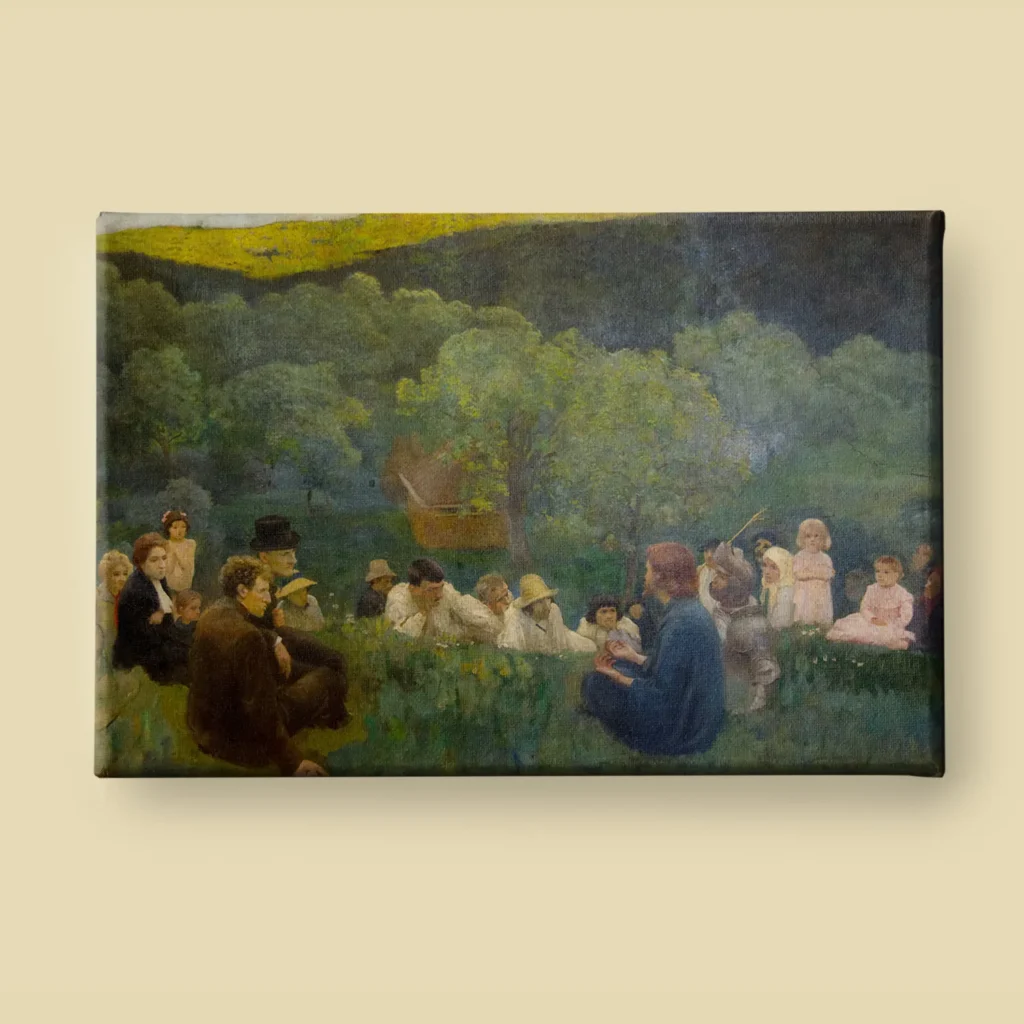
7. The Sermon on the Mount by Károly Ferenczy (1896)
Ferenczy was a Hungarian Post-Impressionist painter who brought to sacred subjects a lightness and naturalism that was genuinely new in the tradition of biblical painting. His Sermon on the Mount, painted in 1896, sets the scene in a sun-dappled hillside landscape where Christ addresses a small crowd of ordinary listeners, men and women in contemporary dress, painted with the loose, vibrant brushwork of the Impressionist moment. The painting is less interested in doctrinal statement than in the texture of a warm afternoon, a human gathering, and the quality of attention that a certain kind of speech can produce in its listeners.
This approach, making sacred scenes feel like things that could happen today rather than events at a permanent historical remove, was controversial in its time and remains theologically rich. The painting is at the Hungarian National Gallery in Budapest.

8. The Annunciation by Henry Ossawa Tanner (1898)
Tanner was the first African-American painter to achieve international recognition, and his Annunciation is one of the most original treatments of the subject in the entire history of Christian art. Mary sits on the edge of her bed in a simply furnished room, a young woman clearly woken from sleep, wrapping a blanket around herself and looking, with an expression of absorbed concentration rather than fear or ecstasy, at the form of the angel: not a figure but a column of vibrating golden light, abstract and overwhelming, filling the doorway of the room. There are no wings, no lily, no elaborate gold-ground setting. Just a girl and a presence.
Tanner had traveled to Palestine to paint from the actual landscape and architecture he imagined for his biblical scenes, and the room in the Annunciation has the texture of something genuinely observed. The decision to render Gabriel as pure light rather than a human figure was radical and has never been surpassed as a visual solution to the theological problem of how to paint the divine. The painting is at the Philadelphia Museum of Art. For more on this great subject, see our article on famous Annunciation paintings.

9. Head of Christ by Georges Rouault (c. 1932-1938)
Rouault began his working life as an apprentice in a stained-glass workshop, and his entire painting career was spent trying to recover for oil paint the qualities of medieval glass: the thick black lead lines, the luminous color trapped within bounded spaces, the way a stained-glass window turns ordinary light into something sacred. His series of Head of Christ paintings, produced across the 1930s, are the fullest expression of this ambition. Christ’s face, built up in heavy impasto with outlines of near-black, seems to emit rather than reflect light: a face made of color, staring out from the canvas with an expression of sorrow that is not broken but somehow gathered.
Rouault was a devout Catholic who described his painting as an act of prayer rather than artistic production, and the Head of Christ canvases have the force of objects that have been prayed over. They belong to the tradition of icons more than to the tradition of easel painting, and they sit, in the history of twentieth-century sacred art, as a kind of visual theology: Christ as the suffering face of God, painted again and again until the act of painting itself becomes intercession. The version at the Chrysler Museum of Art in Norfolk, Virginia is among the finest examples.

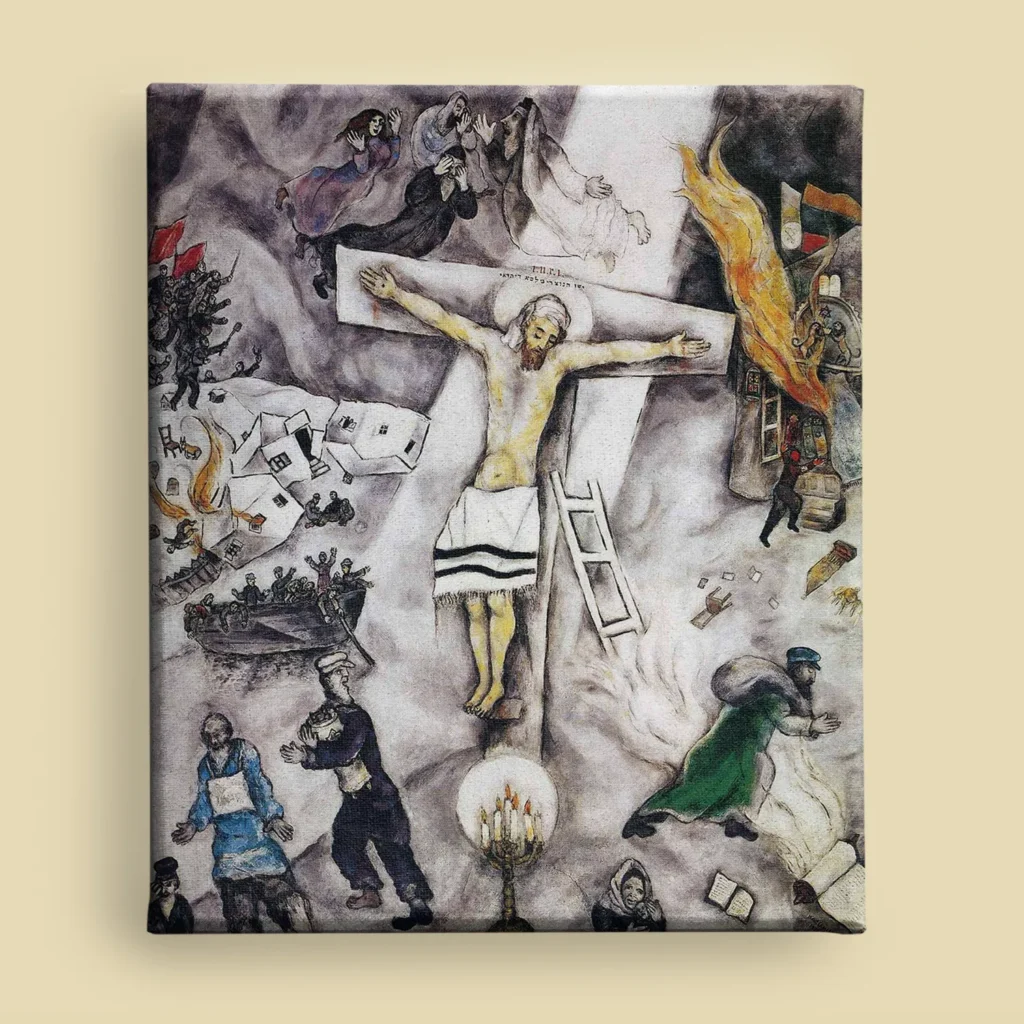
10. White Crucifixion by Marc Chagall (1938)
Chagall painted White Crucifixion in 1938, the year of Kristallnacht, and the painting is a direct response to what was happening to the Jewish people of Europe. Christ is crucified at the center of the composition, a Jewish prayer shawl serving as his loincloth, while around him the catastrophe of antisemitic persecution unfolds: a synagogue in flames, a Torah scroll burning, figures fleeing with bundles on their backs, a village being attacked. At the base of the cross, a menorah burns. The ancestors of the faith (the patriarchs and the matriarchs) float at the edges of the image, bearing witness.
Chagall was painting Christ not as a Christian icon but as a Jewish figure of suffering, the ultimate embodiment of a people’s martyrdom. The painting carries a theological weight that grows heavier with knowledge of what came after 1938. Pope Francis once named it as his favorite painting, a statement that generated considerable comment and reflection. The painting is at the Art Institute of Chicago. For more on the history of sacred Crucifixion imagery, see our article on famous Crucifixion paintings.

11. The Madonna of Port Lligat by Salvador Dalí (1950)
In 1949, Dalí sought a private audience with Pope Pius XII at the Vatican and presented him with a small preliminary version of a painting he was working on. The Pope gave it his blessing. The following year, Dalí completed the large version of The Madonna of Port Lligat, one of the most remarkable Marian images of the twentieth century. The Virgin sits enthroned in a coastal landscape that is unmistakably the rocky shore of Port Lligat in Catalonia, where Dalí had his studio. Her body is open at the center: within the cavity of her torso floats the Christ Child, held in a kind of sacred suspension, an egg hanging above him from a scallop shell. The whole composition is built from the visual language of Renaissance altarpieces, reconceived through Dalí’s surrealist grammar of floating forms and displaced gravities.
Gala, Dalí’s wife, stands in as the Virgin, a devotional act of personal theology as much as artistic choice. The painting represents Dalí’s fullest exploration of what he called “nuclear mysticism,” the attempt to find in the structure of matter itself (in atoms, in geometry, in the suspension of forms in space) a visual language adequate to the mystery of the Incarnation. The large version is at Marquette University Museum of Art in Milwaukee, Wisconsin. For more on Dalí’s extraordinary sacred vision, see our article on Dalí’s Surrealist Jesus paintings, and for a wider view of the Virgin in art, see our article on the most beautiful Virgin Mary paintings.

12. The Sacrament of the Last Supper by Salvador Dalí (1955)
Five years after the Madonna of Port Lligat, Dalí completed the most ambitious sacred painting of his career. The Sacrament of the Last Supper is one of the largest canvases he ever produced, and one of the most theologically precise. Christ sits at the center of a table of white marble, flanked by six apostles on each side. The composition is governed by a perfect dodecahedron (the Platonic solid associated since antiquity with the structure of the cosmos) whose transparent geometric form encloses the scene like a cosmic frame. Above, a translucent Christ in the act of ascension rises through the glass. The whole scene is bathed in a light that seems to come from within the painting rather than from any external source.
Dalí described the work as “arithmetic, Pythagorean, and divine.” The setting is the bay of Port Lligat at dawn. The apostles’ faces are bowed, their identities dissolved into the collective act of the Eucharist. Only Christ faces outward, his gaze meeting the viewer’s with an expression of complete, uncanny calm. It is one of the most visited paintings in the National Gallery of Art in Washington D.C., where it has hung since 1962. For more on this subject, see our article on the most famous Last Supper paintings.

Summary of the 12 Modern Christian Paintings Featured in This Article
| Painting | Artist | Date | Medium | Location |
|---|---|---|---|---|
| The Appearance of Christ Before the People | Alexander Ivanov | 1837-1857 | Oil on canvas | State Tretyakov Gallery, Moscow |
| Ecce Homo | Antonio Ciseri | 1871-1891 | Oil on canvas | Galleria d’Arte Moderna, Palazzo Pitti, Florence |
| Christ in Gethsemane | Carl Bloch | 1873 | Oil on canvas | Museum of National History, Frederiksborg Castle, Denmark |
| The Resurrection | Carl Bloch | c. 1875 | Oil on canvas | Museum of National History, Frederiksborg Castle, Denmark |
| Christ Before Pilate | Mihály Munkácsy | 1881 | Oil on canvas | Déri Museum, Debrecen, Hungary |
| Christ and the Rich Young Ruler | Heinrich Hofmann | 1889 | Oil on canvas | Riverside Church, New York |
| The Sermon on the Mount | Károly Ferenczy | 1896 | Oil on canvas | Hungarian National Gallery, Budapest |
| The Annunciation | Henry Ossawa Tanner | 1898 | Oil on canvas | Philadelphia Museum of Art |
| Head of Christ | Georges Rouault | c. 1932-1938 | Oil on panel | Chrysler Museum of Art, Norfolk, Virginia |
| White Crucifixion | Marc Chagall | 1938 | Oil on canvas | Art Institute of Chicago |
| The Madonna of Port Lligat | Salvador Dalí | 1950 | Oil on canvas | Marquette University Museum of Art, Milwaukee |
| The Sacrament of the Last Supper | Salvador Dalí | 1955 | Oil on canvas | National Gallery of Art, Washington D.C. |
Conclusion
The twelve paintings on this list span almost exactly one century, from Ivanov’s twenty-year meditation on the moment of recognition to Dalí’s geometric vision of the Eucharist. The world changed beyond recognition between 1857 and 1955: industrialization, two world wars, the Holocaust, the birth of modernism and its fragmentation of all visual certainty. Sacred painting survived all of it and, in some cases, drew its deepest strength directly from the catastrophe around it. Chagall’s White Crucifixion would not exist without the Nazi persecution. Rouault’s Christ would not have the weight it carries without the secularism he was painting against.
This is what modern Christian painting teaches: faith does not require historical distance to be serious. The painters on this list found their subjects in the present tense, and their works speak directly to anyone who has ever brought a contemporary grief to an ancient Gospel story and found it answered.
To explore the full arc of Christian painting from its origins, see our articles on medieval Christian painters and our overview of the Life of Christ in 20 paintings.
Frequently Asked Questions
What counts as a “modern” Christian painting?
For the purposes of this article, modern Christian painting covers roughly the period from 1840 to 1960, encompassing the Academic Realist tradition, the Romantic and Symbolist movements, Post-Impressionism, and the early twentieth century. The painters on this list were all working in the aftermath of the French Revolution and the Industrial Revolution, in a world where religious authority was being questioned as never before, and where the question of how to paint the sacred with both honesty and faith was genuinely urgent.
Is Marc Chagall’s White Crucifixion really Pope Francis’s favorite painting?
Yes. Pope Francis has mentioned White Crucifixion on several occasions as the painting he loves most. In a 2013 interview conducted shortly after his election, he named it specifically and described it as a painting that moves him deeply. His choice was widely noted, not least because Chagall was Jewish and painted Christ explicitly as a Jewish martyr rather than as a Christian savior. The Pope’s appreciation for the painting reflects a theology of solidarity and shared suffering that his pontificate has consistently emphasized.
Who was Henry Ossawa Tanner and why does his Annunciation matter?
Henry Ossawa Tanner (1859-1937) was the first African-American painter to achieve sustained international recognition. The son of an African Methodist Episcopal bishop, he trained in Philadelphia under Thomas Eakins and later moved to Paris, where he spent most of his career. His Annunciation (1898) is remarkable not only for its technical beauty but for its theological originality: by rendering the angel Gabriel as pure abstract light rather than a human figure, Tanner found a visual solution to the problem of representing the divine that was genuinely unprecedented. The painting is at the Philadelphia Museum of Art.
What is “nuclear mysticism” in Dalí’s sacred paintings?
Nuclear mysticism was Dalí’s term for his postwar theological and artistic philosophy. Having been deeply affected by the atomic bomb and by his reading of modern physics, Dalí became convinced that the structure of matter at the subatomic level offered a new visual language for the sacred: atoms, molecules, and geometric forms suspended in space could embody divine order in a way that traditional figurative representation no longer could. In The Sacrament of the Last Supper and The Madonna of Port Lligat, Dalí used mathematical solids, floating forms, and transparent geometries to suggest that the Incarnation and the Eucharist were not opposed to modern science but were its deepest confirmation. For more, see our article on Dalí’s Surrealist Jesus paintings.
Were the Realist painters of the nineteenth century devout Christians?
Several of them were, though the tradition is diverse. Carl Bloch was a committed Lutheran whose sacred paintings were explicitly devotional commissions for a royal chapel. Mihály Munkácsy was raised Catholic and returned to faith in his later life, though his monumental Passion cycle was also a commercial enterprise that toured the world for profit. Alexander Ivanov was deeply and sometimes agonizingly religious; he spent years in theological study alongside his painting and described the work as a spiritual as well as artistic endeavor. Henry Ossawa Tanner came from a devout Methodist family and maintained throughout his career that his sacred paintings were acts of faith, not merely artistic exercises. See our article on Realist Jesus paintings for more on this tradition.
Where can I buy reproductions of these modern Christian paintings?
You can buy reproductions of these modern Christian paintings at jesuschrist.pictures, in our shop. Several works from this list are available as canvas reproductions in our shop, including Ivanov’s Appearance of Christ Before the People, Ciseri’s Ecce Homo, both Carl Bloch paintings, Hofmann’s Christ and the Rich Young Ruler, and Ferenczy’s Sermon on the Mount. Reproductions of Munkácsy’s Christ Before Pilate and Chagall’s White Crucifixion are also available. We are continually expanding our collection of modern sacred art.