Among all themes in Christian art, nativity paintings hold a uniquely tender and theological importance. The birth of Christ represents the mystery of the Incarnation: God made flesh, light entering the world in humility. Across centuries, artists have returned to this sacred moment, interpreting it through medieval symbolism, Renaissance humanism, and Baroque light.
This article is accompanied by a short podcast episode that offers an audio overview of the main themes and artworks discussed below.
The Nativity is one of the most beloved subjects in the wider tradition of biblical paintings that has shaped Christian art for centuries.
The First Great Nativity Paintings of the Middle Ages
Nativity by Giotto (c. 1305, Scrovegni Chapel, Padua)
Giotto’s Nativity fresco in the Scrovegni Chapel marks a decisive shift in Western painting. Departing from rigid Byzantine conventions, Giotto introduces emotional presence and spatial coherence. The Virgin leans gently toward the Child, while angels bend in reverence above. Joseph rests in contemplative thought, grounding the sacred event in human reality.
The rocky shelter replaces the traditional stable, symbolizing the humble conditions of Christ’s birth. The composition is structured yet alive, with figures occupying believable space. Giotto’s contribution to nativity paintings lies in his ability to make the sacred accessible. The Incarnation becomes a historical event, not merely a symbol.
Nativity by GiottoSave
Nativity and the Annunciation to the Shepherds by Giovanni di Paolo (c. 1440)
This Sienese masterpiece combines lyricism and narrative clarity. Giovanni di Paolo situates the Nativity within a luminous landscape, while the Annunciation to the Shepherds unfolds in the distance. The Virgin kneels in adoration before the radiant Child, who rests upon a golden mandorla.
The elongated figures and mystical atmosphere reflect the spiritual refinement of Siena. The scene balances wonder and intimacy, inviting contemplation rather than spectacle.
Nativity and the Annunciation to the Shepherds by Giovanni di PaoloSave
Early Renaissance Nativity Paintings and the Birth of Naturalism
Nativity by Fra Angelico (c. 1437–1446)
Fra Angelico’s Nativity expresses Franciscan humility and theological clarity. The Virgin kneels in silent prayer, Joseph rests thoughtfully, and angels sing above in harmonious order. Light flows gently across the composition, suggesting divine grace rather than dramatic contrast.
Fra Angelico painted as an act of devotion. His nativity paintings are acts of prayer rendered in tempera and gold.
Nativity by Fra AngelicoSave
Nativity by Domenico Ghirlandaio (c. 1485)
Ghirlandaio situates the Holy Family within classical ruins, symbolizing the passing of the old covenant and the birth of a new era. Perspective, architecture, and natural detail reveal the maturity of Renaissance technique. Angels hover gracefully above, announcing the event to shepherds beyond.
Nativity by Domenico GhirlandaioSave
Nativity of Christ by Gandolfino da Roreto (late 15th century)
This Northern Italian work reflects Flemish influence through detailed landscape and architectural ruins. The Virgin’s serene posture and the attentive shepherds emphasize reverence. The Child lies on the ground in humility, reinforcing theological themes of poverty and salvation.
Nativity of Christ by GandolfinoSave
Mysticism and Light in Renaissance Nativity Paintings
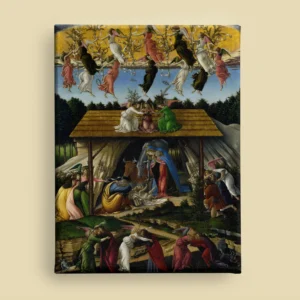
Mystic Nativity by Sandro Botticelli (1501, National Gallery, London)
Botticelli’s Mystic Nativity is one of the most theologically charged nativity paintings of the Renaissance. Painted during a time of political and spiritual turmoil in Florence, the work reflects apocalyptic hope and penitential fervor. Angels dance above the stable, holding olive branches and crowns. Demons flee beneath the earth, symbolizing the defeat of evil through Christ’s birth.
The composition blends symbolic complexity with graceful line. Botticelli’s spiritual sensitivity makes this painting deeply contemplative.
Mystic Nativity by Sandro BotticelliSave
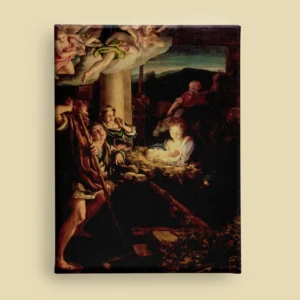
Correggio revolutionized nativity paintings through light itself. In this work, the Christ Child becomes the luminous source illuminating Mary, shepherds, and angels. The surrounding darkness heightens the spiritual impact. The figures lean inward, drawn by the radiant Infant.
The chiaroscuro anticipates later Baroque developments. The scene is intimate yet monumental, balancing tenderness with grandeur.
The Holy Night by CorreggioSave
Poërson’s French Baroque interpretation introduces theatrical movement and warm color harmonies. Angels descend dynamically, while architectural elements frame the sacred group. The composition reflects Counter-Reformation emphasis on clarity and devotion.
Nativity by Charles PoërsonSave
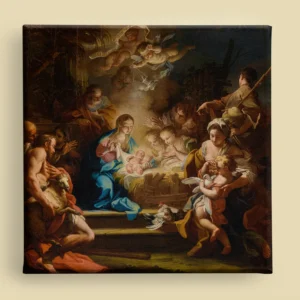
The Adoration of the Shepherds by Sebastiano Conca (18th century)
Conca’s painting exemplifies late Baroque vitality. Angels swirl above, shepherds gather in animated poses, and the Virgin gazes tenderly at the Child. Rich color and dynamic movement create a sense of celebration. Light radiates from Christ, uniting heaven and earth.
The Adoration of the Shepherds by Sebastiano ConcaSave
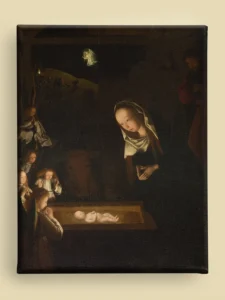
The Nativity at Night by Geertgen tot Sint Jans (c. 1490, National Gallery, London)
This Northern Renaissance gem portrays the Child as a glowing source within the darkness. Mary bows in quiet adoration, surrounded by angels in reverent silence. The nocturnal setting heightens spiritual intimacy. The light symbolizes Christ as the Light of the World.
A generation earlier, another Netherlandish painter had given the scene monumental scale: the central panel of the Portinari Altarpiece by Hugo van der Goes shows the shepherds arriving in the same hushed adoration, on a triptych nearly six metres wide.
The Nativity at Night by Geertgen tot Sint JansSave
This selection of ten famous nativity paintings reveals how Christian artists, from Giotto to Correggio, have contemplated the mystery of Christ’s birth across centuries. Each masterpiece reflects not only stylistic evolution, but also the spiritual depth and theological reflection of its time.
For a broader visual experience, you may browse our dedicated Nativity Paintings Gallery, where these sacred scenes are gathered together in one place for prayerful reflection and artistic appreciation.
Conclusion: The Timeless Beauty of Nativity Paintings
From Giotto’s early realism to Correggio’s luminous innovation, nativity paintings have shaped Christian imagination for centuries. Each artist brought theological depth, cultural context, and artistic mastery to the mystery of the Incarnation. The birth of Christ continues to inspire painters and believers alike, reminding us that divine glory entered the world through humility and love.
The evolution of nativity paintings through History
To explore how artists have represented Christ beyond His birth, you may also read our article 10 Most Famous Jesus Paintings, which traces the major master.
✦ Free Nativity Coloring Pages
Bring the Christmas story home. The Nativity, the Three Wise Men and more great Bible scenes are free printable coloring pages for kids and adults, ready to print and color at home.
Love this sacred art? Our complete collection of illuminated prayer cards and Scripture verses, the Memorare, Psalm 23, Psalm 91 and more, is ready to print, free, in one place.
Frequently Asked Questions About Nativity Paintings
What is the most famous nativity painting?
Among the most famous nativity paintings are Giotto’s fresco in Padua and Botticelli’s Mystic Nativity in London.
Why do some nativity paintings glow from the Child?
The light symbolizes Christ as the Light of the World, a theological reference drawn from the Gospel of John.
How did nativity paintings change over time?
They evolved from symbolic medieval forms to naturalistic Renaissance compositions and dramatic Baroque interpretations.
Where can I see famous nativity paintings?
Major examples are held in London, Florence, Padua, Dresden, and Boston.
Where can I buy Nativity paintings on canvas?
You can buy Nativity paintings on canvas at jesuschrist.pictures. Our collection of Nativity paintings on canvas features museum-quality reproductions of the greatest Nativity masterpieces. Browse the Nativity canvas collection, or our Christian art gift buying guide where you’ll find a Christmas section.
William-Adolphe Bouguereau paintings give French Catholic Belle Époque devotion its most polished voice. Step into the Madonnas and angels of the great Salon master.
Hans Baldung paintings carry the Dürer line into a stranger, more visionary world. Step inside the altarpieces of the German Renaissance master of Strasbourg.