10 beautiful Virgin Mary paintings that made history of art
Introduction: Why Virgin Mary Paintings Matter in the History of Art
Among all sacred subjects in Western art, few have inspired painters more deeply than the Virgin Mary. For centuries, artists returned to her image to express tenderness, purity, sorrow, majesty, and maternal protection. In churches, monasteries, chapels, and private homes, images of Mary became central to prayer and contemplation. That lasting importance is one reason Virgin Mary paintings remain among the most admired works in Christian art today. They speak not only to Catholic devotion, but also to the visual history of Europe and the Americas.
The many forms of madonna paintings reveal how artists understood both theology and human emotion. Sometimes Mary appears as a young mother holding the Christ Child with quiet intimacy. Sometimes she is enthroned like the Queen of Heaven, the title the Church sings to her all through Easter in the Regina Caeli. In other works, she stands as the radiant woman of the Immaculate Conception, lifted above the earth in light and glory. Through these changing images, painters shaped a rich tradition of marian art that joins doctrine, beauty, and feeling. The Virgin is not simply a recurring figure. She is the spiritual and visual center of countless masterpieces.
Mary’s role as the Mother of God gave artists an ideal subject through which to show both the humanity of Christ and the dignity of the woman chosen to bear Him. This is why so much Virgin Mary artwork stands at the heart of Renaissance, Baroque, and later Catholic painting. A panel by Fra Angelico, a circular tondo by Botticelli, or a monumental altarpiece by Raphael can each present a different aspect of the same mystery. Mary is humble and exalted, gentle and solemn, earthly and heavenly.
In this article, we look at ten famous paintings that helped define the image of the Virgin across time. Arranged in chronological order, they show how painters from Fra Angelico to Miguel Cabrera transformed devotion into some of the most memorable works in art history. Readers interested in a broader visual selection may also enjoy our future Virgin Mary paintings gallery, which will gather more examples of Marian imagery across periods and styles.
What Are the Most Famous Virgin Mary Paintings?
The most famous Virgin Mary paintings include The Madonna of Humility by Fra Angelico, Madonna and Child with Two Angels by Fra Filippo Lippi, Madonna of the Magnificat by Sandro Botticelli, Virgin of the Rocks by Leonardo da Vinci, The Sistine Madonna by Raphael, Madonna with the Long Neck by Parmigianino, Madonna of the Rosary by Caravaggio, The Immaculate Conception of Los Venerables by Bartolomé Esteban Murillo, and Virgen de Guadalupe by Miguel Cabrera. These works are among the best known examples of madonna paintings and remain essential landmarks in the history of marian art.
They became famous for different reasons. Some are admired for their beauty and tenderness, such as Lippi’s delicate Madonna and Child. Others are celebrated for innovation, as in Leonardo’s mysterious rocky setting in Virgin of the Rocks. Raphael’s Sistine Madonna is especially well known for its serene grandeur and for the two little angels at the bottom, which became iconic far beyond the original painting. Caravaggio’s Madonna of the Rosary stands out for its dramatic realism and powerful Baroque lighting, while Murillo’s Immaculate Conception became one of the defining images of Marian purity in Spanish Catholic art.
Seen together, these paintings show how artists across centuries portrayed the Virgin as mother, intercessor, queen, and model of holiness. They also show why Virgin Mary artwork holds such a special place in Christian visual culture. The image of the Mother of God gave painters a way to join doctrine with emotion, and that combination helped create some of the most beloved masterpieces ever made.
Below, we will move through these paintings in chronological order, beginning in the early Renaissance and ending in the great devotional traditions of the Spanish world. This order makes it easier to see how the image of Mary changed over time while remaining one of the most constant themes in sacred art.
10 Beautiful Virgin Mary Paintings That Made History of Art
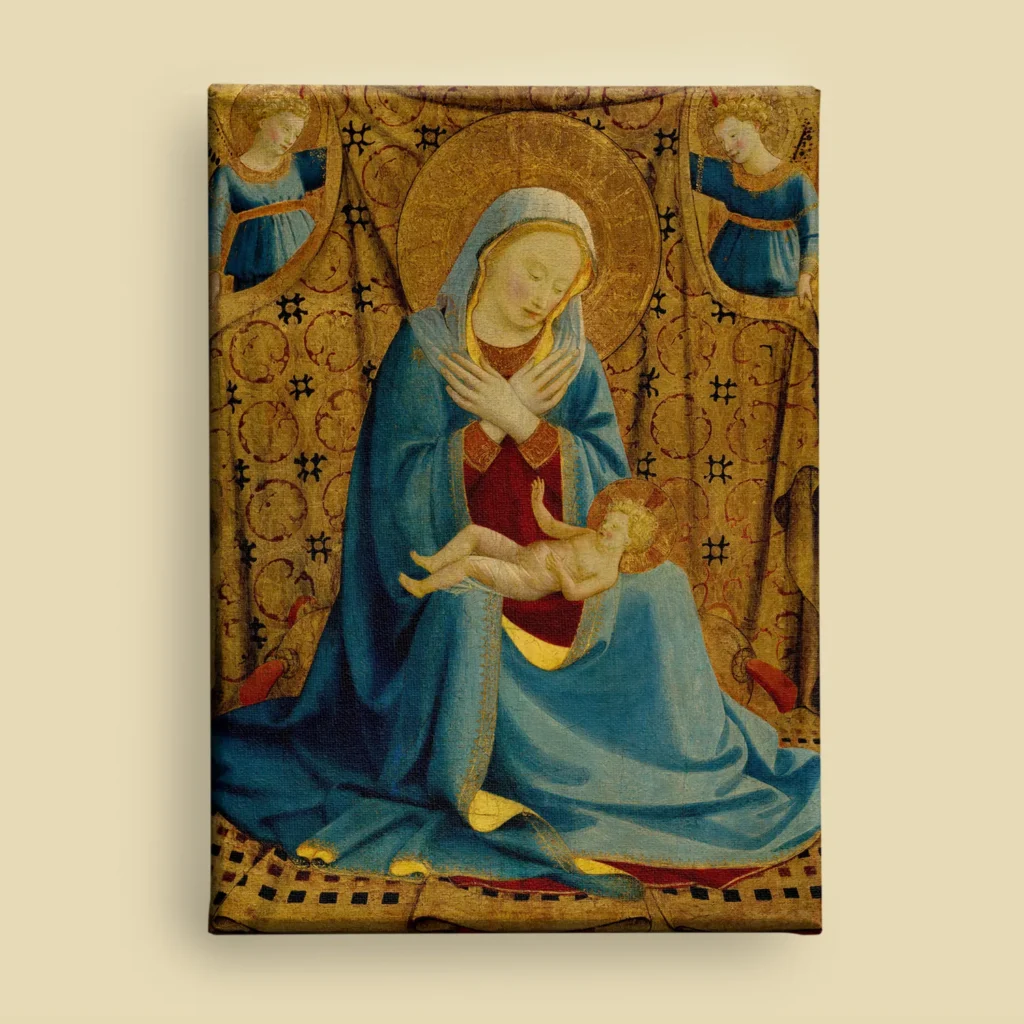
The Madonna of Humility by Fra Angelico (c. 1433-1435)
One of the most touching early examples of marian art is The Madonna of Humility by Fra Angelico. Painted in the early Renaissance, this devotional panel shows the Virgin seated directly on the ground rather than on a throne. This unusual posture expresses the idea of humility, an essential virtue associated with Mary in Christian theology.
Fra Angelico, a Dominican friar as well as a painter, approached sacred imagery with deep spiritual conviction. His paintings were meant to inspire prayer and reflection. In this work, the Virgin gently holds the Christ Child across her lap while crossing her hands over her chest in a gesture of devotion. Two angels appear in round medallions behind her, while the golden background recalls the traditions of medieval altarpieces.
The tenderness of the scene helped shape later madonna paintings. The Virgin is presented not as a distant queen but as a loving mother. The image reflects the theological idea of Mary as the compassionate Mother of God, someone close to humanity yet filled with divine grace. This painting remains one of the finest early examples of Virgin Mary artwork in the Italian Renaissance.

Madonna and Child with Two Angels by Fra Filippo Lippi (c. 1465)
Few Renaissance paintings capture maternal tenderness as beautifully as Madonna and Child with Two Angels by Fra Filippo Lippi. Created in Florence during the fifteenth century, this painting reflects the growing interest of Renaissance artists in human emotion and natural beauty.
The Virgin Mary appears young and serene, gazing lovingly at the Christ Child. Two playful angels support the infant while leaning over a parapet. Behind them stretches a luminous Tuscan landscape, opening the sacred scene toward the natural world. This integration of landscape became an important development in Renaissance painting.
Lippi’s delicate figures and graceful lines influenced later masters, including Botticelli, who trained in his workshop. The work helped define the image of the Virgin as both a tender mother and a symbol of divine purity. As a result, it remains one of the most admired examples of Renaissance Virgin Mary paintings and an essential work within the tradition of madonna paintings.

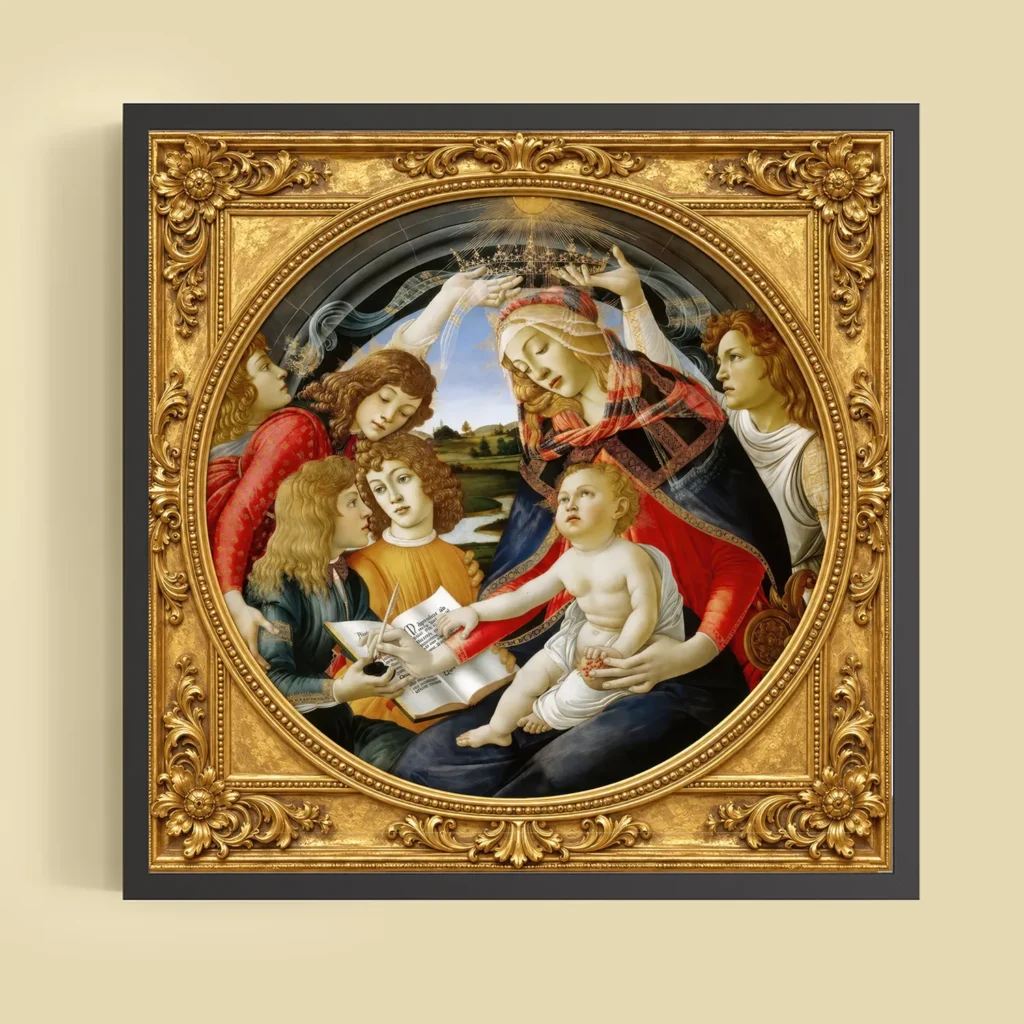
Madonna of the Magnificat by Sandro Botticelli (c. 1481)
The circular composition of Madonna of the Magnificat by Sandro Botticelli makes it one of the most elegant works in Florentine marian art. Painted as a tondo, a round panel popular in Renaissance Florence, the work shows Mary writing the words of the Magnificat while the Christ Child guides her hand. The words the Virgin is writing are her own song, the Magnificat prayer, which she sang at the Visitation.
The Magnificat is the hymn of praise spoken by Mary in the Gospel of Luke. By illustrating this moment, Botticelli highlights the Virgin as a figure of humility and devotion. Angels surround her, placing a crown upon her head while presenting the sacred book. The composition flows in a gentle rhythm typical of Botticelli’s refined style.
This painting demonstrates how Renaissance artists combined theology and visual beauty. The Virgin is shown not only as a mother but also as a contemplative figure deeply connected to scripture. Through its grace and symbolism, the work became one of the most recognizable Virgin Mary artwork pieces in Western art.

Virgin of the Rocks by Leonardo da Vinci (1483-1486)
Leonardo da Vinci transformed traditional madonna paintings with his extraordinary Virgin of the Rocks. Instead of placing Mary in a throne or domestic setting, Leonardo situates the sacred group within a mysterious rocky landscape. The figures appear in a grotto surrounded by dramatic stone formations and subtle atmospheric light.
The Virgin gently protects the infant John the Baptist while the Christ Child raises his hand in blessing. An angel points toward John, guiding the viewer’s attention. Leonardo’s innovative use of sfumato softens the transitions between light and shadow, creating an atmosphere of quiet mystery.
This painting represents a turning point in Renaissance Virgin Mary artwork. Leonardo combined scientific observation with spiritual symbolism. The rocky cave may represent the hidden mysteries of creation, while Mary remains the calm center of the composition. Through this masterpiece, the image of the Mother of God gained a new sense of natural realism and emotional depth.

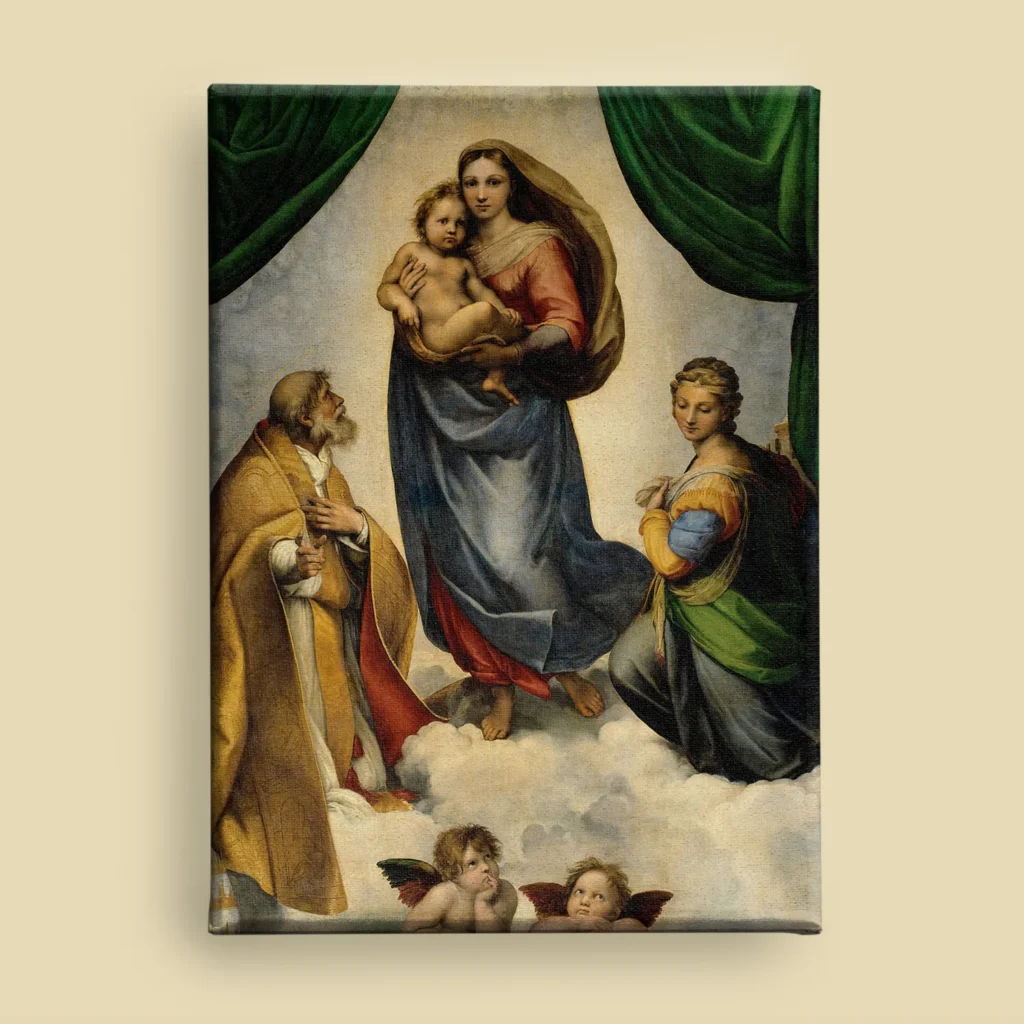
The Sistine Madonna by Raphael (1512)
Among all Renaissance Virgin Mary paintings, few are as famous as The Sistine Madonna by Raphael. Commissioned for a monastery church in Piacenza, the painting presents Mary stepping forward from the clouds while holding the Christ Child. On either side stand Saint Sixtus and Saint Barbara, both gazing upward in reverence. Raphael had painted the Virgin many times before, most tenderly in the Madonna of the Meadow of his Florentine years.
Raphael’s balanced composition and luminous colors give the scene a remarkable sense of serenity. The Virgin appears both maternal and majestic, embodying the dignity traditionally associated with the Mother of God. At the bottom of the painting, two small angels rest their heads on their hands while looking upward. These charming figures later became some of the most widely reproduced details in European art.
The painting quickly became one of the most celebrated works of marian art. Its harmonious design and emotional clarity made it a defining image of the High Renaissance. Even today, the Sistine Madonna remains one of the most recognizable examples of sacred madonna paintings.

Madonna of the Harpies by Andrea del Sarto (1517)
Madonna of the Harpies by Andrea del Sarto reflects the elegance and harmony of the High Renaissance in Florence. The Virgin stands upon a pedestal decorated with sculpted harpies, mythical creatures whose presence may symbolize the triumph of divine grace over evil.
The Christ Child sits confidently in Mary’s arms while two saints stand beside them. Andrea del Sarto’s soft modeling and refined colors create a sense of calm dignity. The balanced composition and graceful figures demonstrate the influence of Raphael and Leonardo while preserving the artist’s distinctive style.
This work illustrates how Virgin Mary artwork could express both theology and beauty. The Virgin appears calm and protective, reinforcing her role as the spiritual intercessor for believers. The painting remains one of the most admired Florentine madonna paintings of the sixteenth century.

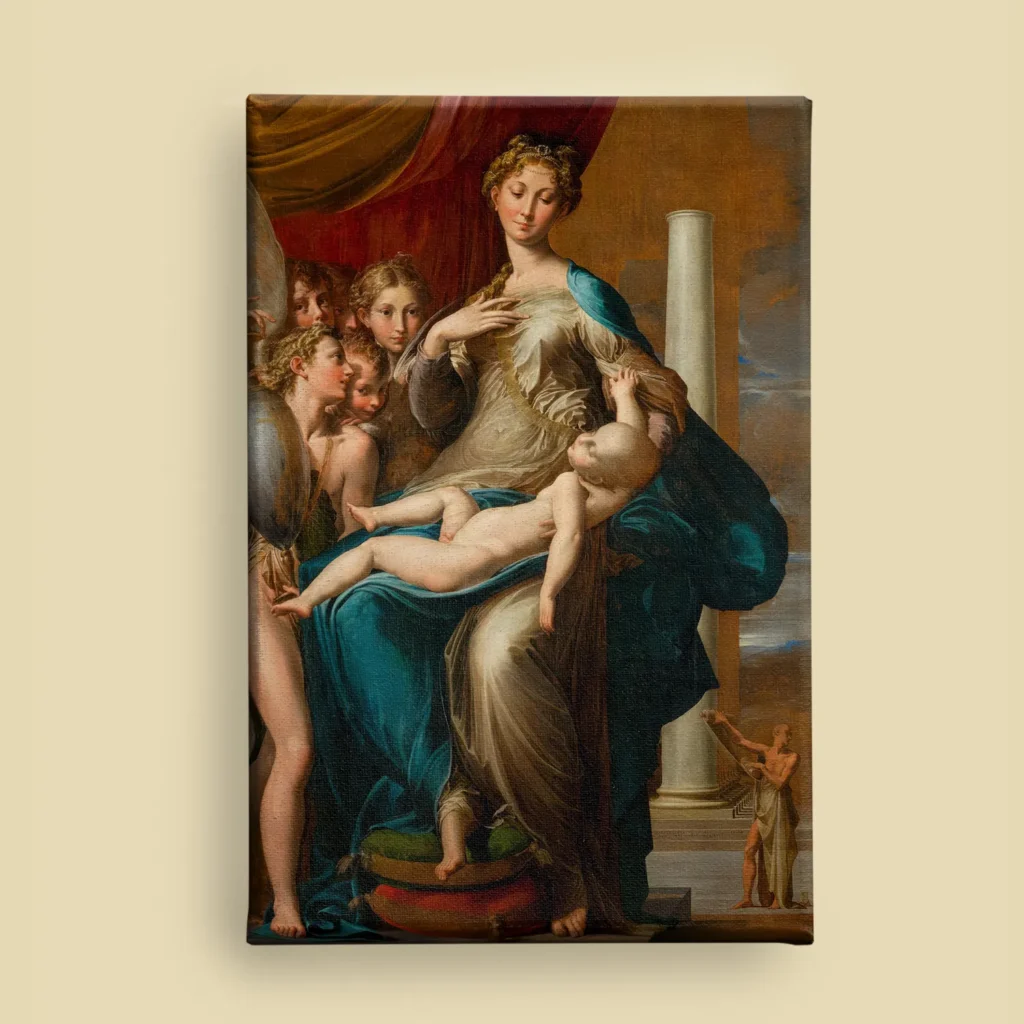
Madonna with the Long Neck by Parmigianino (1534-1540)
Madonna with the Long Neck by Parmigianino represents the elegance and experimentation of Mannerist painting. Unlike the balanced compositions of the High Renaissance, Parmigianino deliberately stretched proportions to create a more refined and stylized image.
The Virgin’s elongated neck and graceful figure give the painting its famous name. She sits on a grand throne while holding the Christ Child, whose relaxed pose echoes classical sculpture. A group of angels fills the left side of the composition, while a mysterious architectural space opens in the distance.
This unusual composition reveals how artists reinterpreted traditional madonna paintings. The painting still expresses devotion to the Mother of God, yet it introduces a new artistic language based on elegance and distortion. Through its originality, the work became one of the most recognizable examples of Mannerist marian art.

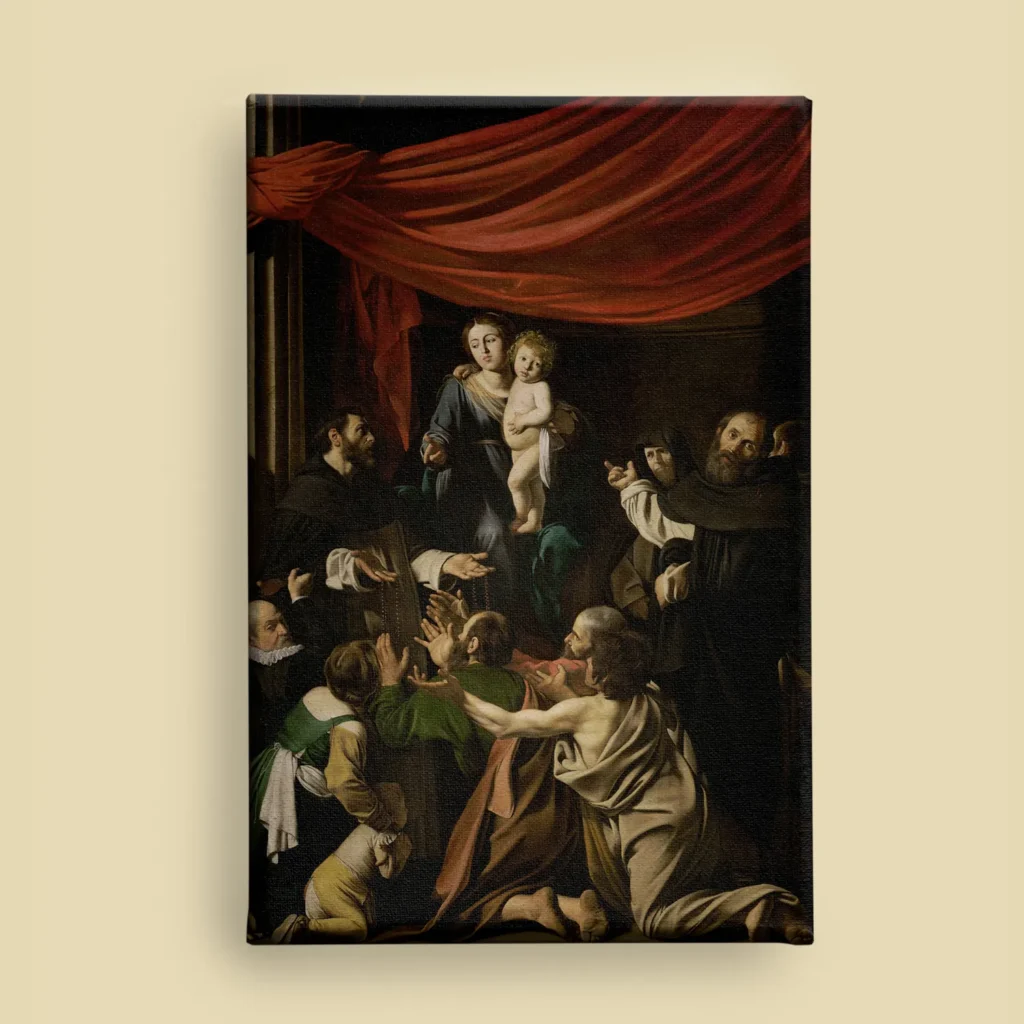
Madonna of the Rosary by Caravaggio (1607)
Madonna of the Rosary by Caravaggio belongs to the dramatic world of Baroque Virgin Mary paintings. Unlike the idealized beauty of the Renaissance, Caravaggio presented sacred figures with striking realism and intense contrasts of light and shadow.
The Virgin appears above a group of believers while Saint Dominic distributes rosaries to the faithful. The composition emphasizes the importance of the rosary prayer within Catholic devotion. Dominic was himself a Castilian, one of a long line of preachers and mystics whose faces Spanish painters fixed for good, a company gathered in our guide to the Spanish saints. Caravaggio’s powerful lighting highlights the figures emerging from darkness, creating a sense of spiritual drama.
This painting demonstrates how Baroque artists used emotion and realism to strengthen religious imagery. The Virgin remains the compassionate Mother of God, offering spiritual protection to those who seek her help. As a result, the painting stands as one of the most powerful examples of Baroque marian art. Caravaggio painted the Virgin again at the birth of Christ, in a Nativity for Palermo that was stolen in 1969 and has never been found; its story is told in our selection of famous nativity paintings.

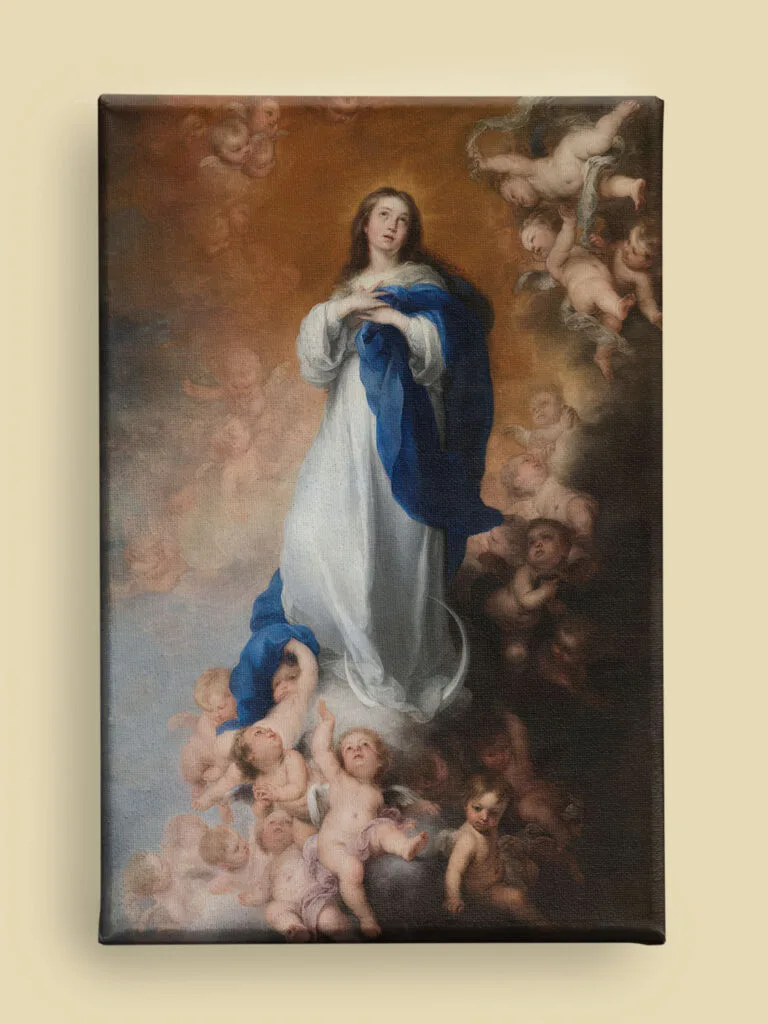
The Immaculate Conception of Los Venerables by Bartolomé Esteban Murillo (c. 1678)
Spanish Baroque painting produced some of the most radiant images of the Virgin, and The Immaculate Conception of Los Venerables by Bartolomé Esteban Murillo is among the finest examples. The painting represents the doctrine that Mary was conceived without original sin.
Murillo portrays the Virgin floating in heavenly light, surrounded by angels and soft clouds. She stands upon a crescent moon while looking upward in serene devotion. The luminous colors and gentle expressions became characteristic of Murillo’s religious style.
This image helped define Spanish marian art during the seventeenth century. The Virgin appears as the radiant Mother of God, free from sin and lifted toward heaven. Murillo’s graceful compositions ensured that his Virgin Mary artwork would remain among the most beloved in Catholic tradition.
A very different Marian image took shape in Bavaria in the same decades: Mary, Untier of Knots by Johann Georg Schmidtner, painted in Augsburg around 1700, where the Virgin patiently unties a long ribbon of knots held out to her by angels. Almost forgotten for three centuries, it became one of the most reproduced Marian images in the world after Pope Francis discovered it as a young priest.

Virgen de Guadalupe by Miguel Cabrera (18th century)
The devotion to Our Lady of Guadalupe inspired many works of sacred art across Mexico and Latin America. Among the most famous is the version painted by Miguel Cabrera, one of the leading artists of colonial Mexico.
The Virgin appears surrounded by radiant light and standing upon a crescent moon. Her image follows the miraculous icon venerated in Mexico City. Cabrera studied the original image carefully and produced several faithful copies that spread the devotion throughout the Spanish world.
This painting illustrates how Virgin Mary paintings expanded beyond Europe into the Americas. The Virgin is honored as both a spiritual protector and a cultural symbol. Through works like Cabrera’s, the tradition of madonna paintings became truly global.
The devotion to Our Lady of Guadalupe became one of the most powerful expressions of Marian faith in the Americas. For a deeper look at the history, symbolism, and artistic representations of this sacred image, you can read our dedicated article on Virgen de Guadalupe, which explores how this miraculous icon shaped Christian art and devotion across Mexico and beyond.

The Virgin Mary plays a quiet but decisive role at the first of Christ’s miracles; explore our guide to Wedding at Cana paintings.
Conclusion
The history of Christian art cannot be understood without the image of the Virgin Mary. Across centuries, painters returned to this sacred subject to express tenderness, devotion, and divine grace. From the quiet humility of Fra Angelico’s early Renaissance panel to the luminous Baroque visions of Murillo, these works reveal how artists continually reinterpreted the image of the Mother of God. Seven masterpieces of this tradition, from Raphael’s Sistine Madonna to Fra Angelico’s Madonna of Humility, also illustrate, line by line, the Hail Holy Queen prayer.
Each painting reflects the artistic language of its time while remaining part of a continuous tradition of marian art. Renaissance masters emphasized harmony and beauty, Mannerist painters explored elegance and stylization, and Baroque artists introduced dramatic light and emotion. Yet in every period, the Virgin remained a symbol of compassion and spiritual protection.
Today, these masterpieces remain central examples of Virgin Mary artwork and continue to inspire believers, historians, and art lovers around the world. Their enduring popularity shows why madonna paintings have occupied such a central place in the visual culture of Christianity for more than six centuries.
The tradition is older still than the panels gathered here. Six centuries before Fra Angelico, the earliest surviving image of the Virgin and Child in any Western manuscript was painted by Irish monks: folio 7v of the Book of Kells, made around the year 800 in the family of monasteries founded by Saint Columba. Mary sits in three quarter view with the Child on her lap, four angels around her, the whole page held inside interlace. It is where the line that leads to Fra Angelico and Raphael actually begins. The gold ground behind her, and the ten greatest surviving pages painted in that manner, are the subject of our guide to medieval manuscript art, and the monks who made them of our page on the Irish saints and the art they left behind.
✦ Free Christian & Catholic Printables
Illuminated prayer cards and Scripture verses, the Memorare, Psalm 23, Psalm 91 and more, already free to print with no email needed. Join and I will send you the complete set in every format, US Letter, A4 and pocket size, and each new card by email first, thirty days before it reaches the public library.
No spam, unsubscribe anytime. Or browse the whole library →
Summary of the Virgin Mary Paintings feautured in this article
| Painting | Artist | Date | Medium | Museum |
|---|---|---|---|---|
| The Madonna of Humility | Fra Angelico | c. 1433-1435 | Tempera on panel | Museo Thyssen-Bornemisza |
| Madonna and Child with Two Angels | Fra Filippo Lippi | c. 1465 | Tempera on panel | Uffizi Gallery |
| Madonna of the Magnificat | Sandro Botticelli | c. 1481 | Tempera on panel | Uffizi Gallery |
| Virgin of the Rocks | Leonardo da Vinci | 1483-1486 | Oil on panel | Louvre Museum |
| The Sistine Madonna | Raphael | 1512 | Oil on canvas | Gemäldegalerie Alte Meister |
| Madonna of the Harpies | Andrea del Sarto | 1517 | Oil on panel | Uffizi Gallery |
| Madonna with the Long Neck | Parmigianino | 1534-1540 | Oil on panel | Uffizi Gallery |
| Madonna of the Rosary | Caravaggio | 1607 | Oil on canvas | Kunsthistorisches Museum |
| The Immaculate Conception of Los Venerables | Bartolomé Esteban Murillo | c. 1678 | Oil on canvas | Museo del Prado |
| Virgen de Guadalupe | Miguel Cabrera | 18th century | Oil on canvas | National Museum of Mexican Art |
FAQ
What is the most famous Madonna painting?
Many historians consider The Sistine Madonna by Raphael to be the most famous Madonna painting. Its balanced composition, serene expression, and the famous two angels at the bottom made it one of the most recognizable images in Western art.
Who painted the most Madonna paintings?
Several artists created numerous depictions of the Virgin Mary, but Raphael and Botticelli are especially known for producing many celebrated Madonna paintings during the Renaissance.
What artist is known for painting the Madonna?
Raphael is widely associated with Madonna paintings. His works, including the Sistine Madonna and many other versions of the Virgin and Child, helped define the ideal image of the Virgin in Renaissance art.
How much is the Sistine Madonna worth today?
The Sistine Madonna is considered priceless because it belongs to the Gemäldegalerie Alte Meister in Dresden. Art historians estimate that if such a masterpiece were ever sold, its value would likely exceed hundreds of millions of dollars.
Why are Madonna paintings so common in Christian art?
The Virgin Mary holds a central place in Christian theology as the Mother of God. Because of her spiritual importance, artists across centuries created countless images of Mary and the Christ Child to inspire devotion and prayer.
What is the difference between Madonna paintings and other Virgin Mary artwork?
Madonna paintings usually show the Virgin Mary with the Christ Child. Other forms of Virgin Mary artwork may represent different moments of her life, such as the Annunciation, the Immaculate Conception, or the Assumption.
Where can I buy Virgin Mary paintings on canvas?
You can buy Virgin Mary paintings on canvas at jesuschrist.pictures. Our collection of Virgin Mary paintings on canvas features museum-quality reproductions of the greatest Marian masterpieces. Browse the Virgin Mary canvas collection.