Mysterious Giorgione Paintings That Still Fascinate
Among all the painters of the Italian Renaissance, Giorgione paintings occupy a singular place. Born Giorgio Barbarelli da Castelfranco around 1477, he transformed Venetian art in barely a decade before dying of plague in 1510 at around thirty-three years of age. His output was small and many attributions remain debated, yet his influence on painting, on Titian, on Sebastiano del Piombo, on the entire tradition of coloristic landscape, was enormous. What marks his work above all is atmosphere: a warm, twilight light that suffuses figures and landscapes alike, and a refusal to explain. His pictures invite contemplation rather than narration, which is precisely why they have fascinated viewers for five centuries.

A Short Life, a Lasting Presence
Giorgione likely trained in the workshop of Giovanni Bellini, from whom he inherited a love of luminous color and serene religious feeling. By the early 1500s he was already receiving independent commissions, and his frescoes on the Fondaco dei Tedeschi in Venice (now mostly lost) brought him city-wide recognition. What distinguishes his mature style from Bellini’s is a new atmospheric softness, shadows that dissolve rather than define, landscapes that breathe, and a mood of poetic ambiguity that scholars have long called poesia. He rarely told a clear story. He preferred to evoke.
His career overlapped with Leonardo da Vinci‘s stays in Venice and northern Italy, and the influence of Leonardo’s sfumato technique is unmistakable in Giorgione’s handling of light and shadow. Yet his palette remained distinctly Venetian: warm ochres, deep greens, and golden skies that have no equivalent in Florentine or Roman painting.
Sacred Scenes and Religious Works
Despite the mystery that surrounds his biography, the majority of Giorgione’s surviving works are religious in subject. They range from intimate private devotional panels to a monumental altarpiece for his hometown cathedral.
Adoration of the Magi
Painted around 1506–1507 and now in the National Gallery in London, this small-scale Adoration places the Holy Family at the center of a landscape that threatens to engulf them. The Magi approach from the left, their robes rich and warm, while the sky behind opens into the cool blues that Giorgione reserved for distance. The scene has an intimacy unusual for the subject: no crowd, no fanfare, just a quiet meeting between the divine child and the world’s wisdom.

Adoration of the Shepherds
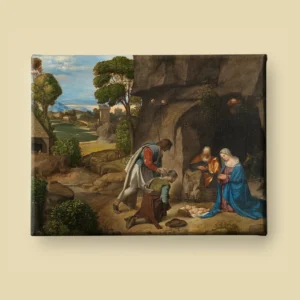
Known also as the Allendale Nativity, this panel at the National Gallery of Art in Washington is among the works most securely given to Giorgione. The Holy Family shelters in a rocky grotto while two shepherds approach with quiet reverence. Behind them a landscape opens into a luminous distance, hills fading into golden haze. The warm light radiating from the Christ child picks out Joseph’s face, the Virgin’s mantle, the roughened hands of the kneeling shepherd, a handling of nocturnal light that anticipates Correggio and the Northern tradition of the Notte.

Castelfranco Madonna
This altarpiece, painted around 1504 for the cathedral of Castelfranco Veneto, Giorgione’s own birthplace, is one of the most unusual sacred compositions of the Renaissance. The Virgin sits enthroned high above the picture plane on a tall pedestal, while Saints Liberale and Francis flank her far below, each turned away and absorbed in private thought. The spatial gap between the Virgin and the saints, usually a weakness in altarpiece design, becomes here an expression of transcendence: she is above, distant, unreachable. Behind her, a Venetian landscape stretches to the horizon under a cool, calm sky.

Christ Carrying the Cross
Housed at the Scuola Grande di San Rocco in Venice, this half-length figure of Christ bearing the cross is one of Giorgione’s most moving works. The format, a close-up, the figure pressing toward the viewer, was common in Flemish devotional painting and was spreading rapidly through Venice in the early sixteenth century. What Giorgione adds is his characteristic light: a warm glow on Christ’s face that seems to come from within, set against a dark ground. The expression is not anguished but resigned, almost serene, as if the weight of the cross has been accepted rather than suffered.

Holy Family
This tender domestic scene at the National Gallery of Art in Washington presents Mary, Joseph, and the Christ child in a moment of quiet intimacy. The composition is compact and warm, the figures gathered close, their gazes soft. A landscape fills the background with the atmospheric depth that Giorgione had made his signature. It is a painting for private devotion: small, personal, meant to be held in the hand or hung in a bedchamber, not displayed in a church. The warmth it radiates is thoroughly Venetian.

Virgin and Child in a Landscape
Now in the Hermitage Museum in Saint Petersburg, this small panel places the Madonna and Child against one of Giorgione’s most lyrical landscapes. Trees frame the figures on either side, and behind them a valley opens into blue distance. The Virgin holds the child with the same natural tenderness that Bellini had taught the Venetians, but the surrounding world breathes and glows in a way that belongs entirely to Giorgione. It is a picture that seems to exist at dusk, in that hour when outlines soften and everything takes on the quality of memory.

Dramatic Figures
Judith
The Judith in the Hermitage Museum is among Giorgione’s most celebrated works. The biblical heroine stands in a landscape holding a long sword in her right hand, her left foot resting lightly on the severed head of Holofernes. The mood is unlike most treatments of the subject: there is no horror, no blood, no urgency. Judith is pensive, almost melancholy, as if she bears the weight of what she has had to do. The landscape behind her is the familiar Giorgionesque world, a warm sky, dark foliage, soft hills, and she stands within it as naturally as a saint in a devotional image. The painting turns a story of violence into a meditation on sacrifice and courage.

Portrait of Francesco Maria della Rovere
Painted around 1510, possibly among the last works Giorgione completed before his death, this portrait at the Kunsthistorisches Museum in Vienna shows a young man in armor holding a baton of command. The identity of the sitter as Francesco Maria della Rovere, future Duke of Urbino, is not universally accepted, but the quality of the painting is beyond doubt. The face is alert and searching, lit against a dark ground, the eyes turned slightly from the viewer. It is a portrait in the Venetian tradition of psychological depth: not merely a record of a face but an image of a particular human presence.

Old Testament: The Test of Fire of Moses
Painted around 1502–1505 for the studiolo of Lorenzo de’ Medici and now in the Uffizi Gallery in Florence, this panel depicts an episode from Exodus: the infant Moses being tested by Pharaoh, who places before the child a dish of gold and a burning coal to determine whether the child is a threat. Moses, guided by an angel, reaches for the coal rather than the gold and burns his tongue, explaining, in some traditions, why Moses later spoke with difficulty. Giorgione renders the scene as a courtly gathering set in a Venetian landscape, the figures clustered under trees while the drama of divine protection plays out almost quietly. It is one of his most intellectually complex works, and one of the few that illustrates a specific narrative with any clarity.

Summary of Giorgione’s Paintings
| Painting | Date | Location |
|---|---|---|
| Adoration of the Magi | c. 1506–07 | National Gallery, London |
| Adoration of the Shepherds | c. 1500 | National Gallery of Art, Washington |
| Castelfranco Madonna | c. 1504 | Cathedral of Castelfranco Veneto |
| Christ Carrying the Cross | c. 1508–10 | Scuola Grande di San Rocco, Venice |
| Holy Family | c. 1500 | National Gallery of Art, Washington |
| Judith | c. 1504 | Hermitage Museum, Saint Petersburg |
| Portrait of Francesco Maria della Rovere | c. 1510 | Kunsthistorisches Museum, Vienna |
| The Test of Fire of Moses | c. 1502–05 | Uffizi Gallery, Florence |
| Virgin and Child in a Landscape | c. 1503–04 | Hermitage Museum, Saint Petersburg |
Important Facts about Giorgione
- Born: Around 1477–1478 in Castelfranco Veneto, in the Veneto region of northeastern Italy.
- Training: Almost certainly trained in the workshop of Giovanni Bellini in Venice, absorbing the Venetian tradition of rich color and luminous, atmospheric painting.
- Style: Pioneer of Venetian colorismo and of a poetic, atmospheric approach to painting, called poesia, in which mood and atmosphere take precedence over narrative clarity.
- Major work: The Castelfranco Madonna (c. 1504) is his only securely documented altarpiece and one of the most spatially original sacred compositions of the High Renaissance.
- Death: Died in Venice in 1510, aged around thirty-three, from plague. Titian, who had worked alongside him, completed several of his unfinished paintings.
Frequently Asked Questions about Giorgione
Why are so few paintings securely attributed to Giorgione?
Giorgione died young and left no signed works. The attributions we have rely on early written sources, primarily Giorgio Vasari and Marcantonio Michiel, and on stylistic comparison. Because Titian worked in his workshop and finished some of his paintings, distinguishing the two hands in early Venetian works has been a subject of debate among art historians for over a century. Only about six paintings are universally agreed to be his.
What makes Giorgione’s style different from other Renaissance painters?
Where Florentine painters prized sharp contours and clearly legible narratives, Giorgione preferred atmospheric light and ambiguous meaning. His figures exist in landscapes that seem to breathe and glow, and his subjects resist easy explanation. This preference for mood over story, what contemporaries called poesia, meaning painting as poetry, was new in Italian art and enormously influential.
Did Giorgione paint religious subjects?
Yes, the majority of his surviving works are religious: Nativity scenes, Madonna compositions, a devotional image of Christ carrying the cross, and his major altarpiece in Castelfranco. Even when his subject is not explicitly religious, as with Judith or the portrait attributed to him, the paintings carry a gravity and contemplative depth that reflects his formation in a tradition of sacred art.
What is the connection between Giorgione and Titian?
Titian was a younger contemporary who worked alongside Giorgione, possibly in his workshop. When Giorgione died in 1510, Titian is believed to have completed several of his unfinished paintings, including The Sleeping Venus (Dresden). Titian then carried Giorgione’s atmospheric, coloristic approach into a long career, becoming the dominant painter in Venice for the next sixty years. Without Giorgione, there is no Titian as we know him.
Where can I see Giorgione’s paintings today?
His works are scattered across major museums. The Castelfranco Madonna remains in the cathedral of his hometown. The Adoration of the Shepherds and Holy Family are at the National Gallery of Art in Washington. The Judith and Virgin and Child in a Landscape are in the Hermitage Museum in Saint Petersburg. The Adoration of the Magi and Christ Carrying the Cross are in London and Venice respectively.
Where can I buy a canvas reproduction of a Giorgione painting?
You can buy them at jesuschrist.pictures: browse all the canvas canvas prints in our shop, printed on museum-grade canvas and available in several sizes.


