8 Famous Transfiguration Paintings Across Six Centuries
Of all the scenes from the life of Christ that painters have attempted across the centuries, few posed a greater challenge than the Transfiguration. How do you paint divine light? How do you render on a flat surface the moment when a man’s face “shone like the sun” and his garments turned “white as light”? The best Transfiguration paintings in art history did not try to solve that problem with tricks or theatrics. They solved it with faith, with composition, and with a deep theological understanding of what the scene actually means. This article looks at eight of those paintings, chosen across six centuries: from a Gothic panel by Duccio di Buoninsegna painted around 1308 to a copper masterpiece by the Danish artist Carl Bloch completed in 1877. Each one is a study in how sacred art grows and changes while remaining anchored in a single, extraordinary moment on a mountaintop.

The Transfiguration in Scripture and in Art
The account appears in three of the four Gospels: Matthew 17:1-8, Mark 9:2-8, and Luke 9:28-36. Jesus takes three of his closest disciples, Peter, James, and John, up a high mountain. There, he is suddenly transformed before them. His face blazes with light. His robes become brilliant white. Two figures appear beside him: Moses, representing the Law, and Elijah, representing the Prophets. A voice speaks from a cloud: “This is my beloved Son, with whom I am well pleased; listen to him.” The disciples fall to the ground in fear. Then the vision passes, and Jesus stands alone.
The theological weight of this scene is enormous. It is the moment when Christ’s divine nature is made fully visible to human witnesses. It is also a bridge between the Old and New Testaments, confirming that the Law and the Prophets point toward Christ. For sacred art, the scene presented a compositional problem that painters handled in very different ways: how to show both the elevated, luminous vision of Christ above and the stunned, earthbound reaction of the apostles below. That double register, heavenly and human, runs through almost every major Transfiguration painting in history. The results, as the eight works below show, are among the most spiritually charged images in the entire Christian tradition.
1. Duccio di Buoninsegna – The Transfiguration (c. 1308-1311)

Duccio’s Maesta, created between 1308 and 1311 for the high altar of Siena Cathedral, is one of the great landmarks of medieval sacred art. The front face shows the enthroned Virgin in Majesty surrounded by saints and angels. The back face carries a large cycle of narrative scenes, painted in tempera on panel with a gold ground in the Byzantine tradition. The Transfiguration panel belongs to this cycle, small in scale but precise in its theological architecture.
Duccio arranges the scene in strict vertical hierarchy. Christ stands at the top, his white robe luminous against the gold ground, flanked by Moses and Elijah. Below, the three apostles react in postures of awe and prostration. The gold background eliminates any sense of earthly space. We are not on a mountain. We are in a timeless, sacred realm beyond geography and atmosphere.
For all its apparent simplicity, the panel does exactly what the liturgical function of the Maesta required: it does not invite quiet contemplation. It makes a direct, authoritative theological statement. This is not a scene to be witnessed. It is a truth to be proclaimed. Duccio understood the difference, and his Transfiguration has the quality of an icon: flat, frontal, and completely certain of what it depicts. The panel is currently on display at the Museo dell’Opera del Duomo in Siena, alongside the rest of the dismembered altarpiece.
For those interested in the longer tradition of medieval Jesus paintings, this panel is an essential reference point. It shows how Gothic painters saw the Transfiguration not as a dramatic event to be staged, but as a theological mystery to be proclaimed.
2. Fra Angelico – The Transfiguration (c. 1438-1440)

When Cosimo de’ Medici funded the rebuilding of the Dominican convent of San Marco in Florence in the late 1430s, he entrusted Fra Angelico with the decoration of the monks’ cells. Each fresco was meant to serve as a subject for private prayer and meditation, not as public art to be admired from a distance. The Transfiguration, painted in one of the cells of the upper dormitory around 1438-1440, is perhaps the most spiritually charged of them all.
The composition is stripped of nearly everything unnecessary. Christ stands at the center, arms outstretched in the orans position, his white robe glowing softly against a pale background. Moses and Elijah flank him, shown as half-figures emerging from the cloud of light. Below, the three apostles crouch in postures of awe and submission. On either side of this lower group, Fra Angelico has added two figures not present in the Gospel account: the Virgin Mary and Saint Dominic, the founder of the Dominican order. Their presence transforms the scene from a historical event into a living devotional image, inviting the friar who prays before it to stand alongside the apostles as a witness.
The fresco is modest in size and restrained in color. There is no dramatic flash of gold, no churning clouds. The light radiates quietly, as if it were simply the natural state of things in Christ’s presence. This restraint is not a limitation. It is the whole point. Fra Angelico was a friar before he was a painter, and the Transfiguration he gives us is a friar’s vision: hushed, interior, and completely certain of what it depicts.
As one of the finest examples of Italian Renaissance Jesus paintings, Fra Angelico’s Transfiguration stands apart from the more classical works that followed. It belongs to a spiritual tradition rooted in medieval piety as much as in Florentine innovation. The fresco is on display at the Museo di San Marco in Florence.
3. Giovanni Bellini – Transfiguration of Christ (1478-1479)

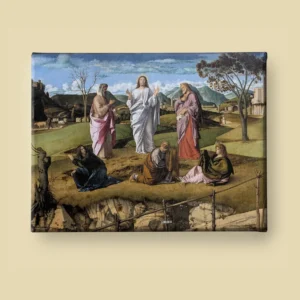
Giovanni Bellini’s Transfiguration, completed between 1478 and 1479 and held at the Museo di Capodimonte in Naples, represents a radical rethinking of how the subject should be approached. Painted in oil on panel and measuring 115 by 152 centimeters, it is one of the landmarks of Venetian Renaissance painting.
Rather than placing Christ against an abstract gold ground or at the summit of a stylized mountain, Bellini sets the Transfiguration in a real Venetian landscape. Rolling hills, a distant town, a dead tree on the left balanced by a living tree on the right, shadows crossing a rural path: everything around Christ is entirely terrestrial. And yet Christ himself stands in the center of all this ordinariness wearing robes of brilliant white, luminous in a way that has no natural explanation. That tension between the familiar and the miraculous is precisely what gives the painting its power.
The symbolic landscape rewards slow looking. The dead tree on the left recalls the passion to come. The living tree on the right suggests the resurrection. A castle in shadow faces sunlit city walls across the composition. A recent technical study published in npj Heritage Science confirmed the date of 1478-1479 and identified the presence of stibnite in the pigments, making this the earliest known use of that material in any painting anywhere.
Bellini also makes a subtle compositional decision that separates the viewer from the scene. The apostles, scattered on the ground in attitudes of awe, are positioned on a slight rise of terrain separated from the viewer by a small ditch or path. We can watch. We cannot approach. This is the Transfiguration as something not quite meant for human eyes, and Bellini makes you feel that with nothing more than a line in the soil.
4. Pietro Perugino – The Transfiguration (1498)
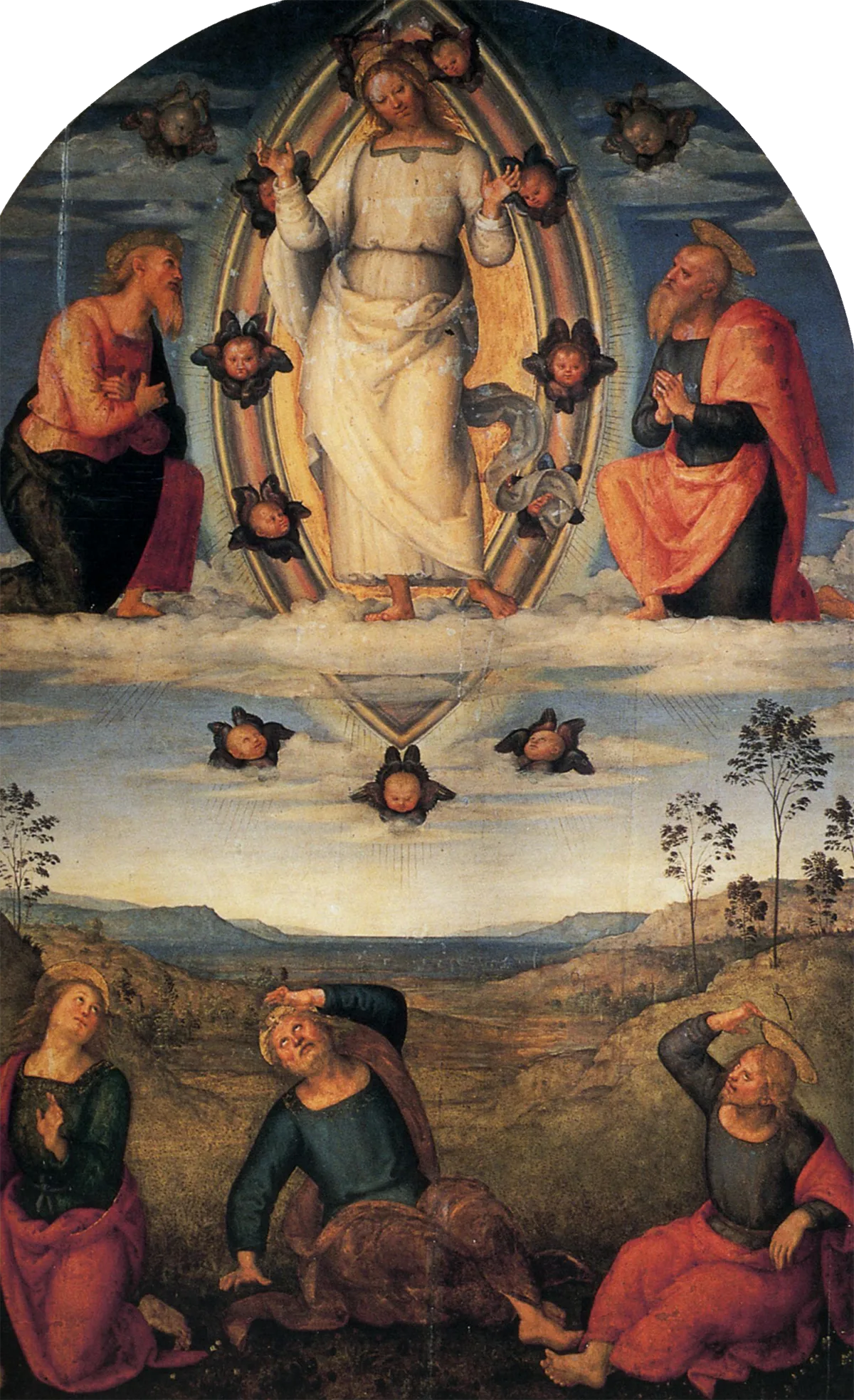
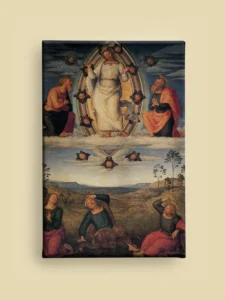
Pietro Perugino is remembered today mostly as the teacher of Raphael, which is only fair: his most gifted pupil did overtake him, decisively and permanently. But in 1499, when the guild of money-changers in Perugia commissioned him to decorate their audience hall, the Collegio del Cambio, Perugino was at the height of his reputation. The Transfiguration fresco on the wall of the hall, completed in 1498, is among the finest works he ever produced.
The fresco measures 226 by 229 centimeters and occupies a key position within the hall’s decorative scheme, paired with a Nativity scene. Perugino’s Christ floats gently in a mandorla of golden light, arms raised, flanked by Moses and Elijah. The three apostles below are arranged in postures of wonder that already anticipate the manner Raphael would later develop with such mastery. The figures have the calm, idealized grace that is the hallmark of Perugino’s best work: no agitation, no drama, only a serene and almost mathematical order.
Standing before this fresco, it is impossible not to think of the young Raphael, who very likely spent time in Perugino’s workshop during precisely these years. The way space is organized, the way figures are distributed across the picture plane, the mood of hushed and luminous solemnity: all of it points forward to the Stanze of the Vatican. Perugino did not become Raphael. But without him, the Raphael we know would not exist.
5. Giovanni Buonconsiglio – Transfiguration of Christ (early 16th century)

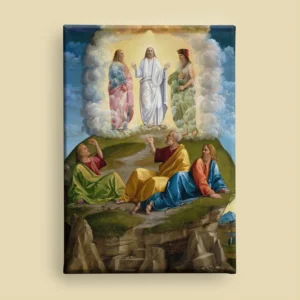
Giovanni Buonconsiglio, known in his own time as “Il Marescalco,” was a Venetian painter born around 1465 who trained under Bartolomeo Montagna in Vicenza and spent much of his career working between Venice and the Veneto. He is not among the famous names. He does not appear in most general histories of Renaissance painting. But his Transfiguration, held at the Accademia Carrara in Bergamo, is a work that deserves far more attention than it normally receives.
The influence of Giovanni Bellini is unmistakable. Buonconsiglio studied the great Venetian master closely, and his Transfiguration shares Bellini’s fundamental compositional logic: Christ at the center in brilliant white robes, Moses and Elijah flanking him above, the three apostles disposed in the lower zone in varying attitudes of awe and prostration. But Buonconsiglio gives the scene a warmer palette and a more theatrical quality. The clouds behind Christ billow generously. The golden light at the top presses against the white robes with real intensity. The apostles below are more physically expressive, their drapery caught in motion.
This is a Transfiguration painted by someone who had absorbed the Venetian tradition fully and was now pushing it toward the dramatic warmth of the High Renaissance. The painting’s precise date is not established, but its style points to the early decades of the sixteenth century, when Venetian painters were beginning to absorb the innovations of Giorgione and the young Titian. Buonconsiglio stands at exactly that crossroads: looking back toward Bellini’s measured stillness and forward toward something more urgent and alive.
6. Raphael – The Transfiguration (1516-1520)


This is Raphael’s final painting. Left unfinished at his death in April 1520 at the age of thirty-seven and completed by his pupil Giulio Romano, it now hangs in the Pinacoteca Vaticana in Rome and measures a monumental 405 by 278 centimeters. It was reportedly displayed beside the painter’s body before his funeral, which says a great deal about how his contemporaries understood what they were looking at.
What makes this Transfiguration unlike any other is the audacity of its double composition. The upper half shows Christ glorified, floating above the mountain in a blaze of white light, flanked by Moses and Elijah, with three apostles below in states of rapturous awe. The lower half shows a crowd gathered around a possessed boy who the remaining disciples have been unable to heal. This second episode comes from a different passage of the same chapter of Matthew (17:14-18), and Raphael places it in deliberate visual and theological contrast with the glory above.
The compositional logic is theological before it is aesthetic. The possessed child below, beyond the reach of human effort, can only be healed through the divine power revealed above. The two scenes are not separate incidents joined on a single canvas. They are a single argument: human suffering on one side, divine intervention on the other. No painter before Raphael had attempted this with such clarity, and no one who came after quite matched it.
Among all Renaissance Jesus paintings, Raphael’s Transfiguration stands as a culmination: an entire tradition of figure painting, spatial organization, and spiritual expression gathered into one vast canvas. The fact that it was left unfinished at the very moment of the painter’s death gives it a meaning beyond art history. It feels, still, like something interrupted.
7. Lodovico Carracci – The Transfiguration (1594-1595)

By the end of the sixteenth century, the Baroque had arrived, and with it a new approach to religious painting. Where the High Renaissance prized harmony, balance, and idealized form, the Baroque prized motion, drama, and emotional force. Lodovico Carracci’s Transfiguration, painted in 1594-1595 for the church of San Pietro Martire in Bologna and now at the Pinacoteca Nazionale di Bologna, is a perfect illustration of that shift.
The painting’s energy is vertical and explosive. Christ at the top radiates light so intensely that the art critic Malvasia wrote that “from close up it terrified, exceeding by much what would be natural, but from a distance it is pleasing.” The apostles below are not simply awestruck. They are overwhelmed, their bodies twisted, their poses unstable, their faces caught in a mixture of fear and ecstasy that no Renaissance painter would have permitted himself. Moses and Elijah crowd close to Christ, their presence almost aggressive in its immediacy.
Lodovico Carracci, together with his younger cousins Agostino and Annibale, had founded the Carracci Academy in Bologna in the early 1580s, an institution that became one of the great reforming forces in European painting. The academy taught naturalism from life, rejected the decorative emptiness of late Mannerist style, and proposed a return to the directness and emotional power of the Renaissance masters. This Transfiguration is that programme made fully visible. It is also worth knowing that Carracci painted an earlier version of the same subject between 1588 and 1590, now in the Scottish National Gallery in Edinburgh, which shows him working through the same compositional problems with a slightly more restrained hand.
For those who love Baroque Jesus paintings, Carracci’s Transfiguration is an essential work: the moment when a new artistic language found its voice on one of the oldest subjects in Christian sacred art.
8. Carl Bloch – The Transfiguration (1877)

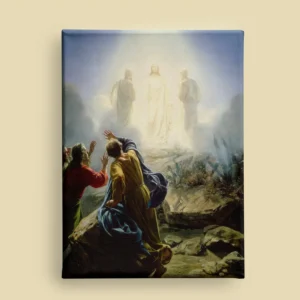
Carl Bloch, the Danish painter born in Copenhagen in 1834, is one of the most beloved artists in the history of Christian devotional painting, though academic art history has not always treated him kindly. His 23 paintings of the life of Christ, commissioned for the King’s Oratory at Frederiksborg Castle and executed between 1865 and 1879, represent one of the most coherent and emotionally powerful cycles of Gospel illustration ever made. The Transfiguration, completed in 1877 in oil on copper and measuring 104 by 83 centimeters, is among the finest of them.
Bloch was profoundly influenced by Rembrandt, and that influence is visible here in the way light behaves. The upper zone of the painting is flooded with golden-white radiance that pours downward over Christ’s white robes and spills across the rocky ground below. The three apostles, prostrate or half-risen at the base of the composition, are caught at the outer edge of that light, their faces turned upward with an expression that is simultaneously terrified and transfixed. Moses and Elijah stand on either side of Christ, grave and still, as if they have been waiting for this moment across all of human history.
What sets Bloch apart from the Renaissance and Baroque painters who came before him is his handling of the human face. Trained in 19th-century academic realism and shaped by careful observation of real people, he gave his figures a specificity of expression that was genuinely new. The apostle shielding his eyes from the light might be a fisherman from a harbor. The figure reaching toward Christ with one hand could be any person caught in the grip of sudden, overwhelming revelation. This is the Transfiguration not as a formal theological demonstration, but as a terrifying and beautiful intrusion of the divine into ordinary human life.
The painting remains at Frederiksborg Castle in Denmark, where it can still be seen in the chapel for which it was made. Among the most famous Jesus paintings of the nineteenth century, Bloch’s Transfiguration stands as proof that the tradition of Christian sacred art remained fully alive and fully capable of great things well beyond the Renaissance.
The 8 Famous Transfiguration Paintings: Summary Table
| Title | Artist | Date | Medium | Museum |
|---|---|---|---|---|
| The Transfiguration (from the Maesta) | Duccio di Buoninsegna | c. 1308-1311 | Tempera on panel | Museo dell’Opera del Duomo, Siena |
| The Transfiguration | Fra Angelico | c. 1438-1440 | Fresco | Museo di San Marco, Florence |
| Transfiguration of Christ | Giovanni Bellini | 1478-1479 | Oil on panel | Museo di Capodimonte, Naples |
| The Transfiguration | Pietro Perugino | 1498 | Fresco | Collegio del Cambio, Perugia |
| Transfiguration of Christ | Giovanni Buonconsiglio | Early 16th century | Oil on panel | Accademia Carrara, Bergamo |
| The Transfiguration | Raphael | 1516-1520 | Oil on panel | Pinacoteca Vaticana, Rome |
| The Transfiguration | Lodovico Carracci | 1594-1595 | Oil on canvas | Pinacoteca Nazionale di Bologna |
| The Transfiguration | Carl Bloch | 1877 | Oil on copper | Frederiksborg Castle, Denmark |
Conclusion
These eight paintings were made in very different times, in very different places, for very different audiences. Duccio painted for a cathedral congregation in medieval Siena. Fra Angelico painted for Dominican friars in a Florentine convent. Bellini painted for an educated Venetian patron who could read the symbolism of a dead tree and a living one. Carl Bloch painted for a Danish king, on copper, six centuries later. And yet all eight are working on the same problem: how to make visible a moment that is, by definition, beyond the visible.
What is striking, looking at them together, is not the differences but the continuities. The gold ground of Duccio reappears, in transformed form, in the golden radiance of Bloch’s copper panel. The double register of divine above and human below, present in every single painting, is never solved and never abandoned. Each artist accepted the impossibility of the task and then went ahead and painted it anyway. That is, in its own way, an act of faith.
If there is one thing these paintings ask of those who look at them, it is this: slow down. They are not images meant to be passed quickly in a museum corridor. They reward patience, silence, and the willingness to look longer than is comfortable. Given that time, they begin to work. And you begin to understand something of what the apostles felt: not just awe at the light, but the strange certainty that what they were seeing was the most real thing they had ever witnessed.
✦ Free Christian & Catholic Printables
Love this sacred art? Our complete collection of illuminated prayer cards and Scripture verses, the Memorare, Psalm 23, Psalm 91 and more, is ready to print, free, in one place.
Browse all free printables →Questions and Answers About Transfiguration Paintings
What does the Transfiguration represent in Christian theology?
The Transfiguration is the moment recorded in Matthew 17, Mark 9, and Luke 9 when Christ’s divine nature became fully visible to three of his disciples on a mountaintop. His face blazed with light and his robes turned brilliant white. Moses and Elijah appeared beside him, and a voice from a cloud declared him the Son of God. Theologically, the scene confirms Christ’s identity as both fully human and fully divine, and it bridges the Old and New Testaments by linking Moses (the Law) and Elijah (the Prophets) with the person of Jesus. In the liturgical calendar of the Catholic Church, the feast of the Transfiguration is celebrated on August 6.
On which mountain did the Transfiguration take place?
The Gospels do not name the mountain. Christian tradition has long identified it as Mount Tabor in Galilee, which is why the feast is sometimes called the feast of Mount Tabor. Some scholars have proposed Mount Hermon as an alternative, given its proximity to Caesarea Philippi, where the preceding events took place. The question remains open. Painters across the centuries have shown the mountain in very different ways, from the abstract gold ground of Duccio to the specific Venetian countryside of Bellini.
Why did so many Renaissance painters choose to depict the Transfiguration?
The subject attracted Renaissance painters for several reasons. It offered a genuine compositional challenge: how to divide the picture space between the heavenly vision above and the earthly witness below. It also allowed painters to show Christ at his most radiant, clothed in light rather than suffering. This made it a subject of particular interest to artists who wanted to represent the full range of Christ’s nature across a career. The Transfiguration also carried strong liturgical importance, celebrated as a feast in the Western Church since at least the 7th century, which meant commissions from churches and chapels were steady.
Why is Raphael’s Transfiguration considered his greatest work?
Raphael’s Transfiguration (1516-1520) is widely seen as the culmination of his career because of its extraordinary compositional ambition. He combined two separate Gospel episodes on a single canvas, creating a theological argument in paint: the possessed child below can only be healed through the divine power revealed above. The painting also represents the full development of his figurative style, from the measured grace of his early Madonnas to a more dynamic and emotionally charged language that would influence Baroque painting for a century. The fact that it was left unfinished at his death in 1520, at only thirty-seven, adds an additional layer of meaning that makes it impossible to look at neutrally.
What makes Carl Bloch’s Transfiguration different from earlier versions?
Carl Bloch worked in the 19th-century academic tradition, profoundly shaped by Rembrandt’s use of directional light and by a concern for human expression rooted in careful observation rather than classical idealization. His figures have faces that feel emotionally specific and recognizable in a way that Renaissance or Baroque figures rarely achieve. The light in his Transfiguration pours down from above in a way that feels almost physically plausible, rather than emanating from a formally defined aura or mandorla. The overall effect is of a vision that could actually be witnessed: overwhelming, beautiful, and entirely beyond explanation. Bloch painted it not as sacred doctrine, but as lived experience.
Are any of these Transfiguration paintings available as canvas reproductions?
Yes. The shop at jesuschrist.pictures offers high-quality canvas print reproductions of three of the paintings covered in this article: the Transfiguration by Raphael, the Transfiguration of Christ by Giovanni Bellini (Capodimonte), and the Transfiguration by Pietro Perugino. Canvas reproductions of the Transfiguration by Carl Bloch and by Giovanni Buonconsiglio are coming soon. Each piece is printed on premium canvas and available in multiple sizes, making them genuine devotional works for Catholic homes and spaces.
Where can I buy Transfiguration paintings on canvas?
You can buy Transfiguration paintings on canvas at jesuschrist.pictures. The canvas reproduction is in our shop, printed on premium canvas and shipped worldwide.


