How Salvador Dalí Transformed Jesus into Surrealist Vision
Introduction: Surrealism and the Absence of Jesus
Surrealism, born in the early 20th century, was a radical artistic movement aiming to liberate imagination from the constraints of reason, tradition, and even morality. Fueled by Freudian psychoanalysis and dreams, Surrealist painters explored the subconscious through strange juxtapositions, dream imagery, and irrational scenes. Artists like Salvador Dalí, Max Ernst, René Magritte, and André Masson brought visions to life that were bizarre, provocative, and often irreverent. But amidst melting clocks and uncanny landscapes, one subject remained surprisingly rare… Jesus Christ.
The absence of Jesus in Surrealist art is striking, especially considering how thoroughly other themes (birth, death, eroticism, and myth) were explored. Most Surrealists, steeped in anti-clerical sentiment or abstract metaphysics, saw Christianity as too rigid or outdated to include in their works. This void left Christian imagery nearly untouched, until Salvador Dalí defied that current.
In the postwar years, Dalí embarked on a spiritual and artistic journey that would change not only his own style but also open a new path in modern religious art. Embracing Catholic mysticism and the language of dreams, Dalí painted a series of extraordinary works centered on Jesus Christ. These paintings are the only major examples of Surrealist Jesus imagery, and they are among the most powerful religious icons of the 20th century. They blend science, geometry, cosmic energy, and divine faith into unforgettable visual experiences. In this article, we explore these “mystic icons” in depth.
To see how contemporary artists reinterpret Christ through modern styles and visual language, visit our Modern Jesus Art gallery.
Dalí’s Mystical Turn: Faith Meets the Subconscious
By the late 1940s, Salvador Dalí had already shocked and fascinated the art world with his surreal landscapes, grotesque figures, and symbolic dreamscapes. But after World War II, Dalí took a sharp and unexpected turn, one toward Catholicism. He declared a return to “classicism and mysticism,” marking the start of what he called his “nuclear mysticism” phase. This new vision fused his interest in modern science (especially atomic theory) with spiritual transcendence. At its center stood Jesus Christ.
Dalí believed that postwar humanity needed not just dreams, but faith. In his view, Christ was not a figure of outdated tradition, but the embodiment of spiritual harmony, cosmic order, and timeless mystery. He saw no contradiction between the divine and the scientific. On the contrary, he used mathematical precision, sacred geometry, and religious symbolism to elevate his subjects beyond earthly limits. For Dalí, Christ was the ultimate surrealist figure: both man and God, wounded yet radiant, suspended between reality and the eternal.
Unlike traditional depictions, Dalí’s Jesus floats, glows, and ascends beyond the physical world. Gala, his muse and wife, often stands in for the Virgin Mary, grounding his cosmic visions in deep personal devotion. With luminous colors, dreamlike compositions, and metaphysical symbols, Dalí’s paintings present Jesus as a figure of awe, mercy, and divine intellect. They are not just religious, they are profoundly mystical, visionary, and unmistakably surrealist.
What follows are five of the most stunning representations of Jesus in Dalí’s surrealist style, works that continue to inspire, provoke, and mesmerize viewers around the world.
The Surrealist Jesus According to Dalí: His 5 Most Powerful Works
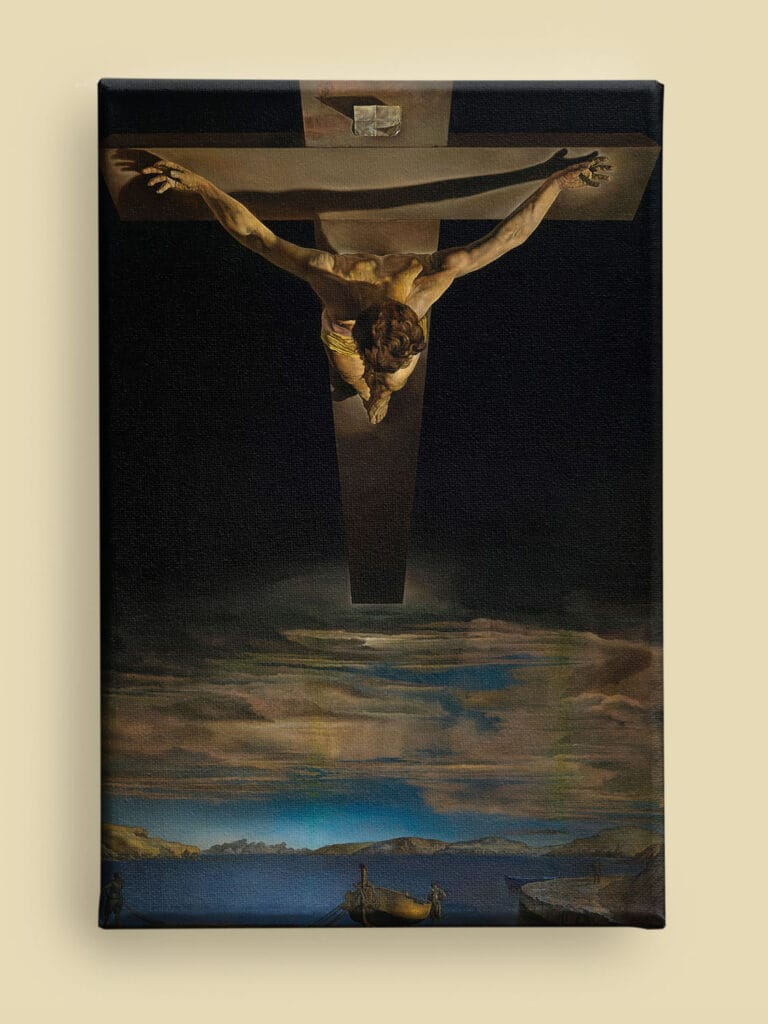
1. Christ of Saint John of the Cross (1951)
This is perhaps Dalí’s most iconic religious painting, and one of the most famous depictions of Jesus in modern art. Christ of Saint John of the Cross offers a unique perspective: the viewer looks down at the crucified Christ from above, as if from the vantage of heaven itself. Jesus floats over a darkened sea, with fishermen below, suggesting his ongoing connection to humanity. There is no blood, no crown of thorns, no nails. Dalí intentionally removed all signs of suffering to focus instead on divine serenity and cosmic peace.
The inspiration came from a 16th-century sketch by the Spanish mystic Saint John of the Cross. Dalí claimed the composition came to him in a dream and that it represented the “beauty of the divine.” Christ’s form is idealized, muscular, radiant, hovering like a suspended deity. The unusual geometry and lighting, combined with Dalí’s technical mastery, turn this into a deeply spiritual image, both surreal and profoundly reverent.

2. The Sacrament of the Last Supper (1955)
In The Sacrament of the Last Supper, Dalí transforms one of the most painted scenes in Christian art into a surreal, almost science-fictional vision. Christ and the apostles are seated at a transparent table inside a luminous dodecahedron, a geometric shape long associated with divine harmony. Christ gestures toward the Eucharist, his body and blood represented simply and centrally. Above him, a semi-transparent divine figure (perhaps God the Father) extends protectively over the scene.
The mood is one of ethereal tranquility. The setting appears more celestial than earthly, suspended between the spiritual and the mathematical. Dalí blends Renaissance perspective with mystical symbolism, creating a transcendent atmosphere where time, space, and faith converge. The painting now resides at the National Gallery of Art in Washington, D.C., and remains one of the most admired examples of Dalí’s religious vision.

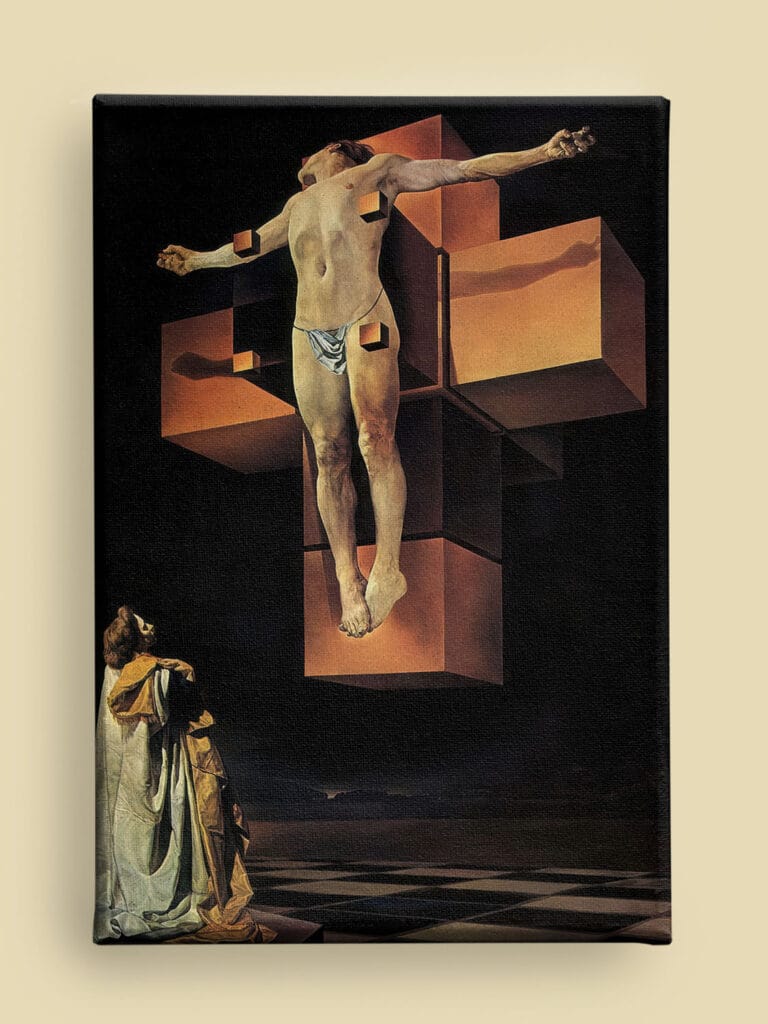
3. Crucifixion (Corpus Hypercubus) (1954)
This extraordinary painting, also called Corpus Hypercubus, reimagines the crucifixion using a four-dimensional mathematical structure, a hypercube or tesseract. Here, Christ is not nailed to a traditional cross but to an unfolded cube floating in space. His body hovers in luminous serenity, without pain, his gaze upward, transcending the mortal realm. Gala stands below, in quiet adoration, dressed like a Marian figure.
Dalí called this his attempt to merge science, religion, and art. The hypercube symbolizes the divine dimension beyond human perception, while Jesus embodies the harmony between body and spirit, space and eternity. With this piece, Dalí challenges traditional crucifixion iconography, replacing suffering with transcendence, and anchoring faith in mathematical beauty. The painting is housed at the Metropolitan Museum of Art in New York.

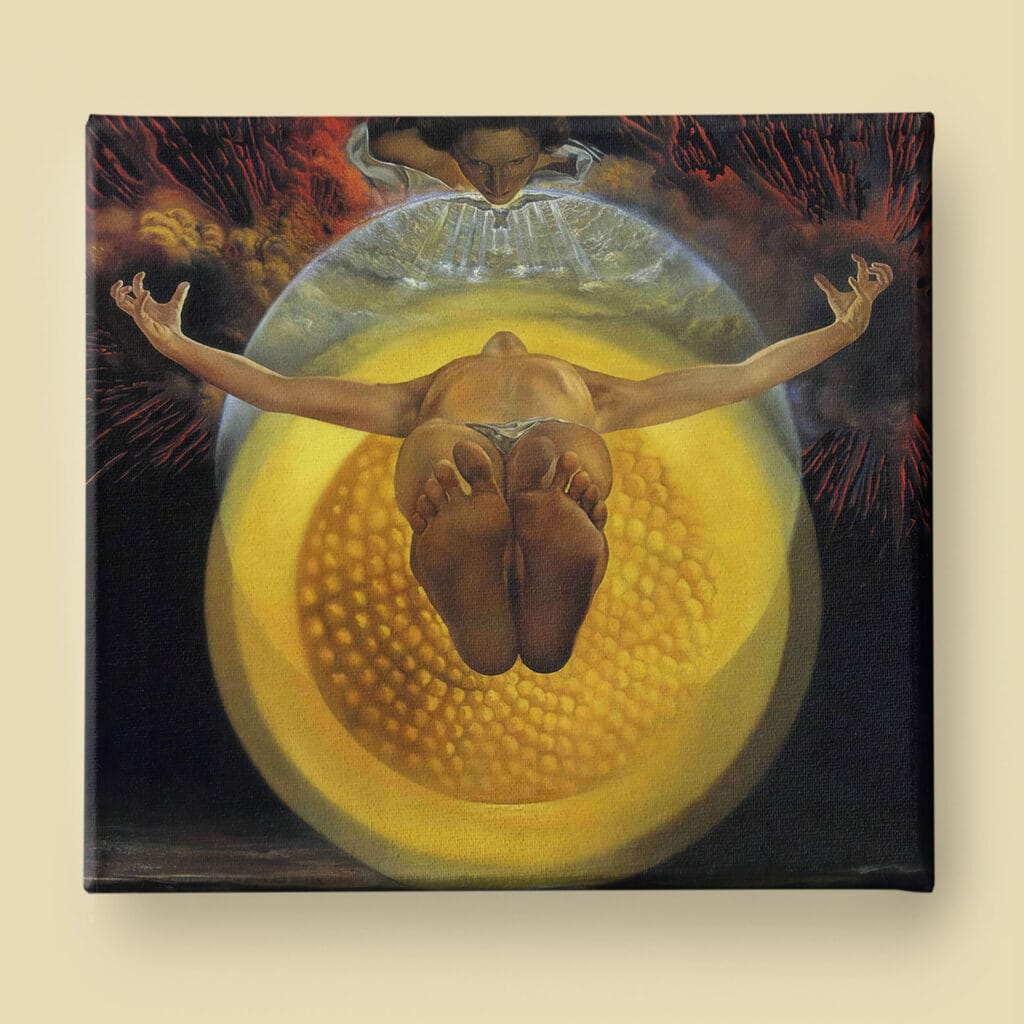
4. The Ascension of Christ (1958)
Dalí’s The Ascension of Christ depicts Jesus spiraling upward into golden light, viewed from below, a perspective that pulls the viewer directly into the celestial ascent. Christ’s body is radiant, surrounded by swirling clouds, and the composition suggests both resurrection and cosmic fusion. His feet, illuminated and foreshortened, dominate the foreground, creating a dramatic sense of scale and divine movement.
The ascension, in Dalí’s hands, becomes a metaphysical explosion, Jesus becoming one with the universe. Inspired by atomic theory and baroque dynamism, this painting visualizes the moment when the divine breaks through material boundaries. The energy of the composition, along with the dreamlike colors and glowing aura, give the work a distinctly surrealist aura, blending modern physics with biblical transcendence.

5. Christ of Gala (1963-67)
In Christ of Gala, one of Dalí’s later religious paintings, the artist merges the sacred with the personal. Christ appears as a celestial figure, suspended over a surreal dreamscape filled with classical and Dalinian symbols. Gala, Dalí’s wife and muse, appears again in the role of a divine witness or intercessor, reflecting her spiritual importance in his life and work.
This painting continues Dalí’s fascination with atomic mysticism, using fragmented forms and a glowing palette to depict Christ as both human and transcendent. The background, rich with floating elements and esoteric shapes, evokes the subconscious realm of dreams and faith. “Christ of Gala” is not just about theology, it is a deeply intimate reflection of devotion, love, and metaphysical belief, culminating Dalí’s decades-long spiritual exploration.

Together, these five masterpieces by Salvador Dalí form a powerful canon of Surrealist Jesus paintings, unrivaled in their originality, complexity, and spiritual depth. They reveal a side of Surrealism that dared to engage not just with the subconscious, but with the sacred.
For more modern Jesus images, visit our gallery of Modern Jesus Art
Conclusion
Salvador Dalí’s body of work stands alone in the history of sacred modern art. While Surrealism rarely embraced overt religious themes, Dalí carved out a unique space where faith, science, and dreams collided, producing some of the most enigmatic and powerful images of Christ ever painted. These Surrealist Jesus paintings do more than depict. They meditate, question, and transcend.
Unlike the solemn traditions of medieval Jesus paintings or the emotional grandeur of Baroque Jesus paintings, Dalí’s works explore Christ through the lens of nuclear mysticism, dream logic, and metaphysical wonder. From the suspended calm of Christ of Saint John of the Cross to the dizzying ascension of Corpus Hypercubus, Dalí invites us not just to view, but to enter these spiritual worlds with awe.
These paintings also provide a bridge to 20th-century questions of belief, identity, and perception, placing Jesus not only at the center of faith, but at the crossroads of science and imagination. If you’re curious to compare Dalí’s vision with earlier or contemporary styles, explore our articles on Renaissance Jesus paintings, Romantic Jesus paintings, or the deeply psychological depth of Expressionist Jesus paintings.
Paintings Featured in This Article
| Painting | Artist | Date | Medium | Location |
|---|---|---|---|---|
| Christ of Saint John of the Cross | Salvador Dalí | 1951 | Oil on canvas | Kelvingrove Art Gallery and Museum, Glasgow |
| The Sacrament of the Last Supper | Salvador Dalí | 1955 | Oil on canvas | National Gallery of Art, Washington D.C. |
| Crucifixion (Corpus Hypercubus) | Salvador Dalí | 1954 | Oil on canvas | The Metropolitan Museum of Art, New York |
| The Ascension of Christ | Salvador Dalí | 1958 | Oil on canvas | Private Collection / Salvador Dalí Foundation |
| Christ of Gala | Salvador Dalí | 1963-1967 | Oil on canvas | Private Collection / Salvador Dalí Foundation |
FAQ
Was Salvador Dalí religious?
Yes. Though raised Catholic, Dalí distanced himself from religion in his youth, only to return with fervent interest in Christian mysticism and Catholic dogma later in life. His later works reflect deep religious and philosophical themes, particularly centered on Christ and divine transcendence.
What made Salvador Dalí’s art unique?
Dalí’s art is marked by hyper-realistic technique blended with surreal, dreamlike symbolism. He fused science, religion, and psychoanalysis, creating highly imaginative and technically masterful pieces that challenge traditional perception. His ability to combine mathematical precision with spiritual depth makes his style one of a kind.
Who painted “The Last Supper” featured in this article?
The Sacrament of the Last Supper was painted by Salvador Dalí in 1955. It is a visionary reinterpretation of the biblical scene, blending classical composition with surrealist elements like a glowing dodecahedron and a translucent divine figure above the table.
Is Dalí’s Crucifixion (Corpus Hypercubus) traditional?
Far from traditional. Dalí’s use of a hypercube (tesseract) instead of a wooden cross places the crucifixion within a metaphysical and mathematical dimension. It represents Dalí’s attempt to depict Christ not in suffering, but in transcendent, multi-dimensional glory.
Where can I see Dalí’s religious paintings in person?
Many of Dalí’s religious masterpieces can be seen in museums like the Kelvingrove Art Gallery (Glasgow), the National Gallery of Art (Washington D.C.), the Metropolitan Museum of Art (New York), and the Dalí Theatre-Museum in Figueres, Spain.
Are there other surrealist Jesus paintings?
Very few. While Surrealism rarely embraced overt religious imagery, Dalí stood apart by integrating Christian themes into his work. Most Surrealist artists avoided explicit depictions of Christ, making Dalí’s contributions uniquely bold and influential.
How do Dalí’s paintings compare with Renaissance or Baroque depictions?
Dalí’s Jesus paintings focus more on transcendence and metaphysics than on earthly suffering or realism. Where Renaissance art sought harmony and Baroque emphasized emotion, Dalí’s works aim for spiritual revelation and cosmic symbolism.
Did Dalí consider himself a mystic?
Yes. In the 1950s, Dalí declared himself a “nuclear mystic.” He believed that faith, science, and art could be unified in visual language, and his Jesus paintings are prime examples of that synthesis.
Where can I buy Salvador Dalí religious paintings on canvas?
You can buy Salvador Dalí religious paintings on canvas at jesuschrist.pictures. Our contemporary Christian art buying guide features all three of Dalí’s major sacred works available as premium canvas prints, ready to hang.


