For nearly two thousand years, the life of Christ has inspired more paintings than any other subject in Western art. From the quiet intimacy of the Annunciation to the cosmic drama of the Resurrection, generations of masters have turned the Gospels into images of astonishing beauty and theological depth. This article gathers twenty of the most powerful life of Christ paintings ever made, arranged chronologically as a visual biography of Jesus, from his conception in Nazareth to his Ascension into heaven. Each scene is illustrated by a single masterpiece, chosen for its historical importance, artistic excellence, and spiritual resonance. If you want a broader overview of Christ in painting, also read our selection of the 10 most famous Jesus paintings in art history.
The reverse of Duccio’s Maestà (1311) — one of the earliest narrative cycles of Christ’s life in Western painting
Why Artists Have Painted the Life of Christ for Two Thousand Years
From the catacombs of Rome to the ceilings of the Sistine Chapel, Christian artists have returned endlessly to the same set of scenes. The reason is simple: the Gospels are a visual story. Pope Gregory the Great defended sacred images as “the Bible of the illiterate,” and for centuries painted scenes from Christ’s life were the primary way the faithful meditated on salvation history. By the year 1000, the repertoire of scenes was largely settled, organized around the great liturgical feasts: Annunciation, Nativity, Baptism, Transfiguration, Crucifixion, Resurrection, Ascension, and a handful of other key moments. Every major painter, from Giotto to Caravaggio to Dalí, measured himself against this inherited tradition. The twenty paintings that follow are among the finest examples of that immense artistic inheritance.
Part I: The Infancy of Christ
1. The Annunciation by Fra Angelico (c. 1426)
The story of Jesus begins in Nazareth, when the Archangel Gabriel appears to a young Jewish girl named Mary and announces that she will conceive the Son of God. Her humble reply, “Let it be done unto me according to thy word,” opens the entire drama of salvation. Fra Angelico’s Annunciation, painted around 1426, is perhaps the most serene rendering of this mystery ever created. The Florentine friar places Mary and Gabriel beneath a delicate portico, bathed in pastel light. Gabriel’s feathered wings still ripple from his flight; Mary sits quietly, hands crossed over her chest in perfect surrender. Above the capitals, small inscriptions remind the viewer of the doctrine at stake: this is the moment the Word becomes flesh. For a wider look at this sacred theme, see our article on the most famous Annunciation paintings in art history.
The Annunciation by Fra Angelico (san marco)Save
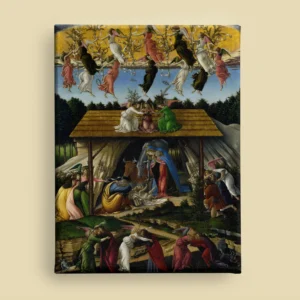
2. The Mystic Nativity by Sandro Botticelli (1500)
Nine months later, Mary and Joseph travel to Bethlehem for the Roman census, and Jesus is born in a humble stable. Shepherds arrive with their flocks to adore the newborn King. Of all the Nativities in Western art, Botticelli’s Mystic Nativity, signed in 1500, is one of the most passionate and unusual. Painted in the aftermath of Savonarola’s execution, when Florence was torn by apocalyptic fervor, the work blends the Gospel scene with imagery from the Book of Revelation. Angels dance in a golden ring above the stable; on the ground, three angels embrace three men while small devils flee into cracks in the earth. The Greek inscription at the top announces the coming of the Thousand Years of peace. It is, remarkably, the only painting Botticelli ever signed. To see more Nativities by the great masters, read our guide to the famous Nativity paintings that shaped Christian art.
Mystic Nativity by Sandro BotticelliSave
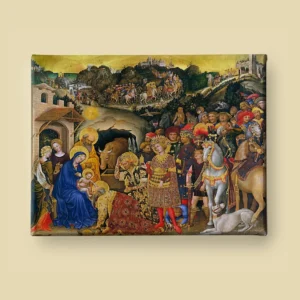
3. The Adoration of the Magi by Gentile da Fabriano (1423)
Twelve days after the Nativity, three wise men from the East follow a rising star to Bethlehem and present the infant Jesus with gold, frankincense, and myrrh. Gentile da Fabriano’s altarpiece of 1423, commissioned by the Florentine banker Palla Strozzi for the sacristy of Santa Trinita, is the crowning masterpiece of the International Gothic style. Every inch glitters: the Magi’s robes are embroidered with gold thread, their horses gleam like polished ivory, and the procession winds through an Umbrian landscape alive with hunting dogs, exotic animals, and courtly detail. At the center of this spectacle, the three kings kneel before the Christ Child with a tenderness that feels startlingly human. For a broader look at this theme, see our article on the Adoration of the Magi paintings every Christian art lover should know.
Adoration of the Magi by Gentile da FabrianoSave
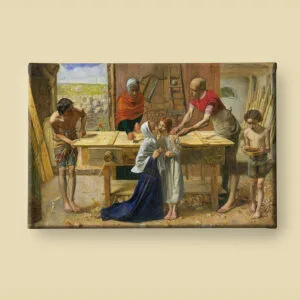
4. Christ in the House of His Parents by John Everett Millais (1849–50)
After the Magi leave, Joseph takes his family to Egypt to escape Herod’s massacre, then eventually settles back in Nazareth. For roughly thirty years, Jesus lives an ordinary life as the carpenter’s son. The Gospels tell us almost nothing about this “hidden life,” but John Everett Millais imagined it with astonishing realism in Christ in the House of His Parents, painted in 1849 and 1850. The young Jesus, having cut his palm on a nail, is comforted by Mary while Joseph continues his work at the bench. Every tool is studied from life; every face is modeled on a real person. When first exhibited, the painting caused a scandal: critics called the Holy Family too ordinary, too working-class. That was precisely Millais’ point. The Incarnation means God entered the dirt and sweat of a real carpenter’s shop.
Christ in the House of His Parents by John Everett MillaisSave
5. The Baptism of Christ by Verrocchio and Leonardo da Vinci (c. 1472–75)
When Jesus is about thirty, he walks south to the Jordan River and asks his cousin John to baptize him. This moment, the first act of his public ministry, reveals the Trinity in a single scene: the Son is baptized, the Father’s voice speaks from heaven, and the Holy Spirit descends as a dove. Verrocchio’s workshop version, painted in Florence around 1472 to 1475, is famous for one reason above all others. The young Leonardo da Vinci painted the angel on the far left. Vasari reports that when Verrocchio saw his pupil’s work, he put down his brush forever, unable to be surpassed by a boy. The story may be embellished, but the difference in quality is visible even today: Leonardo’s angel, with its soft modeling and dreaming gaze, announces a new era of painting. For more masterworks of this theme, see our article on the famous Baptism of Christ paintings in the history of Christian art.
The Baptism of Christ by Andrea del Verrocchio and Leonardo da VinciSave
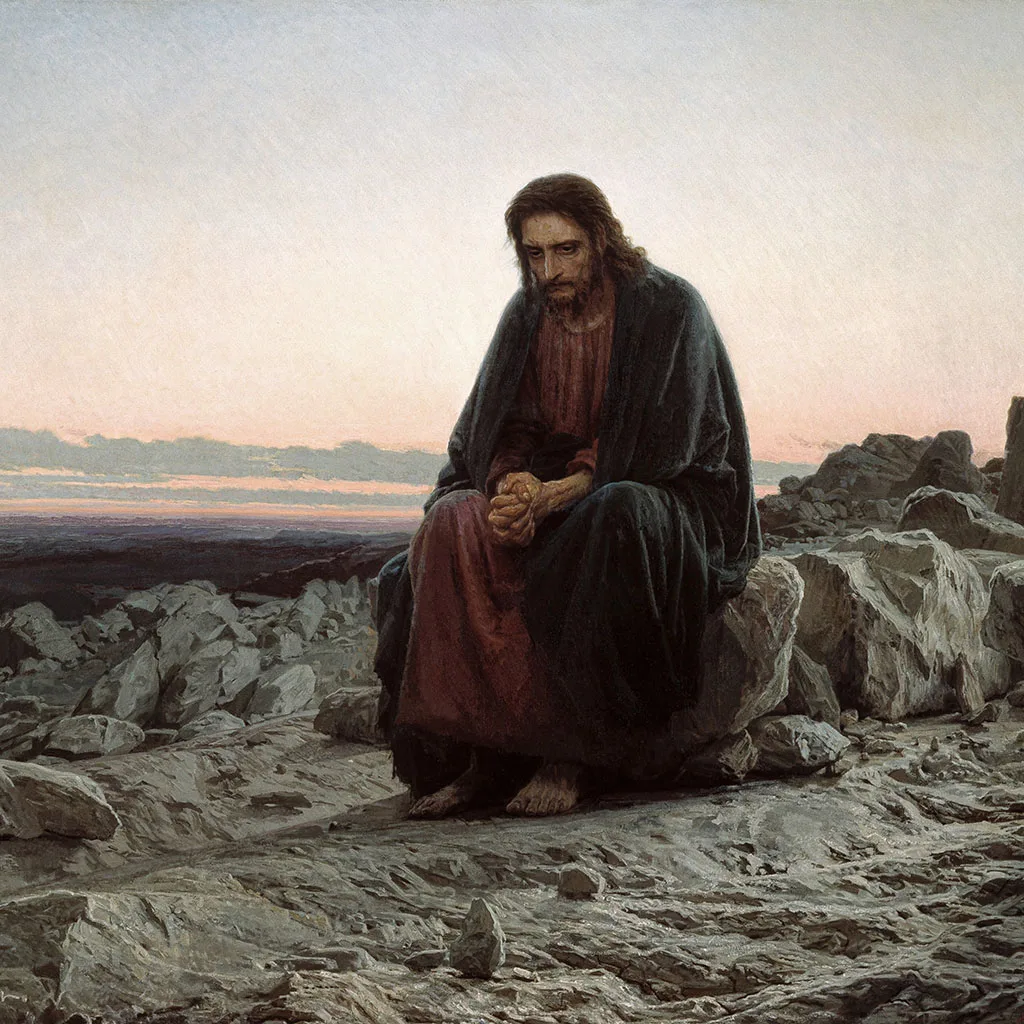
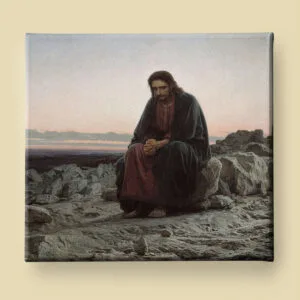
6. Christ in the Wilderness by Ivan Kramskoy (1872)
Immediately after his baptism, the Spirit leads Jesus into the desert for forty days of fasting, where Satan tempts him three times. The Russian realist Ivan Kramskoy painted this scene in 1872 in a way no Western master had ever attempted. His Christ in the Wilderness shows no devil, no dramatic gestures, no supernatural effects. Only a man alone on a barren rock, hands clasped, staring into a stony horizon at dawn. Kramskoy reportedly spent five years working on the painting and described it as a portrait of his own moral struggle. The canvas is now one of the most beloved works in the Tretyakov Gallery in Moscow. Every generation of Russian viewers has read it as a silent icon of human suffering, conscience, and the solitude of genuine faith.
Christ in the Wilderness by Ivan KramskoySave
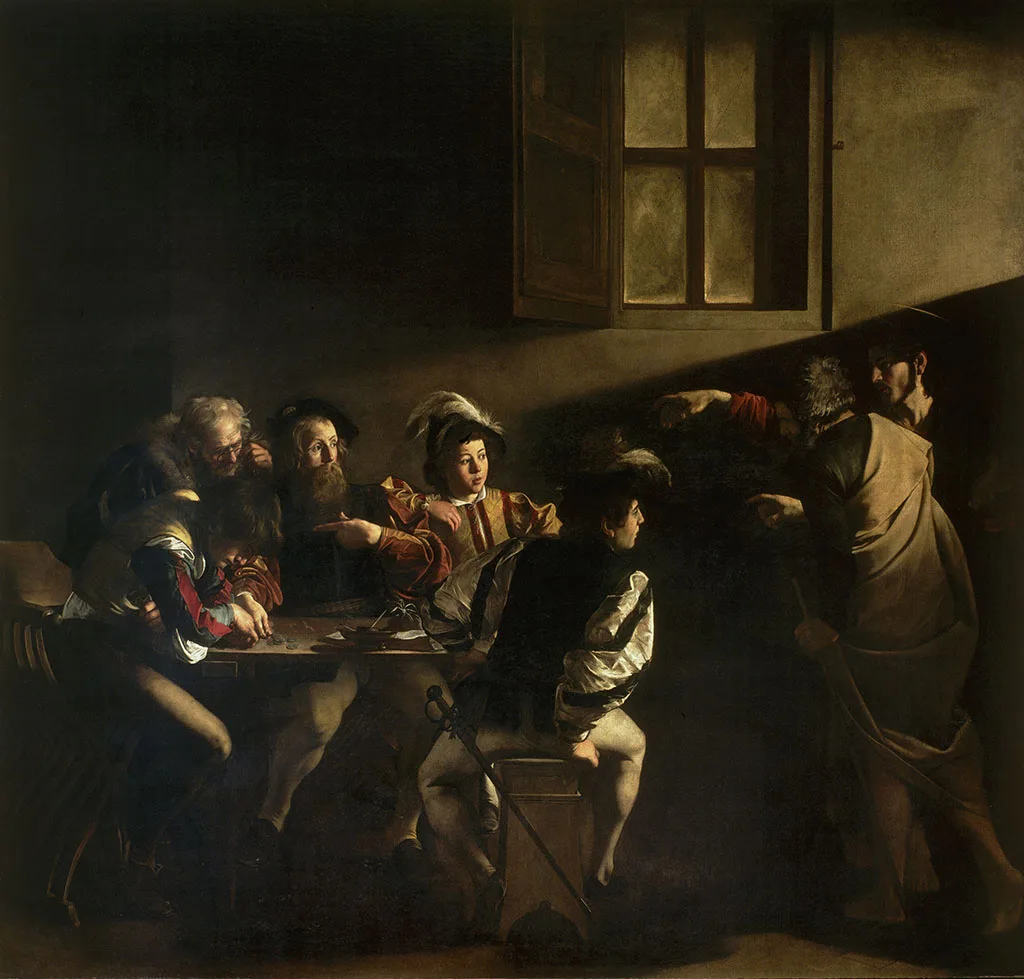
7. The Calling of Saint Matthew by Caravaggio (1599–1600)
Jesus returns from the desert and begins to gather disciples. Among the most dramatic callings is that of Matthew, a hated tax collector sitting at his counting table when Christ walks in and says, “Follow me.” Caravaggio’s version, painted for the Contarelli Chapel in Rome between 1599 and 1600, reinvented religious art in a single stroke. The scene takes place in a dim, smoke-stained tavern. Christ, half-hidden behind Peter, points toward Matthew with a languid hand that quotes Michelangelo’s Adam on the Sistine ceiling. A shaft of raking light cuts across the room like divine grace breaking through everyday life. Matthew, stunned, seems to ask, “Who, me?” It is the birth of Baroque painting and one of the most psychologically electric moments in all of Christian art.
The Calling of St Matthew by CaravaggioSave
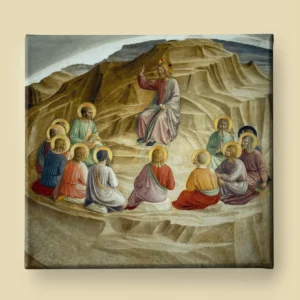
8. The Sermon on the Mount by Fra Angelico (c. 1440)
Of all the teachings Jesus gave, the Sermon on the Mount is the longest and most luminous. Seated on a Galilean hillside, he delivers the Beatitudes, the Lord’s Prayer, and the moral heart of the Gospel. Fra Angelico painted this scene around 1440 as a fresco in the Dominican convent of San Marco in Florence. In keeping with the meditative silence of a friar’s cell, the composition is strikingly simple: a bare mountain, a small group of attentive disciples, and Christ speaking with one hand raised in blessing. There is no crowd, no spectacle. Only the Word and those who listen. Fra Angelico, beatified by John Paul II in 1982, painted every figure as an act of prayer. For more interpretations of this scene, read our guide to the famous Sermon on the Mount paintings explained.
Sermon on the Mount by Fra AngelicoSave
At the climax of his ministry, Jesus leads Peter, James, and John to a high mountain where he is transfigured before them: his face shines like the sun, Moses and Elijah appear at his sides, and the Father’s voice declares him the Beloved Son. Raphael’s Transfiguration, painted between 1516 and 1520, is the last work he ever completed and is regarded by many as his supreme masterpiece. The upper half of the canvas blazes with divine light as Christ levitates above the mountain. The lower half, darker and more agitated, shows the disciples struggling to heal a possessed boy. Between the two zones, heaven and earth, Raphael stages the entire mystery of the Gospel in a single image. The painting was placed at the head of his coffin during his funeral in April 1520. Read more in our article on the famous Transfiguration paintings across six centuries.
Transfiguration by RaphaelSave
10. Christ’s Entry into Jerusalem by Peter Paul Rubens (1632)
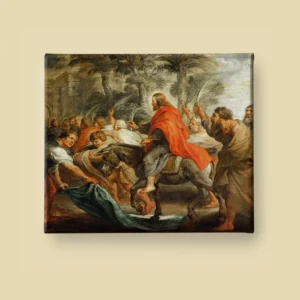
Six days before Passover, Jesus enters Jerusalem riding on a donkey while crowds wave palm branches and shout “Hosanna.” This triumphal moment, celebrated as Palm Sunday, opens the final week of his earthly life. Peter Paul Rubens’ Christ’s Entry into Jerusalem, painted around 1632 and kept today at the Musée des Beaux-Arts in Dijon, captures the scene with the Baroque master’s characteristic energy. The crowd surges forward; children climb trees to see the prophet from Nazareth; a servant spreads garments on the dusty road. Christ, at the center, rides calmly through the tumult with an expression that already looks past the cheers to the cross five days away. It is one of Rubens’ most compelling meditations on the fragile nature of public acclaim.
Christ’s entry into Jerusalem by Peter Paul RubensSave
11. The Last Supper by Leonardo da Vinci (1495–98)
On Holy Thursday, Jesus shares a final Passover meal with his twelve apostles. He breaks bread, shares wine, and announces that one of them will betray him. Leonardo da Vinci’s Last Supper, painted on the refectory wall of Santa Maria delle Grazie in Milan between 1495 and 1498, is the most studied painting in the world. Leonardo froze the moment just after Christ’s shocking words: “One of you will betray me.” The apostles react in twelve different ways: shock, denial, whispered consultation, outrage. Judas recoils in the shadows, clutching his purse of silver. The composition, organized around Christ’s perfectly balanced silhouette, remains a perpetual model of narrative clarity. For a deeper look, see our list of the 13 most famous Jesus Last Supper paintings, or read our dedicated study of Leonardo’s Last Supper composition and symbolism.
The Last Supper by Leonardo da VinciSave
12. Christ in Gethsemane by Carl Heinrich Bloch (c. 1875)
After the Last Supper, Jesus crosses the Kidron Valley to the Garden of Gethsemane, also known as the Garden of Olives, and prays in anguish while his disciples sleep. “My soul is sorrowful even unto death,” he tells them. Carl Heinrich Bloch’s Christ in Gethsemane, painted around 1875 for the chapel at Frederiksborg Castle in Denmark, is one of the most tender images of this moment ever created. An angel kneels beside Jesus to offer a chalice, representing the cup of suffering Christ must drink. The surrounding darkness is deep, but a soft light falls on Christ’s face, illuminating his consent. Bloch’s Danish realism gives the scene an intimacy that Italian Baroque painters rarely achieved. See also our article on the Agony in the Garden paintings that capture Christ’s last night.
Christ in Gethsemane by Carl Heinrich BlochSave
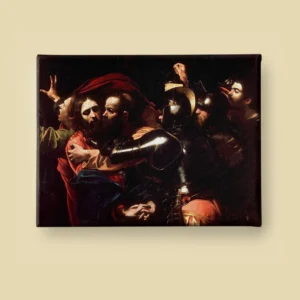
Judas arrives in the Garden with soldiers and identifies Jesus with a kiss. Caravaggio’s Taking of Christ, painted in 1602 and now in the National Gallery of Ireland in Dublin, turns this betrayal into one of the most charged images in Western art. The composition is brutally tight: five figures crammed into the frame, a clanging sheet of black armor, and the contrast between Judas’ strained embrace and Christ’s passive, sorrowful face. On the right edge of the painting, Caravaggio has included a self-portrait holding up a lantern, implicating himself, and all of us, in the arrest. The painting was lost for nearly two centuries and rediscovered in a Jesuit residence in Dublin in 1990. It is now considered one of Caravaggio’s most devastating religious works.
The Taking of Christ by CaravaggioSave
14. The Flagellation of Christ by Caravaggio (1607)
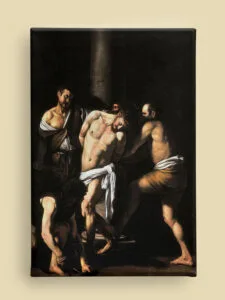
Brought before Pontius Pilate, Jesus is scourged and mocked. Roman soldiers braid a crown of thorns, press it onto his head, and hail him “King of the Jews.” Caravaggio painted several versions of these tortures. The Flagellation now at the Museo Nazionale di Capodimonte in Naples, executed in 1607, stands among his most powerful compositions. A massive column dominates the center. Two executioners, stripped to the waist, bind Jesus to it with ropes while a third stoops to gather more branches. Christ’s body glows against the surrounding darkness, almost luminous, with the serenity of a martyr who has already accepted what is coming. The painting was commissioned for a Neapolitan chapel, where it remained largely hidden for centuries, untouched by the crowds who made Caravaggio a household name only in modern times.
The Flagellation of Christ by CaravaggioSave
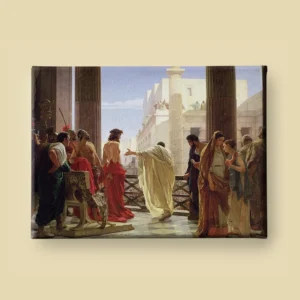
After the scourging, Pilate brings the wounded Jesus out to the balcony and presents him to the crowd with the Latin phrase Ecce Homo, “Behold the Man.” Antonio Ciseri’s Ecce Homo, finished in 1871 and kept today at the Galleria d’Arte Moderna in Palazzo Pitti, Florence, shows the scene from a remarkable angle: from behind. We look out with Pilate over the stone balustrade at the hostile crowd below. Christ, his back turned to us, wears a white cloak over bleeding shoulders; beside him, Pilate spreads his arms in an almost theatrical gesture. The choice to withhold Christ’s face is a master stroke: we feel the abandonment without seeing it. Ciseri worked on this painting for nearly twenty years, and it remains one of the most cinematic compositions in all of sacred art.
Ecce Homo by Antonio CiseriSave
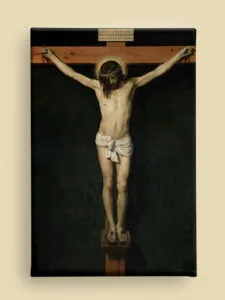
Condemned to death, Jesus carries his cross to Golgotha and is crucified between two thieves. After six hours of agony, he cries “It is finished” and dies. Diego Velázquez’s Christ Crucified, painted around 1632 and now hanging in the Museo del Prado in Madrid, is a Spanish meditation on the holiest moment in history. Against an impenetrable black background, Christ hangs alone, bathed in a cold, silvery light. His head is slightly bowed; a strand of dark hair falls over half his face. There is no theatrical grief, no angelic chorus, no mourners at his feet. Only a perfect body, silently given. Velázquez painted with a restraint that feels almost austere, yet every inch of the canvas is saturated with Counter-Reformation devotion. For more Crucifixion masterpieces, read our article on the famous Crucifixion paintings: a visual history of Christ on the cross.
Christ Crucified by Diego VelázquezSave
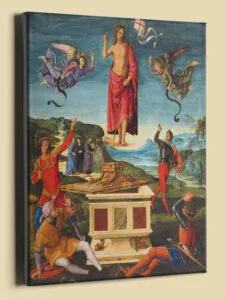
17. The Resurrection of Christ by Raphael (1499–1502)
On the third day, Christ rises from the tomb. The guards fall back in terror, the angels roll away the stone, and death itself is defeated. Raphael’s Resurrection of Christ, painted between 1499 and 1502 when he was still a teenager, is one of the earliest masterpieces of his career. It is now preserved in the São Paulo Museum of Art (MASP) in Brazil, an extraordinary piece of the Italian High Renaissance held outside Europe. Christ rises weightlessly above the sarcophagus, holding the banner of victory. Two angels flank him in perfect symmetry. Below, four Roman soldiers react with the full range of Renaissance gesture: astonishment, fear, incredulity, prayer. Raphael was already an unrivaled draftsman at eighteen. For more Resurrection masterworks, see our article on the famous Resurrection paintings that shaped Christian art.
The Resurrection of Christ by RaphaelSave
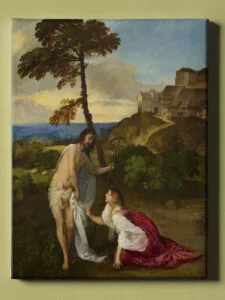
On Easter morning, Mary Magdalene comes to the tomb to anoint Christ’s body and finds it empty. When she turns, she sees a man she mistakes for the gardener. Then he speaks her name, “Mary,” and she recognizes him. Jesus gently tells her, “Do not cling to me,” Noli Me Tangere in Latin, for he has not yet ascended to the Father. Titian painted this intimate encounter around 1514, and it now hangs at the National Gallery in London. His Christ steps back and inclines his body in a perfect serpentine curve, half-draped in a white shroud; Mary Magdalene reaches forward on her knees, fingertips trembling in the space just short of his wounded side. The quiet Venetian landscape behind them glows with the soft gold of early morning. Read more in our article on the Noli Me Tangere paintings you must see.
Noli Me Tangere by TitianSave
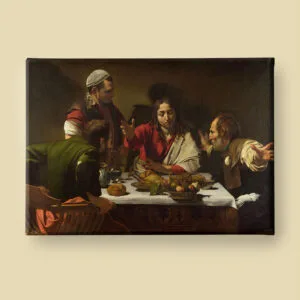
Later that same Easter day, two disciples walk the road to the village of Emmaus, grieving the death of their master. A stranger joins them and explains the Scriptures. When they sit to share a meal and he breaks the bread, they recognize him as the risen Christ, and he vanishes. Caravaggio’s Supper at Emmaus, painted in 1601 and also in the National Gallery in London, captures the exact instant of recognition. One disciple throws his arms wide in astonishment, the other grips his chair and almost rises from it. A basket of fruit teeters on the edge of the table, as if about to fall. Christ, beardless and almost boyish, blesses the bread with calm certainty. See also our article on the iconic Supper at Emmaus paintings in art history.
The Supper at Emmaus by CaravaggioSave
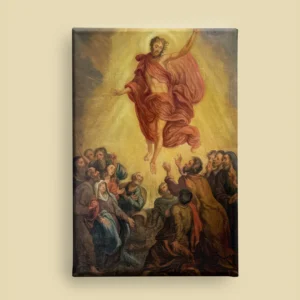
Forty days after the Resurrection, Jesus leads his apostles to the Mount of Olives, blesses them one last time, and ascends into heaven. Peter Paul Rubens’ Ascension, painted around 1620 and preserved at the Academy of Fine Arts in Vienna, brings the earthly story of Christ to a triumphant close. The composition is built on a powerful diagonal: Christ, arms outstretched in benediction, rises through a swirl of clouds and angels, while the apostles below lift their faces in wonder. The Virgin Mary kneels at the center of the group, her gaze fixed on her ascending son. Rubens’ brush, at the height of his Antwerp maturity, turns the scene into a whirlwind of light, flesh, and rising hope. For more Ascension masterworks, read our guide to the Ascension paintings that defined Christian art through the centuries.
The Ascension by Peter Paul RubensSave
Among the Resurrection appearances, the moment Thomas touched the wounds of the risen Christ has its own rich tradition; see our guide to Doubting Thomas paintings.
Conclusion
From Fra Angelico’s hushed Annunciation to Rubens’ triumphant Ascension, these twenty paintings tell the greatest story ever narrated in Western art. Each generation of painters took up the same set of scenes and remade them according to its own light: medieval gold, Renaissance geometry, Baroque drama, Romantic tenderness, modern realism. Behind every canvas stands the same conviction. A carpenter’s son from Nazareth changed history, and art has never exhausted the task of showing why. For the devoted art lover, following the life of Christ through paintings is not only a walk through art history but also a slow meditation on the mystery that gave birth to the greatest visual tradition humanity has ever produced.
✦ Free Christian & Catholic Printables
Love this sacred art? Our complete collection of illuminated prayer cards and Scripture verses, the Memorare, Psalm 23, Psalm 91 and more, is ready to print, free, in one place.
The life of Jesus is traditionally divided into four parts: the Infancy (Annunciation, Nativity, Adoration of the Magi, hidden years in Nazareth), the Public Ministry (Baptism, Temptation, calling of the apostles, Sermon on the Mount, miracles, Transfiguration), the Passion (Entry into Jerusalem, Last Supper, Agony in the Garden, arrest, trial, Crucifixion, Entombment), and the Resurrection and Glorification (Resurrection, appearances to the disciples, Ascension into heaven). The Gospels identify five major milestones of Christian faith: Baptism, Transfiguration, Crucifixion, Resurrection, and Ascension.
How old was Jesus when he died?
Scripture does not state the exact age of Jesus at his death. By combining Luke’s statement that he was “about thirty” when he began his public ministry with the three Passovers mentioned in John’s Gospel, most scholars conclude that Jesus died between the ages of 33 and 36. The traditional Christian number is 33, often taken as symbolic of a life fully completed. The Crucifixion is most commonly dated to either 7 April AD 30 or 3 April AD 33.
How long did Jesus’ public ministry last?
The Gospel of John mentions three distinct Passover festivals during Jesus’ ministry, which places its duration at approximately three years. Some Church Fathers, such as Clement of Alexandria, argued for a single year of preaching; others, like Irenaeus, proposed a longer period of up to fifteen years. The three-year reading, supported by the Gospel of John and by the majority of early commentators, has been the accepted Catholic chronology since the Middle Ages.
Who painted the most famous scenes from the life of Christ?
No single artist covered the whole life of Christ, but a handful of masters defined how specific scenes would be painted forever after. Leonardo da Vinci’s Last Supper set the model for the institution of the Eucharist. Raphael’s Transfiguration established the visual climax of Christ’s ministry. Caravaggio transformed the Passion into Baroque drama in works like the Taking of Christ and the Flagellation. Velázquez gave the Crucifixion its most solemn form. In the nineteenth and twentieth centuries, Carl Bloch, William Holman Hunt, and Salvador Dalí brought new sensibilities to the ancient subjects.
What are the Twelve Great Feasts of Christ’s life in art?
In the Eastern Orthodox and Byzantine traditions, the Twelve Great Feasts organize the liturgical year around twelve key scenes from the life of Christ and the Virgin Mary. They typically include the Annunciation, Nativity, Presentation of Christ in the Temple, Baptism, Transfiguration, Raising of Lazarus, Entry into Jerusalem, Crucifixion, Descent into Hell, Ascension, Pentecost, and Dormition of the Virgin. These feasts became the core of Christian iconography in both Eastern and Western art and shaped the repertoire painters returned to for centuries.
Why have so many artists painted the life of Christ?
For most of European history, the Church was the greatest patron of the arts, and scenes from the life of Christ were the central subject of painting, sculpture, and illuminated manuscripts. Beyond patronage, the Gospels offered painters an inexhaustible narrative rich in emotion, drama, and theological depth. Pope Gregory the Great wrote that sacred images were “the Bible of the illiterate”; for more than a thousand years, painters took that mission seriously and competed to render the sacred story with unmatched beauty.
Where can I buy canvas reproductions of life of Christ paintings?
Jesuschrist.pictures shop offers museum-quality canvas reproductions of all twenty masterpieces presented in this article, along with dozens of other life of Christ paintings across every major period and style, from Byzantine icons to Surrealist crucifixions. Each canvas is printed on premium material, carefully packaged, and shipped worldwide for Christian homes, parishes, and collectors who want to live beside these timeless images.
Parmigianino paintings are the distillation of a particular kind of artistic intelligence: brilliant, refined, and slightly unreal. Born Girolamo Francesco…