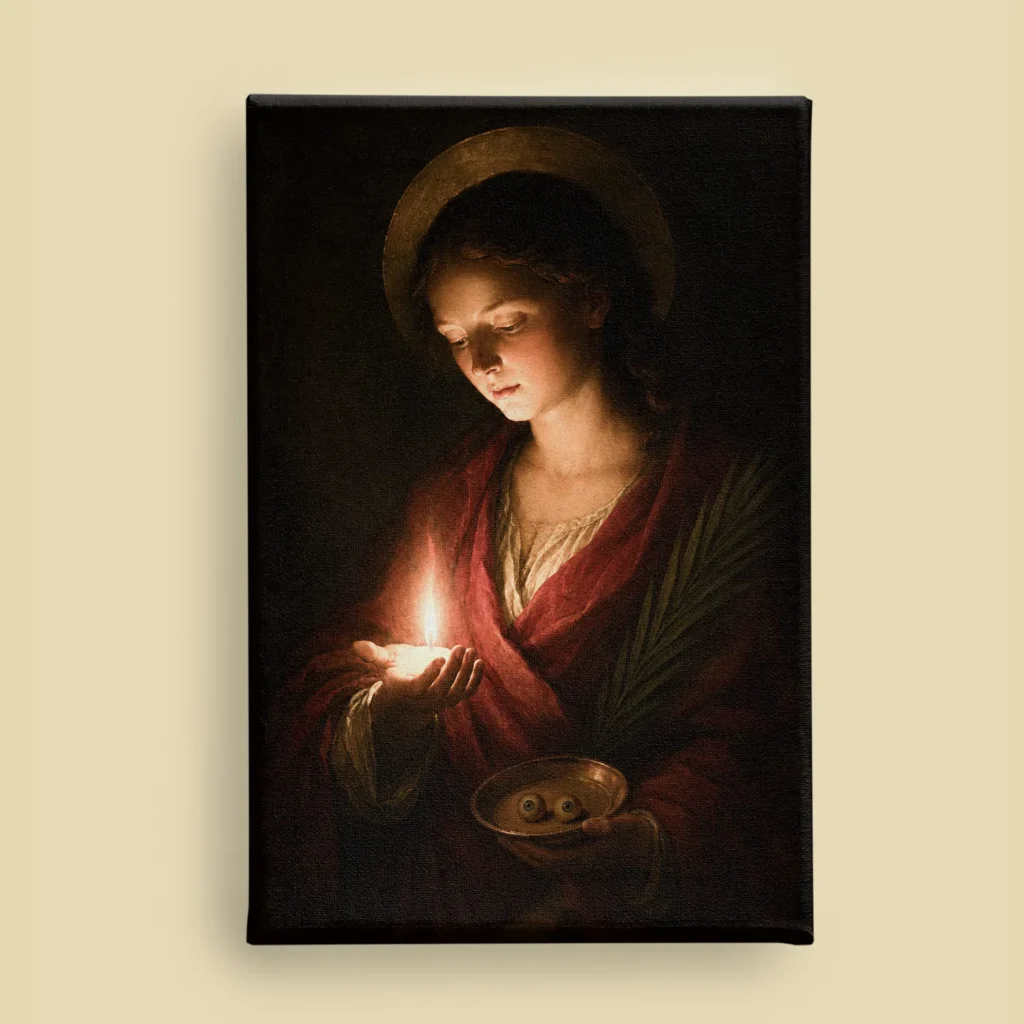
Domenico Veneziano Paintings and His Revolutionary Light
Domenico Veneziano (c. 1410–1461) was one of the most influential and least-known figures of the Florentine Early Renaissance. Born in Venice, he spent most of his working life in Florence, where he contributed something entirely new to the tradition of Italian sacred painting: a system of unified outdoor light, pale, diffused, almost noon-quality, that replaced the gold-ground hieratic space of earlier altarpieces with the continuous atmosphere of a sunlit loggia or a clear Italian sky. This innovation, achieved above all in his masterpiece the Santa Lucia de’ Magnoli Altarpiece, had profound consequences for the development of Italian painting, influencing Piero della Francesca, who trained in his workshop, and through him the entire tradition of Umbrian and central Italian painting.

Domenico’s surviving works are few, a handful of panels and a letter that attests to his presence in Perugia and Florence, but their quality is consistently exceptional. He is documented working alongside the young Piero della Francesca on a fresco cycle in Florence that is now lost, and his influence on Piero’s color and light is one of the most important transmissions in the history of Italian Renaissance painting. Domenico brought to Florence the Venetian understanding of color and atmosphere and fused it with the Florentine tradition of formal clarity and architectural order, producing a synthesis that briefly lit up the history of sacred painting before he died in obscurity in 1461.
Adoration of the Magi

This small tondo, now in the Gemaldegalerie in Berlin, is one of Domenico’s earliest surviving works and one of the most beautiful examples of the Adoration of the Magi in Florentine Early Renaissance painting. The circular format, rare in Italian altarpiece painting but common in Florentine domestic art, contains the procession of the Magi approaching the Holy Family in a rocky landscape of delicate atmospheric beauty. The figures’ costumes are rendered with the precise, almost Northern European attention to material culture that Domenico brought from Venice, and the quality of the light, cool, clear, diffused, already prefigures the innovations of his great altarpiece.
Madonna and Child

This Madonna and Child in the National Gallery of Art in Washington shows Domenico’s approach to the intimate devotional format. The Virgin holds the Christ Child with the physical naturalness that the Florentine tradition demanded, and the pale, clear color, the blond warmth of the flesh tones, the cool blue of the mantle, already reflects the distinctive palette that would define the Santa Lucia Altarpiece. The figure style, with its delicate modeling and gentle expression, reflects Domenico’s synthesis of Venetian softness and Florentine formal clarity.
Martyrdom of Saint Lucy

The Martyrdom of Saint Lucy, a predella panel from the Santa Lucia de’ Magnoli Altarpiece now in the Gemaldegalerie in Berlin, shows the execution of Saint Lucy, the fourth-century martyr who remains one of the most beloved saints of the Christian tradition. Lucy is stabbed in the throat with a sword after a failed attempt to move her body through supernatural intervention; Domenico renders the moment of martyrdom with a controlled emotional directness that avoids both theatrical violence and saccharine sentimentality. The clear outdoor light, the pale ground, and the elegant figure of the saint make this one of the most beautiful predella panels of the fifteenth century.
Saint Francis Receiving the Stigmata

Saint Francis Receiving the Stigmata in the National Gallery of Art is another predella panel from the Santa Lucia Altarpiece, showing the moment when the crucified Seraph appears to Francis on Mount La Verna and imprints the wounds of Christ on his body. Domenico renders Francis in the rocky wilderness in his characteristic pale outdoor light, the landscape almost lunar in its clarity, the saint’s figure small against the great rock formation, his arms slightly open in the posture of reception. The panel’s combination of physical precision and spiritual intensity is characteristic of Domenico at his most accomplished.
Saint John the Baptist in the Wilderness

Saint John the Baptist in the Wilderness, also from the Santa Lucia Altarpiece predella, shows the young Baptist in the desert landscape, divesting himself of his rich garments in the act that signifies his renunciation of the world. Domenico renders the moment of undressing, John has one foot raised, pulling off his shoe, with the physical specificity and grace that characterize his figure style. The desert landscape, seen in the same clear, pale light that fills all the predella panels, has a quality of spiritual emptiness that perfectly suits the Baptist’s preparation for his prophetic mission.
Santa Lucia de’ Magnoli Altarpiece

The Santa Lucia de’ Magnoli Altarpiece in the Uffizi Gallery is Domenico Veneziano’s masterpiece and one of the most historically significant paintings of the Florentine Renaissance. Painted around 1445–47 for the church of Santa Lucia de’ Magnoli in Florence, it shows the Madonna and Child enthroned in a marble loggia with Saints Francis, John the Baptist, Zenobius, and Lucy arranged symmetrically around them, a sacra conversazione in a unified space flooded with outdoor light. What was unprecedented was the quality of the light itself: not the gold of the traditional Byzantine icon or the warm interior light of a Masaccio, but the pale, diffused clarity of a real Italian day. The shadows are soft, the colors pale and saturated simultaneously, the whole space coherent in a way that had never been achieved before. It was this painting that Piero della Francesca absorbed and developed into the monumental achievements of his own career.
The Annunciation

The Annunciation in the Fitzwilliam Museum in Cambridge is another predella panel from the Santa Lucia Altarpiece, showing the angel Gabriel and the Virgin Mary in a walled garden, the hortus conclusus, symbol of the Virgin’s purity, separated by a garden gate through which they regard each other. The composition is of an almost architectural simplicity: two figures, a wall, a gate, a sky of pale clarity. Within this economy Domenico creates an image of extraordinary power. The spatial recession of the garden walk, the quality of the light falling on the wall and ground, and the perfect balance between Gabriel’s kneeling approach and Mary’s contemplative response make this one of the most beautiful and influential Annunciations in Italian painting.
Summary Table
| Name | Date | Medium | Location |
|---|---|---|---|
| Adoration of the Magi | c. 1439–1441 | Tempera on panel | Gemaldegalerie, Berlin |
| Madonna and Child | c. 1445 | Tempera on panel | National Gallery of Art, Washington |
| Martyrdom of Saint Lucy (predella) | c. 1445–1447 | Tempera on panel | Gemaldegalerie, Berlin |
| Saint Francis Receiving the Stigmata (predella) | c. 1445–1447 | Tempera on panel | National Gallery of Art, Washington |
| Saint John the Baptist in the Wilderness (predella) | c. 1445–1447 | Tempera on panel | National Gallery of Art, Washington |
| Santa Lucia de’ Magnoli Altarpiece | c. 1445–1447 | Tempera on panel | Uffizi Gallery, Florence |
| The Annunciation (predella) | c. 1445–1447 | Tempera on panel | Fitzwilliam Museum, Cambridge |
Important Facts About Domenico Veneziano
- Domenico Veneziano (c. 1410–1461) was born in Venice but spent most of his working life in Florence, bringing Venetian sensibility to color and atmosphere into the Florentine Early Renaissance tradition.
- His Santa Lucia de’ Magnoli Altarpiece (c. 1445–47) in the Uffizi introduced a new system of unified outdoor daylight to Italian altarpiece painting, a revolutionary contribution that influenced an entire generation of painters.
- Piero della Francesca trained in his workshop, and Domenico’s pale, diffused light and cool color became the foundation on which Piero built one of the greatest achievements in the history of painting.
- Only a handful of works are attributed to him with certainty, he is one of the most important painters of the Early Renaissance to survive through so few documented works.
- The story, spread by Vasari, that he was murdered by Andrea del Castagno out of professional jealousy, is false: records show that Castagno predeceased Domenico by four years.
Frequently Asked Questions
Who was Domenico Veneziano?
Domenico Veneziano (c. 1410–1461) was a Venetian-born painter who worked primarily in Florence and is regarded as a pioneer of unified outdoor light in Italian Renaissance altarpiece painting. His Santa Lucia de’ Magnoli Altarpiece revolutionized the sacra conversazione format and deeply influenced Piero della Francesca, who trained in his workshop.
What is the Santa Lucia de’ Magnoli Altarpiece?
Painted around 1445–47 for the church of Santa Lucia de’ Magnoli in Florence, now in the Uffizi, the Santa Lucia Altarpiece shows the Madonna and Child enthroned with four saints in a unified architectural space flooded with outdoor daylight. It is historically significant as one of the first Italian paintings to use a single, coherent outdoor light source to unify the entire composition, an innovation of enormous consequence for the development of Italian painting.
How did Domenico Veneziano influence Piero della Francesca?
Piero della Francesca trained in Domenico Veneziano’s workshop in Florence in the early 1440s and directly absorbed Domenico’s innovation of pale, diffused outdoor light and cool, saturated color. Piero developed these principles into his own monumental style of geometric precision and metaphysical stillness, one of the greatest achievements in Western painting, and the debt to Domenico is visible throughout his career.
Is the story of Domenico Veneziano’s murder true?
No. Giorgio Vasari’s story that Domenico was murdered by the jealous Andrea del Castagno is false: archival research shows that Castagno died in 1457, four years before Domenico in 1461. The story reflects Vasari’s habit of dramatizing the lives of artists rather than any historical fact.
Where can I see Domenico Veneziano’s paintings?
His masterpiece, the Santa Lucia de’ Magnoli Altarpiece, is in the Uffizi Gallery in Florence. Predella panels from the same altarpiece are in the Gemaldegalerie in Berlin (Martyrdom of Saint Lucy) and the National Gallery of Art in Washington (Saint Francis Receiving the Stigmata, Saint John the Baptist in the Wilderness, and the Annunciation is in the Fitzwilliam Museum in Cambridge). A tondo with the Adoration of the Magi is also in Berlin.
Where can I buy a Domenico Veneziano painting reproduction?
The shop at jesuschrist.pictures offers museum-quality canvas reproductions of the great Christian paintings, and the collection keeps growing; it is the best place to look for a Domenico Veneziano painting reproduction.