The Last Supper by Leonardo da Vinci: Composition, Symbolism and Controversies
This article is accompanied by a short podcast episode that offers an audio overview of the main themes and artworks discussed below.
There is a small room in Milan that draws more visitors per year than almost any other site in Italy. The queue outside the Convent of Santa Maria delle Grazie can stretch for hours. Entry is timed. You get fifteen minutes. And then you stand in front of a wall painting that is, by any technical measure, in a state of permanent decay, and somehow, despite everything, still one of the most arresting images in the history of Western art.
This is Leonardo da Vinci’s Last Supper. It was painted between 1495 and 1498. It has been damaged by moisture, overpainted by restorers who made things worse, bombed during the Second World War (the wall survived; the roof did not), and debated for five centuries. None of it has diminished what Leonardo put there.
This article is a close reading of what he actually did (the composition, the figures, the symbolism, and the controversies) alongside the broader tradition of Last Supper painting that preceded and followed him. If you want to explore that tradition further, our gallery of Last Supper paintings through art history brings together the major works in one place.

The Commission and Its Unusual Technique
Leonardo received the commission from Ludovico Sforza, Duke of Milan, as part of a renovation of the convent’s refectory: the dining hall where the Dominican monks ate their meals. The choice of subject was deliberate: a scene of a sacred meal painted on the wall of a room where men ate in silence, contemplating the Scriptures. The painting was meant to extend the room, to make the monks feel, at least imaginatively, that they were seated at the same table.

What makes the technical history of the painting so interesting, and so tragic, is the technique Leonardo chose. Traditional fresco required painting on wet plaster, working quickly before it dried. Leonardo was not a quick worker. He was notoriously slow, returning to a face or a hand over days or weeks, making adjustments that fresco could not accommodate. So he devised his own method: a base of pitch and gesso on the dry stone wall, with layers of tempera and oil paint on top.
It did not hold. Within twenty years of its completion, the paint had begun to flake. By the seventeenth century, visitors were already describing it as a ruin. The irony is that Leonardo’s obsession with getting it right is precisely what condemned it to deteriorate. The painting we see today, even after the most recent restoration completed in 1999, is partly Leonardo’s work and partly centuries of accumulated damage and repair.
The Composition: A Room Within a Room
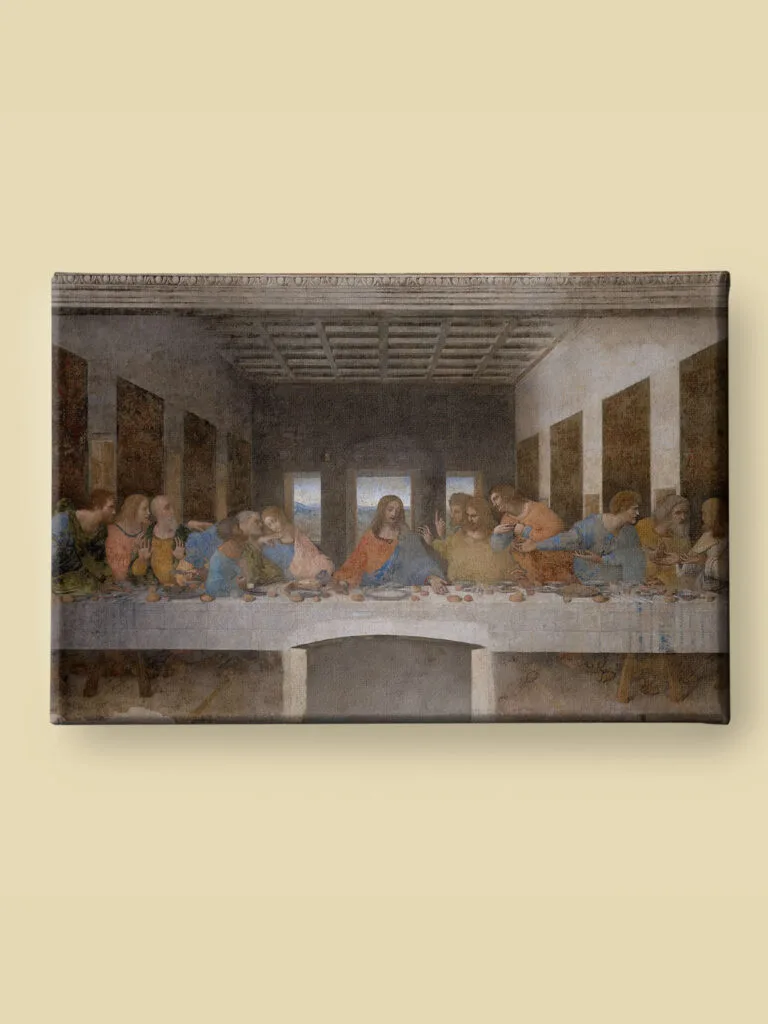
Stand where the monks stood, at the far end of the refectory, and the painting does something remarkable: it appears to continue the actual architecture of the room. The coffered ceiling of the painted space aligns with the real ceiling. The tapestries on the walls echo the ones hanging beside the painting. The perspective is calibrated to a specific viewpoint (roughly two metres above the floor, at the centre of the room) and from that position, the painted space reads as a genuine extension of the physical one.

At the centre of all this is Christ. Every perspective line in the painting converges at a single vanishing point directly behind his head, surrounded by the light of the window. This is not accidental. Leonardo is using the mechanics of Renaissance perspective, a purely mathematical system, to make a theological argument: everything in the world, every sight line, every converging line of architecture and geometry, points toward this figure.
Around Christ, Leonardo has arranged the twelve apostles in four groups of three, each group forming its own internal drama while simultaneously responding to the moment of crisis at the centre: the announcement that one of them will betray him.
The Apostles, Group by Group
Bartholomew, James the Less, and Andrew (far left)
The three figures on the far left are still processing the announcement. Bartholomew has leapt to his feet, pressing his hands on the table; James leans forward in shock; Andrew raises his hands in a gesture that might be horror, or might be an attempt to calm the others. They are the furthest from the moment and the most bewildered by it.

Judas, Peter, and John (second group from left)
This is the compositional and dramatic heart of the painting. John, traditionally depicted as a young man and often shown asleep at Christ’s shoulder in earlier versions of the scene, is here leaning away from Peter, his eyes downcast. He is either faint or composed: it is genuinely difficult to say which.
Peter is leaning across him, holding a knife that will later appear in Gethsemane, whispering something urgent into John’s ear. And in the space between these two, almost lost in shadow: Judas. He is pulling back, his face darker than the others, his hand reaching toward the bread on the table. He holds a small bag: the thirty pieces of silver, or perhaps the communal purse he managed for the group. This is the only figure who already knows what is about to happen.
The spilled salt cellar in front of Judas (visible in early copies of the painting, though now largely lost from the deteriorated original) has been read as a symbol of bad luck and betrayal.

Christ
Alone in the centre, framed by the window and the light behind him, Christ has just spoken the words. His hands rest open on the table, one pointing toward the bread, the other toward the wine: an anticipation of the Eucharist that will follow. His face is lowered, eyes cast down. There is no anger, no triumph, no drama in his expression. Just a kind of foreknowledge that has already moved past the moment of revelation.
The triangle formed by his figure, a geometric shape that Leonardo uses throughout the painting, was traditionally associated with the Holy Trinity.

Thomas, James the Greater, and Philip (second group from right)
Thomas raises his finger: a gesture that will return, famously, when he doubts the Resurrection. James the Greater throws his arms wide in what reads as pure disbelief. Philip, leaning forward with his hands on his chest, appears to be asking: Is it me? Could it be me? He is the one most visibly seeking reassurance.

Matthew, Thaddaeus, and Simon (far right)
The three figures at the far right are arguing among themselves, gesturing back toward Christ, trying to make sense of what has been said. Matthew turns toward Thaddaeus and Simon with his hands spread open: he is either asking for their interpretation or reporting what he has heard. The conversation is already beginning before the shock has fully landed.

The Symbolism: What is Actually on the Table
There has been a great deal written about the hidden symbolism of the Last Supper, not all of it reliable. What can be said with confidence is this:
The bread and wine on the table carry an obvious Eucharistic charge: this is, after all, the moment before the institution of the sacrament. Leonardo paints them as ordinary objects, not yet elevated, which is part of the painting’s tension: the sacred is here, in this room, at this table, but it has not yet been declared.
The fish, which appears in some early copies of the painting and which some historians believe was present in the original, would carry additional symbolic weight in a Christian context. The ichthys symbol, the fish as a sign of Christ, was well established by the fifteenth century.
Then there is the food on the plates. After the 1999 restoration brought new details into view, scholars noticed something unexpected: the dishes appear to contain not bread or lamb, what a Passover meal would historically have included, but what looks like grilled eel, garnished with slices of citrus fruit. The art historian John Varriano, who studied the plates closely, identified the dish as eel and noted that a recipe for it appears in a Renaissance cookbook that Leonardo had in his library.
This is a quiet anomaly that says something interesting about what Leonardo was doing. Eel is not kosher. There is no biblical precedent for it at the Last Supper. And in Italian, the word aringa, close to the word for eel, means indoctrination, while renga, the northern Italian word for herring, refers to someone who denies religion. Whether Leonardo intended these word games or whether he simply updated the menu to reflect Renaissance Milanese tastes is impossible to say. But it is precisely the kind of detail (visually subtle, symbolically loaded, historically incongruous) that keeps scholars returning to this painting five centuries later.

The hands, as the original article noted, are among the most carefully designed elements. Leonardo was a compulsive student of human gesture. Each pair of hands in this painting is different: open, closed, raised, pressed down, pointing, reaching. They function almost as a separate visual narrative running alongside the figures.

The Da Vinci Code Controversy: Is That John, or Mary Magdalene?
In 2003, Dan Brown’s novel The Da Vinci Code popularised a theory that had been circulating at the fringes of art history for decades: that the figure traditionally identified as John, seated to Christ’s right, is in fact Mary Magdalene, and that her presence constitutes a hidden message about her relationship with Christ.

The argument rests on the figure’s appearance. John is depicted here as distinctly feminine (soft features, long hair, a delicate frame) in contrast to the more rugged apostles around him. This, the theory goes, is not because Leonardo was following the convention of depicting John as a young and beardless man (which he was: this convention goes back to early Christian art) but because the figure is actually a woman.
Art historians have not taken this seriously as a factual claim. The feminised depiction of John is well documented in Italian Renaissance painting long before Leonardo. But as a question about what Leonardo was doing (whether he was deliberately creating ambiguity, or whether the androgyny of the figure is simply a consequence of his aesthetic preferences, visible also in the Saint John the Baptist in the Louvre) it is not entirely without interest.
What the Da Vinci Code controversy did, usefully, was draw attention to how strange and deliberate the figure of John actually is. He leans away from Christ, toward Peter, eyes closed. In earlier versions of the scene (in Ghirlandaio’s Last Supper, for example, painted a few years before Leonardo’s) John is asleep on Christ’s shoulder, in a posture of intimate devotion. Leonardo has separated them. John is alone in his composure, while everyone around him reacts.
Why This Painting Survived Its Own Destruction
During the Second World War, on the night of 15 August 1943, Allied bombing destroyed the roof of the refectory. The walls remained standing. The painting, which had been protected by sandbags and bracing, survived: exposed to the open sky for three years, but intact enough to be restored.
This story has become part of the painting’s mythology, and perhaps rightly so. The Last Supper has survived its own technique, centuries of incompetent restoration, Napoleonic soldiers who used the refectory as a stable, and aerial bombardment. It is, at this point, less a painting than a record of survival.

The Other Last Suppers
Leonardo’s version is so dominant in the cultural memory that it is easy to forget how many extraordinary paintings have taken up the same subject. Tintoretto’s version at San Trovaso in Venice moves the scene into a bustling tavern, with servants and cats scrambling at the margins. Rubens gives it Baroque grandeur. Champaigne brings a French restraint that is almost Protestant in its severity.
Each of these painters was responding to Leonardo: agreeing with certain choices, arguing with others, solving the compositional problem differently. The result is one of the richest traditions in Western religious art.
You can explore thirteen of the most important Last Supper paintings, from the Italian Renaissance through the Baroque, in our dedicated article: 13 Most Famous Jesus Last Supper Paintings. And if you want to see them gathered together visually, our Last Supper paintings gallery brings the major works into one place.
For a broader view of how Christ has been depicted across the history of painting, the article on the most famous Jesus paintings traces the major works from the medieval period to the twentieth century.
The Cultural Afterlife
The painting has been reproduced, parodied, appropriated, and referenced so many times that it has become something close to a visual grammar: a compositional template that can be loaded with almost any meaning. Twelve figures at a long table, one at the centre, a moment of revelation or crisis: the structure is immediately legible even when the content is entirely secular.

Dalí used it in his 1955 Sacrament of the Last Supper, placing the scene inside a geometric crystal and framing Christ against a transparent body. Andy Warhol made his own version. Banksy has referenced it. The composition appears in films, television, advertising, political cartoons, and memes with such regularity that most people recognize it instantly even without knowing the original.
This cultural ubiquity is part of what makes it difficult to see the painting freshly. The image has become so familiar that the actual work (deteriorated, specific, carefully thought through) can disappear behind its own legend.
Which is one reason the fifteen minutes in Milan are worth the wait.

✦ Free Last Supper Coloring Page
Leonardo’s Last Supper is now a free coloring page: the long table, the twelve apostles in four groups of three, Jesus calm in the middle. It sits beside the real painting, with a short story for children, among twenty free Easter coloring pages and a printable booklet.
Frequently Asked Questions
Who painted The Last Supper?
The Last Supper was painted by Leonardo da Vinci between 1495 and 1498. It was commissioned by Ludovico Sforza, Duke of Milan, for the refectory of the Convent of Santa Maria delle Grazie in Milan.
Where is The Last Supper painting located?
The Last Supper is located in the former refectory of the Convent of Santa Maria delle Grazie in Milan, Italy. It is a UNESCO World Heritage Site. Timed entry tickets are required and must be booked in advance.
What technique did Leonardo da Vinci use for The Last Supper?
Leonardo used a mixed technique of tempera and oil paint on a prepared gesso and pitch ground applied to the dry stone wall, not traditional fresco, which required painting on wet plaster. This experimental method allowed him to work slowly and make revisions, but it proved unstable, and the painting began deteriorating within decades of its completion.
How many apostles are in The Last Supper?
There are twelve apostles in The Last Supper, arranged in four groups of three on either side of Christ. From left to right: Bartholomew, James the Less, Andrew, Judas, Peter, John, Christ, Thomas, James the Greater, Philip, Matthew, Thaddaeus, and Simon.
Who is Judas in The Last Supper?
Judas is the fourth figure from the left, partially in shadow, leaning back from the table while the others lean forward. He holds a small bag, traditionally interpreted as the thirty pieces of silver, and his hand reaches toward the bread. A spilled salt cellar in front of him, visible in early copies of the painting, has long been read as a symbol of betrayal.
Is Mary Magdalene in The Last Supper?
No. The figure sometimes claimed to be Mary Magdalene by proponents of theories popularised by Dan Brown’s The Da Vinci Code is John the Apostle, traditionally depicted as young and beardless in Italian Renaissance painting. There is no credible art-historical evidence that Leonardo intended this figure to represent anyone other than John.
Why is The Last Supper deteriorating?
Because Leonardo painted on dry wall rather than wet plaster, the paint layers did not bond permanently with the surface and began to flake within decades. Centuries of moisture, poor restoration attempts, and the removal of a doorway through the lower centre of the painting (destroying the feet of Christ and several apostles) have compounded the damage. The most recent major restoration, completed in 1999, stabilised what remained.
Where can I buy a reproduction of The Last Supper on canvas?
You can buy a reproduction of The Last Supper on canvas at jesuschrist.pictures.Our Last Supper paintings reproductions includes several major versions of the scene (by Leonardo, Tintoretto, Rubens, Champaigne, and others) available as premium canvas prints.