The Art and Spirit of Renaissance Jesus Paintings Across Europe
Introduction
The Renaissance era, stretching approximately from the early 14th century to the late 17th century, represents one of the most remarkable periods in art history. Renowned for its transformative influence, the Renaissance was a cultural rebirth, drawing heavily from the classical antiquities of Greece and Rome. Artists of this epoch were driven by a renewed focus on humanism, a philosophical movement emphasizing human experience, emotion, and realism in artistic representation. Within this significant revival, paintings depicting Jesus Christ emerged as powerful and profound, providing rich insights into the spiritual and artistic consciousness of the time.
Renaissance depictions of Jesus were characterized by their diverse interpretations across European regions. Artists such as Leonardo da Vinci, Raphael, Jan van Eyck, Hieronymus Bosch, and El Greco each provided uniquely regional reflections of theological doctrines, social conditions, and artistic styles. This article embarks on a fascinating journey exploring these distinctive portrayals, from the balanced elegance and harmony of Italian Renaissance paintings to the intricate symbolism prevalent in Northern Renaissance art. Additionally, we will uncover how Dutch painters expressed emotional realism shaped by the Protestant Reformation, and how Spanish masters infused their canvases with profound spirituality driven by the fervor of the Catholic Counter-Reformation.
By delving into these regional variations, readers will better appreciate not only the artistic mastery but also the underlying spiritual and cultural influences shaping these magnificent works. To deepen your understanding further, you can explore other articles about specific periods, such as the insightful journey into Byzantine Jesus Paintings, or the emotionally charged Gothic Jesus Paintings. Each exploration illuminates a different facet of Christ’s portrayal through the centuries.
Jesus Paintings during Italian Renaissance
The Italian Renaissance, stretching from approximately 1300 to 1600, marked an unprecedented revival of classical philosophy, art, and culture, rooted in the humanist belief that humanity is inherently capable of greatness. Artists in Italy sought to represent human figures, including Christ, with an idealized beauty based on classical antiquity and meticulous anatomical studies. These paintings are notable for their use of perspective, balanced compositions, realistic human anatomy, and dramatic use of chiaroscuro, a sophisticated interplay of light and shadow aimed at creating a striking three-dimensional effect.
One of the most emblematic Italian Renaissance depictions of Jesus is undoubtedly The Last Supper by Leonardo da Vinci (1495-1498). Painted directly onto the walls of the Convent of Santa Maria delle Grazie in Milan, this mural dramatically captures the moment Christ announces his impending betrayal. Leonardo masterfully conveys human emotion and divine serenity through a harmonious composition, clear spatial perspective, and meticulously nuanced expressions. The careful arrangement and emotional resonance of the figures showcase both Leonardo’s scientific approach to anatomy and his profound philosophical exploration of human psychology.


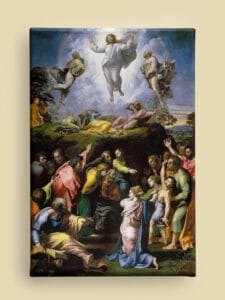
Raphael’s Transfiguration (1516-1520), housed in the Vatican Museums, is another masterpiece capturing Jesus’ divine nature. Raphael ingeniously juxtaposes Christ’s serene divinity during his transfiguration with the emotional turmoil of his apostles below. The painting exemplifies idealized beauty, symmetry, and clarity typical of the High Renaissance style. Its composition emphasizes spiritual and physical realms simultaneously, reflecting Renaissance ideals of balance, harmony, and theological depth.

Exploring these works not only highlights the artistic achievements of Renaissance Italy but also provides insight into the evolving theological interpretations of Christ.
To explore more deeply how Jesus was portrayed during this pivotal period, see our dedicated feature on Italian Renaissance Jesus paintings.
Jesus in Northern Renaissance Art: Realism and Symbolic Depth
The Northern Renaissance, flourishing primarily in regions such as present-day Belgium, Germany, and parts of France from the early 15th to the 16th century, differed significantly from its Italian counterpart. Northern artists meticulously combined heightened realism with profound symbolism, often reflecting complex theological narratives and intricate spiritual metaphors. Unlike the idealized beauty pursued in Italy, artists in the North aimed for precise, often microscopic accuracy in detail, using vibrant, luminous colors to amplify their symbolic meanings. Their religious works expressed deeper emotional intensity, intertwining religious narrative and personal devotion.
A paramount example of this approach is the famous Ghent Altarpiece (Adoration of the Mystic Lamb) by brothers Jan and Hubert van Eyck (1432). Located in Saint Bavo Cathedral, Ghent, this masterful polyptych astonishingly merges intense symbolism with hyper-realistic detail. At its center, Christ is symbolically represented as the divine sacrificial lamb, whose blood, vividly rendered in detail, symbolizes redemption and eternal life. Surrounding figures (saints, angels, and patrons) are depicted with remarkable clarity, each carrying distinct symbolic meanings. The altarpiece’s visual richness exemplifies Northern artists’ obsession with rendering both divine truths and human experiences in tangible realism.

Another masterpiece embodying Northern realism and emotional depth is Rogier van der Weyden’s The Descent from the Cross (1435), now in the Museo del Prado, Madrid. Van der Weyden portrays Christ’s lifeless body with dramatic emotional impact, highlighting human vulnerability and suffering. The anguish depicted on each figure’s face is meticulously detailed, evoking empathy and spiritual reflection from viewers. Unlike the serenity and harmonious proportions of Italian works, this painting’s emotional intensity and meticulous realism reflect Northern Europe’s unique devotional practices and contemplative spirituality.

These powerful depictions exemplify how Northern Renaissance art provided an intense emotional engagement with the divine, contrasting sharply with Italian artistic idealism.
To see how sacred themes were rendered with symbolic precision in the North, explore our guide to Northern Renaissance Jesus paintings.
Jesus in Dutch Renaissance Art: Emotion and Individual Spirituality
The Dutch Renaissance, occurring primarily throughout the late 15th and early 16th centuries, was heavily influenced by socio-religious shifts, notably the Protestant Reformation. These transformations deeply impacted artistic expression, leading Dutch painters to adopt a uniquely introspective and emotional style when depicting religious themes, especially portrayals of Jesus Christ. Rather than grand idealization or meticulous symbolism dominant in other regions, Dutch artists emphasized intense emotional realism, exploring individual spirituality, psychological depth, and human vulnerability.
Hieronymus Bosch’s haunting work, Christ Crowned with Thorns (circa 1495-1500), housed at the National Gallery in London, exemplifies the powerful emotional realism characteristic of Dutch Renaissance art. Bosch’s painting poignantly captures Christ’s profound suffering through stark facial expressions and exaggerated grotesqueries of the mocking figures. This depiction emphasizes psychological torment and human cruelty, evoking profound empathy from viewers. Bosch uniquely merges realism with surreal symbolic elements, reflecting his personal contemplation on human sinfulness and redemption. His unsettling imagery compels viewers to internalize Christ’s anguish, fostering deep personal reflection.


Lucas van Leyden, another Dutch master, created similarly introspective works, notably his engraving The Mocking of Christ (1520-1525), preserved at the Rijksmuseum in Amsterdam. In this piece, Christ is portrayed with remarkable psychological subtlety, revealing vulnerability and quiet endurance amidst torment. The engraving medium allowed for meticulous detail, intensifying the emotional weight of Christ’s suffering. Van Leyden’s detailed realism provides a deeply personal connection, reflecting Protestantism’s emphasis on individual relationship with the divine rather than institutional mediation.

Dutch Renaissance portrayals of Jesus, characterized by emotional intensity and introspective realism, thus mark a significant departure from both the idealized forms of Italy and the detailed symbolism of Northern Europe. Their unique artistic language reflects profound shifts in theological thought and devotional practices sparked by the Protestant Reformation.
Discover how Dutch artists blended human emotion with spiritual narrative in our overview of Dutch Renaissance Jesus paintings.
Jesus in Spanish Renaissance Art: Mysticism and Emotional Drama
During the Spanish Renaissance, roughly spanning the late 15th through early 17th centuries, religious art was profoundly shaped by the fervent spiritual climate of Catholic Spain. Unlike the balanced and serene idealism prevalent in Italy or the meticulous realism of Northern Europe, Spanish painters focused heavily on mysticism, emotional drama, and spiritual intensity. This period coincided with the Counter-Reformation, a significant religious movement reinforcing Catholic orthodoxy and spirituality, which profoundly influenced artistic expression. Artists employed dramatic use of color, exaggerated proportions, stark lighting, and emotionally charged scenes, often aiming to elicit deep religious reflection and emotional engagement from viewers.
El Greco, originally from Crete but active primarily in Spain, epitomizes this intense spiritual expression. His painting Christ Carrying the Cross (circa 1580s), now in the Metropolitan Museum of Art in New York, perfectly encapsulates the emotional depth characteristic of Spanish Renaissance art. Christ’s elongated figure and upward gaze express profound sorrow mingled with divine acceptance. The dramatic contrast of shadow and light, characteristic of El Greco’s style, heightens the emotional tension, immersing viewers deeply in Christ’s suffering. This painting embodies the Spanish fascination with mysticism, emphasizing spiritual rather than physical reality, compelling the observer towards spiritual contemplation.

Another remarkable work by El Greco, The Holy Trinity (1577-1579), displayed in the Museo del Prado in Madrid, pushes further into mystical territory. The portrayal vividly visualizes complex theological ideas with dramatic expressionism, emotional intensity, and ethereal use of color and form. The figures, elongated and stylized, appear to transcend earthly reality, highlighting El Greco’s deep fascination with spiritual mysticism. This distinctly Spanish approach, dramatic and emotionally charged, contrasts vividly with more grounded portrayals of Christ seen elsewhere in Europe.


The Spanish Renaissance thus contributed a unique chapter to the artistic legacy of Jesus representations, deeply embedding emotional drama and spiritual fervor into its artworks.
For a closer look at how Spanish painters uniquely expressed faith through sacred art, visit our article on Spanish Renaissance Jesus paintings.
Comparing Renaissance Jesus Paintings : Regional Styles and Characteristics
As we’ve explored throughout this article, Renaissance portrayals of Jesus varied significantly across Europe, shaped profoundly by cultural, religious, and artistic contexts unique to each region. To fully appreciate these distinctions, let us now summarize and compare the artistic traits that set Italian, Northern, Dutch, and Spanish representations apart.
Italian Renaissance artists, heavily influenced by classical antiquity and humanism, aimed to achieve idealized beauty, symmetry, and proportional realism. Figures of Christ, as seen in works by Leonardo da Vinci and Raphael, reflect harmony and perfect anatomical proportions, utilizing techniques like chiaroscuro and linear perspective to create depth and realism. This approach emphasized Christ’s dual nature, fully divine yet humanly approachable.
Northern Renaissance art, primarily represented by Flemish masters like the Van Eyck brothers and Rogier van der Weyden, diverged distinctly. Instead of classical idealism, they emphasized meticulous detail, vibrant colors, and elaborate symbolism. Christ was portrayed realistically and emotionally, embedded in intricate visual symbolism reflecting deep theological meanings and personal devotional practices.
In contrast, Dutch Renaissance depictions, emerging from a context deeply affected by Protestantism, highlighted psychological introspection and emotional intensity. Painters such as Hieronymus Bosch and Lucas van Leyden depicted Christ with striking emotional realism, exploring personal spirituality and human vulnerability, diverging significantly from the idealism or symbolic intricacy of their contemporaries elsewhere.
Finally, Spanish Renaissance art, profoundly influenced by the Counter-Reformation, gravitated towards mysticism, spiritual intensity, and emotional drama. El Greco’s elongated figures, dramatic lighting, and ethereal atmospheres expressed deep spiritual truths and emotional depth, distinctively focusing on the mystical rather than physical realism.
Comparative Table of Renaissance Styles
| Characteristic | Italian Renaissance | Northern Renaissance | Dutch Renaissance | Spanish Renaissance |
|---|---|---|---|---|
| Main Artistic Focus | Classical Idealism & Humanism | Detailed Realism & Symbolism | Emotional Realism & Psychological Depth | Mysticism & Emotional Drama |
| Use of Color | Balanced, Harmonious | Rich, Vibrant, Symbolically Charged | Muted, Emotional Contrasts | Dramatic, Stark Contrasts |
| Figure Representation | Idealized, Anatomically Precise | Highly Detailed, Realistic | Realistic, Emotionally Expressive | Stylized, Elongated Forms |
| Techniques & Features | Perspective, Chiaroscuro, Symmetry | Symbolism, Meticulous Detail | Expressive Imagery, Psychological Realism | Dramatic Lighting, Mystical Imagery |
| Religious Context | Catholic Humanism, Balanced Spirituality | Catholic Devotion, Personal Piety | Protestant Individualism, Spiritual Reflection | Catholic Counter-Reformation, Spiritual Intensity |
This comprehensive comparison underscores how regional artistic traditions and religious contexts uniquely shaped each region’s portrayal of Jesus. For deeper exploration into specific styles that paved the way for these Renaissance interpretations, we invite you to explore our dedicated article on Byzantine Jesus Paintings, highlighting earlier influences on artistic representations of Christ.
Continue your journey through faith and art by exploring our Renaissance Jesus Paintings Gallery, featuring masterpieces that capture the divine beauty and humanity of Christ in the golden age of art.
Conclusion: The Timeless Legacy of Renaissance Depictions of Jesus
Throughout this journey across European Renaissance art, we’ve witnessed how profoundly cultural, theological, and regional contexts shaped the diverse portrayals of Jesus Christ. From the classical humanism of Italian artists to the intricate symbolism of Northern painters, from the emotional introspection in Dutch works to the mysticism and spiritual intensity of Spanish masters, each artistic tradition provides a unique lens through which we understand and reflect on the divine and human nature of Jesus. These variations enrich not only our appreciation of Renaissance artistry but also deepen our understanding of the historical, spiritual, and emotional landscape of this pivotal era.
These remarkable paintings remain powerful today, not merely as historical artifacts, but as timeless expressions of human spirituality and artistic achievement. Leonardo da Vinci’s balanced harmony, Jan van Eyck’s vibrant symbolism, Hieronymus Bosch’s emotional complexity, and El Greco’s dramatic mysticism all continue to speak profoundly to contemporary viewers. Each work invites contemplation, bridging centuries by reflecting universal themes of human experience, faith, and artistic pursuit of perfection.
Beyond artistic admiration, these paintings offer profound spiritual insights. They challenge viewers to contemplate not only theological interpretations but also the universal human condition : suffering, compassion, sacrifice, and redemption. In this way, Renaissance Jesus paintings remain vital and relevant, continually inspiring new generations to explore deeper meanings within their imagery.
As you continue your journey exploring sacred art, consider delving into earlier depictions that influenced Renaissance artists. Our comprehensive articles on earlier periods, such as Romanesque and Gothic Jesus Paintings, provide essential context to appreciate the Renaissance fully. Each step along this artistic and spiritual journey enhances our appreciation of humanity’s enduring quest to express the divine through art.
Table of Renaissance Jesus Paintings Mentioned in this Article
| Name of Painting | Artist | Date | Medium | Museum (with link) |
|---|---|---|---|---|
| The Last Supper | Leonardo da Vinci | 1495-1498 | Mural | Santa Maria delle Grazie |
| Transfiguration | Raphael | 1516-1520 | Oil on wood | Vatican Museums |
| Ghent Altarpiece (Adoration of the Mystic Lamb) | Jan & Hubert van Eyck | 1432 | Oil on wood | Saint Bavo Cathedral |
| The Descent from the Cross | Rogier van der Weyden | 1435 | Oil on panel | Museo del Prado |
| Christ Crowned with Thorns | Hieronymus Bosch | c.1495-1500 | Oil on panel | National Gallery, London |
| The Mocking of Christ | Lucas van Leyden | 1520-1525 | Engraving | Rijksmuseum, Amsterdam |
| Christ Carrying the Cross | El Greco | c.1580s | Oil on canvas | Metropolitan Museum of Art |
| The Holy Trinity | El Greco | 1577-1579 | Oil on canvas | Museo del Prado |
Frequently Asked Questions
- 1. What distinguishes Renaissance paintings of Jesus from earlier medieval depictions?
Renaissance paintings emphasize realism, perspective, anatomical precision, and emotional depth, contrasting with the symbolic and stylized portrayals common in medieval art. - 2. Why did Renaissance portrayals of Jesus differ significantly across European regions?
Variations in religious beliefs, cultural traditions, political contexts, and artistic influences in Italy, Northern Europe, the Netherlands, and Spain resulted in distinctly regional styles. - 3. How did the Protestant and Catholic Reformations influence depictions of Jesus during the Renaissance?
Protestantism influenced Dutch painters towards introspective and personal spiritual portrayals, whereas the Catholic Counter-Reformation inspired Spanish artists to emphasize mysticism and emotional intensity. - 4. Which painting techniques emerged or were perfected during the Renaissance that significantly impacted portrayals of Jesus?
Techniques like linear perspective, chiaroscuro (light and shadow contrasts), sfumato (soft blending of colors), and detailed realism transformed portrayals of Jesus into emotionally resonant and visually compelling works. - 5. Who are considered the most influential Renaissance artists in depicting Jesus, and why?
Leonardo da Vinci, Raphael, Jan van Eyck, Hieronymus Bosch, Lucas van Leyden, and El Greco significantly shaped Renaissance portrayals due to their pioneering techniques, emotional depth, and theological insight, each representing their unique regional style. - Where can I buy Renaissance Jesus paintings reproductions?
You can buy Renaissance Jesus paintings reproductions at jesuschrist.pictures, in our shop: the canvas reproduction comes in several sizes, ready to hang.