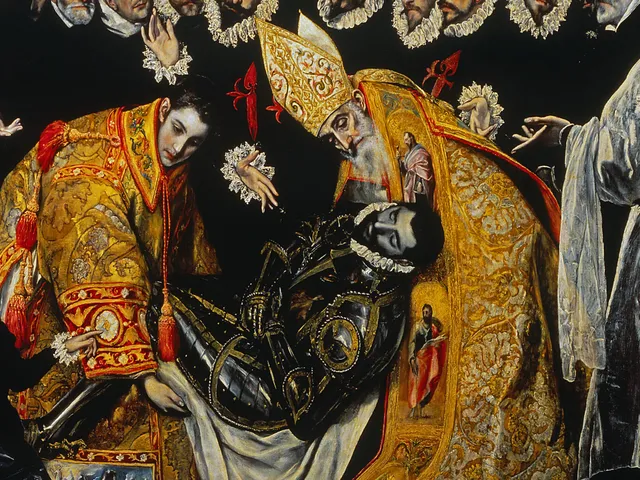
Leonardo da Vinci Paintings: Faith, Science, and the Sacred
Of all the painters who shaped the course of Christian art, few left a body of work as varied, as technically revolutionary, or as spiritually charged as Leonardo da Vinci. His Leonardo da Vinci paintings on religious subjects are not merely beautiful objects. They are arguments: painted propositions about how sacred figures look, how light falls, how the human body carries the weight of the divine. Born in 1452 near the Tuscan town of Vinci, Leonardo spent his working life in Florence, Milan, Rome, Venice, and finally France, and everywhere he went he changed what painting was capable of. This article takes you through his principal religious works: where they came from, what makes them remarkable, and why they still speak to us across five centuries.

Leonardo da Vinci, portrait by Attributed to Francesco Melzi
The Annunciation: Where Leonardo First Found His Voice
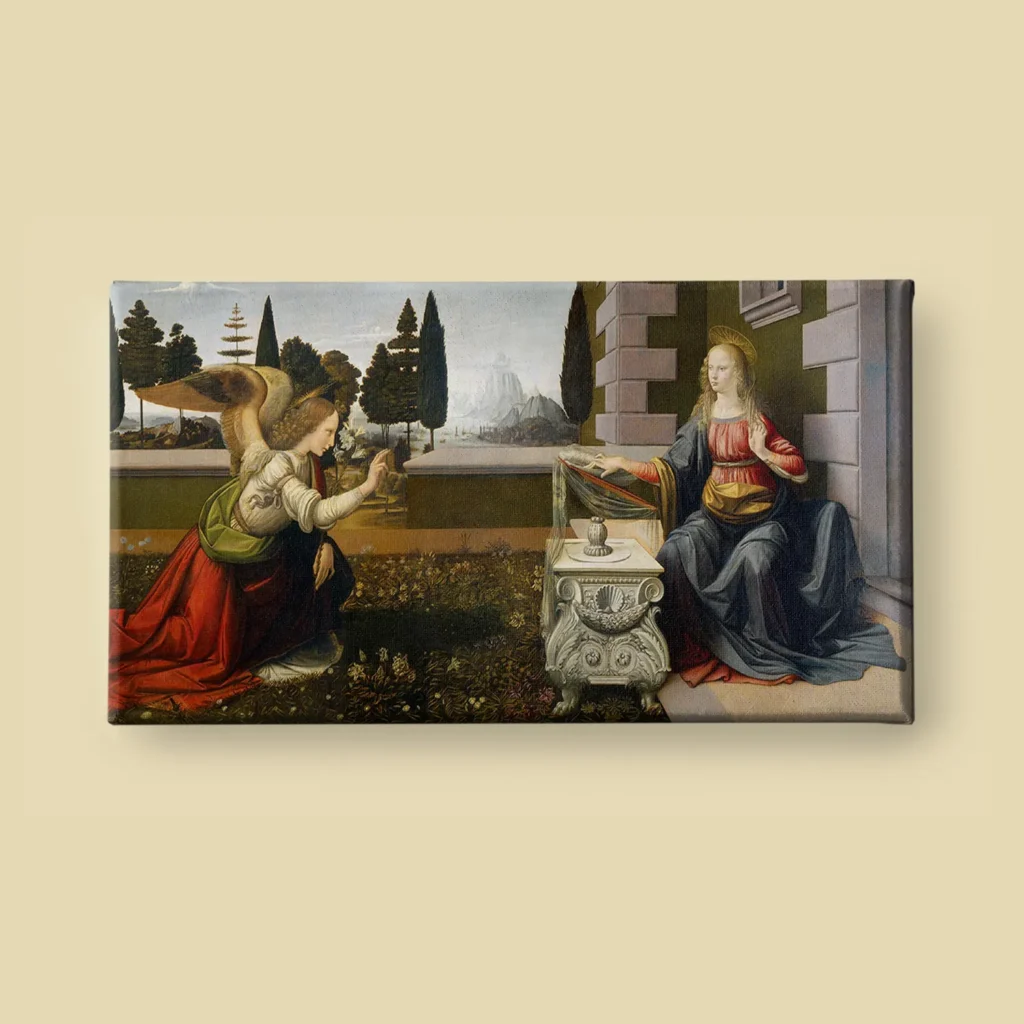
Painted around 1472 to 1476, while Leonardo was still apprenticed in Andrea del Verrocchio’s Florentine workshop, the Annunciation at the Uffizi Gallery is one of the earliest works attributable to him with confidence. It shows the Angel Gabriel kneeling in a garden, his wings spread wide. The Virgin Mary sits at her reading desk, her right hand raised in a gesture of calm acceptance. Nothing about this is especially new in iconographic terms. What sets Leonardo’s version apart is the quality of attention he brought to it.
The wings are painted feather by feather, with the precision of someone who had clearly studied real birds. The marble lectern at Mary’s side is rendered with sculptural care. And the landscape visible behind the figures, a river valley receding into blue-grey haze, already shows the atmospheric perspective technique Leonardo would develop more fully in later years. It is, unmistakably, the work of someone with an extraordinary eye. You can see how the Annunciation theme was handled by other Renaissance masters in our article on famous Annunciation paintings.

Annunciation by Leonardo da Vinci
The Baptism of Christ: A Story About Surpassing Your Master
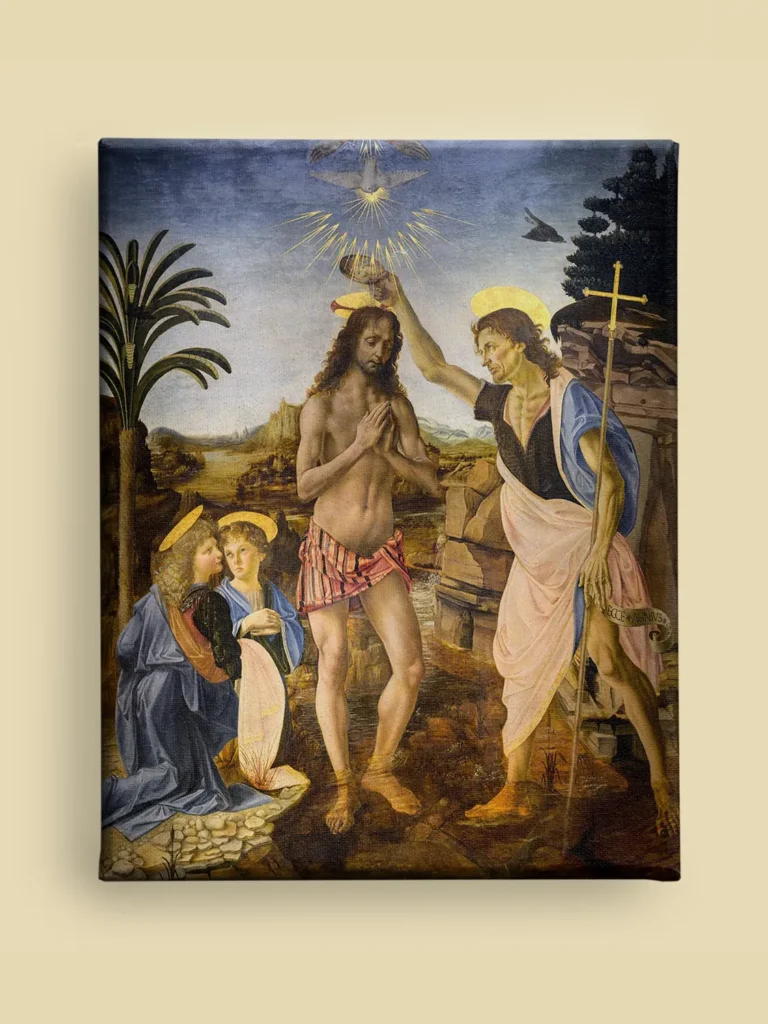
This large panel was painted primarily by Verrocchio, probably between 1475 and 1478, with significant contributions from Leonardo: most notably the angel on the far left and parts of the background landscape. Giorgio Vasari’s famous account, written half a century later, may be embellished, but its core claim is accurate. Verrocchio’s angel, on the right, is competent and handsome. Leonardo’s, on the left, has depth. The face is turned at a three-quarter angle that suggests thought behind it, and the paint has a luminosity that the rest of the panel cannot match.
Leonardo was working in oil here while Verrocchio used tempera, and the technical difference translates directly into a visual one. The Baptism of Christ hangs today in Hall A.35 of the Uffizi Gallery. Our broader survey of famous Baptism of Christ paintings places it in full historical context.

The Baptism of Christ by Leonardo da Vinci
Three Madonnas: Benois, Carnation, and Litta
Leonardo returned to the Madonna and Child theme repeatedly throughout his career. The three works discussed here come from different moments and represent different technical approaches. Each repays close looking.
The Benois Madonna (c. 1478-1480)
The Benois Madonna, now at the Hermitage Museum in Saint Petersburg, is among Leonardo’s earliest surviving oil paintings. The Virgin sits in a three-quarter view, holding a small plant with four white petals, almost certainly a crucifer, whose four-petaled form was associated in late medieval iconography with the cross. The Christ Child reaches toward it with the absorbed concentration of a real infant.
What is striking, beyond the intimacy of the gesture, is the light. It enters from a small arched window at upper left and falls on the two figures with a softness that has no precedent in earlier Florentine painting. The Virgin looks not at us but at her child, wholly absorbed. This quality of inward attention, a face whose thoughts we cannot read but whose emotional presence we feel, would become one of Leonardo’s signatures. Our article on beautiful Virgin Mary paintings traces the tradition to which these works belong.

Benois Madonna by Leonardo da Vinci
The Madonna of the Carnation (c. 1478-1480)
Painted at roughly the same time as the Benois Madonna and now in the Alte Pinakothek in Munich, this panel shows the Virgin holding a carnation, a flower whose pink variety was associated in Renaissance iconography with the Incarnation and with maternal love. The rocky landscape visible through the two arched windows is worth studying: it looks observed from nature, not invented, and anticipates the geological curiosity that would fill Leonardo’s notebooks for decades.

Madonna of the Carnation by Leonardo da Vinci
The Madonna Litta (c. 1490-1491)
This painting has generated more scholarly debate about attribution than almost any other work in the Hermitage collection. Most scholars today believe the execution was largely carried out by Leonardo’s pupil Giovanni Antonio Boltraffio, working from Leonardo’s composition. Whether Leonardo’s own hand appears in certain passages, particularly the face of the Virgin, remains an open question.
Attribution debates aside, the painting is visually powerful. The Madonna’s downward gaze, the Child’s upward look, and the gentle interplay of their hands create a circle of tenderness that is complete in itself. Its influence on later Milanese painting was considerable.

Madonna Litta by Leonardo da Vinci
The Adoration of the Magi: The Grandest Unfinished Work in Western Art
In 1481, the Augustinian monks of San Donato a Scopeto commissioned Leonardo to paint a large altarpiece. He accepted, began work, and within a year had left for Milan without finishing it. The monks eventually commissioned a replacement from Filippino Lippi.
What Leonardo left behind is now in room 15 of the Uffizi Gallery, and it is one of the most studied unfinished paintings in the world. The traditional Adoration was an orderly affair: kings, camels, attendants, the Holy Family in a stable. Leonardo threw all of that out. His composition places the Virgin and Child at the center of a pressing crowd so dense and agitated that the scene feels overwhelming. Ruins and rearing horses occupy the background. The Magi kneel not in dignified procession but as if physically compelled.
The underlying drawing, revealed by infrared reflectography, shows Leonardo revising constantly as he worked. The painting teaches us more about his process than any finished work could. Our article on Adoration of the Magi paintings shows how other artists handled this challenging subject.

Adoration of the Magi by Leonardo da Vinci
Saint Jerome in the Wilderness: Anatomy in Service of Faith
Another unfinished panel, probably dating from the early 1480s and now in the Pinacoteca Vaticana, shows Saint Jerome kneeling in a rocky landscape in an act of penitential self-flagellation, a lion resting at his feet. What makes this painting remarkable, even incomplete, is the anatomy. The muscles of Jerome’s neck and chest are rendered with a specificity that can only come from dissection, and Leonardo was conducting exactly such studies at this period. The incomplete state of the panel, with bare ground visible in patches, makes the anatomy even more legible than a finished surface would allow.

Saint Jerome in the Wilderness by Leonardo da Vinci
The Virgin of the Rocks: Light From an Unknown Source
Two versions of the Virgin of the Rocks exist. One is in the Louvre (painted in the early 1480s); the other is in the National Gallery in London (completed between 1495 and 1508). The Louvre version is generally considered the more powerful, and the one most fully by Leonardo’s own hand.
The composition has no clear Biblical precedent. The Virgin, the infant Christ, the infant Saint John the Baptist, and an angel gather in a dark grotto of stalactites and strange plants, in a world that feels neither fully natural nor supernatural. The light does not come from any identifiable source: it seems to emanate from the figures themselves. Leonardo’s sfumato technique is here in full force for the first time, blending tones so gradually that hard edges disappear entirely. The result is a scene of complete, troubling, beautiful mystery. It is one of the foundational works of Italian Renaissance painting and of the broader Renaissance Jesus painting tradition.

Virgin of the Rocks by Leonardo da Vinci
The Last Supper: The Most Celebrated Painting in Christian Art
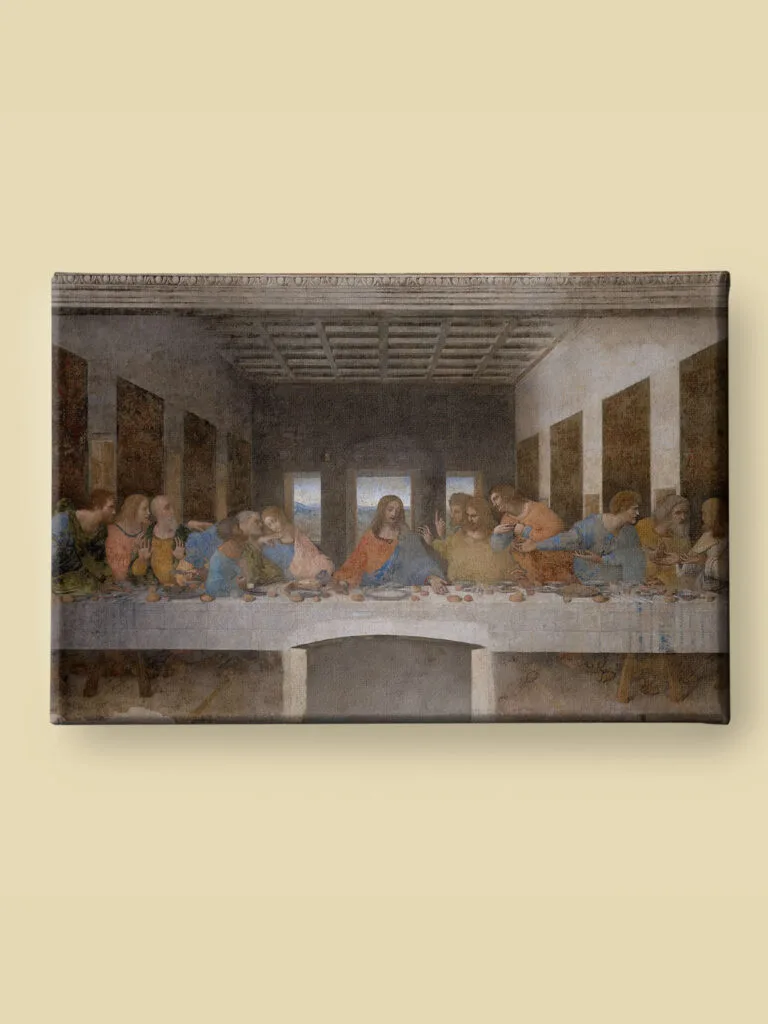
No other work by Leonardo, and arguably no other religious painting in the Western tradition, has been as widely reproduced, referenced, and argued over as the Last Supper. It covers the entire end wall of the refectory of Santa Maria delle Grazie in Milan, painted between 1495 and 1498, and it measures roughly nine by four and a half meters. It has been deteriorating almost since the day it was finished.
Leonardo chose not to use fresco, the technique standard for wall paintings, because fresco required working fast on wet plaster with no possibility of correction. He used tempera and oil on a dry prepared surface instead, which gave him time and precision but at the cost of durability. By the 16th century, visitors were already noting the damage. The most recent restoration, completed in 1999 after 21 years of work, stabilized what remained.
The subject is the moment in the Gospel of John when Christ announces that one of the twelve will betray him. Leonardo chose to capture the psychological shockwave of that announcement. Every apostle reacts differently: some lean forward, some draw back, some turn to their neighbors. Judas, clutching his bag of silver, is caught slightly in shadow but is not separated from the group as earlier painters had always done. Christ sits at the center in perfect stillness, arms spread wide. The perspective of the entire composition was calculated so that the painted table appears, from the refectory floor, to be a continuation of the room in which the monks ate their meals.
We have devoted a full article to this work: The Last Supper by Leonardo da Vinci. You can also trace the full iconographic tradition in our guide to the most famous Last Supper paintings.

The Last Supper by Leonardo da Vinci
The Virgin and Child with Saint Anne: A Late Meditation on Generations
This large panel, now in Room 710 of the Louvre, occupied Leonardo intermittently from around 1503 until close to his death in 1519. It shows three generations: Saint Anne, her daughter the Virgin Mary seated on Anne’s lap, and the infant Christ reaching down to embrace a lamb. The composition is unusual in that Mary, though an adult woman, sits in her mother’s lap, as if the Church (personified by Anne) supports the Mother of God even in maturity.
The pyramidal arrangement of the three figures is classically stable, but Leonardo filled it with subtle movement. The Virgin’s body twists as she reaches toward her son. Anne’s face carries that characteristic Leonardo smile that gives nothing away. Behind them stretches one of the most beautiful landscapes in his entire body of work: a world of grey-blue water, ice, and dissolving mountains that seems to exist beyond ordinary time and geography.

The Virgin and Child with Saint Anne by Leonardo da Vinci
Salvator Mundi: The World Record and the Debate Behind It
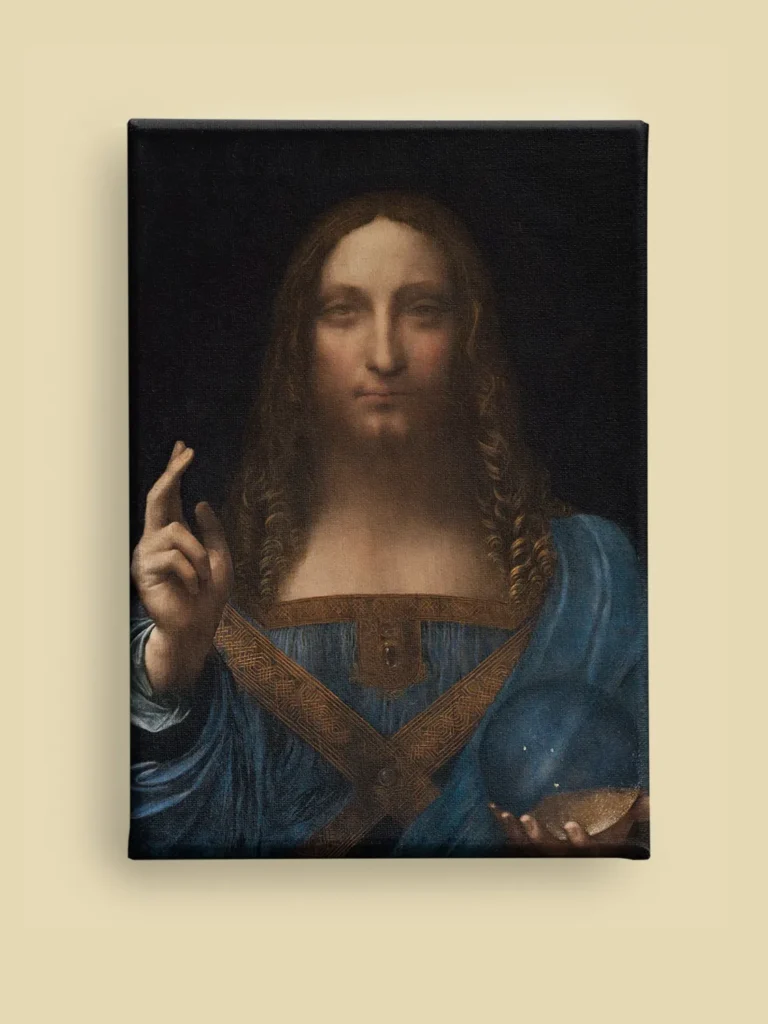
The Salvator Mundi (Saviour of the World) depicts Christ in a frontal pose, his right hand raised in benediction, his left holding a crystal orb. The painting re-entered public consciousness in 2011, when it was exhibited at the National Gallery in London as a fully authenticated Leonardo da Vinci, probably painted around 1499 to 1510. In November 2017, it sold at Christie’s New York for $450.3 million, the highest price ever paid for any painting.
The attribution has not been accepted universally. Some scholars argue for significant workshop involvement; others question whether Leonardo painted it at all. The crystal orb, which shows no optical distortion despite the fact that a solid glass sphere would invert the image behind it, has generated a substantial scientific commentary. Our dedicated article covers the full story: Salvator Mundi by Leonardo da Vinci.

Salvator Mundi by Leonardo da Vinci
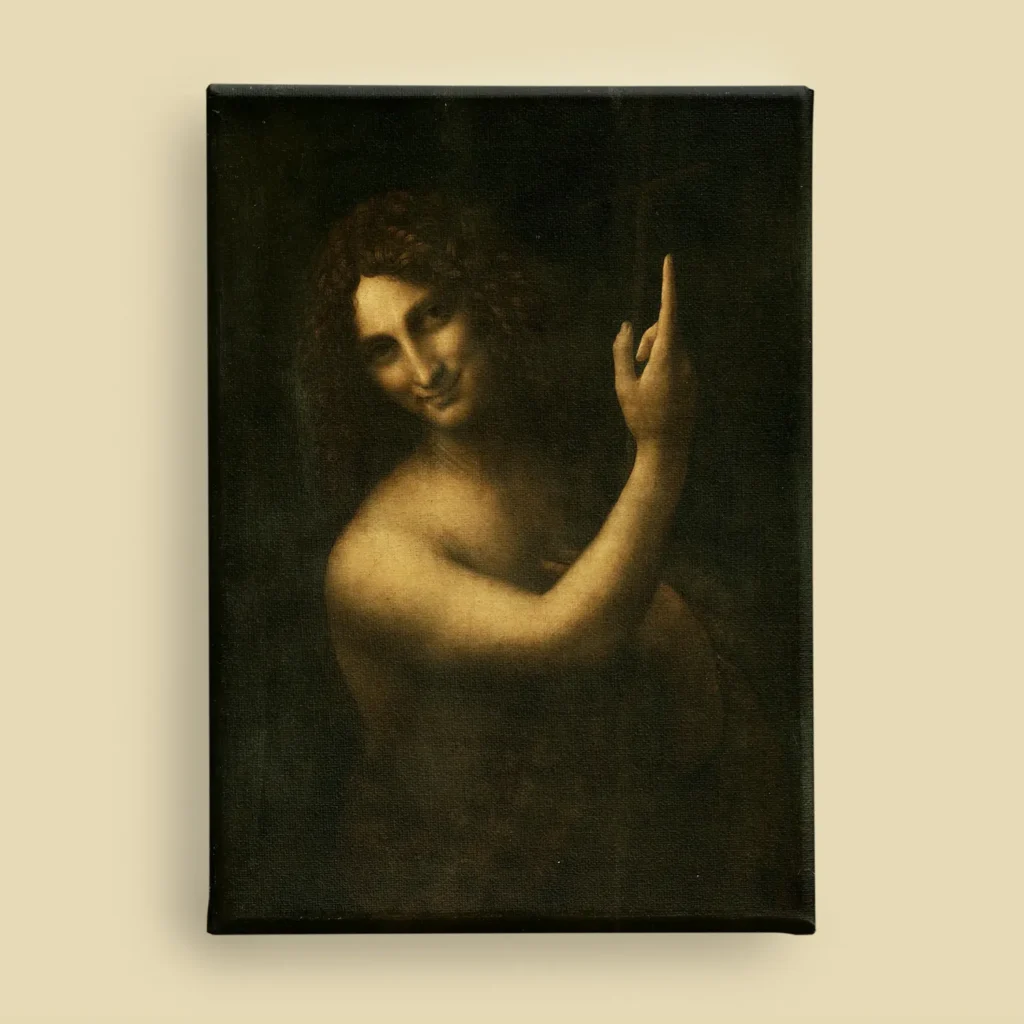
Saint John the Baptist: The Last and Strangest Work
Generally dated to 1513-1516, Saint John the Baptist in the Louvre is almost certainly the last completed painting Leonardo made. The figure emerges from an absolute black background, pointing upward with his right index finger. His expression is ambiguous in a way that has unsettled viewers for five centuries: the smile is gentle but impenetrable, the gaze carries something that resists being named.
John the Baptist was the forerunner of Christ, the prophet who announced the coming of the Messiah. Leonardo chose not to show him at the Jordan or in the wilderness. He shows him at the moment of pure prophetic declaration: the pointing finger, the gaze that looks beyond whatever stands in front of it. The figure’s androgynous quality, the soft skin and curling hair that recall the Virgin of the Rocks, has prompted endless commentary. What seems clear is that Leonardo was still, in his sixties, pushing painting toward something that had no prior name. Our article on Saint John the Baptist paintings places this work in full iconographic context.

Saint John the Baptist by Leonardo da Vinci
Summary of Leonardo da Vinci’s Religious Paintings
| Painting | Date | Medium | Museum |
|---|---|---|---|
| Annunciation | c. 1472-1476 | Oil and tempera on wood | Uffizi Gallery, Florence |
| The Baptism of Christ | c. 1475-1478 | Oil and tempera on wood | Uffizi Gallery, Florence |
| Benois Madonna | c. 1478-1480 | Oil on wood (transferred to canvas) | Hermitage Museum, Saint Petersburg |
| Madonna of the Carnation | c. 1478-1480 | Oil on wood | Alte Pinakothek, Munich |
| Adoration of the Magi (unfinished) | c. 1481-1482 | Oil, tempera, and white lead on wood | Uffizi Gallery, Florence |
| Saint Jerome in the Wilderness (unfinished) | c. 1480-1490 | Oil and tempera on walnut | Pinacoteca Vaticana, Vatican |
| Virgin of the Rocks | c. 1483-1486 | Oil on wood (transferred to canvas) | Louvre Museum, Paris |
| Madonna Litta | c. 1490-1491 (workshop) | Tempera on wood (transferred to canvas) | Hermitage Museum, Saint Petersburg |
| The Last Supper | c. 1495-1498 | Tempera and oil on plaster | Santa Maria delle Grazie, Milan |
| The Virgin and Child with Saint Anne | c. 1503-1519 | Oil on wood | Louvre Museum, Paris |
| Salvator Mundi | c. 1499-1510 (attribution debated) | Oil on walnut | Louvre Abu Dhabi |
| Saint John the Baptist | c. 1513-1516 | Oil on walnut | Louvre Museum, Paris |
Important Facts About Leonardo da Vinci
- Leonardo da Vinci was born on April 15, 1452, in Vinci, a small Tuscan town near Florence, the illegitimate son of a local notary named Ser Piero and a peasant woman named Caterina.
- At around age 14, he entered the Florence workshop of Andrea del Verrocchio, the leading sculptor and painter of the city, where he trained alongside Domenico Ghirlandaio, Pietro Perugino, and Lorenzo di Credi.
- Leonardo is the defining master of the Italian High Renaissance, recognized above all for his invention of sfumato, a technique of blending light and shadow without visible edges that gave his figures an unmatched sense of depth and inner life.
- His most celebrated work, The Last Supper, was painted between 1495 and 1498 on the refectory wall of Santa Maria delle Grazie in Milan, commissioned by Duke Ludovico Sforza.
- He died on May 2, 1519, at the Château du Clos Lucé in Amboise, France, in the service of King Francis I, and his direct influence on Raphael, Correggio, and the entire generation of High Renaissance painters was immediate and lasting.
Frequently Asked Questions
How many paintings by Leonardo da Vinci have survived?
Fewer than 20 paintings can be attributed to Leonardo with reasonable certainty, and scholars debate several of those. Only five to seven are considered fully secure attributions based on historical sources and technical analysis alone. The small number reflects not a lack of ambition but the extraordinary time he devoted to each work, often painting for years on a single panel, and the decades he spent on scientific and engineering projects alongside his art.
What makes Leonardo da Vinci’s religious paintings different from those of his contemporaries?
Two things set them apart immediately. First, the faces: Leonardo’s figures carry an interior life that earlier Renaissance painting rarely achieved, partly because he studied human anatomy, emotion, and gesture with scientific rigor. Second, the light: he developed sfumato to a degree no other painter of his century matched, which gives his sacred figures a softness and mystery that hard-edged tempera painting could not produce. Where his contemporaries showed saints and Madonnas, Leonardo showed people.
Where are Leonardo da Vinci’s religious paintings today?
The largest concentrations are at the Louvre in Paris, which holds the Virgin of the Rocks, the Virgin and Child with Saint Anne, and Saint John the Bapt
Where can I buy Leonardo da Vinci paintings reproductions?
You can buy them at jesuschrist.pictures. All the Leonardo da Vinci canvas prints are gathered in our shop, printed on premium canvas and shipped worldwide.