The Strange Religious Paintings of Hieronymus Bosch
No painter in the history of Christian art has produced a religious world quite as strange, as crowded, and as morally serious as Hieronymus Bosch. The Hieronymus Bosch paintings that survive today belong to one of the most singular religious imaginations of the late Middle Ages. He worked at the very edge of the Catholic devotional tradition, painting Adorations and Crucifixions in the calm Flemish manner, then bursting out into the apocalyptic crowds of his great Temptation triptychs, with their hybrid demons, their swarming sins, and their unforgettable visions of the human soul under siege.
This article gathers fourteen of his most important religious works, the panels and triptychs that have made the Bois-le-Duc master one of the most studied painters in the history of European art.

The Painter of ‘s-Hertogenbosch
Jheronimus van Aken, who signed his work as Jheronimus Bosch after his native town of ‘s-Hertogenbosch in Brabant, was born around 1450 into a family of painters that had worked in the city for at least three generations. He trained in his father’s workshop, joined the conservative lay confraternity of Our Lady in 1486, and remained an active member until his death in 1516. His patrons included the Dukes of Burgundy, Philip the Handsome, and after the painter’s death, the deeply pious King Philip II of Spain, who eventually amassed the world’s greatest collection of his works.
Bosch’s religious painting belongs to the calm linear tradition of late Netherlandish art, but he transformed it with an iconographic invention that has no parallel in his time. His altarpieces are the visual equivalent of the great late medieval Dutch and Flemish devotional manuals, with their dense and often disturbing emblematic representations of sin, temptation, and divine judgement.
The Adoration of the Magi (Prado)
Painted around 1494, the great Prado Adoration of the Magi triptych is one of Bosch’s most enigmatic religious compositions. The central panel shows the three Magi adoring the Christ child in the foreground while a strange figure of the Antichrist watches from the ruined stable behind. Each detail of the kings’ gifts, embroidered robes, and gathered onlookers carries a precise theological meaning, and the wings show the donor families with their patron saints.

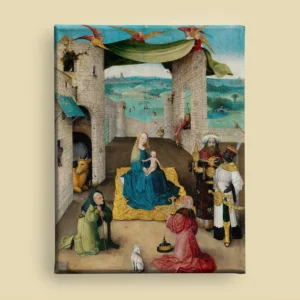
The triptych is now at the Museo del Prado in Madrid. For a wider survey, see our article on famous Adoration of the Magi paintings.
The Temptation of Saint Anthony (Lisbon)
The most famous of all Bosch’s triptychs, the great Temptation of Saint Anthony of around 1501 shows the desert hermit assailed by every form of demonic apparition the painter could imagine. The central panel shows the saint kneeling in the foreground while a black mass of hybrid demons celebrates a parody of the Eucharist around him. The wings show the flight of Anthony into the air and his torment by the devil in monstrous form.

The triptych is now at the Museu Nacional de Arte Antiga in Lisbon, having entered the Portuguese royal collection in the sixteenth century.
Christ Carrying the Cross (Ghent)
Painted in the last years of his life, this is one of the most disturbing religious panels of the entire Northern Renaissance. The picture is a tight closeup of Christ carrying the cross, surrounded on every side by hideous grimacing faces of his tormentors. There is no landscape, no space, no air. Only the press of grotesque humanity against the silent figure of the saviour. Some scholars dispute the attribution to Bosch himself and ascribe the panel to a close follower.

The painting is at the Charterhouse of Granada, where it has been preserved since the sixteenth century.
Christ Crowned with Thorns
This intimate devotional panel shows Christ in three-quarter view at the centre, looking directly at the viewer, while four figures around him fix the crown of thorns on his head and reach for his white robe. Each of the four faces is a different psychological study of cruelty, and Christ himself is the only calm figure in the picture. The composition is one of the most concentrated of Bosch’s late panels.


The painting is at the National Gallery in London.
The Crucifixion with a Donor
This small early panel shows Christ on the cross with the Virgin and John the Evangelist at his feet and a kneeling donor with his patron saint on the right. The composition is unusually calm and quiet for Bosch, with the figures arranged in the traditional iconography of the late medieval Crucifixion. The landscape behind the cross opens onto a peaceful view of a Flemish city.

The painting is at the Royal Museums of Fine Arts of Belgium in Brussels, in the Oldmasters Museum.
Saint Christopher Carrying the Christ Child
The legendary giant Saint Christopher wades through the river with the Christ child on his shoulder. Bosch transforms the conventional iconography by placing them in a strange landscape full of small dragons, fishermen, a hanged man visible in the upper background, and a dog walking calmly along the riverbank. The whole picture reads as an allegorical meditation on the burden of Christian conversion.

The painting is at the Museum Boijmans Van Beuningen in Rotterdam, having passed through the Paul Cassirer Gallery in Berlin.
Saint Jerome at Prayer
The doctor of the Church Saint Jerome lies prone on the ground in penance, his hands clasped around the wood of his cross, while strange rocks and decaying organic forms close in around him. The lion, his traditional companion, is reduced to a small detail in the background. The picture is one of the most concentrated images of Christian asceticism in the Northern Renaissance.

The painting is at the Museo di Capodimonte in Naples.
Saint John on Patmos
The apostle John sits on the rocky island of Patmos with the open scroll of the Apocalypse on his knee, an angel hovering above to point out the visions in the sky. The whole composition is unusually calm and reflective for Bosch, although a small grotesque demon at the lower right of the picture reminds us of his characteristic iconographic invention.

The painting is at the Gemäldegalerie in Berlin.
Saint John the Baptist in the Wilderness
The Baptist reclines in a strange Flemish landscape, his finger pointing toward the lamb of God in the foreground, while bizarre vegetation, including a giant flowering plant, fills the middle ground. The picture has all of Bosch’s late ability to fuse a calm religious figure with a hallucinatory natural setting.

The painting is at the Lázaro Galdiano Museum in Madrid.
The Adoration of the Kings (National Gallery)
This small triptych of around 1495, smaller and more concentrated than the great Prado version, shows the three Magi in adoration before the Christ child in the central panel. The wings show the donors with their patron saints. Bosch handles the central scene with the same enigmatic theological care as his great Prado altarpiece, with strange peering figures in the ruined stable and a distant landscape of the holy land.

The Adoration of the Kings (Upton House)
A third Adoration, this smaller panel is preserved at the National Trust property of Upton House in Warwickshire. The composition is the most concentrated of the three, with the kings and the holy family arranged around the central infant in a tight Flemish bourgeois interior rather than a ruined stable.

The painting is at the National Trust Upton House and Gardens in England.
The Hermit Saints Triptych
This great triptych shows three hermit saints in their wilderness retreats, with Saint Anthony in the centre, Saint Jerome on the left, and Saint Aegidius on the right. Each saint is shown in deep prayer or contemplation while around them the strange Boschian landscape teems with hybrid creatures and emblematic objects. The whole work is one of his most concentrated visual treatises on the contemplative life.

The triptych is at the Gallerie dell’Accademia in Venice, having entered the Doge’s Palace collection in the sixteenth century.
The Passion of Christ
This panel from a small altarpiece shows the Passion of Christ as a continuous narrative landscape, with the betrayal in the garden, the trial before Pilate, the Way of the Cross, and the Crucifixion all unfolding across a single panoramic scene. Bosch uses the format that Hans Memling had recently developed in Bruges and transforms it with his characteristic dense iconographic energy.

The panel is at the Gemäldegalerie in Berlin.
The Temptation of Saint Anthony (Nelson-Atkins)
A different version of the Saint Anthony theme, this small panel concentrates the demonic visions of the desert into a single dense composition. The saint kneels in the foreground while hybrid creatures swarm in the strange Flemish landscape around him. Bosch returned to the subject of Saint Anthony several times in his career, and the smaller versions allow us to see his iconographic invention at work in a more concentrated form.

The panel is at the Nelson-Atkins Museum of Art in Kansas City, Missouri.
For more context on Bosch’s Netherlandish world, see our articles on his great predecessors Jan van Eyck, Rogier van der Weyden, and Hans Memling, and on his great inheritor in Antwerp, Quentin Matsys.
Summary Table of Hieronymus Bosch’s Religious Paintings
| Name | Artist | Date | Medium | Museum |
|---|---|---|---|---|
| The Adoration of the Magi (Prado) | Hieronymus Bosch | c. 1494 | Oil on panel | Museo del Prado, Madrid |
| The Temptation of Saint Anthony (Lisbon) | Hieronymus Bosch | c. 1501 | Oil on panel | Museu Nacional de Arte Antiga, Lisbon |
| Christ Carrying the Cross | Hieronymus Bosch | c. 1515 | Oil on panel | Charterhouse of Granada |
| Christ Crowned with Thorns | Hieronymus Bosch | c. 1510 | Oil on oak | National Gallery, London |
| Crucifixion with a Donor | Hieronymus Bosch | c. 1480 | Oil on panel | Royal Museums of Fine Arts of Belgium, Brussels |
| Saint Christopher Carrying the Christ Child | Hieronymus Bosch | c. 1490 | Oil on panel | Museum Boijmans Van Beuningen, Rotterdam |
| Saint Jerome at Prayer | Hieronymus Bosch | c. 1485 | Oil on panel | Museo di Capodimonte, Naples |
| Saint John on Patmos | Hieronymus Bosch | c. 1505 | Oil on panel | Gemäldegalerie, Berlin |
| Saint John the Baptist in the Wilderness | Hieronymus Bosch | c. 1489 | Oil on panel | Lázaro Galdiano Museum, Madrid |
| The Adoration of the Magi (National Gallery) | Hieronymus Bosch (and workshop) | c. 1495 | Oil on panel | National Gallery, London |
| The Adoration of the Kings (Upton) | Hieronymus Bosch (workshop) | c. 1495 | Oil on panel | National Trust, Upton House |
| The Hermit Saints Triptych | Hieronymus Bosch | c. 1495 | Oil on panel | Gallerie dell’Accademia, Venice |
| The Passion of Christ | Hieronymus Bosch | c. 1500 | Oil on panel | Gemäldegalerie, Berlin |
| The Temptation of Saint Anthony (Nelson-Atkins) | Hieronymus Bosch (workshop) | c. 1500 | Oil on panel | Nelson-Atkins Museum of Art, Kansas City |
Conclusion
Bosch is the painter no other painter resembles. His religious world is built on the same Catholic doctrine as that of Memling, Van Eyck, and Van der Weyden, but he gives it a visual vocabulary that no one before him had dared. Behind every grimacing demon and every hybrid creature in his crowded triptychs lies a precise emblematic meaning drawn from the late medieval Dutch devotional manuals. To read his paintings is to read the soul of the late medieval North under the pressure of its own anxieties about sin, temptation, and the four last things.
Important Facts About Hieronymus Bosch
- Jheronimus van Aken, known to history as Hieronymus Bosch, was born around 1450 in ‘s-Hertogenbosch, in the Duchy of Brabant, into a family of painters that had worked in the city for at least three generations.
- He trained in his father’s Bosch workshop and married the wealthy patrician Aleyt van de Meerveen in 1481, which gave him the social standing to work for the leading patrons of the Burgundian Netherlands.
- Bosch is one of the most original religious painters in the entire history of Western art and is celebrated for his crowded apocalyptic triptychs, his hybrid demons, and his calm, theologically dense Adoration and Passion panels.
- His most famous religious work is the great Temptation of Saint Anthony triptych of around 1501, painted for an unknown patron and now displayed at the Museu Nacional de Arte Antiga in Lisbon.
- He died on 9 August 1516 in his native ‘s-Hertogenbosch, having been a member of the conservative lay Confraternity of Our Lady since 1486, and after his death his work was eagerly collected by King Philip II of Spain, who built the world’s greatest Bosch collection now at the Prado.
Questions and Answers About Hieronymus Bosch Paintings
What is Hieronymus Bosch’s most famous painting?
The most famous single work is the great Garden of Earthly Delights at the Museo del Prado in Madrid, painted around 1500. Among the religious panels covered in this article, the Temptation of Saint Anthony of Lisbon and the Adoration of the Magi at the Prado are the most studied and the most often reproduced.
Where can I see Hieronymus Bosch paintings today?
The single richest collection is at the Museo del Prado in Madrid, built by King Philip II in the sixteenth century. The Museu Nacional de Arte Antiga in Lisbon holds the great Saint Anthony Triptych, the Gemäldegalerie in Berlin holds two important religious panels, and the Gallerie dell’Accademia in Venice holds the Hermit Saints Triptych. The National Gallery in London and the Boijmans Van Beuningen in Rotterdam also hold major works.
What style is Hieronymus Bosch associated with?
Bosch belongs to the late phase of the early Netherlandish school, sometimes also called the Northern Renaissance. His mature style combines the calm linear refinement of Van der Weyden and Memling with an iconographic invention drawn from the late medieval Dutch devotional manuals and from the popular preaching tradition of the Burgundian Netherlands. He has no real stylistic predecessor and only one true imitator, Pieter Bruegel the Elder.
Did Bosch invent surrealism?
The twentieth century Surrealists, especially André Breton and Salvador Dalí, certainly considered him a kind of ancestor and admired the dreamlike density of his triptychs. But Bosch himself was working firmly within the late medieval Dutch Catholic tradition, and modern scholarship has shown that almost every one of his strange creatures and emblematic objects can be traced to a specific source in the religious literature of his time.
Was Bosch heretical?
No. Earlier generations sometimes speculated that he might have belonged to a heretical sect like the Adamites or the Brethren of the Free Spirit, but recent archival research has confirmed that he was an active and conservative member of the Confraternity of Our Lady in his native ‘s-Hertogenbosch from 1486 until his death in 1516, and that his patrons included the most orthodox Catholic princes of his age.
How did King Philip II collect Bosch?
The Spanish Habsburg prince was deeply attracted to the moral seriousness of Bosch’s religious painting and acquired the largest collection of his work anywhere in the world, much of which he kept in his own private rooms at the Escorial. The Prado in Madrid still preserves this royal collection, including the Garden of Earthly Delights, the Adoration of the Magi, the Haywain, and several smaller religious panels.
Where can I buy Hieronymus Bosch paintings reproductions?
You can buy them at jesuschrist.pictures: browse all the Hieronymus Bosch canvas prints in our shop, printed on museum-grade canvas and available in several sizes.


