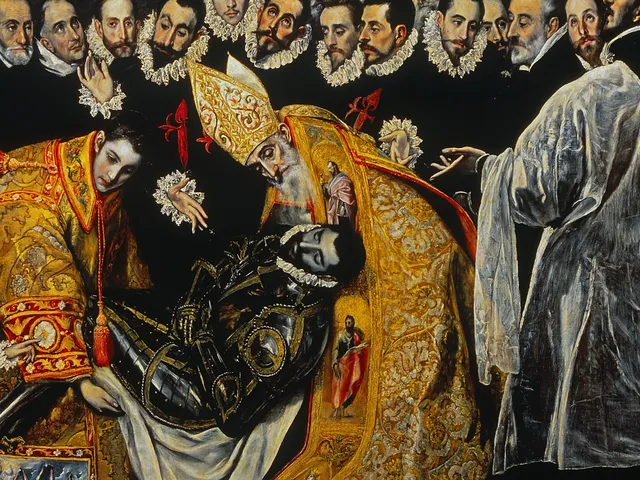
10 Adoration of the Magi Paintings Every Christian Art Lover Should Know
The Epiphany in Art: A Subject Unlike Any Other
Few scenes in sacred art carry the weight that Adoration of the Magi paintings have carried across six centuries of Christian creativity. The Epiphany, as told exclusively in Matthew’s Gospel, is both intimate and cosmic: three wise men from the East, following a star, kneel before a newborn child in a provincial town in Judea. That child, in Christian belief, is the Son of God. The contrast between the grandeur of the visitors and the poverty of the setting, between earthly knowledge and divine mystery, gave artists an almost inexhaustible source of meaning to work with.

Unlike the Nativity scene focused on birth and quiet wonder, the Adoration of the Magi brings the world to Christ’s doorstep. It raises questions about power, humility, and the universality of salvation. Who are these men? What do their gifts truly signify? How does one kneel before a God who looks like an infant? Each generation of painters answered those questions differently, and those answers tell us as much about the artists as about the Gospel itself.
What follows is a selection of ten masterworks, spanning the International Gothic to the French Baroque, that represent the full range of this tradition. Two of them, by Gentile da Fabriano and by Fra Angelico with Filippo Lippi, are available as canvas reproductions in our shop. For each work, I have verified the title, artist, date, and current location, and I invite you to look at each one closely before reading. These paintings reward attention.
1. Adoration of the Magi by Gentile da Fabriano (1423)

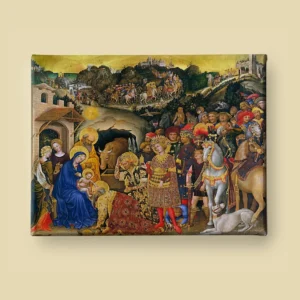
This is where the story of the Adoration in Western painting truly begins in its most spectacular form. Completed in 1423 for the Florentine banker Palla Strozzi, who wanted something worthy of the family chapel in Santa Trinita, Gentile da Fabriano produced an altarpiece that was, quite simply, a statement of overwhelming beauty. The gold leaf that covers a large part of the surface does not merely decorate: it transforms the panel into a kind of sacred threshold, something between painting and icon.
The composition unfolds across the full width of the panel in three arched registers, with the main Adoration scene at the center and the retinue of the Magi spilling outward in both directions. Horses, camels, leopards, peacocks, pages, and knights fill every corner. The Middle Ages loved this kind of sacred excess, and Gentile gives it with complete mastery. Yet amid the pageantry, the actual moment of devotion, the eldest Magus removing his crown and bending to kiss the foot of the Christ Child, is tender and surprisingly personal.
Gentile was the last great master of the International Gothic style, and this painting was his crowning achievement. Gothic Jesus paintings rarely reached this level of sophistication. Within a few years, Brunelleschi and Masaccio would change everything in Florentine art, making this altarpiece feel like a farewell to a world that was already ending. The Adoration of the Magi by Gentile da Fabriano hangs today in the Uffizi Gallery in Florence.
2. Adoration of the Magi by Fra Angelico and Filippo Lippi (c. 1440-1460)


Here is one of the most unusual objects in the entire history of Christian art: a large circular panel, or tondo, nearly one and a half meters in diameter, containing what feels like an entire world compressed into a single scene. Fra Angelico began this work, but died in 1455 before completing it. Filippo Lippi, a painter of a very different temperament, took it over and finished what you see today. The result is a collaboration between two of the finest minds of the Early Italian Renaissance, and it shows.
Fra Angelico’s characteristic serenity is visible in the central group around the Virgin and Child: calm faces, clear light, a deep spiritual composure. Lippi’s hand is felt in the energy of the surrounding crowd, in the bold architectural ruins that frame the scene, and in the richly observed figures scattered through the middle ground. The circular format creates a sense of gathering, as if the whole human race is slowly converging on this single point of light at the center.
The painting was almost certainly made for the Medici family, and many of the figures are thought to be portraits of members of that circle. Looking carefully, the work rewards patience: every corner contains a small story. This tondo is now in the National Gallery of Art in Washington, D.C., where it is one of the most celebrated objects in the collection.
3. Adoration of the Magi by Sandro Botticelli (c. 1475)

Botticelli painted the Adoration of the Magi more than once, but the version completed around 1475 for a chapel in Santa Maria Novella remains the most celebrated, and for good reason. It is not simply a religious image. It is also a political and social document of Renaissance Florence, disguised as devotion.
The Medici family, who effectively governed Florence, are portrayed here as the Three Wise Men and their attendants. Cosimo de’ Medici, the patriarch who had died in 1464, appears as the eldest Magus kneeling at Christ’s feet. His sons Piero and Giovanni are also present, as is his grandson Lorenzo, the future Lorenzo the Magnificent, shown as a young man on the left. Botticelli himself stands at the far right, looking directly out at the viewer with an expression that seems to say: yes, I know exactly what I have done here.
The painting is a masterwork of Renaissance religious art: the figures are arranged with extraordinary care, the faces full of individual character, the architectural backdrop suggesting both Roman antiquity and Christian renewal. That the Magi are the rulers of Florence is meant not as arrogance but as an affirmation: true power, the painting suggests, should kneel before Christ. Whether the Medici fully believed that is another question. The Adoration of the Magi by Botticelli is on display at the Uffizi Gallery in Florence.
4. Adoration of the Magi by Hieronymus Bosch (c. 1475)

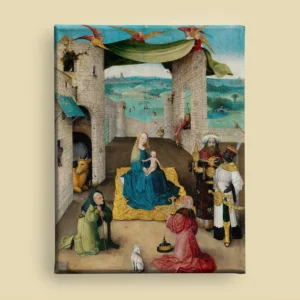
Before Bosch became the painter of nightmares and monsters, he was this: a careful, precise, and deeply attentive young artist in the Netherlandish tradition. The Adoration of the Magi at the Metropolitan Museum dates from around 1475, making it roughly contemporary with the Botticelli above, and it is almost certainly one of Bosch’s earliest surviving works. It looks nothing like his later, more famous paintings, and that contrast is part of what makes it so fascinating.
The composition is built around a bold perspective tunnel: an open courtyard formed by ruined stone walls draws the eye inward toward the Virgin and Child at the center. Angels hold a green canopy above, a theatrical curtain that art historians have linked to the religious plays performed in Bosch’s hometown of ‘s-Hertogenbosch. The three Magi are carefully individualized, the Black king elaborately dressed in gold and green with a jeweled sword. A white greyhound sits on the ground at the front, perfectly still, watching.
Bosch’s imagination was already working, however. Look at the background landscape: a distant river, scattered armies on the move, a gibbet on a far hillside. The world outside the sacred space is already restless and slightly sinister. This tension between order and chaos, between the sanctity of the central scene and the ambiguity of everything surrounding it, would become the defining mark of his later work. The Northern Renaissance rarely produced anything quite like it. The painting is held at the Metropolitan Museum of Art in New York.
5. Adoration of the Magi by Leonardo da Vinci (1481-1482, unfinished)

This is perhaps the most extraordinary unfinished painting in the world. Leonardo began the Adoration of the Magi in 1481, commissioned by the Augustinian monks of San Donato a Scopeto outside Florence. He worked on it intensively for about a year, producing an elaborate series of preparatory drawings and then laying down the underdrawing and initial paint layers on the large panel. Then, in 1482, he left for Milan to serve Ludovico Sforza, and never came back to it.
What he left behind is a revelation. The composition breaks entirely with the conventions of the time. Instead of a pageant, Leonardo gives us a crowd in movement, a swirling mass of figures around the Virgin and Child at the precise center. Old men peer forward. Young men gesticulate. Horses rear up in the background. The emotional temperature is extraordinary: every figure is caught in the act of being changed by what they are witnessing. This is not a ceremony. It is a crisis of faith, a confrontation with the divine.
The underpainting, now visible after a careful restoration completed in 2017, reveals the full ambition of the design: architectural ruins suggesting the collapse of the old pagan world, a crowd that anticipates the Passion as much as the birth. Of all Leonardo’s great works, the Adoration of the Magi may be the most radical. It is kept at the Uffizi Gallery in Florence, where it occupies its own room. You can read more about Leonardo’s vision of Christ in our article on the Salvator Mundi.
Because Leonardo left the painting unfinished, I created an almost completed version with full color, imagining what the final work might have looked like had he returned to it.

6. Adoration of the Magi by Albrecht Dürer (1504)

Albrecht Dürer brought the full weight of Northern European technical precision to the Italian sense of monumental composition, and the result is one of the most balanced and intellectually complete Adoration paintings ever made. Painted in 1504 for Frederick III, Elector of Saxony, and now in the Uffizi, this work represents the high point of Dürer’s synthesis of two great traditions.
The scene is set amid classical ruins, a device that carries theological meaning: the architecture of paganism crumbles as Christ arrives in the world. The three Magi are painted with Dürer’s characteristic attention to texture and surface: the weight of their robes, the gleam of the gold vessels they carry, the aged skin of the kneeling elder. The Virgin is serene and frontal, almost iconic, while the Child reaches forward with an openness that humanizes the whole scene.
What makes this painting particularly remarkable is the integration of landscape. Through the ruined arches and beyond the central group, Dürer opens a panoramic view of hills, forest, and sky that feels like northern Germany transposed onto a biblical setting. The natural world is observed with the same care as the human figures. It was a quality he shared with his Netherlandish predecessors and one that set him apart from the Italian masters he admired. The painting hangs today at the Uffizi Gallery in Florence.
7. Adoration of the Magi by Pieter Bruegel the Elder (1564)

Bruegel’s Adoration of the Magi is unlike any other version of this subject. Painted in 1564, just five years before his death, and executed in tempera on linen rather than the more common oil on panel, it brings the scene down from any pedestal it may have occupied and places it firmly in the middle of a crowd of ordinary, aging, weathered human beings.
The Magi themselves look nothing like kings. The one kneeling closest to Christ is very old, nearly bald, wrapped in a red robe that has seen better days. The gift he presents looks modest. Behind the Holy Family, a soldier leans in to whisper something in Joseph’s ear. No one knows what the soldier says. The interruption is unsettling: even here, in this holiest of moments, the world intrudes. Bruegel seems to ask whether the men around the Christ Child actually understand what they are looking at.
The faces in this painting are extraordinary: curious, suspicious, blank, moved, confused. They are a cross-section of humanity gathered around something they cannot fully grasp. That honesty is what makes Bruegel so remarkable among the Northern Renaissance painters, and why this Adoration remains one of the most thought-provoking versions of the subject. It is held at the National Gallery in London.
8. Adoration of the Magi by Peter Paul Rubens (1609)

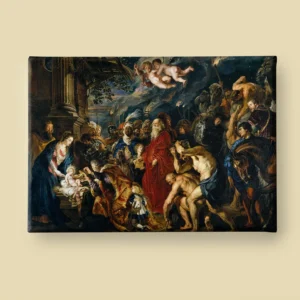
Rubens had just returned from eight years in Italy when he painted this enormous Adoration of the Magi in 1609. He had absorbed everything: the drama of Caravaggio, the grandeur of Michelangelo, the color of Titian. He was now ready to deploy all of it, and on a very large scale. The canvas measures over three and a half meters high by nearly five meters wide. Standing before it in the Prado, the experience is physical as much as visual.
The composition is pure theater. Light pours down from the upper left onto the Virgin and Child, who are surrounded by a cascade of figures, Magi, servants, soldiers, animals, all in various states of motion and devotion. The eldest Magus kneels with his back to the viewer, his white hair catching the light, his gesture one of complete surrender before the Child. The Black king stands to the right, richly dressed, holding his gift and watching. The third Magus, still standing, looks young and impatient.
Rubens also included himself in the painting, standing near the right edge on horseback, calm and observant. This was a painter fully in command of his craft, and fully aware of it. The Flemish Baroque never produced a more confident religious composition. The painting is at the Prado Museum in Madrid.
9. Adoration of the Magi by Diego Velázquez (1619)

Velázquez was around nineteen years old when he painted this Adoration of the Magi, and it remains one of the most remarkable early works by any painter in the Western tradition. The young Sevillian, still under the influence of his teacher Francisco Pacheco, was working in a tenebrist mode shaped by Caravaggio’s revolution: strong light, deep shadow, figures emerging from darkness with the weight of real people rather than idealized types.
The faces are portraits. Velázquez used his family as models: his wife Juana Pacheco is thought to appear as the Virgin Mary, and their infant daughter as the Christ Child. His father-in-law Pacheco appears among the Magi. This practice of painting sacred figures from life was not unusual at the time, but Velázquez brings a particular directness to it. These do not look like people posing. They look like people being.
The gifts, the light on the gold and glass vessels, the fabrics, the skin, all are painted with an already extraordinary command of surface and texture. Spanish Baroque painters had a gift for making sacred subjects feel immediate and present, and Velázquez had that gift from the beginning. The Adoration of the Magi by Velázquez is in the collection of the Prado Museum in Madrid.
10. Adoration of the Magi by Nicolas Poussin (1633)

Poussin’s Adoration of the Magi marks something of a turning point in this long tradition. By 1633, the French painter had been living in Rome for nearly a decade, studying antiquity, absorbing Raphael, and working out a personal style that placed reason, order, and moral clarity at the center of everything he did. The result, for this Adoration, is a scene that feels both deeply reverent and quietly intellectual.
The setting is not a stable or a manger. It is a half-ruined classical structure: columns, timber beams, stone floors. The old world is literally falling apart around the arrival of the new. The figures are arranged with the architectural clarity of a frieze: each gesture reads distinctly, each relationship between characters is legible at a glance. Yet for all its order, the painting is not cold. The kneeling Magus in yellow and red, prostrating himself before the Child, brings genuine feeling to a composition that could easily have been merely correct.
Poussin was moving away from the Baroque emotionalism that surrounded him in Rome, toward a classicism that would define French painting for the next two centuries. You can trace a direct line from this Adoration to the restraint and moral seriousness of Neoclassical religious art. The painting is in the Gemäldegalerie Alte Meister in Dresden.
✦ Free Christian & Catholic Printables
Love this sacred art? Our complete collection of illuminated prayer cards and Scripture verses, the Memorare, Psalm 23, Psalm 91 and more, is ready to print, free, in one place.
Browse all free printables →Summary Table
| Painting | Artist | Date | Medium | Museum |
|---|---|---|---|---|
| Adoration of the Magi | Gentile da Fabriano | 1423 | Tempera and gold on panel | Uffizi Gallery, Florence |
| Adoration of the Magi | Fra Angelico and Filippo Lippi | c. 1440-1460 | Tempera on panel | National Gallery of Art, Washington, D.C. |
| Adoration of the Magi | Sandro Botticelli | c. 1475 | Tempera on panel | Uffizi Gallery, Florence |
| Adoration of the Magi | Hieronymus Bosch | c. 1475 | Oil and gold on oak panel | Metropolitan Museum of Art, New York |
| Adoration of the Magi | Leonardo da Vinci | 1481-1482 (unfinished) | Oil and tempera on panel | Uffizi Gallery, Florence |
| Adoration of the Magi | Albrecht Dürer | 1504 | Oil on panel | Uffizi Gallery, Florence |
| Adoration of the Magi | Pieter Bruegel the Elder | 1564 | Tempera on linen | National Gallery, London |
| Adoration of the Magi | Peter Paul Rubens | 1609 | Oil on canvas | Prado Museum, Madrid |
| Adoration of the Magi | Diego Velázquez | 1619 | Oil on canvas | Prado Museum, Madrid |
| Adoration of the Magi | Nicolas Poussin | 1633 | Oil on canvas | Gemäldegalerie Alte Meister, Dresden |
Conclusion: What the Magi Still Have to Teach Us
Looking at these ten paintings together, something becomes clear: the Adoration of the Magi was never just a single scene. It was a mirror that each generation held up to itself. For Gentile da Fabriano and the medieval patrons who commissioned him, it was proof that earthly wealth and power find their true purpose only in submission before God. For Botticelli and the Medici, it was a statement about who mattered in Florence and why. For Leonardo, it was an opportunity to ask what it actually looks like when humanity encounters the divine. For Velázquez and Bruegel, it was a chance to say that ordinary people, real faces, real hands, can bear the weight of sacred meaning.
Poussin, at the end of our list, brings a kind of summary clarity: the old world falls away, order and reason arrive, but the gesture of kneeling before Christ remains unchanged from Gentile’s gold-covered altarpiece painted two centuries earlier. That continuity is part of what makes this subject so enduring.
If you are looking to bring one of these great works into your home, two of the paintings featured here are available as high-quality canvas reproductions in our shop: the Adoration of the Magi by Gentile da Fabriano and the Adoration of the Magi by Fra Angelico and Filippo Lippi. Both are famous art reproductions printed on professional canvas and designed to carry the presence of the originals into your space.
You may also find it worthwhile to read our article on the ten great biblical masterpieces in art history, which places this tradition in broader context, or our survey of the most famous Jesus paintings of all time.
Questions and Answers
What is the Adoration of the Magi in Christian tradition?
The Adoration of the Magi, also called the Epiphany, refers to the visit of the Three Wise Men, or Magi, to the infant Jesus following his birth in Bethlehem. It is described in the Gospel of Matthew (Matthew 2:1-12). The Magi follow a star from the East, find Jesus with his mother Mary, and offer him gifts of gold, frankincense, and myrrh. In Catholic tradition, this event is celebrated as the Feast of the Epiphany on January 6th, marking the revelation of Christ to the Gentiles and affirming the universal reach of the Incarnation.
What do the three gifts of the Magi symbolize?
The three gifts carried distinct theological meanings in Christian interpretation. Gold signified Christ’s kingship: it was a gift fit for a ruler. Frankincense, an incense used in Jewish and pagan religious ceremonies, pointed to his divinity and priestly role. Myrrh, a fragrant resin used in burial rites, foreshadowed his death and the Passion. Together, the gifts presented a complete vision of who Christ was: king, priest, and sacrificial victim. This layered symbolism gave artists rich material to work with, and most of the paintings in this article incorporate these objects with deliberate care.
How many Magi are there according to the Bible?
The Gospel of Matthew does not specify a number. The tradition of three Magi developed from the three gifts mentioned in the text: gold, frankincense, and myrrh. By the sixth century, the names Caspar, Melchior, and Balthasar had become widely accepted in Western Christian tradition. Later tradition also associated each Magus with a different age and region of the world, turning the three figures into a representation of all humanity gathered before Christ. Most paintings in the Western tradition follow this convention of three figures.
Why did so many painters choose to set the Adoration among ruins?
The motif of classical ruins as a setting for the Adoration carries a specific theological meaning. The crumbling architecture of the pagan Greco-Roman world represents the old order that is being superseded by the arrival of Christ. The ruined temple or palace in which the Holy Family shelters is a visual way of saying that the old world is giving way to the new. Leonardo, Dürer, and Poussin all use this device prominently. It connects the birth of Christ to the broader sweep of history and places the Incarnation within a narrative of transformation rather than simple celebration.
Which Adoration of the Magi painting is considered the greatest?
There is no single answer, and any serious response depends on what criteria matter most. If you value sheer technical ambition and compositional revolution, Leonardo’s unfinished Adoration at the Uffizi stands alone. If the quality of devotion and human feeling is the measure, Velázquez’s early work in the Prado is difficult to surpass. For opulence and the perfection of a complete medieval vision, Gentile da Fabriano’s 1423 altarpiece has no equal. The paintings of Rubens and Botticelli remain the most recognized by general audiences. In the end, each of the ten works in this article represents a different form of greatness, and they are best understood not as competitors but as chapters in a single, very long story.
Are there canvas reproductions of Adoration of the Magi paintings available at jesuschrist.pictures?
Yes. We offer canvas reproductions of two works featured in this article: the Adoration of the Magi by Gentile da Fabriano (1423) and the Adoration of the Magi by Fra Angelico and Filippo Lippi (c. 1440-1460). Both are printed on professional canvas and available in several sizes. You can find them directly in our shop.
Where can I buy Adoration of the Magi paintings on canvas?
You can buy Adoration of the Magi paintings on canvas at jesuschrist.pictures, in our shop: the canvas reproduction comes in several sizes, ready to hang.