Christ of Saint John of the Cross: Dali’s Sacred Geometry
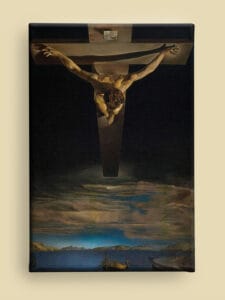
Christ of Saint John of the Cross is one of the most famous religious paintings of the twentieth century, made by Salvador Dali in 1951. It shows Christ on the cross from an unusual angle, seen from above, floating in a dark sky over a quiet bay. The painting hangs in the Kelvingrove Art Gallery and Museum in Glasgow. Its medium is oil on canvas.
The first surprise is the viewpoint. Instead of looking up at the cross, we look down on it, as if hovering above Christ’s bowed head. The body is calm and whole, and there are no nails, no blood, and no crown of thorns. Dali has stripped away the marks of suffering to leave a figure of pure, quiet beauty.
Below the cross lies a still bay with a boat and two fishermen. The dark sky above and the soft light on the water turn the crucifixion into something cosmic and dreamlike, more a vision than a historical scene.
Dali called this his picture of the metaphysical Christ. Readers who want to see more can read our article on Dali’s religious paintings, or compare this work with older treatments of the subject in our gallery of Crucifixion paintings.
The History of Christ of Saint John of the Cross
Dali painted Christ of Saint John of the Cross in 1951, during the deeply religious phase of his career that he called nuclear mysticism. He took the title and the strange angle from a small drawing of the crucifixion made by the sixteenth century Spanish mystic Saint John of the Cross, which is kept in a convent in Avila and shows Christ on the cross seen from above.

In 1952 the city of Glasgow bought the painting for 8,200 pounds, a price that caused a public outcry at the time. The decision proved farsighted. The picture became one of the most loved works in Britain, now valued far beyond what was paid, and the most popular painting in Scotland. In 1961 a visitor attacked the canvas, but it was carefully restored and returned to view.
A Crucifixion Seen From Above
The power of the painting lies in its geometry. The arms of the cross and the bowed head form a triangle, and the head itself reads as a circle, shapes Dali linked to the harmony of the universe. He said the design came to him in a dream, in which he understood the crucifixion as the very center of creation.

By lifting the viewpoint above Christ, Dali removes us from the crowd at the foot of the cross and places us, instead, in the position of God the Father looking down. The dark void around the figure deepens the sense of a sacred event taking place outside ordinary time and space.
No Blood, No Nails
Dali made a deliberate choice to leave out the wounds. There are no nails through the hands and feet, no gash in the side, no thorns. He wanted, in his own words, to paint a Christ that was beautiful, the opposite of the broken, bleeding figures of earlier Spanish art.
The result is a crucifixion without horror. The body is strong and serene, lit softly against the black sky. For Dali this beauty was the point, a sign that the death on the cross leads not to despair but to glory.
The Bay of Port Lligat
At the foot of the painting lies the bay of Port Lligat, the small Catalan harbor where Dali lived and worked. The boat and the fishermen are based on figures from older paintings, and they anchor the cosmic vision in a real and humble place.

The contrast is deliberate. Above hangs the eternal Christ, weightless in a dark sky, while below lies the ordinary world of water, work, and home. The painting joins the two, heaven and the everyday, in a single quiet image.
An Old Subject Seen Anew
Christ of Saint John of the Cross has become one of the most reproduced religious images of modern times. Its calm beauty and its strange, soaring viewpoint reach people who might pass by a more traditional crucifixion, and it has drawn crowds to Glasgow for over seventy years.
It endures because it makes an ancient subject feel new. Dali takes the most painted scene in Western art and turns it, lifts it, and clears away the blood, so that the viewer sees the cross as if for the first time.
Conclusion
In Christ of Saint John of the Cross Salvador Dali reimagined the crucifixion as a vision of beauty and order. Seen from above, without a wound or a thorn, Christ floats between a dark heaven and a quiet sea.
Bought against the doubts of its day and loved ever since, the painting remains the treasure of Glasgow and one of the great religious images of the modern age. It shows that even the oldest subjects can still be seen in a wholly new way.
Artwork Information
| Artwork | Artist | Date | Medium | Current Location |
|---|---|---|---|---|
| Christ of Saint John of the Cross | Salvador Dali | 1951 | Oil on canvas | Kelvingrove Art Gallery and Museum, Glasgow |
Five Facts About Christ of Saint John of the Cross
- Christ of Saint John of the Cross is a 1951 oil painting by Salvador Dali.
- It shows Christ on the cross from above, without nails, blood, or a crown of thorns.
- The title and the angle come from a small drawing by the sixteenth century mystic Saint John of the Cross.
- Below the cross lies the bay of Port Lligat, Dali’s home in Catalonia, with a boat and fishermen.
- Glasgow bought it in 1952 for 8,200 pounds, and it now hangs in the Kelvingrove Art Gallery and Museum.
FAQ
Why did Salvador Dali paint Christ of Saint John of the Cross?
Dali said the image came to him in a dream, in which he saw the crucifixion as the center of the universe. During his religious period he wanted to paint a beautiful, metaphysical Christ rather than a scene of suffering.
Why is there no blood, nails, or crown of thorns?
Dali deliberately left out the wounds. He wanted to show a Christ of beauty and calm, not horror, so that the cross would point toward glory rather than pain.
Why is it called Christ of Saint John of the Cross?
The title comes from a small drawing by the sixteenth century Spanish mystic Saint John of the Cross, who pictured Christ on the cross seen from above. Dali based his unusual viewpoint on that sketch.
What is unusual about the viewpoint?
We look down on Christ from above, rather than up from the ground. This aerial angle places the viewer over the bowed head of Christ and gives the scene a floating, cosmic quality.
Where is Christ of Saint John of the Cross?
It is in the Kelvingrove Art Gallery and Museum in Glasgow, where it has hung since 1952.
How much did the painting cost?
Glasgow bought it in 1952 for 8,200 pounds, a controversial sum at the time. It is now valued at many millions and counted among the most treasured paintings in Britain.
When did Dali paint Christ of Saint John of the Cross?
He painted it in 1951, during the religious, so called nuclear mysticism phase of his career.
Where can I buy Dali’s Christ of Saint John of the Cross as a canvas print?
You can buy Dali’s Christ of Saint John of the Cross as a canvas print at jesuschrist.pictures. The canvas reproduction is in our shop, printed on premium canvas and shipped worldwide.


