12 Baroque Christian Paintings by the Masters of Light and Shadow
Baroque Christian paintings transformed the language of sacred art more radically than any movement before or since. Between roughly 1600 and 1680, painters from Rome to Amsterdam to Seville invented a new way of seeing God: not through the serene harmony of the Renaissance, but through darkness, flesh, and the sudden shock of light. Caravaggio placed Christ in taverns and hired ordinary laborers as his apostles. Rubens depicted the Passion with a physical force that bordered on violence. Rembrandt painted Christ’s face from a Jewish model living in his neighborhood. Velázquez reduced the Crucifixion to a single silent figure against absolute black. These twelve works, arranged chronologically, are among the most powerful statements in the entire history of Christian art.
For the broader context of this extraordinary tradition, see our articles on Baroque Jesus paintings, Italian Baroque Jesus paintings, and Flemish Baroque Jesus paintings.
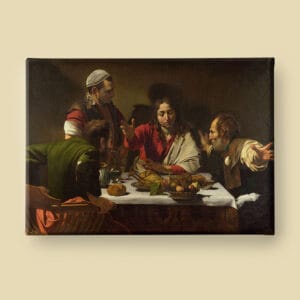
1. The Supper at Emmaus by Caravaggio (1601)
Caravaggio painted the Supper at Emmaus in 1601 for the Marchese Ciriaco Mattei in Rome, and the result was something the history of painting had not prepared the world for. Christ sits at a table in an ordinary inn, breaking bread with two disciples who did not recognize him during their journey from Jerusalem. The moment he blesses the bread, they see who he is. One spreads his arms in a gesture so wide it seems to burst through the picture plane. The other grips the arms of his chair as if steadying himself against a physical shock. An innkeeper looks on with mild curiosity, understanding nothing. The still life on the table — a roast fowl, a basket of fruit teetering at the edge — is painted with a precision that would not be surpassed until the Dutch Golden Age.
No painter before Caravaggio had made the Resurrection feel like this: sudden, physical, ambushing an ordinary Tuesday. The painting hangs in the National Gallery in London. For more of his sacred vision, see our article on Caravaggio’s paintings, and for a broader exploration of this subject, our article on iconic Supper at Emmaus paintings.

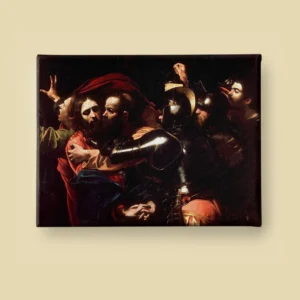
2. The Taking of Christ by Caravaggio (c. 1602)
For two hundred years, this painting was lost. It hung in a Jesuit house in Dublin, catalogued as a copy of a lost Caravaggio, unrecognized even by the people who walked past it every day. In 1990 a restorer noticed it was something more. When cleaned, it emerged as one of the great masterpieces of Baroque painting: the arrest of Christ in the Garden of Gethsemane, the moment Judas leans in for the kiss while the soldiers press in with their armor and their torches, and Christ submits with his hands clasped, his eyes cast downward, his expression containing the full weight of what he knows is about to happen.
On the right edge of the composition, a figure in a black cloak holds a lantern and cranes forward to see better. Art historians believe this figure is Caravaggio himself. He gave himself no heroic role, no redemptive gesture. He painted himself as a bystander at the arrest of Christ, holding a lamp, watching. The painting is now at the National Gallery of Ireland in Dublin, on long-term loan from the Jesuit community.

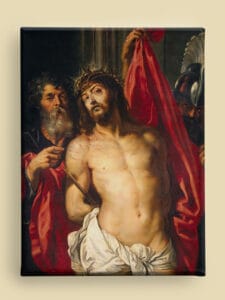
3. Ecce Homo by Peter Paul Rubens (c. 1612)
Rubens spent eight years in Italy before returning to Antwerp in 1608, and the Ecce Homo, painted around 1612, shows everything he had absorbed: the musculature of Michelangelo, the chiaroscuro of Caravaggio, the color and texture of the Venetian masters. Christ stands nearly frontal, scourged and crowned with thorns, his bound wrists held before him. The look in his eyes is not despair but something more complex: an awareness of suffering that has passed beyond protest into a kind of luminous endurance. Pilate is barely visible, gesturing toward this figure as if presenting an exhibit.
Where Caravaggio’s version of the same scene is claustrophobic and raw, Rubens gives Christ a physical idealization that is almost classical. The Flemish master believed that the suffering of the Passion did not diminish Christ’s divine majesty but revealed it. The painting is at the Hermitage Museum in Saint Petersburg.

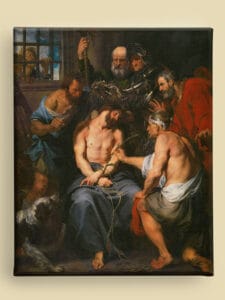
4. Christ Crowned with Thorns by Anthony van Dyck (c. 1618–1620)
Van Dyck was barely twenty when he painted this, and already the influence of his master Rubens is being filtered through something distinctly his own. Christ sits facing the viewer at the center of a large canvas, almost life-size, composed amid a group of five tormentors who push the crown down, hold his arms, and mock him with a reed scepter. The figure of Christ is idealized, his expression sorrowful yet removed from the aggression around him, as if he inhabits a different register of reality. A shaft of cold light falls on his body; the soldiers are in comparative shadow.
Van Dyck offered the finished painting to Rubens, who declined it. It was then acquired by Philip IV of Spain, who placed it in the Escorial, and it entered the Prado in 1839. The anecdote of Rubens declining the gift has never been fully explained. Looking at the painting, it is hard to imagine it was rejected on grounds of quality. The work is at the Museo del Prado in Madrid.

5. The Last Supper by Peter Paul Rubens (c. 1631–1632)
Rubens’s Last Supper, painted around 1631-1632, is one of the most physically imposing treatments of the subject in the Baroque period. Where Leonardo conceived the moment as a frieze of psychologically individuated reactions, Rubens brings the full force of his compositional energy to bear on the sacred mystery itself: the institution of the Eucharist, Christ’s gesture of offering, the gathering of light around his figure. The apostles are large, substantial men, their bodies pressing against each other in the confined space, their faces running the full spectrum from devotion to confusion to suppressed grief.
Rubens never separated theological content from physical reality. For him, the Incarnation meant that sacred events had weight, warmth, and dimension, and his Last Supper insists on this with every square centimeter of paint. The painting is at the Pinacoteca di Brera in Milan. For a broader survey of this subject across the centuries, see our article on the most famous Last Supper paintings.


6. Christ’s Entry into Jerusalem by Peter Paul Rubens (1632)
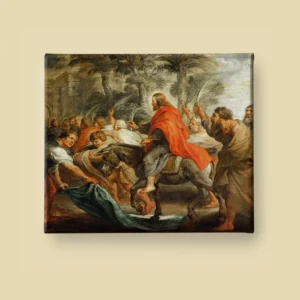
Painted in the same productive year as the Last Supper, Rubens’s Entry into Jerusalem gives the Palm Sunday scene a processional grandeur that matches its theological significance. Christ rides into the holy city on a donkey while the crowd spreads cloaks and palm branches before him. Rubens peoples the crowd with faces drawn from every type (the devout, the curious, the ecstatic, the skeptical) and gives each figure a physical presence that makes the event feel genuinely public: this is a city welcoming a king, and the city is paying attention.
The contrast with the solitary, silent Christ of Velázquez’s Crucifixion, painted in the same year, is worth noting. Rubens and Velázquez were working simultaneously from opposite ends of the same Gospel narrative, and the difference in their approaches tells the full story of Baroque sacred painting’s range. The painting hangs in the Musée des Beaux-Arts in Dijon, France.

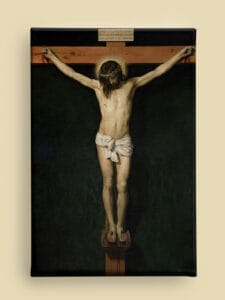
7. Christ Crucified by Diego Velázquez (c. 1632)
Velázquez painted this crucifixion in the early 1630s, and it is one of the most extraordinary acts of reduction in the history of religious art. Christ hangs on the cross against a background of absolute black. There is no landscape, no sky, no crowd, no weeping Virgin, no attending angels. Nothing but the body, the cross, the four nails, and the darkness. The figure is idealized but not otherworldly: this is a man who has died, his head falling forward, his hair covering his face with a stillness that could be sleep. The palette is almost monochrome, silver and black, with the body catching light as if from a single candle.
The painting was commissioned for the convent of San Plácido in Madrid and has been at the Prado since 1829. It has been called the most perfect Spanish religious painting ever made. That assessment is hard to argue with. Standing in front of it at the Museo del Prado, the silence it enforces is not reverence but something closer to confrontation. For more on this subject, see our article on famous Crucifixion paintings. And for more of the Spanish Baroque tradition, see our article on Spanish Baroque Jesus paintings.

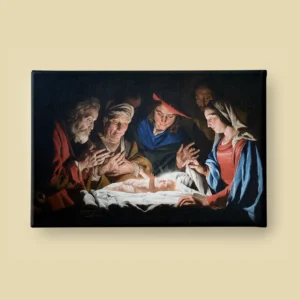
8. The Adoration of the Shepherds by Matthias Stomer (c. 1632)
Matthias Stomer was a Dutch painter who spent most of his career in Italy, and the Adoration of the Shepherds is his masterpiece of nocturnal light. The newborn Christ lies in the manger at the center of the composition, radiating a warm golden light that illuminates the Virgin, the shepherds pressing in from the left, and the angels watching from above. The shepherds are old men with rough hands and weathered faces, their expressions of wonder all the more powerful for their apparent inability to quite believe what they are seeing.
Stomer had absorbed the lessons of Caravaggio’s Roman followers with complete thoroughness, and here he deploys the tenebrism (the dramatic opposition of light and shadow) at its most focused and devotionally effective. The Christ Child is literally the light source, and every face in the painting is oriented toward that light as toward a fire on a cold night. For more beautiful Nativity paintings, see our article on famous Nativity paintings.

9. Head of Christ by Rembrandt (c. 1648)
In the late 1640s, Rembrandt made a decision that was radical in the context of Dutch Baroque painting: he was going to paint Christ’s face from life. He found his model among the Sephardic Jewish community in the quarter of Amsterdam where he lived, and he painted the same young man in several variants, each slightly different in pose and expression, as if exploring the question from multiple angles. The result was a series of small panels that are among the most searching images of Christ in the entire history of Christian art.
The primary autograph version, dated c. 1648 and held at the Gemäldegalerie in Berlin, shows a young man with long dark hair, a short beard, and an expression of extraordinary calm. There is no halo, no divine light, no symbolic attribute. Just a face. The idea that this face was painted from a real person, a young Jewish man in seventeenth-century Amsterdam, is theologically precise: this is what the Incarnation means. Christ as a specific human being, not a symbol. The painting is at the Gemäldegalerie in Berlin.


10. Christ in the House of Martha and Mary by Johannes Vermeer (c. 1654–1655)
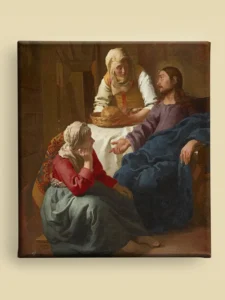
This painting surprises everyone who finds it. Vermeer is known for intimate genre scenes: women reading letters, men weighing pearls, the quiet interiors of bourgeois Dutch life. Christ in the House of Martha and Mary, painted around 1654-1655 when Vermeer was in his early twenties, is a large religious canvas that looks nothing like his later work and yet carries the same quality of absorbed attention. Christ sits at a table, his hand raised in a gesture of gentle speech, addressing Mary who sits at his feet listening. Martha, standing to the left, holds a basket of bread and looks toward him with an expression that is not resentment but a kind of earnest appeal: is this right? Should she not also be sitting?
The painting handles the theological question at the heart of the Luke passage, active service versus contemplative listening, with unusual openness. Vermeer does not resolve it. Christ’s expression contains both acknowledgment of Martha’s labor and the suggestion that what Mary has chosen is not in competition with it. The painting is at the Scottish National Gallery in Edinburgh.

11. The Baptism of Christ by Bartolomé Esteban Murillo (c. 1655)
Murillo was the great painter of tender piety in the Spanish Baroque tradition, and his Baptism of Christ shows those qualities at their most assured. The scene takes place in a luminous landscape: John pours water from a shell over the bowed head of Christ, who kneels at the river’s edge in an attitude of complete submission. Above, the heavens open. The dove descends. Angels watch from clouds that glow with the same warm golden light that Murillo gave to all his sacred scenes, a light that feels not theatrical but genuinely consoling.
Where the Spanish Baroque could tip toward the austere, as in Velázquez, or the monumental, as in Zurbarán, Murillo’s vision of sacred events is characterized by accessibility and warmth. His saints and holy figures are present in a way that invites the viewer in rather than holding them at a devotional distance. This quality made his paintings enormously popular in their own time and kept them in continuous use as devotional images long after the Baroque period ended. For more on the history of this subject, see our article on famous Baptism of Christ paintings.


12. The Return of the Prodigal Son by Rembrandt (c. 1668)
Rembrandt painted the Return of the Prodigal Son in the last years of his life, and the painting carries the accumulated weight of everything he had lived through: bankruptcy, the death of his wife Saskia, the death of his son Titus, the loss of his house and collections, the years of working in deepening obscurity while his reputation faded from its earlier heights. The prodigal son kneels before his father, his head shaved, his shoes worn through, his robe in rags. The father bends forward and lays both hands on his son’s shoulders in an embrace of absolute unconditional welcome. The figures watching from the sides are quiet, their expressions unreadable.
The painting is one of the largest Rembrandt ever made and technically among the most extraordinary: the surface has been built up in layers of paint that are almost sculptural in their depth, the light emerging from within the canvas rather than falling on it from outside. It is, for many who have stood before it, the most moving painting in the world. It hangs in the Hermitage Museum in Saint Petersburg.

Summary of the 12 Baroque Christian Paintings Featured in This Article
| Painting | Artist | Date | Medium | Location |
|---|---|---|---|---|
| The Supper at Emmaus | Caravaggio | 1601 | Oil on canvas | National Gallery, London |
| The Taking of Christ | Caravaggio | c. 1602 | Oil on canvas | National Gallery of Ireland, Dublin |
| Ecce Homo | Peter Paul Rubens | c. 1612 | Oil on panel | Hermitage Museum, Saint Petersburg |
| Christ Crowned with Thorns | Anthony van Dyck | c. 1618–1620 | Oil on canvas | Museo del Prado, Madrid |
| The Last Supper | Peter Paul Rubens | c. 1631–1632 | Oil on canvas | Pinacoteca di Brera, Milan |
| Christ’s Entry into Jerusalem | Peter Paul Rubens | 1632 | Oil on canvas | Musée des Beaux-Arts, Dijon |
| Christ Crucified | Diego Velázquez | c. 1632 | Oil on canvas | Museo del Prado, Madrid |
| The Adoration of the Shepherds | Matthias Stomer | c. 1632 | Oil on canvas | Galleria Sabauda, Turin |
| Head of Christ | Rembrandt | c. 1648 | Oil on panel | Gemäldegalerie, Berlin |
| Christ in the House of Martha and Mary | Johannes Vermeer | c. 1654–1655 | Oil on canvas | Scottish National Gallery, Edinburgh |
| The Baptism of Christ | Bartolomé Esteban Murillo | c. 1655 | Oil on canvas | Museo de Bellas Artes, Seville |
| The Return of the Prodigal Son | Rembrandt | c. 1668 | Oil on canvas | Hermitage Museum, Saint Petersburg |
Conclusion
The twelve paintings on this list span seventy years and five countries. What unites them is not style but conviction: a shared belief that sacred subjects demand the full force of the painter’s intelligence, and that depicting the Gospel honestly requires confronting the full weight of human experience. Fear, grief, wonder, tenderness, physical suffering, unconditional love: the Baroque painters put all of it on the canvas without flinching, and the results changed the way the Christian world pictured its faith.
The tradition they built has never really ended. Its influence runs through the Romantic painters of the nineteenth century, the Realists, and into the modern period. For the story of what came next, see our articles on Romantic Jesus paintings and Realist Jesus paintings.
Frequently Asked Questions
What defines Baroque Christian painting?
Baroque sacred painting, which flourished roughly between 1600 and 1720, is characterized by dramatic contrasts of light and shadow (known as chiaroscuro or, in its most extreme form, tenebrism), powerful physical realism in the depiction of sacred figures, dynamic diagonal compositions, and a strong emotional directness designed to engage the viewer’s devotion. It emerged partly as a response to the Protestant Reformation, as the Catholic Church used art to make sacred subjects vivid and emotionally compelling. The Council of Trent (1545-1563) explicitly encouraged this approach.
Who are the most important Baroque Christian painters?
The list is long, but Caravaggio stands apart as the painter who most fundamentally changed the course of Baroque sacred art, particularly in Italy. Rubens dominated the Flemish tradition; Velázquez and Murillo defined the Spanish approach; Rembrandt and Vermeer brought an extraordinary intimacy to the Dutch tradition, where religious painting occupied a smaller but remarkable place. Our dedicated articles on Caravaggio and on Italian Baroque Jesus paintings explore several of these painters in depth.
What is chiaroscuro, and why is it so important in Baroque art?
Chiaroscuro, from the Italian for “light-dark,” refers to the technique of using strong contrasts between illuminated and shadowed areas to model three-dimensional forms and create dramatic atmosphere. Caravaggio developed an extreme version of this, placing figures in near-total darkness relieved only by a single concentrated shaft of light, a technique so distinctive it inspired an entire school of followers known as the Caravaggisti. For Baroque sacred painters, chiaroscuro was not merely aesthetic: it carried a theological meaning, with light representing divine presence and grace breaking into the darkness of the fallen world.
Why did Rembrandt use a Jewish model to paint Christ?
Rembrandt lived in a neighborhood of Amsterdam with a large Sephardic Jewish community, and around 1648 he began painting Christ’s face from life, using a young Jewish man as his model. The decision was partly theological: unlike many of his contemporaries, Rembrandt understood that Christ was Jewish, and he sought to restore that historical specificity to the image. It was also an artistic decision, a commitment to the same truthfulness that characterized all his portraiture. A 1656 inventory of his possessions lists a painting described as “a Head of Christ, done from life,” evidence that he kept the work in his own bedroom.
Where can I see these Baroque Christian paintings in person?
Several are accessible at major public museums. Caravaggio’s Supper at Emmaus is at the National Gallery in London. The Taking of Christ is at the National Gallery of Ireland in Dublin. Velázquez’s Christ Crucified and Van Dyck’s Christ Crowned with Thorns are both at the Prado in Madrid. Rembrandt’s Head of Christ is at the Gemäldegalerie in Berlin. His Return of the Prodigal Son and Rubens’s Ecce Homo are at the Hermitage in Saint Petersburg. Vermeer’s Christ in the House of Martha and Mary is at the Scottish National Gallery in Edinburgh.
Is the Return of the Prodigal Son by Rembrandt the most famous Baroque painting?
It is certainly one of the most discussed and emotionally affecting. Many who have stood before it describe it as the most moving painting they have ever seen. Among Baroque sacred works, it competes for that distinction with Caravaggio’s Calling of Saint Matthew and, in a different register, Velázquez’s Christ Crucified. The question is ultimately unanswerable, but the fact that it is seriously asked tells you something about the painting’s power.
Where can I buy reproductions of these Baroque Christian paintings?
You can buy reproductions of these Baroque Christian paintings at jesuschrist.pictures, in our shop. All twelve works on this list are available as canvas reproductions in our shop, including both Caravaggio paintings, all three Rubens works, Van Dyck’s Christ Crowned with Thorns, Velázquez’s Christ Crucified, Stomer’s Adoration of the Shepherds, Rembrandt’s Head of Christ, Vermeer’s Christ in the House of Martha and Mary, and Murillo’s Baptism of Christ.


