12 Renaissance Christian Paintings That Defined Sacred Art
Renaissance Christian paintings did not simply depict the Gospel. They reinvented it. Between roughly 1420 and 1580, Italian artists achieved something that no tradition before them had managed: they gave sacred scenes the full weight of human experience, placing Christ and the Virgin in real space, surrounded by real light, watched by figures who feel genuine emotion. The result was a revolution that changed Christian art permanently. These twelve paintings, drawn from the Early, High, and Late Renaissance, represent the full reach of that transformation, from Fra Angelico’s ethereal frescoes in Florence to the late canvases of Titian in Venice.
Each of the works on this list is a masterpiece on its own terms. Together, they tell the story of how sacred painting grew from tender devotional imagery into one of the most sophisticated visual traditions the world has ever seen. The paintings are presented in chronological order.
1. The Annunciation by Fra Angelico (c. 1438–1440)
No artist earned his beatification more honestly than Fra Angelico. The Dominican friar who painted the cells and corridors of the Convent of San Marco in Florence did not think of his work as art in any modern sense. For him, painting was prayer, and the Annunciation he placed at the top of the convent’s stairs is among the most purely spiritual images the Renaissance produced. The Virgin and the Angel Gabriel face each other beneath a graceful loggia. The colors are cool and precise: white robes, blue mantle, rose and gold wings. There is no drama, no theatrical gesture. Just a moment of absolute quiet before the most consequential yes in Christian history.
Fra Angelico reputedly said that no one who was not himself devout could paint such things. Looking at this fresco, that claim is easy to believe. It is the first work every visitor encounters when climbing the stairs to the monks’ cells at what is now the Museo di San Marco in Florence. For more of his sacred vision, see our article on Fra Angelico’s paintings. And for a broader view of how great painters depicted this mystery, see our article on famous Annunciation paintings.


2. Noli Me Tangere by Fra Angelico (c. 1440–1441)
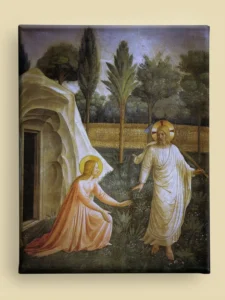
Just a few steps from the Annunciation, in the first cell on the upper floor, Fra Angelico painted the Noli Me Tangere. The Risen Christ, wrapped in a white gardener’s robe, turns away from Mary Magdalene who reaches toward him from her knees. He holds a spade. The garden behind them is impossibly delicate, pale pink flowers scattered across a pale green ground. The painting captures a moment that is both physically specific and theologically immense: the first appearance of the Resurrection, the first testimony of the faith.
What makes this fresco remarkable is its restraint. There is no triumphant glow, no angelic retinue, no celestial light. Just Christ and Mary, in a garden, in the early morning. Fra Angelico understood that the most sacred moments do not require spectacle. Our article on the most famous Noli Me Tangere paintings places this work in the broader tradition of this extraordinary subject.

3. Adoration of the Magi by Fra Angelico and Filippo Lippi (c. 1445–1460)
This large circular panel, begun by Fra Angelico and completed by Filippo Lippi after his death, is one of the great collaborative masterpieces of the Early Renaissance. The format itself is unusual: a tondo, a circular composition, which forces the painter to fit a complex narrative scene into a shape that naturally resists it. The result is a procession of extraordinary visual richness, the Three Kings and their retinue filling the curved space with color, texture, and movement. At the center, calm and luminous, the Virgin holds the Child as the Magi kneel before him.
The painting now hangs in the National Gallery of Art in Washington D.C. It is one of the most ambitious Italian panel paintings in North America. The contrast between Fra Angelico’s spiritual precision in the central figures and Lippi’s more worldly energy in the crowd is visible to any attentive viewer. For more on this great Gospel scene, see our article on Adoration of the Magi paintings.


4. The Baptism of Christ by Piero della Francesca (c. 1448–1450)
Piero della Francesca painted a universe of absolute stillness. His Baptism of Christ belongs to a category of art that transcends technique: it is one of those paintings where something real seems to have been stopped in time. Christ stands at the center of the composition, white and motionless as a column of stone, while John pours water from a bowl above his head. A dove descends. Three angels, their robes painted with meticulous attention to the fall of cloth, stand to the left. The Umbrian landscape behind them is pale gold and green, bathed in a light that seems to come from nowhere and everywhere at once.
The geometry of the painting is almost mathematical in its precision: the dove, Christ’s clasped hands, and his navel form a vertical axis that anchors the whole composition. Piero was as much a mathematician as a painter, and here the two talents are indistinguishable. The work hangs in the National Gallery in London. For a wider view of this subject, see our article on famous Baptism of Christ paintings.


5. The Annunciation by Leonardo da Vinci (c. 1472–1475)
Leonardo was barely twenty when he painted this. The painting was long attributed to Verrocchio, the master in whose workshop Leonardo trained The same workshop produced the Baptism of Christ a year or two later, the panel in which Leonardo painted the kneeling angel on the left and, according to Vasari, ended his master’s career as a painter., and the confusion is understandable: the garden, the lectern, the architectural detail all show a kind of precision that goes beyond what most twenty-year-olds are capable of. But the Angel Gabriel, particularly the extraordinary wing (painted feather by feather with the knowledge of a naturalist) is unmistakably Leonardo’s hand. The Virgin looks up from her reading with an expression that is calm without being distant, present without being startled.
The painting has hung in the Uffizi Gallery in Florence since 1867. It is one of the most visited rooms in one of the most visited museums in the world, and still manages to surprise. For more of Leonardo’s sacred work, see our article on Leonardo da Vinci’s paintings.


6. The Baptism of Christ by Andrea del Verrocchio and Leonardo da Vinci (c. 1472–1476)
The story attached to this painting has the quality of legend. Verrocchio, painting the Baptism of Christ for the monastery of San Salvi in Florence, enlisted his young apprentice to complete one of the angels on the left side of the composition. When the master saw what Leonardo had done, he put down his brushes and never painted again, recognizing that his student had surpassed him. The story may be apocryphal, but the painting supports it. Verrocchio’s figures are competent and clear. Leonardo’s angel, turning his face with a softness that has no equivalent in the rest of the canvas, inhabits a different order of painting entirely.
Technical analysis has confirmed that Leonardo also repainted parts of Christ and the background landscape in his characteristic sfumato technique. The two hands are visible in the same canvas, and the distance between them is the distance between a very good painter and a genius. The painting is at the Uffizi Gallery in Florence.


7. Mystic Nativity by Sandro Botticelli (c. 1500–1501)
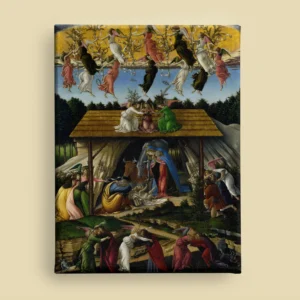
Botticelli painted the Mystic Nativity in the shadow of Savonarola. The fiery Dominican friar had convulsed Florence with his sermons about sin, purgation, and the end of the world. The Bonfire of the Vanities had burned. Botticelli himself, according to Vasari, threw some of his own paintings into the flames. The Mystic Nativity is the work of an artist in the grip of genuine religious terror, and it shows. The composition is medieval in its scale hierarchy: the Virgin and Child are largest, the angels enormous, the human figures small. Greek text across the top refers to the Apocalypse of Saint John. Three demons are trampled beneath the earth.
And yet, for all its anxiety, the painting is also radiant. The dancing angels above the stable, the tender embrace of the figures who greet each other in the foreground, the soft gold of the roof, all of it pulses with a joy that survives the fear beneath it. It hangs in the National Gallery in London. For more of Botticelli’s Christian work, see our article on Sandro Botticelli’s paintings. For a wider view of Nativity painting, see our article on famous Nativity paintings.

8. The Man of Sorrows by Sandro Botticelli (c. 1500–1510)
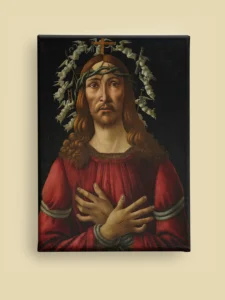
This is one of the strangest and most haunting works in Botticelli’s career. Christ faces the viewer directly, a crown of thorns on his head, his wrists bound with rope. Behind him, painted in grisaille (grey monochrome that evokes sculpture rather than flesh) a circle of angels holds the instruments of the Passion: the ladder, the spear of Longinus, the pillar, the nails. The composition belongs to an old medieval tradition, the Imago Pietatis, the image of the suffering Christ as an object of private devotion. Botticelli strips it down to its essentials and gives it an intensity that is almost unbearable.
The painting was long attributed to Botticelli’s workshop before being reattributed to the master himself following a major exhibition at the Städel Museum in Frankfurt in 2009-2010. In January 2022, it sold at Sotheby’s in New York for $45.4 million and now rests in a private collection. It is one of the rarest and most theologically concentrated works of the Italian Renaissance.

9. The Sistine Madonna by Raphael (1512)
In 1512, Raphael painted the Sistine Madonna for the church of San Sisto in Piacenza. The Pope in the image, Saint Sixtus II, gestures toward the viewer with a hand that seems to be pointing outside the frame, as if presenting the Virgin and Child to the congregation watching from below. Saint Barbara looks down with a composed, slightly melancholy expression. The Virgin, emerging from clouds, holds the Christ Child with a directness that is almost alarming: this is not a distant queen of heaven, but a mother carrying her son toward his destiny.
At the base of the painting, two winged cherubs rest their chins on their hands and gaze upward. They have become, over the centuries, perhaps the most reproduced detail in the history of art, appearing on posters, mugs, notebooks, and cushions worldwide. Their fame can make it easy to forget that the painting surrounding them is among the most quietly perfect works Raphael ever produced. It hangs in the Gemäldegalerie Alte Meister in Dresden. For more, see our dedicated article on the Sistine Madonna by Raphael.


10. Noli Me Tangere by Titian (c. 1514)
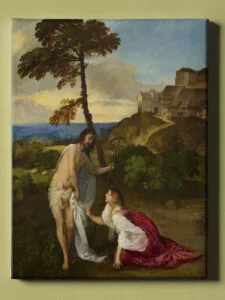
Titian painted his Noli Me Tangere around 1514, when he was still under thirty, and it already shows the qualities that would make him the greatest colorist of the Venetian Renaissance. The scene is set at dawn, with the golden light of early morning catching the folds of Christ’s white robe and illuminating Mary Magdalene’s red dress from below. Christ turns away from her outstretched hand, leaning on a gardener’s staff, his expression tender but resolved. The landscape behind them, a soft Venetian countryside with a farmhouse visible in the distance, places the Resurrection not in the abstract but in the tangible world.
Comparing this work with Fra Angelico’s version of the same scene reveals, in miniature, the distance traveled by Italian painting in seventy years. Where Fra Angelico’s figures exist in a space of spiritual allegory, Titian’s stand in real sunlight on real ground. Both approaches are true; they simply speak in different registers. The painting is at the National Gallery in London. For more on this subject, see our article on famous Noli Me Tangere paintings.

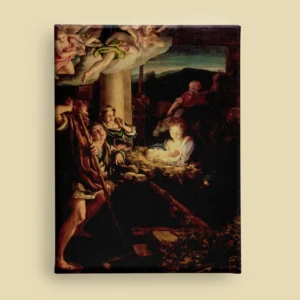
11. The Holy Night by Correggio (c. 1528–1530)
Correggio solved a problem that had occupied painters for generations: how to paint a scene whose only light source is the Christ Child himself. The Holy Night, also known as the Adoration of the Shepherds, places the newborn at the center of the composition, radiating a warm, golden light that falls across the faces of the Virgin, the shepherds, and the angels surrounding them. The effect is not merely technically impressive. It is theologically precise: Christ as the light of the world, literally, from the moment of his birth.
The shepherds react with a naturalness that was relatively new in devotional painting: one shields his eyes from the brightness, another points in astonishment. Only an angelic figure in the upper left seems fully at ease with what is happening. The painting now hangs in the Gemäldegalerie Alte Meister in Dresden, alongside the Sistine Madonna, making that gallery one of the great concentrations of Renaissance sacred painting outside Italy. For more on Correggio’s work, see our article on Correggio’s paintings.

12. The Agony in the Garden by Titian (1558–1562)
Four decades after painting the Noli Me Tangere, Titian returned to the life of Christ with the Agony in the Garden, completed for Philip II of Spain around 1562. By this point in his career, Titian was in his seventies, painting with a freedom that his contemporaries found baffling and that later generations would recognize as the origin of Baroque and even Impressionist technique. The surface is rough, the brushwork visible, the forms dissolving into light and atmosphere. Christ kneels in the foreground, an angel appearing above him, while in the middle ground the sleeping apostles and advancing soldiers create a horizon of human failure and divine resolution.
The painting was sent to the Escorial, then transferred to the Prado in 1837, where it still hangs. It is one of the supreme late paintings by one of the supreme painters of the Renaissance, and a reminder that the period’s achievement did not end with the death of Raphael in 1520. For this subject across the full history of Christian art, see our article on famous Agony in the Garden paintings. For more of Titian’s work, see our article on Titian’s paintings.


Summary of the 12 Renaissance Christian Paintings Featured in This Article
| Painting | Artist | Date | Medium | Location |
|---|---|---|---|---|
| The Annunciation | Fra Angelico | c. 1438–1440 | Fresco | Museo di San Marco, Florence |
| Noli Me Tangere | Fra Angelico | c. 1440–1441 | Fresco | Museo di San Marco, Florence |
| Adoration of the Magi | Fra Angelico and Filippo Lippi | c. 1445–1460 | Tempera on panel | National Gallery of Art, Washington D.C. |
| The Baptism of Christ | Piero della Francesca | c. 1448–1450 | Tempera on panel | National Gallery, London |
| The Annunciation | Leonardo da Vinci | c. 1472–1475 | Oil and tempera on panel | Uffizi Gallery, Florence |
| The Baptism of Christ | Andrea del Verrocchio and Leonardo da Vinci | c. 1472–1476 | Tempera and oil on panel | Uffizi Gallery, Florence |
| Mystic Nativity | Sandro Botticelli | c. 1500–1501 | Tempera on canvas | National Gallery, London |
| The Man of Sorrows | Sandro Botticelli | c. 1500–1510 | Tempera and oil on panel | Private collection |
| The Sistine Madonna | Raphael | 1512 | Oil on canvas | Gemäldegalerie Alte Meister, Dresden |
| Noli Me Tangere | Titian | c. 1514 | Oil on canvas | National Gallery, London |
| The Holy Night | Correggio | c. 1528–1530 | Oil on panel | Gemäldegalerie Alte Meister, Dresden |
| The Agony in the Garden | Titian | 1558–1562 | Oil on canvas | Museo del Prado, Madrid |
Conclusion
The twelve paintings on this list span one hundred and twenty years and range from the intimate frescoes of a Florentine convent to the vast canvases of Venice in its golden age. What they share is a conviction that sacred subjects deserve the full force of artistic intelligence, that faith and beauty are not in competition but in conversation. Fra Angelico prayed before he painted. Titian painted as if the physical world itself were a form of theology. Both were right.
Renaissance Christian painting remains, for many art lovers and believers, the highest achievement in the long history of sacred art. The works on this list are only the beginning of what the period produced. To go further, see our articles on Renaissance Jesus paintings and Italian Renaissance Jesus paintings, as well as our dedicated articles on the great painters of the period.
Frequently Asked Questions
What makes a painting “Renaissance”?
Renaissance painting, which developed in Italy between roughly 1400 and 1600, is characterized by the use of linear perspective to create convincing three-dimensional space, a new attention to human anatomy and naturalistic rendering of the body, and an interest in classical antiquity. In Christian art specifically, Renaissance painters placed sacred figures in recognizable architectural settings and gave them genuine human emotions, moving away from the symbolic flatness of medieval and Byzantine tradition.
Who are the most important Renaissance painters of Christian art?
The list is long, but among the most important are Fra Angelico, Piero della Francesca, Leonardo da Vinci, Sandro Botticelli, Raphael, Michelangelo, Titian, and Correggio. Each transformed one or more aspects of sacred painting. Fra Angelico brought spiritual intensity to fresco. Leonardo introduced sfumato and psychological complexity. Raphael achieved a harmonious perfection that became the model for centuries. Titian extended the period’s range with his revolutionary late technique. See our dedicated articles on Raphael, Titian, and Botticelli for more.
What is the most famous Renaissance Christian painting?
By almost any measure, The Last Supper by Leonardo da Vinci holds the title. Painted between 1495 and 1498 on the refectory wall of Santa Maria delle Grazie in Milan, it is the most reproduced and analyzed Christian painting in history. You will find it in our article on the Life of Christ in 20 paintings, as well as in our dedicated piece on The Last Supper by Leonardo da Vinci.
What is the difference between Early, High, and Late Renaissance painting?
The Early Renaissance (roughly 1400–1490) is the period of experimentation, when artists such as Fra Angelico, Piero della Francesca, and Botticelli worked out the principles of perspective, anatomy, and naturalistic representation. The High Renaissance (roughly 1490–1527) is the period of synthesis and perfection, when Leonardo, Raphael, and Michelangelo brought those principles to their greatest expression. The Late Renaissance, or Mannerism (roughly 1520–1600), is characterized by a deliberate departure from High Renaissance harmony toward more complex, elongated, and emotionally charged compositions, as in the late Titian and Michelangelo.
Where can I see these Renaissance Christian paintings in person?
Several are freely accessible in Florence, notably Fra Angelico’s frescoes at the Museo di San Marco and the two Leonardo paintings at the Uffizi. The Piero della Francesca and the Titian Noli Me Tangere are at the National Gallery in London. The Sistine Madonna and the Correggio Holy Night are at the Gemäldegalerie Alte Meister in Dresden. The Titian Agony in the Garden is at the Prado in Madrid. The Fra Angelico and Filippo Lippi Adoration of the Magi is at the National Gallery of Art in Washington D.C.
What happened to the Botticelli Man of Sorrows?
The Man of Sorrows had a remarkable recent history. Attributed for decades to Botticelli’s workshop, it was reattributed to the master himself following a major exhibition at the Städel Museum in Frankfurt in 2009-2010. In January 2022 it was sold at Sotheby’s in New York for $45.4 million, making it one of the most valuable Old Master paintings sold in the twenty-first century. It now belongs to a private collector.
Where can I buy reproductions of these Renaissance Christian paintings?
You can buy reproductions of these Renaissance Christian paintings at jesuschrist.pictures, in our shop. All twelve works on this list are available as high-quality canvas reproductions in our shop, including Fra Angelico’s Annunciation and Noli Me Tangere, the Verrocchio and Leonardo Baptism of Christ, Botticelli’s Mystic Nativity and Man of Sorrows, Raphael’s Sistine Madonna, and Titian’s Noli Me Tangere and Agony in the Garden.


