8 Famous Sermon on the Mount Paintings Explained
The Sermon on the Mount stands at the heart of Christ’s public ministry. Recorded in the Gospel of Matthew, chapters 5 to 7, it contains the Beatitudes and teachings that shaped Christian moral theology. Throughout history, artists have attempted to translate this sacred discourse into visual form. These Sermon on the Mount paintings reveal how different periods understood Christ as teacher, legislator, and spiritual guide.
This article is accompanied by a short podcast episode that offers an audio overview of the main themes and artworks discussed below.
Renaissance Foundations
Sermon on the Mount by Cosimo Rosselli
Painted between 1481 and 1482 for the Sistine Chapel, Rosselli’s fresco integrates the Sermon within a vast biblical landscape. Christ stands elevated at the center, surrounded by a large assembly. The expansive setting reflects early Renaissance interest in perspective and narrative clarity.
Here Christ appears as a new lawgiver. The elevated position echoes Moses receiving the Law, establishing a visual parallel between Old and New Testament authority.

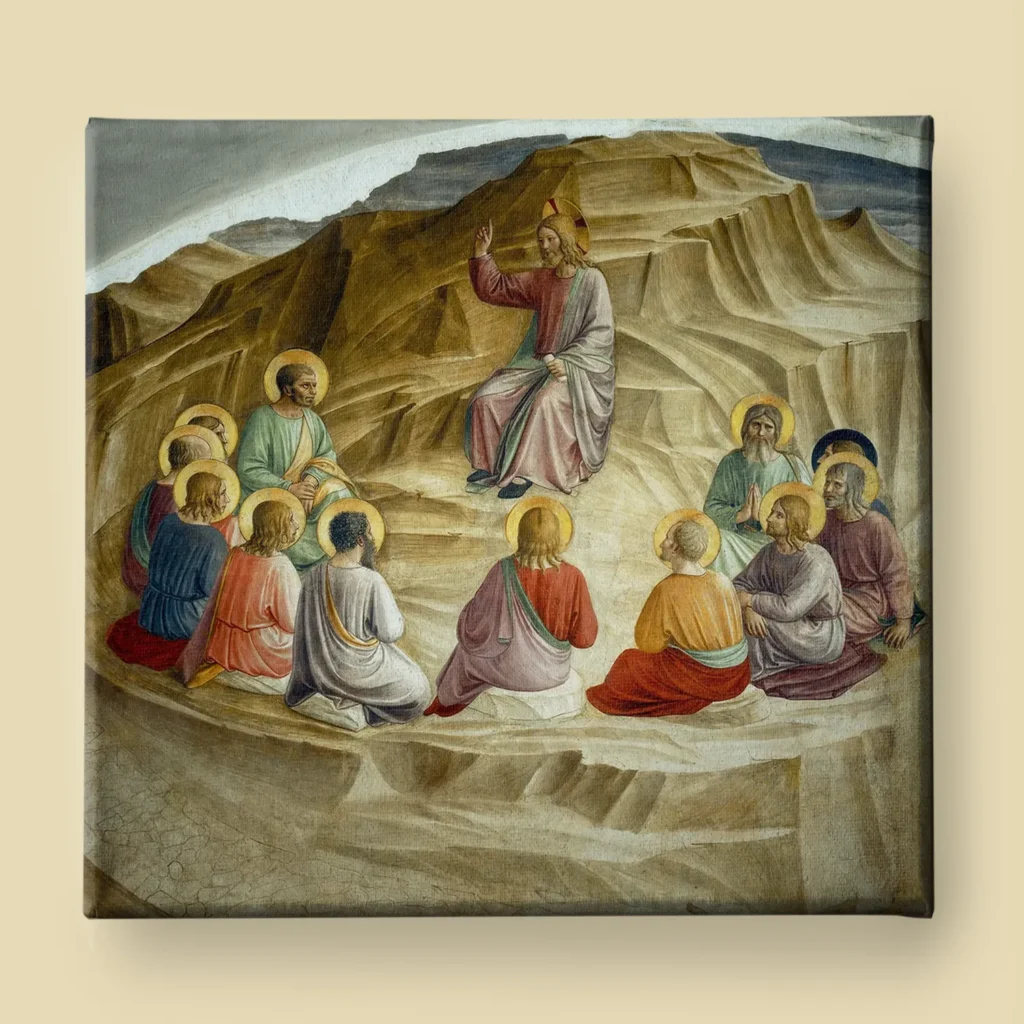
Sermon on the Mount by Fra Angelico
Fra Angelico’s fresco in the Convent of San Marco offers a more intimate interpretation. Christ sits upon simplified rocky forms, encircled by attentive disciples marked with golden halos. The composition is meditative and restrained.
The Dominican spirituality of San Marco shaped this vision. The Sermon becomes an invitation to contemplation rather than spectacle.

French and Roman Interpretations
Le sermon sur la montagne by Jean-Baptiste de Champaigne
This French classical interpretation emphasizes balance and authority. Christ gestures calmly, framed by trees and distant architecture. The composition reflects seventeenth-century order and theological clarity.
Champaigne presents Christ as master and teacher, addressing both apostles and broader audience with composed dignity.

The Sermon on the Mount by Giuseppe Bartolomeo Chiari
Chiari’s Baroque vision introduces movement and expressive gesture. Christ is elevated dramatically, while surrounding figures respond with varied emotion.
The dynamism of the scene reflects Roman Baroque spirituality, where visual intensity reinforces persuasive preaching.

19th Century Spiritual Revival
The Sermon on the Mount by Carl Bloch
Carl Bloch portrays Christ seated upon stone, blessing and instructing the crowd. The realism of faces and posture invites emotional participation.
The painting reflects Protestant devotional art of the nineteenth century, emphasizing moral reflection and personal response.

The Sermon of the Beatitudes by James Tissot
Tissot’s interpretation belongs to his monumental Life of Christ series. After traveling to the Holy Land, he reconstructed the landscape and clothing with ethnographic attention.
The Sermon unfolds across a sweeping hillside, with Christ overlooking a vast multitude. Historical authenticity strengthens devotional impact.

Modern Reinterpretations
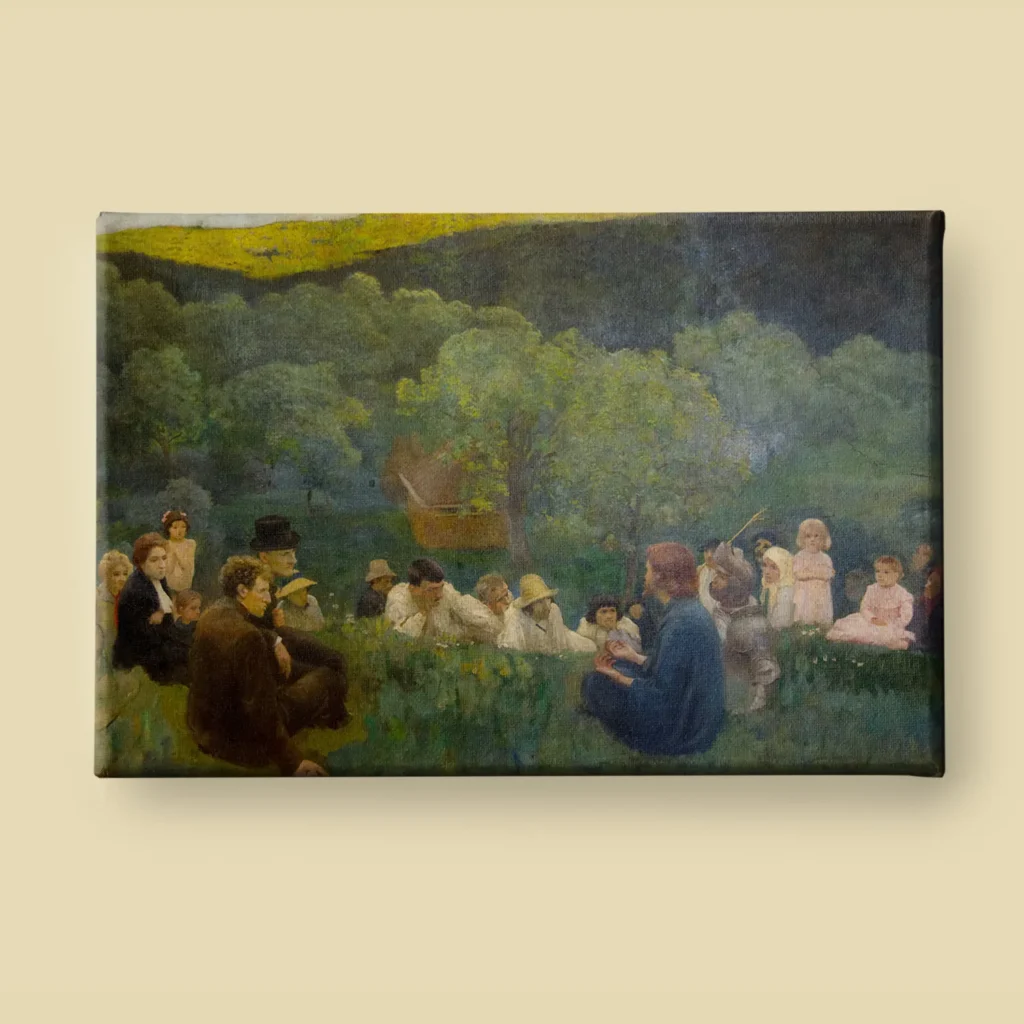
The Sermon on the Mount by Károly Ferenczy
Ferenczy places Christ among contemporary villagers in a rural setting. The green landscape softens the scene, transforming the biblical moment into a timeless message.
This modern reinterpretation highlights universality. The Beatitudes speak beyond historical setting, addressing every generation.

Le Sermon sur la montagne by Robert Arsène
Robert Arsène’s church painting reflects late nineteenth-century French religious art. The composition serves catechetical purposes within a parish environment.
The clarity of gesture and posture ensures that the faithful understand Christ’s moral teaching visually and spiritually.

The Galilean ministry that began on the mountainside also crossed the sea, where Christ walked upon the water; see our guide to Jesus walking on water paintings.
Conclusion
Across five centuries, Sermon on the Mount paintings reveal evolving artistic language while preserving theological continuity. Renaissance masters emphasized harmony and divine authority. Baroque painters introduced movement and emotional persuasion. Nineteenth-century artists sought realism and historical depth. Modern interpretations universalized the message.
The image of Christ preaching on the mountain continues to inspire because it encapsulates the ethical and spiritual foundation of Christian life.

For broader exploration of sacred masterpieces, see our guide to Famous Jesus Paintings.
✦ Free Christian & Catholic Printables
Looking for free Christian & Catholic printables? Our complete collection of illuminated prayer cards & Scripture verses (the Memorare, Psalm 23, Psalm 91 and more) is ready to print, free, in one place.
Browse all free printables →Table of Paintings
| Painting | Artist | Date | Medium | Museum / Location |
|---|---|---|---|---|
| Sermon on the Mount | Cosimo Rosselli | 1481-1482 | Fresco | Sistine Chapel, Vatican Museums |
| Sermon on the Mount | Fra Angelico | c. 1440 | Fresco | Convent of San Marco, Florence |
| Le sermon sur la montagne | Jean-Baptiste de Champaigne | 17th century | Oil on canvas | French Ministry of Culture, Base Joconde |
| The Sermon on the Mount | Giuseppe Bartolomeo Chiari | 17th-18th century | Oil on canvas | Rome, Italy |
| The Sermon on the Mount | Carl Bloch | 19th century | Oil on canvas | Statens Museum for Kunst, Copenhagen |
| The Sermon of the Beatitudes | James Tissot | 1886-1896 | Gouache on paper | Brooklyn Museum, New York |
| The Sermon on the Mount | Károly Ferenczy | Early 20th century | Oil on canvas | Hungarian National Gallery, Budapest |
| Le Sermon sur la montagne | Robert Arsène | 19th century | Church painting | Église Saint-Martin, Castelnau-d’Estrétefonds |
Frequently Asked Questions
Why is the Sermon on the Mount central in Christian art?
It contains the Beatitudes and fundamental teachings that shaped Christian moral theology, making it a powerful visual subject.
Which Renaissance artist painted the Sermon on the Mount?
Cosimo Rosselli and Fra Angelico both produced important Renaissance interpretations.
Are there modern interpretations of the Sermon?
Yes. Artists such as Károly Ferenczy reinterpreted the scene within contemporary landscapes.
Where can I buy Sermon on the Mount paintings on canvas?
You can buy Sermon on the Mount paintings on canvas at jesuschrist.pictures. Our Biblical Scenes canvas collection includes Sermon on the Mount paintings available as high-quality canvas prints, ready to hang in your home or sacred space.