Fra Angelico Paintings That Feel Like Heaven
Fra Angelico paintings occupy a singular place in the history of Christian art. Born Guido di Pietro around 1395 in Vicchio, in the Mugello hills northeast of Florence, he entered the Dominican order around 1420 and received the name Fra Giovanni da Fiesole. The title “Fra Angelico,” the angelic friar, came later, and it stuck because it described something real. His contemporaries sensed that his works came from a different interior space than those of other artists. He reportedly fasted and prayed before each session at the easel, treating painting not as a craft but as a form of contemplation. The luminous colours, the serene devotional figures, the gold and azure that seem to hold their own light: all of it flows from a faith that was lived, not performed.

A Friar Who Painted as Prayer
Fra Angelico trained in the Florentine tradition of manuscript illumination and panel painting before taking the habit. His early works show the late Gothic influence of Lorenzo Monaco, whose palette and figure types left clear marks on his formation, combined with a growing awareness of the spatial rationality of the new Renaissance. He never abandoned the gold backgrounds and hierarchical scale of the Gothic world entirely. What he did was breathe new life into them: the gold in his panels glows rather than merely reflects, and his figures, though sometimes stylized, are always inwardly present.
The Fiesole Altarpiece, painted for the church of San Domenico in Fiesole, where Fra Angelico himself served as prior, is one of his most carefully organized early compositions. The Virgin and Child are enthroned at the centre, flanked by saints in an arrangement that shows clear awareness of Masaccio’s new ideas about pictorial depth. The work was later modified by Lorenzo di Credi, but enough of Fra Angelico’s original survives to show how seriously he was engaging with the emerging Renaissance language of unified pictorial space. For a comparison with the more austere Early Renaissance style, see our article on Masaccio paintings.

The San Pietro Martire Triptych at the Museo di San Marco in Florence belongs to roughly the same period. It shows the Dominican martyr Peter of Verona flanked by the Virgin and by saints, with fine gold detailing still close to the Gothic tradition but the figures already positioned with the natural ease that would mark all of Fra Angelico’s mature work. These early triptychs were made for Dominican churches and communities, an audience that shared his theology and understood the language he was speaking.

Marian Devotion in Paint
Among Fra Angelico’s recurring subjects, the Virgin Mary appears in almost every form: enthroned, humble, crowned, grieving. The Madonna and Child at the Hermitage Museum in Saint Petersburg is one of the quietest of these images. The Virgin looks not at the viewer but at something beyond the frame, with an expression that holds both joy and foreknowledge of loss. The gold tooling around the haloes is worked with the precision of a miniaturist who has not forgotten his origins.

The Madonna of Humility at the Museu Nacional d’Art de Catalunya in Barcelona takes a different theological approach. The Virgin sits on the ground rather than a throne, nursing the Christ Child, in a posture that was a deliberate statement: the Queen of Heaven choosing to be lowly. Fra Angelico returned to this subject several times over his career, each version a meditation on the paradox at the heart of the Incarnation. The subject was common in fourteenth-century Sienese painting, and Fra Angelico brought it fully into the Florentine Renaissance without losing its devotional charge.

Here is another version of Fra Angelico’s Madonna of Humility

The Coronation of the Virgin at the Uffizi Gallery in Florence is one of his most visually elaborate compositions. The crowning of Mary in heaven is shown against a blaze of gold, with ranks of angels and saints in attendance. The musical angels in the lower register bring a note of physical joy to a scene that is otherwise ceremonial and hierarchical. Fra Angelico painted this work for the church of Sant’Egidio in Florence, and it was one of the most admired altarpieces in the city during his lifetime.

The Annunciation
No subject drew Fra Angelico back more consistently than the Annunciation. He painted it on panel, in fresco, for refectories and corridors and cells. The version he made for the main corridor of the convent of San Marco in Florence, around 1440 to 1445, is the one that has become definitive. The Annunciation shows Gabriel kneeling before the Virgin beneath a simple stone loggia, the space architectural, calm, and perfectly measured. Light enters from the left and falls softly on both figures. In a lunette above the arch, Adam and Eve are expelled from the Garden of Eden, the cause of the very mystery now being announced below them.


Fra Angelico placed this fresco at the top of the stairs leading to the friars’ cells, a position he chose deliberately. Every friar ascending to his room for prayer passed before this image of the moment when heaven agreed to enter time. It was not decoration. It was instruction. The painting’s extraordinary serenity comes partly from this function: it was made to still a mind before meditation, not to excite it.
The San Marco Frescoes
Between roughly 1438 and 1445, Fra Angelico led a small team in decorating the renovated convent of San Marco, rebuilt under the patronage of Cosimo de’ Medici. Each of the friars’ cells received its own fresco of a sacred scene, designed for private meditation rather than public display. The San Marco Altarpiece represents the formal public face of this period: a large sacra conversazione with the Virgin enthroned and saints grouped naturally around her on a continuous ground plane, one of the earliest Florentine paintings to abandon the traditional polyptych format entirely in favour of this unified spatial arrangement.

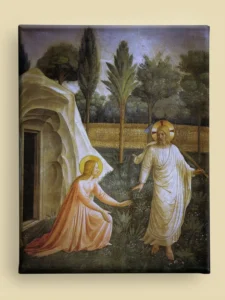
Among the cell frescoes, the Noli me tangere is the most intimate image Fra Angelico ever made. Mary Magdalene reaches toward the risen Christ in the garden, and he draws back gently, his gesture kind rather than harsh. The garden setting is dewy and specific, the morning light clear. The emotional charge of the scene lies entirely in the contrast between her yearning movement and his quiet withdrawal. It is a painting about the limits of physical contact with the divine, made for a friar who had chosen to live within those very limits. As part of the broader tradition of Renaissance Jesus paintings, it stands apart for its silence.

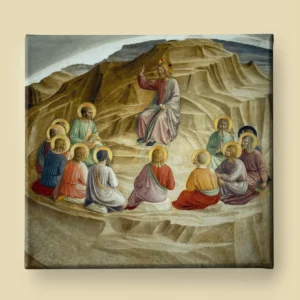
The Sermon on the Mount, also in the San Marco cells, shows Christ teaching from a hillside while the apostles listen at his feet. The composition is stripped to its essentials: the teacher, the taught, the open landscape. Nothing competes for attention. The Adoration of the Magi, another fresco in the San Marco complex, brings a contrasting richness, the procession of the Magi carrying all the colour and pageantry of the earthly world into the presence of the Christ Child.



Passion, Baptism, and Judgment
Fra Angelico’s treatment of the Passion is consistently marked by restraint. He shows suffering without dwelling on it, sorrow without sentimentality. The Deposition of Christ, with a celebrated version at the Museum of San Marco painted for the Florentine confraternity of Santa Maria della Croce al Tempio, shows the body of Christ being lowered from the cross by a group of mourners whose grief is entirely in their posture. The landscape behind opens into a Florentine countryside recognizable to any contemporary viewer, grounding the sacred event in a specific, familiar world.

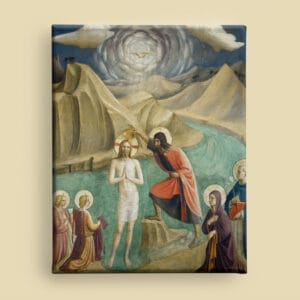
The Baptism of Christ at the National Museum of San Marco shows Christ in the Jordan as John pours water from a shell overhead. Angels attend on the bank, their robes arranged with the careful variety Fra Angelico brought to all his celestial figures. The dove descends from a golden sky in a composition that moves the eye naturally upward, from the water to the Word. The painting has the calm certainty of all Fra Angelico’s depictions of divine action: not dramatic, but irrevocably true.

The Crucifixion at the Metropolitan Museum of Art in New York concentrates the event into a composition of great stillness. Mary and John stand at the foot of the cross, their grief absorbed rather than displayed. For Fra Angelico, the Crucifixion was never a spectacle; it was a fact to be contemplated. This small panel was made for private devotion, and it communicates directly with whoever holds it in still hands.


The Martyrdom of St Lawrence, painted in the 1450s for the private chapel of Pope Nicholas V in the Vatican, is one of Fra Angelico’s most spatially ambitious late frescoes. Lawrence is shown on the gridiron in a public Roman setting, surrounded by soldiers and onlookers. Despite the violence, the fresco holds its characteristic dignity: the saint looks toward heaven, and his face carries no distortion of pain. Among his late Roman contemporaries, Fra Angelico stands apart, with Filippo Lippi representing the worldlier side of the Florentine devotional tradition.

The Last Judgment at the Museo di San Marco is one of his most theologically ambitious panels. The blessed move in orderly procession into a luminous paradise at the left; the damned are driven into a dark and chaotic hell at the right; Christ sits in majesty at the top, flanked by the Virgin and John. Fra Angelico’s paradise is a field of light and communion; his hell is the absence of both. The painting is a summa of his theology rendered in colour and form. It belongs in the same tradition as Michelangelo’s Last Judgment in the Sistine Chapel, but arrives at entirely different emotional conclusions.

Fra Angelico worked at the intersection of the medieval and the modern, taking gold from the Byzantines, space from Brunelleschi, light from God, and combining all three into something that had never existed before. The works he left at San Marco, in Rome, and in collections across Europe and America continue to do what they were made to do. They are objects of prayer that found their way into museums. The prayer still works.
Summary of Fra Angelico’s Major Paintings
| Painting | Artist | Date | Medium | Museum |
|---|---|---|---|---|
| Fiesole Altarpiece | Fra Angelico | c. 1424-1430 | Tempera on panel | Convent of San Domenico, Fiesole |
| San Pietro Martire Triptych | Fra Angelico | c. 1428-1429 | Tempera on panel | Museo di San Marco, Florence |
| Madonna and Child | Fra Angelico | c. 1430 | Tempera on panel | Hermitage Museum, Saint Petersburg |
| Madonna of Humility | Fra Angelico | c. 1430 | Tempera on panel | Museu Nacional d’Art de Catalunya, Barcelona |
| Coronation of the Virgin | Fra Angelico | c. 1432 | Tempera on panel | Uffizi Gallery, Florence |
| Deposition of Christ | Fra Angelico | c. 1432-1435 | Tempera on panel | Museo di San Marco, Florence |
| San Marco Altarpiece | Fra Angelico | c. 1438-1440 | Tempera on panel | Museo di San Marco, Florence |
| Annunciation | Fra Angelico | c. 1440-1445 | Fresco | Museo Nazionale di San Marco, Florence |
| Adoration of the Magi | Fra Angelico | c. 1440-1445 | Fresco | Museo di San Marco, Florence |
| Noli me tangere | Fra Angelico | c. 1440-1441 | Fresco | Museo di San Marco, Florence |
| Sermon on the Mount | Fra Angelico | c. 1440-1441 | Fresco | Museo di San Marco, Florence |
| The Baptism of Christ | Fra Angelico | c. 1440-1441 | Fresco | Museo Nazionale di San Marco, Florence |
| The Crucifixion | Fra Angelico | c. 1440-1445 | Tempera on panel | Metropolitan Museum of Art, New York |
| Martyrdom of St Lawrence | Fra Angelico | c. 1447-1449 | Fresco | Apostolic Palace, Niccoline Chapel, Vatican |
| The Last Judgment | Fra Angelico | c. 1425-1430 | Tempera on panel | Museo di San Marco, Florence |
Important Facts About Fra Angelico
- Guido di Pietro was born around 1395 in Vicchio, in the Mugello hills of northern Tuscany, and entered the Dominican order around 1420, receiving the name Fra Giovanni da Fiesole.
- He trained as an illuminator and panel painter in the Florentine tradition before taking the habit, likely influenced by Lorenzo Monaco, whose late Gothic style clearly marked his early works.
- Fra Angelico is the defining painter of the Early Italian Renaissance devotional tradition, known for a luminous palette of gold and pure blue and for figures of serene spiritual intensity that seem to radiate rather than reflect light.
- His most celebrated work is the Annunciation fresco at the convent of San Marco in Florence, painted around 1440 to 1445 and now at the Museo Nazionale di San Marco.
- He died on February 18, 1455, in Rome, while working on frescoes for Pope Nicholas V, and was beatified by Pope John Paul II in 1982 under the title Beato Angelico.
Questions and Answers About Fra Angelico’s Paintings
What is Fra Angelico’s most famous painting?
The Annunciation at the convent of San Marco in Florence, painted around 1440 to 1445, is universally regarded as his most celebrated work. It shows the Angel Gabriel kneeling before the Virgin in a stone loggia, in a composition of luminous simplicity that became one of the defining images of the Early Renaissance. It is housed today at the Museo Nazionale di San Marco in Florence, which occupies the very convent where Fra Angelico lived and worked. The building itself, with its cycle of decorated friars’ cells, is one of the most moving artistic environments to survive from the fifteenth century.
Was Fra Angelico really a saint?
Fra Angelico was beatified, not canonized. Pope John Paul II proclaimed him Blessed on October 3, 1982, giving him the title Beato Angelico. He is venerated as the patron of artists in the Catholic Church, and his feast day falls on February 18. His cause for canonization remains open, but he has not yet been formally declared a saint. The title “Fra Angelico,” meaning the angelic friar, was used in his lifetime and reflects how his contemporaries perceived the spiritual quality of his art and his manner of life.
Where can I see Fra Angelico’s paintings?
The largest and most significant collection is at the Museo Nazionale di San Marco in Florence, which occupies the former Dominican convent where Fra Angelico worked. The museum holds the full cycle of cell frescoes, the Annunciation, the Deposition, the Last Judgment, and many panel paintings. The Uffizi Gallery, also in Florence, holds the Coronation of the Virgin. The National Gallery of Art in Washington holds his Adoration of the Magi. The Metropolitan Museum of Art in New York holds the Crucifixion panel. The Vatican Museums include his frescoes in the Niccoline Chapel, the private chapel of Pope Nicholas V.
How is Fra Angelico different from other Early Renaissance painters?
The essential difference is his relationship between art and devotion. Masaccio and his circle were primarily interested in the structural problems of representing space and the human figure realistically. Fra Angelico was interested in these problems too, but always in the service of a spiritual end. His use of light, his restraint in depicting suffering, and his preference for serene over dramatic compositions all reflect a Dominican theology in which beauty is a path to God. His technical mastery was considerable, but it was never the point.
Did Fra Angelico really pray before painting?
The tradition that Fra Angelico prayed before beginning each painting session goes back to his earliest biographers, including Giorgio Vasari, who wrote in his Lives of the Artists that Fra Angelico never took up a brush without first praying and that he never retouched or corrected a finished image, believing whatever emerged from his hand was divinely guided. Whether these accounts are strictly factual or somewhat idealized is difficult to know. What is certain is that his contemporaries sensed something in his work that went beyond technical skill, and that the tradition of prayer reflects a genuine perception of the sacred quality his paintings carry.
What technique did Fra Angelico use?
Fra Angelico worked primarily in egg tempera on panel for his altarpieces and devotional paintings, and in buon fresco (painting onto fresh wet plaster) for his wall paintings at San Marco and in Rome. His tempera technique preserved the Gothic tradition of pure, unmixed pigments applied in thin layers over a white ground, giving his paintings their characteristic intensity of colour. His gold backgrounds were applied using gold leaf laid on bole, a warm clay preparation that gave the gold a luminous undertone. His fresco technique, developed for the small-scale cell paintings at San Marco, was adapted for intimate meditation rather than large public narrative.
Where can I buy a canvas reproduction of a Fra Angelico painting?
You can buy them at jesuschrist.pictures, in our shop: see all the canvas canvas prints, ready to hang, in several sizes.


