7 Noli Me Tangere Paintings You Must See
The meeting between Christ and Mary Magdalene after the Resurrection is one of the most tender and theologically rich moments in Christian art. Known by the Latin words Noli Me Tangere, usually translated as “Do not touch me,” this scene comes from John 20:17 and has inspired painters from the Middle Ages to the nineteenth century. It brings together recognition, restraint, joy, sorrow, and a new understanding of the risen body of Christ.

For artists, this subject offered far more than a simple Gospel episode. It made it possible to show Christ not in suffering, but in glory after suffering. It also gave painters the chance to depict Mary Magdalene as the first witness of the Resurrection, a figure of devotion, repentance, and spiritual love. Whether the setting is a quiet garden, a luminous landscape, or a solemn frescoed wall, the emotional force remains the same. She reaches toward Him, and He gently holds her back, inviting faith deeper than physical contact.
These seven paintings show how the image changed across time. Giotto gives the scene a firm narrative clarity. Fra Angelico turns it into a place of meditation. Titian and Correggio bring softness, atmosphere, and natural beauty. Lavinia Fontana offers a rare and important female voice within sacred art. Anton Raphael Mengs reorders the subject with classical balance, while Alexander Ivanov fills it with deep feeling. Together, these works form a beautiful sequence in the history of Christian painting.
The Meaning of Noli Me Tangere in Christian Art
The phrase Noli Me Tangere has fascinated theologians, painters, and viewers for centuries because it seems at once intimate and mysterious. Mary Magdalene has come to the tomb in grief. She finds it empty, weeps, turns, and then recognizes the risen Christ. It is a scene of reunion, but not the kind she expected. Instead of inviting physical closeness, Christ speaks words that create a sacred distance. He is the same Jesus she loved and followed, yet He now belongs to a glorified condition beyond ordinary earthly contact.
Christian artists understood that this was not a rejection of Mary Magdalene, nor a denial of tenderness. It was a revelation. Christ asks her to see Him in a new way. In many paintings, that theological shift is expressed through gesture. Mary kneels, reaches, or opens her hands in yearning. Christ steps back, raises one hand in blessing or gentle refusal, and points the mind toward what is now spiritual rather than bodily. The small gap between the two figures becomes one of the most eloquent spaces in religious painting.
This scene also gave special dignity to Mary Magdalene. In Christian tradition, she is the first witness of the risen Lord, and that role made her central to Resurrection imagery. Artists often show her as intensely human, full of emotion, humility, and wonder. Christ, by contrast, is calm, poised, and already marked by resurrection light. The contrast heightens the drama. She belongs to the world still learning what has happened. He stands at the threshold between earth and heaven.
The subject also changed with artistic style. Medieval painters favored doctrinal clarity and symbolic placement. Early Renaissance artists added stillness and interior prayer. High Renaissance painters brought natural landscapes and more persuasive human anatomy. Later artists used the scene to explore classicism, sentiment, and spiritual emotion. Yet despite these changes, the message remained steady. Noli Me Tangere is not merely a moment of restraint. It is a moment of recognition, faith, and transformation. The Resurrection is real, but it opens onto a new order of presence.
Early Visions: Giotto and Fra Angelico
Noli Me Tangere by Giotto
Giotto’s Noli Me Tangere, painted around 1304 to 1306 in the Scrovegni Chapel in Padua, stands among the earliest great treatments of this Gospel scene in Western painting. The fresco belongs to his vast cycle on the life of Christ, and it shows why Giotto remains such a decisive figure in the move away from Byzantine stiffness toward a more human sacred art. Even within the limited space of the chapel wall, he gives the episode clarity, structure, and emotional focus. The risen Christ appears at the right with the Resurrection banner, while Mary Magdalene bends toward Him in longing. Around them, the open tomb, the sleeping guards, and the angels help anchor the event within the full narrative of Easter morning.
What makes Giotto’s version so important is the balance between story and feeling. The arrangement is easy to read, which mattered in a chapel setting intended for devotion and instruction. Yet the painting is far from cold. The body language already carries deep meaning. Christ’s movement away from Mary Magdalene is gentle but firm. Her posture conveys both recognition and sorrow. Giotto does not rely on elaborate effects. He builds emotion through simple, solid forms and a clear relation between figures.
This medieval fresco also shows how early artists understood the theological core of the subject. Christ is alive, victorious, and no longer bound to ordinary earthly presence. The banner in His hand confirms triumph over death, while the tomb and the sleeping soldiers remind the viewer that the Resurrection has just broken into history. The scene is not only personal but cosmic. It joins the intimacy of one encounter with the victory of salvation.
This early interpretation reflects the foundations of sacred storytelling that defined medieval Christian art. For a deeper understanding of this period, you may have a look at our guide to Medieval Jesus paintings.

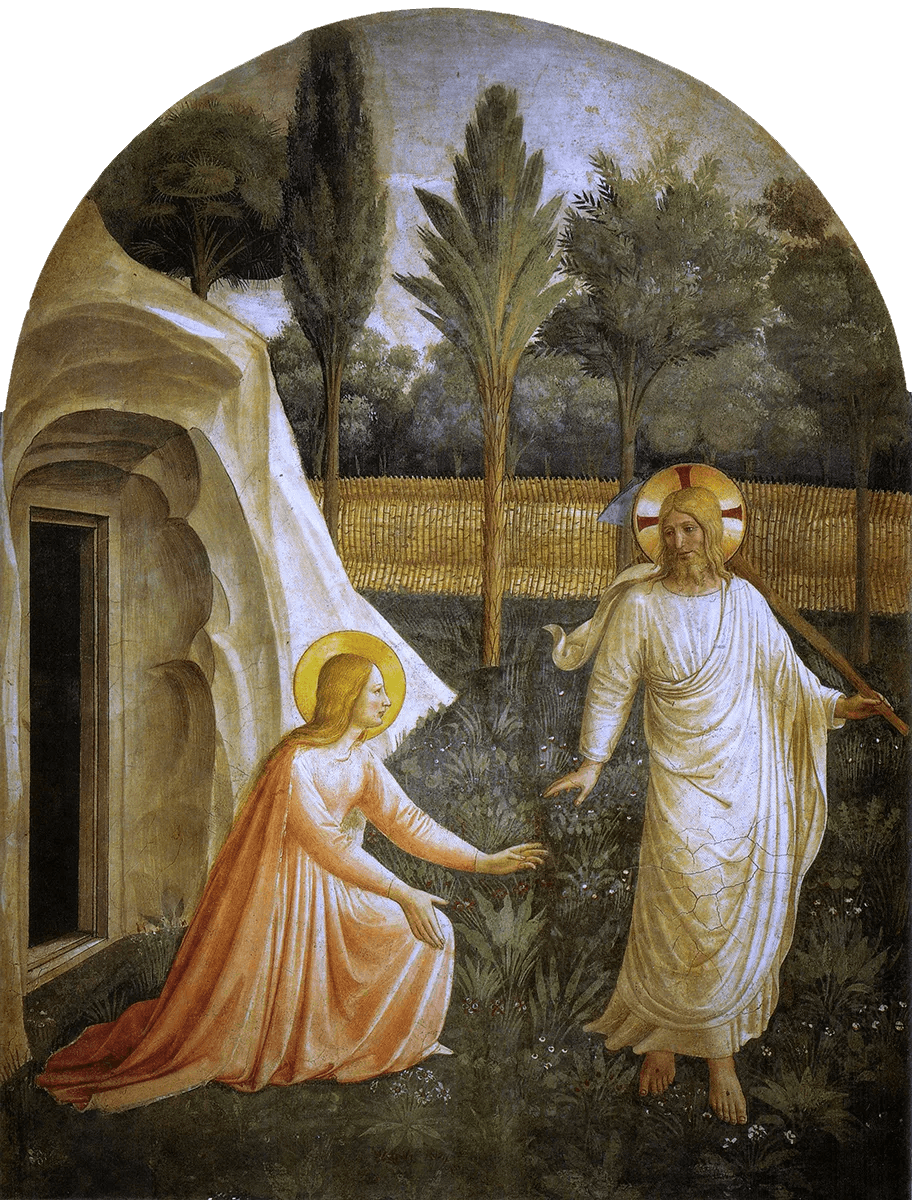
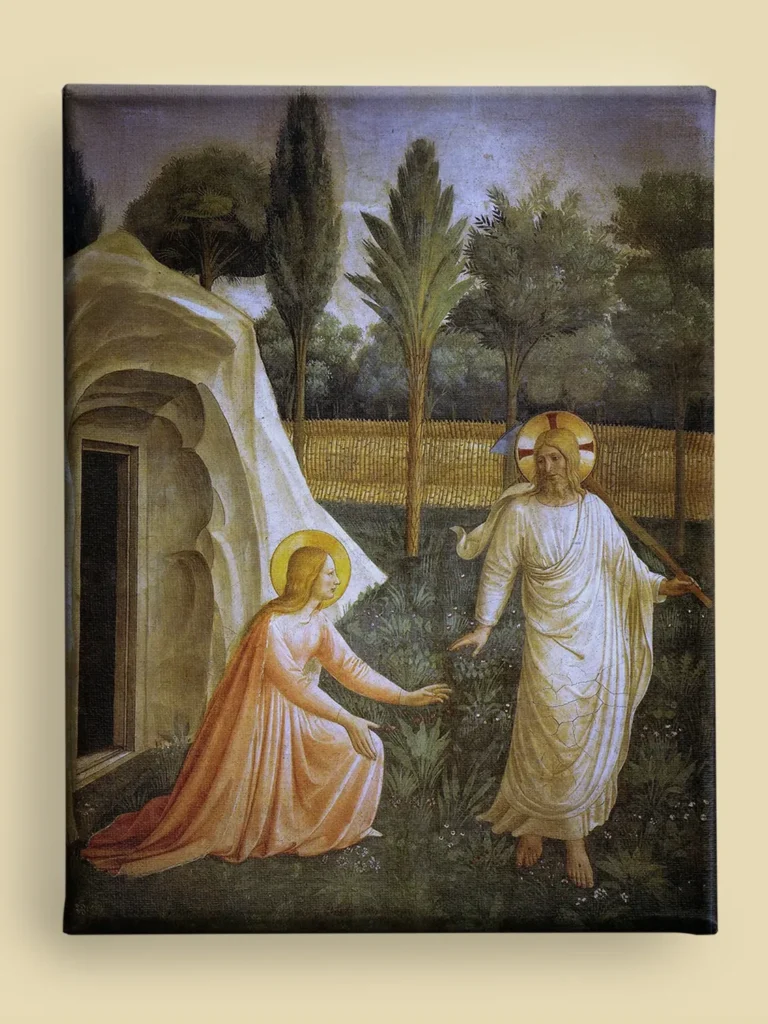
Noli Me Tangere by Fra Angelico
Fra Angelico’s Noli Me Tangere, painted around 1438 to 1440 in the convent of San Marco in Florence, is one of the most beautiful meditations on this subject. Unlike Giotto’s more public narrative fresco, this image belongs to a monastic setting shaped by prayer, silence, and contemplation. Fra Angelico, himself a Dominican friar, was particularly suited to transform biblical scenes into aids for spiritual reflection. In his hands, the encounter between Christ and Mary Magdalene becomes less dramatic in outward action and more profound in inward meaning.
The composition is simple, but carefully ordered. Christ stands in the garden with a serene authority, while Mary Magdalene kneels before Him in reverence. The landscape is enclosed and calm, almost like a protected sacred space removed from the noise of the world. Fra Angelico pays close attention to the plants, the fence, and the soft distribution of color. These details are not mere ornament. They help create a place of quiet awakening, where the Resurrection is received in peace. Christ’s gesture is restrained, and Mary’s response is humble. Their distance is slight, but filled with theological weight.
This fresco is often admired for its purity. Fra Angelico avoids theatrical excess. He uses clarity, light, and measured form to direct the mind toward prayer. The result is deeply moving because it trusts stillness. One feels that the message is not shouted but gently offered. The Resurrection is present, yet it enters the heart through contemplation. This is one reason the work continues to speak so powerfully to Christian viewers today. It presents the risen Christ not only as triumphant, but as a source of inner peace.
Fra Angelico’s work marks a turning point toward the spiritual clarity and harmony of the Renaissance. You can learn more about this transformation in our article on Renaissance Jesus paintings.
Renaissance Masterpieces: Titian, Correggio, and Lavinia Fontana
Noli Me Tangere by Titian
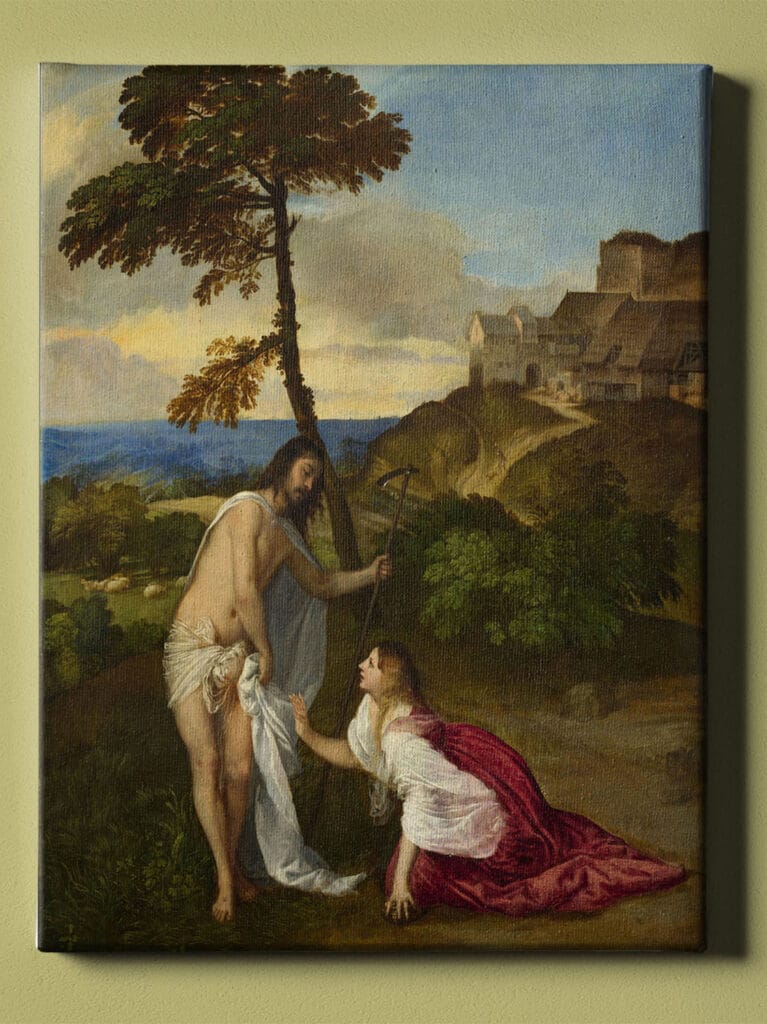
Titian’s Noli Me Tangere, painted around 1514 and now in the National Gallery in London, is one of the most famous versions of the subject. It belongs to the early phase of his career, when Venetian painting was reaching a remarkable union of landscape, atmosphere, and human presence. In this work, the scene unfolds in open air, with Christ and Mary Magdalene placed within a living world of grass, trees, and sky. The result is lyrical, luminous, and full of restrained feeling.
Titian gives the risen Christ a graceful movement, as though He is already stepping beyond earthly grasp. Mary Magdalene kneels with urgent devotion, her body inclining toward Him. A hoe in Christ’s hand recalls the mistaken impression that He was the gardener, a detail drawn directly from the Gospel narrative and turned into a subtle sign of new life. Titian’s handling of the landscape is especially important. Nature does not serve merely as background. It reflects the scene’s emotional and spiritual renewal. The dawn-like light, the open space, and the soft transitions of color all support the meaning of the Resurrection.
What distinguishes Titian’s painting is the way it binds doctrine to beauty. The scene is easy to understand, but it is also deeply poetic. Christ’s body is ideal yet human, and Mary’s emotion is intense without losing dignity. The encounter becomes both sacred history and visual meditation. That combination has made the painting a lasting favorite in Christian art. It captures the delicate instant when grief gives way to recognition, but before closeness is restored in the old form.
This masterpiece belongs to the golden age of Venetian painting, where nature, light, and human emotion reached new heights. To learn more from this remarkable period, see our selection of Italian Renaissance Jesus paintings.

Noli Me Tangere by Correggio
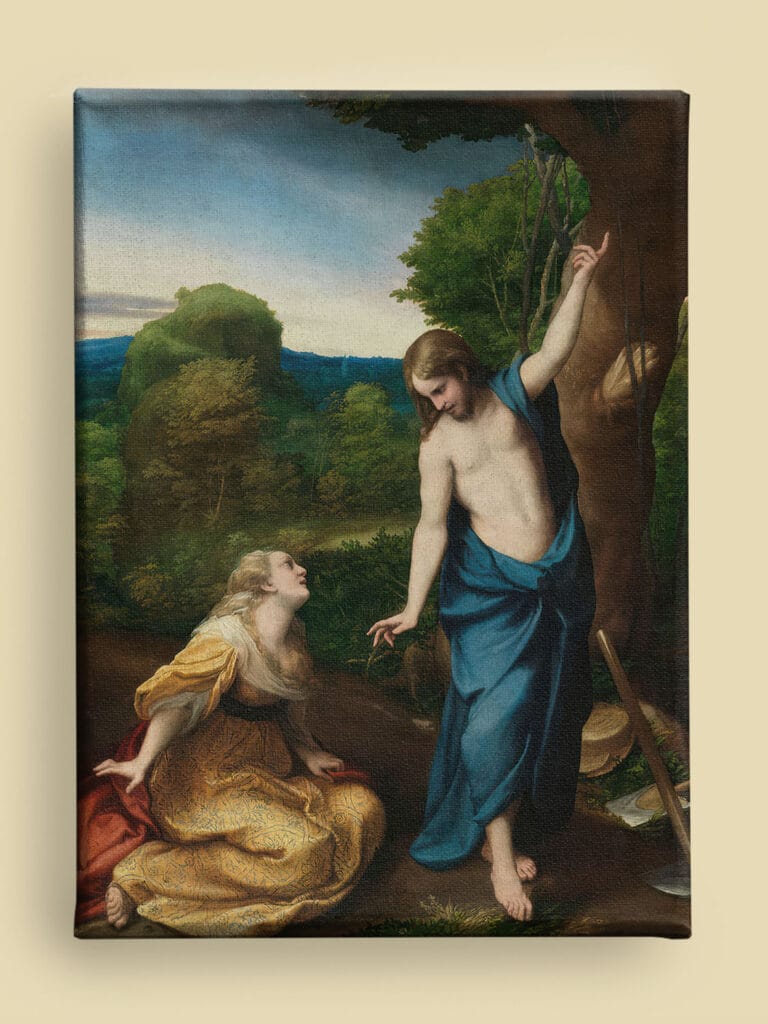
Correggio’s Noli Me Tangere, painted about 1525 and now in the Prado Museum in Madrid, offers one of the most tender and refined treatments of the theme. Correggio had a rare gift for softness, light, and emotional suggestion. In this painting, that gift serves the subject perfectly. Christ and Mary Magdalene are placed in a landscape that feels intimate rather than grand. The forms are gentle, the atmosphere is warm, and the exchange between the figures is charged with feeling.
The painting is notable for the way Correggio combines physical beauty with spiritual delicacy. Christ’s body is elegant and calm, his gesture of withdrawal measured and almost protective. Mary Magdalene bends toward Him with devotion, yet the tone is never harsh or abrupt. This matters greatly for the theology of the scene. Correggio understands that Christ’s words are not a refusal of love, but a redirection of love toward a new reality. The image communicates this through grace rather than severity.
Correggio also excels in the treatment of light and surface. Flesh, drapery, plants, and sky are all rendered with a softness that helps the eye move slowly through the scene. The painting rewards contemplation. One does not simply register the event, but remains within it. The emotional truth unfolds through delicate transitions rather than strong contrasts. For that reason, this version has often been admired as one of the most beautiful visual expressions of post-Resurrection tenderness.
Placed between the devotional reserve of Fra Angelico and the classical discipline of later painters, Correggio’s work occupies a special position. It shows how the High Renaissance could make theology visible not only through order and symbolism, but also through tenderness, atmosphere, and human warmth.

Noli Me Tangere by Lavinia Fontana
Lavinia Fontana’s Noli Me Tangere, painted in 1581 and kept in the Uffizi in Florence, deserves far more attention than it usually receives. Fontana was one of the first women in Europe to build a major professional career as a painter, and her treatment of sacred subjects is of great importance for the history of Christian art. Her version of Noli Me Tangere joins the established iconography of the scene with a distinct sensitivity to gesture, costume, and narrative grace.
What makes this work especially interesting is its place within the late Renaissance and within the career of a woman artist working at a high level in a field largely dominated by men. Fontana approaches the subject with seriousness and compositional clarity. Christ and Mary Magdalene remain the focus, but the surrounding setting, the folds of fabric, and the elegant arrangement of forms show her training in the learned culture of Bolognese painting. The scene is devotional, yet also intellectually composed, with an attention to refinement that marks her style.
Her Mary Magdalene is particularly compelling. Rather than appearing merely as a stock penitent figure, she becomes a person of strong feeling and dignity. Christ, meanwhile, is presented with calm authority. The distance between them remains central, but Fontana gives the moment a polished visual balance that reflects the discipline of late sixteenth-century sacred art. The painting speaks both to faith and to artistic ambition. It demonstrates that this Gospel theme could still be renewed after generations of famous treatments.
For modern readers, Fontana’s Noli Me Tangere also broadens the story of Christian painting itself. It reminds us that sacred art was not shaped only by the most commonly cited male masters. Her work belongs fully within the great tradition and adds an important voice to it. In an article such as this, her presence is essential.

Later Interpretations: Anton Raphael Mengs and Alexander Ivanov
Noli Me Tangere by Anton Raphael Mengs
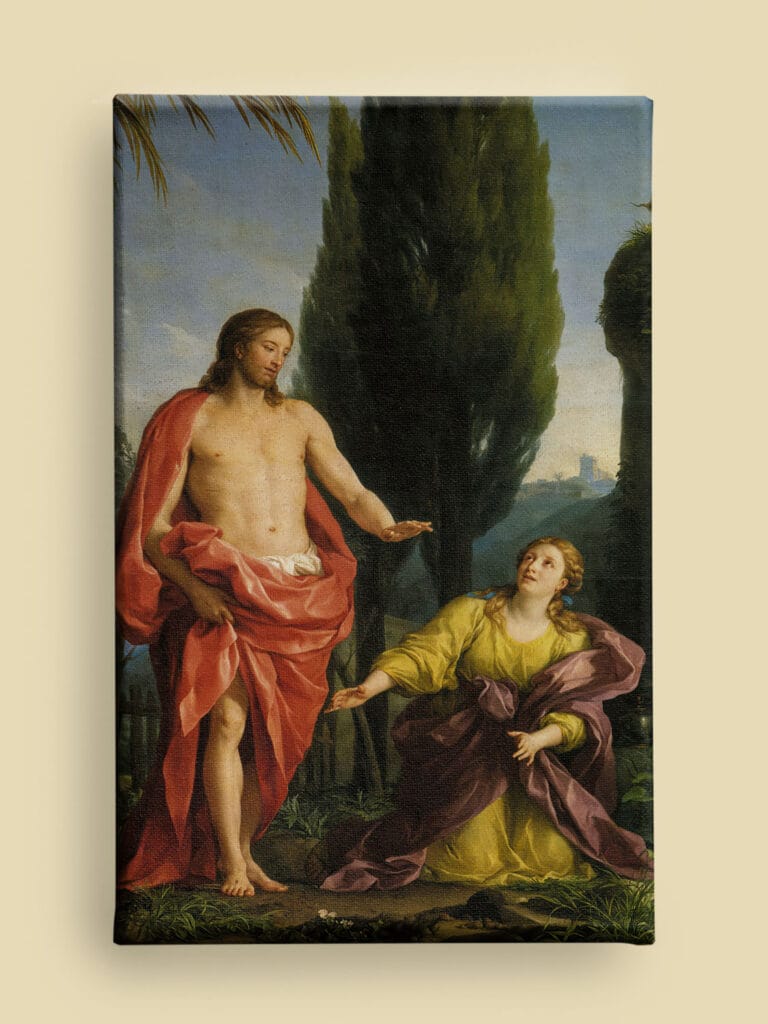
Anton Raphael Mengs brought the subject into a more classical language. His Noli Me Tangere, painted around 1770 and associated with All Souls College, Oxford, shows how the theme could be reshaped within the ideals of eighteenth-century history painting. Mengs was deeply committed to order, noble form, and the study of antique and Renaissance models. In his hands, the encounter between Christ and Mary Magdalene becomes calm, balanced, and elevated. Emotion remains present, but it is disciplined by composition.
This classical restraint does not weaken the spiritual force of the work. Rather, it gives the scene a sense of dignity and permanence. Christ appears with clarity and measured grace. Mary Magdalene’s response is sincere and moving, yet never uncontrolled. The space between them is expressed through carefully organized lines and poses. Mengs treats the biblical moment almost as an ideal sacred drama, one where the truth of the Resurrection is communicated through harmony and noble gesture.
Such an approach reflects a broader shift in religious art. By the eighteenth century, many artists were looking back to Raphael and classical antiquity as models of perfection. Mengs joined that movement and applied it to Christian subjects with seriousness. His Noli Me Tangere is not as atmospheric as Titian or as soft as Correggio, but it offers something else: a purified visual language suited to reverence, order, and thoughtful reflection. It shows that the scene could remain alive even when filtered through a different artistic ideal.
For readers interested in how Christian themes survived and adapted beyond the Renaissance, Mengs is an important figure. His version proves that Noli Me Tangere continued to matter not only as a devotional subject, but as one of the enduring tests of sacred composition.

Noli Me Tangere by Alexander Ivanov
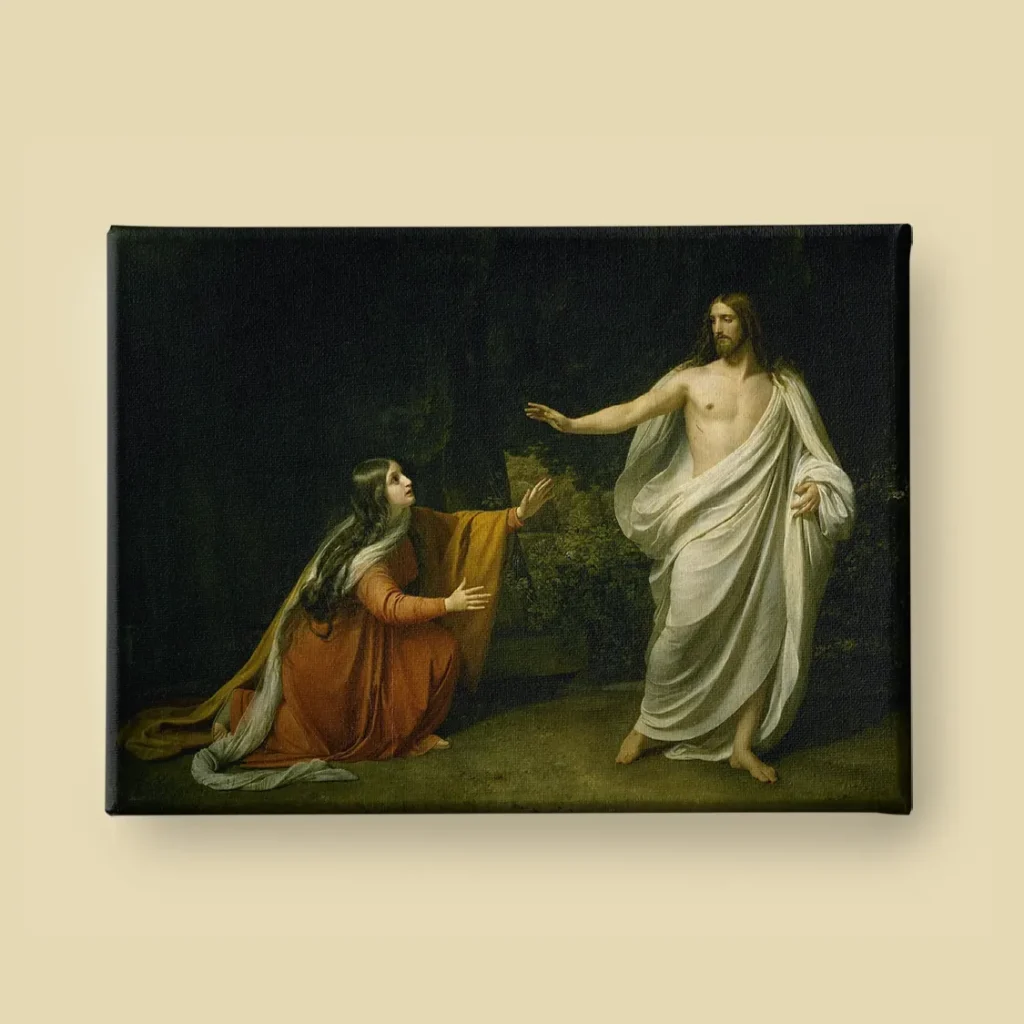
Alexander Ivanov’s Noli Me Tangere, often titled Christ’s Appearance to Mary Magdalene after the Resurrection, was painted in 1835 and is now in the Tretyakov Gallery in Moscow. It brings the theme into the nineteenth century with a new emotional intensity. Ivanov is best known for his large religious ambitions and for the spiritual seriousness that shaped his art. In this painting, that seriousness is felt immediately. The scene is no longer governed mainly by symbolic clarity or classical order, but by a searching human emotion.
Ivanov’s treatment of Mary Magdalene is especially striking. Her recognition of Christ feels deeply personal, almost trembling in its sincerity. Christ remains composed, yet his presence is filled with moral and spiritual gravity. The painting belongs to a world that had absorbed both academic discipline and Romantic feeling. This combination allows Ivanov to make the biblical episode both historically grounded and inwardly intense. The figures are persuasive as bodies, but also charged with spiritual meaning.
In Ivanov’s hands, Noli Me Tangere becomes a scene about longing transformed by grace. The pause between the two figures is emotionally powerful. One senses Mary Magdalene’s joy, but also the pain of learning that the relationship has changed. Christ’s restraint opens a path toward faith that is less immediate, yet more enduring. The subject is therefore not diminished by the passing of centuries. It becomes newly alive in a modern language of feeling.
Ivanov’s work is a fitting close to this sequence because it shows the lasting power of the theme. Even after medieval fresco, Renaissance harmony, and classical order, the encounter in the garden still had the ability to move artists deeply. It remained one of the most human and most mysterious moments in the art of Christ.

Conclusion
These seven paintings show the remarkable richness of a single Gospel moment. Across centuries, artists returned to Noli Me Tangere because it allowed them to paint more than an encounter between two figures. It opened a way to reflect on the Resurrection itself, on the glorified body of Christ, on the role of Mary Magdalene, and on the shift from earthly attachment to spiritual recognition. Few subjects join doctrine and emotion so perfectly.
Giotto gives the scene narrative force. Fra Angelico turns it into prayer. Titian and Correggio fill it with beauty and tenderness. Lavinia Fontana adds an essential late Renaissance voice. Mengs reorders the theme through classical balance, and Ivanov shows that it still spoke powerfully in the modern age. Together, these works prove that Christian painting is never simply repetitive. The same sacred text can give rise to very different visual meditations, each faithful in its own way.
For Catholic art lovers, Noli Me Tangere remains one of the most moving themes in all religious painting. It is a scene of Easter morning, but also a scene of every Christian life: the soul seeks Christ, recognizes Him, and learns to love Him more deeply. That is why these paintings still deserve close attention, whether in a chapel, a museum, or a home shaped by faith.
✦ Free Christian & Catholic Printables
Love this sacred art? Our complete collection of illuminated prayer cards and Scripture verses, the Memorare, Psalm 23, Psalm 91 and more, is ready to print, free, in one place.
Browse all free printables →Table of the Paintings
| Painting | Artist | Date | Medium | Museum |
|---|---|---|---|---|
| Noli Me Tangere | Giotto | c. 1304-1306 | Fresco | Scrovegni Chapel, Padua |
| Noli Me Tangere | Fra Angelico | c. 1438-1440 | Fresco | Museo di San Marco, Florence |
| Noli Me Tangere | Titian | c. 1514 | Oil on canvas | National Gallery, London |
| Noli Me Tangere | Correggio | c. 1525 | Oil on panel transferred to canvas | Museo del Prado, Madrid |
| Noli Me Tangere | Lavinia Fontana | 1581 | Oil on canvas | Galleria degli Uffizi, Florence |
| Noli Me Tangere | Anton Raphael Mengs | c. 1770 | Oil on wood | All Souls College, Oxford |
| Christ’s Appearance to Mary Magdalene after the Resurrection | Alexander Ivanov | 1835 | Oil on canvas | Tretyakov Gallery, Moscow |
Frequently Asked Questions
What does Noli me tangere mean?
Noli me tangere is a Latin phrase meaning “Do not touch me” or “Do not hold on to me.” In Christian art, it refers to the moment after the Resurrection when Jesus speaks these words to Mary Magdalene in John 20:17.
Why did Jesus say “Do not touch me” to Mary Magdalene?
Christian tradition usually understands these words as a sign that Christ has entered a new, glorified state after the Resurrection. The moment teaches Mary Magdalene, and the viewer, that faith must now move beyond physical closeness toward a deeper spiritual communion.
Which Noli Me Tangere painting is the most famous?
Titian’s Noli Me Tangere is often considered the most famous version because of its beauty, its importance in Venetian Renaissance art, and its place in the National Gallery in London. Giotto and Fra Angelico also created highly important versions that shaped the history of the subject.
Who is Mary Magdalene in Noli Me Tangere paintings?
Mary Magdalene is the first witness of the risen Christ in this Gospel episode. In painting, she is usually shown kneeling before Jesus in awe, love, and recognition, making her one of the central female figures in Christian art.
Why was this scene so important to painters?
This subject gave artists a rare chance to unite Resurrection theology with human feeling. It includes grief, recognition, sacred distance, and new life, all within a single image. That is why it remained important from medieval fresco to nineteenth-century painting.
Where can I buy Noli Me Tangere paintings on canvas?
You can buy Noli Me Tangere paintings on canvas at jesuschrist.pictures. Our collection of Noli Me Tangere paintings on canvas features museum-quality reproductions of the greatest Noli Me Tangere masterpieces. Browse the Noli Me Tangere canvas collection.