Iconic Sandro Botticelli Paintings Beyond The Birth of Venus
Sandro Botticelli paintings occupy a singular place in the history of Western art because they combine intellectual ambition with a beauty of line that is entirely his own, flowing, musical, charged with a melancholy that gives even his most festive subjects an undercurrent of longing. Born Alessandro di Mariano Filipepi in Florence around 1445, he trained under Fra Filippo Lippi and worked for most of his career under the patronage of the Medici, who saw in his art the ideal expression of the Neoplatonic culture of their court. His mythological paintings, the Primavera and the Birth of Venus, are among the most famous images in the history of art. But Botticelli was above all a religious painter, and his sacred works, from the intimate devotional Madonnas to the visionary Mystic Nativity, show an artist whose Christian faith gave his work its deepest seriousness.

Birth of Venus
The Birth of Venus, painted around 1484-1486 and now at the Uffizi Gallery in Florence, is not a religious painting. It belongs to the mythological commissions Botticelli executed for the Medici circle, and its subject, the goddess of love emerging from the sea, is drawn from classical antiquity and Neoplatonic philosophy rather than from Scripture. It is included here because it cannot be omitted: it is Botticelli’s most famous work, the painting that defines his place in the history of art, and no account of his achievement is complete without it. The figure of Venus, standing on her shell with that expression of absorbed, melancholy calm, is as much Botticelli’s creation as any of his Madonnas, and it shares with them the same flowing line, the same beauty weighted with sorrow.
If you visit Florence to see Botticelli’s work, the Birth of Venus is at the Uffizi Gallery and the practical advice is simple: arrive at opening time and go directly to it. The Uffizi opens at 9 a.m., and the Botticelli rooms fill quickly. In the first minutes of the day, before the tour groups arrive, you can stand in front of the painting at close range and contemplate it without interruption. It is a very different experience from seeing it through a crowd, and it is the only way to understand what the surface of the painting actually does, the quality of the line at close quarters, the way the paint handles the flesh and the hair and the sea.


Medici Florence and the Formation of a Style
Botticelli grew up in the Florence of Cosimo de’ Medici and came to maturity in the Florence of Lorenzo de’ Medici, “Lorenzo the Magnificent”, who presided over the most brilliant court culture in Europe and made Florence the center of the Neoplatonic revival that shaped the intellectual life of the late fifteenth century. Botticelli was at the center of this culture: he was close to the philosopher Marsilio Ficino and his circle, and the mythological paintings he made for the Medici are the visual expression of Ficino’s synthesis of Platonic philosophy and Christian theology. But alongside this humanist work, Botticelli continued to paint religious subjects throughout his career, and in his final years, after the upheavals caused by the preacher Savonarola’s reform movement in Florence, his religious painting took on a new urgency and a new intensity that represents a different and equally important dimension of his art.
Adoration of the Magi
The Adoration of the Magi at the Uffizi Gallery in Florence, painted around 1475-1477, is one of the most elaborate and most personally invested of Botticelli’s works. The scene of the Magi’s worship of the infant Christ serves as the occasion for a portrait gallery of the Medici circle: Cosimo de’ Medici appears as the oldest Magus, his sons Piero and Giovanni as the other two, and various members of the Medici court can be identified in the crowd. Botticelli himself appears at the far right, looking out at the viewer. The painting is simultaneously a devotional image, a political statement of Medici loyalty to the Church, and an exercise in portraiture.

Agony in the Garden
The Agony in the Garden at the Royal Chapel of Granada shows the night in Gethsemane when Christ prayed before his arrest and the disciples slept. Botticelli renders the scene with a lyrical quality that is characteristic of his approach to sacred narrative: Christ’s prayer is shown in the garden with the angel appearing to comfort him, and the three sleeping disciples are depicted with the natural observation of real sleepers. The landscape, with its rocks and trees and the approaching figures of Judas and the soldiers in the background, is composed with the rhythmic grace that marks Botticelli’s settings throughout his career.


Madonna and Child with an Angel
This devotional panel at the Museo degli Innocenti in Florence shows the Virgin and Child with an attending angel in the intimate format that Botticelli made one of his specialties. The three figures are brought into close proximity, angel and Virgin on either side of the child, and the composition has the flowing, musical quality that distinguishes Botticelli’s handling of the Madonna subject from that of all his contemporaries. The Christ child is active and childlike, the Virgin composed but warm, and the angel attendant with a presence that is both natural and otherworldly.

Madonna Enthroned with Four Angels and Six Saints
The large altarpiece at the Uffizi Gallery, the Bardi Altarpiece, painted around 1484-85, shows the Virgin enthroned with four angels and six saints in the formal sacra conversazione tradition. Botticelli handles the demanding format with his characteristic gifts: the figures are arranged with compositional grace, each saint individualized, and the whole presided over by the Virgin with the serene authority that Botticelli’s Madonnas consistently achieve. The painting was made for the Bardi family chapel in Santo Spirito in Florence and is one of the most complete expressions of Botticelli’s mature altarpiece style.

Madonna of the Magnificat
The Madonna of the Magnificat at the Uffizi Gallery, painted around 1481-1485, is one of Botticelli’s most beautiful tondo paintings, the circular format that he used with particular success. The Virgin writes the Magnificat, the song of praise from the Gospel of Luke, while the Christ child’s hand guides hers and angels surround them both. The composition has the flowing rotational quality that the tondo format demands, and Botticelli’s handling of it shows a complete mastery of the unusual form. The Virgin’s expression, absorbed in prayer while simultaneously the human instrument of the divine, is among the most psychologically precise in all of Botticelli’s Madonnas.

Madonna of the Pomegranate
The Madonna of the Pomegranate at the Uffizi Gallery, another tondo painted around 1487, takes its name from the fruit the Christ child holds, the pomegranate, a symbol of the Resurrection and of the Church. The composition places the Virgin and Child in the center of a circle of six angels, and the faces, the Virgin’s expression, the child’s gaze, the angels’ absorbed attention, show Botticelli at the height of his powers. The pomegranate in the child’s hand introduces a note of symbolic gravity, the fruit of his Passion, that gives the painting its characteristic combination of sweetness and seriousness.

Mystic Nativity
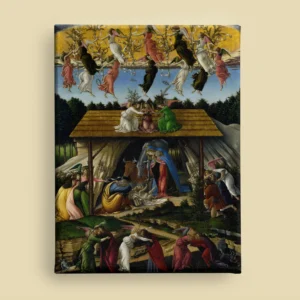
The Mystic Nativity at the National Gallery in London, dated 1500-1501, is Botticelli’s most visionary and most theologically intense painting. The composition places the Nativity in an unusual vertical arrangement: the angels dance in a ring above, the Holy Family occupies the central zone, and at the bottom the figures of men embrace angels while defeated demons crawl beneath the ground. The inscription at the top, in Greek, refers to the troubles of Italy and the coming of the devil’s rule, an allusion to the political upheavals of 1494 and after, which Botticelli interpreted through the prophetic writings of Savonarola. It is a painting of crisis faith, made by an artist who had lived through the destruction of the Medici world that had formed him.

Temptations of Christ
The Temptations of Christ in the Sistine Chapel, painted in 1481-1482 as part of the fresco cycle commissioned by Pope Sixtus IV, is one of Botticelli’s most complex narrative compositions. The fresco shows three episodes from the temptation narrative of Matthew’s Gospel, the temptation to turn stones to bread, the temptation to leap from the temple, and the temptation of worldly power, combined in a single composition with a fourth scene, the offering of a leper’s sacrifice. The architectural setting is elaborate, and the figures are given the energetic variety that the large fresco format required.

The Annunciation
The Annunciation at the Uffizi Gallery, painted around 1489-1490, shows the angel Gabriel’s greeting to the Virgin Mary with a particularity of gesture that is distinctive even within Botticelli’s work. The angel is shown in a sweeping forward movement, his body inclined toward the Virgin with a momentum that seems to carry the divine message physically; the Virgin responds with a gesture of acceptance that is simultaneously graceful and emotionally complex. The two figures are separated by the empty space of the room, and the tension across that space, the moment between the angel’s message and the Virgin’s response, is captured with an eloquence that is entirely Botticelli’s own.

Summary of Sandro Botticelli’s Paintings
| Painting | Date | Location |
|---|---|---|
| Adoration of the Magi | c. 1475-77 | Uffizi Gallery, Florence |
| Agony in the Garden | c. 1498-1500 | Royal Chapel of Granada |
| Birth of Venus | c. 1484-86 | Uffizi Gallery, Florence |
| Madonna and Child with an Angel | c. 1465-67 | Museo degli Innocenti, Florence |
| Madonna Enthroned with Four Angels and Six Saints | c. 1484-85 | Uffizi Gallery, Florence |
| Madonna of the Magnificat | c. 1481-85 | Uffizi Gallery, Florence |
| Madonna of the Pomegranate | c. 1487 | Uffizi Gallery, Florence |
| Mystic Nativity | 1500-01 | National Gallery, London |
| Temptations of Christ | 1481-82 | Sistine Chapel, Vatican |
| The Annunciation | c. 1489-90 | Uffizi Gallery, Florence |
Important Facts about Sandro Botticelli
- Born: Around 1445 in Florence as Alessandro di Mariano Filipepi; trained under Fra Filippo Lippi and became the leading painter of the Medici circle in the 1470s and 1480s.
- Medici patronage: His close relationship with the Medici family shaped the most productive period of his career; his mythological paintings for the Medici, the Primavera and the Birth of Venus, are the most celebrated expressions of the Neoplatonic culture of Lorenzo’s court.
- Sistine Chapel: In 1481-1482 he was one of the painters called to Rome by Pope Sixtus IV to decorate the Sistine Chapel; his contributions included the Temptations of Christ, the Punishment of the Sons of Korah, and scenes from the life of Moses.
- Savonarola: In his final years Botticelli was profoundly affected by the preaching of Girolamo Savonarola, the Dominican friar whose reform movement overturned the Medici order in Florence; his late religious paintings show a new urgency and emotional intensity that differs markedly from the lyrical grace of his earlier work.
- Death: Died 1510 in Florence; his work fell into relative neglect after his death and was not fully recovered until the nineteenth century, when the Pre-Raphaelites recognized in his linear grace and emotional depth a quality they wished to emulate.
Frequently Asked Questions about Sandro Botticelli
What is the relationship between Botticelli’s mythological and religious paintings?
The relationship is closer than it might appear. Botticelli’s mythological paintings, the Primavera, the Birth of Venus, were made for the Medici in the context of the Neoplatonic philosophy of Marsilio Ficino, which interpreted classical mythology as containing truths about the soul and its relationship to the divine. For Ficino, Venus was not merely a pagan goddess but a symbol of celestial beauty, a figure for the love that draws the soul upward toward God. Botticelli’s religious paintings work with the same sensibility: the quality of longing, the beauty of line, the undercurrent of melancholy that gives both his Venuses and his Madonnas their characteristic mood.
What happened to Botticelli after Savonarola’s influence?
After the overthrow of the Medici in 1494 and the period of Savonarola’s dominance in Florence (1494-1498), Botticelli’s work changed significantly. He apparently became a devoted follower of Savonarola’s reform movement, and his late paintings show a new intensity and urgency: the Mystic Nativity, with its visionary composition and its apocalyptic Greek inscription, is the clearest expression of this new orientation. He painted less in his final decade and the secular, humanist world of the Medici circle that had formed him was gone. He died in 1510, relatively poor and largely forgotten by the art world that was now dominated by Leonardo, Michelangelo, and Raphael.
Why are Botticelli’s Madonnas so distinctive?
Botticelli’s Madonnas stand apart from those of his contemporaries primarily because of the quality of his line: the flowing, rhythmic contours that give his figures their musical grace are unlike those of any other Florentine painter of his generation. But equally important is the emotional quality he gives his Virgin, a composed tenderness that is never sentimental, combined with an undercurrent of sorrow, a knowledge of what the child in her arms will suffer, that gives even his most beautiful Madonnas a poignant gravity. This combination of beauty and sorrow is the signature quality of Botticelli’s sacred painting.
What role did Botticelli play in the Sistine Chapel decoration?
In 1481-1482, Pope Sixtus IV summoned a group of the leading Florentine and Umbrian painters, including Botticelli, Perugino, Ghirlandaio, and Signorelli, to Rome to decorate the walls of the newly built Sistine Chapel with fresco cycles depicting scenes from the life of Moses (on the left wall) and the life of Christ (on the right wall). Botticelli painted three frescoes: the Temptations of Christ, the Punishment of the Sons of Korah, and scenes from the life of Moses. These large, complex compositions show a different Botticelli from the painter of intimate Madonnas, more monumental, more architecturally ambitious, more comfortable with crowd scenes and narrative complexity.
Where can the major religious works of Sandro Botticelli be seen?
The Uffizi Gallery in Florence holds the greatest concentration of Botticelli’s work, including the Adoration of the Magi, the Madonna of the Magnificat, the Madonna of the Pomegranate, the Bardi Altarpiece, and the Annunciation. The National Gallery in London has the Mystic Nativity. The Sistine Chapel in the Vatican retains the Temptations of Christ fresco in situ. Smaller devotional panels are distributed among museums across Europe and the United States.
Where can I buy a canvas reproduction of a Sandro Botticelli painting?
You can buy them at jesuschrist.pictures. All the canvas canvas prints are gathered in our shop, printed on premium canvas and shipped worldwide.