Famous Titian Paintings Full of Fire and Faith
Titian paintings represent the fullest expression of what the Venetian school accomplished and one of the longest and most productive careers in the history of art. Born Tiziano Vecellio around 1488-1490 in Pieve di Cadore in the Dolomites, he trained under Gentile and Giovanni Bellini in Venice and emerged as the dominant painter of the city by the time he was thirty. He would remain dominant for half a century more, working until his death, probably of plague, around 1576, when he was close to ninety years old. His sacred paintings range from the massive altarpiece of the Assumption of the Virgin, which changed the direction of Venetian art when it was unveiled in 1516, to intimate devotional panels of extraordinary psychological depth. They show a painter for whom color was not merely a quality of objects but the primary medium of spiritual expression: the warm reds, the deep blues, the golden light that pervade his sacred canvases are not decorative choices but theological ones.

The Venetian Tradition and Titian’s Revolution
Titian inherited from Giovanni Bellini the mastery of oil painting that Bellini had learned from Antonello da Messina, and from Giorgione, who was his near-contemporary in Bellini’s workshop, the revolutionary approach to tonal painting that subordinated precise drawing to the overall atmospheric unity of the composition. After Giorgione’s early death in 1510, Titian became the leading painter in Venice and quickly moved beyond his sources. His approach to color, using it not as a local quality applied to drawn forms but as a primary structural element, built up in layers of glazing and scumbling that give his canvases their characteristic luminosity and depth, was recognized in his own time as unprecedented, and it has influenced the painting of every subsequent century.
He worked for the greatest courts of Europe, the Emperor Charles V, Philip II of Spain, Pope Paul III, and his portraits of these patrons defined the standard for royal and imperial portraiture for two centuries. But he was also the painter of the Venetian church, and his religious works for Venetian institutions, the Assumption of the Virgin for the Frari, the Pesaro Madonna for the same church, the Presentation of the Virgin for the Accademia, are among the defining monuments of Italian religious painting.
Assumption of the Virgin
The Assumption of the Virgin, completed in 1516-1518 for the high altar of the Basilica of Santa Maria Gloriosa dei Frari in Venice, was the work that established Titian’s supremacy in Venetian painting and changed the direction of the entire tradition. The scale, nearly seven meters high, and the compositional boldness were unlike anything Venice had seen: the figure of the Virgin rises in a warm golden light above the apostles who gesture upward from below, while God the Father reaches down to receive her from above. The dramatic energy of the composition, the warmth and radiance of the color, and the physicality of the figures were all new to Venice, and they showed what oil painting on this scale could accomplish in hands of this order.

Crucifixion
The Crucifixion at the Pinacoteca civica in Ancona, painted around 1558 for the church of San Domenico, shows Titian’s approach to the central image of Christian art in his late manner. The figure of Christ on the cross is rendered with a solemn grandeur, and the landscape behind, dark, atmospheric, the sky heavy with the cosmic weight of the event, reflects the dramatic nocturnal quality of his late work. The painting’s power comes not from the explicit depiction of suffering but from the quality of the light and the gravity of the composition: a meditation on the Passion rather than a narrative depiction of it.

Nativity
The Nativity at the National Gallery of Art in Washington shows the birth of Christ in Titian’s characteristic warm palette, with the infant’s light radiating outward to illuminate the faces of the Virgin, Joseph, and the attendant figures. The intimate domestic quality of the scene, the manger, the humble setting, the warmth of the gathering around the newborn, is treated with the human tenderness that Titian brought to devotional subjects throughout his career. The quality of the light, both natural and divine, is the painting’s primary spiritual statement.

Noli Me Tangere
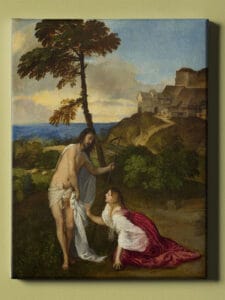
The Noli Me Tangere at the National Gallery in London, painted around 1511-1512, shows the moment after the Resurrection when Mary Magdalene recognizes the risen Christ in the garden and reaches toward him, and he withdraws with the words “Do not touch me”, “Noli me tangere” in the Vulgate. Titian places the two figures in a Venetian landscape of extraordinary beauty, the early morning light, the trees, the distant buildings, and the quality of the moment is entirely atmospheric: the light that fills the scene is the light of Easter morning, and the figures’ relationship is defined through the landscape as much as through their postures and expressions.

Penitent Magdalene
The Penitent Magdalene at the Hermitage Museum in St. Petersburg, of which Titian made several versions, shows Mary Magdalene in the desert of her penitence, her eyes raised toward heaven, her long hair flowing around her. The Magdalene was one of Titian’s most personal subjects, and the successive versions he made of this painting show a development from the sensuous beauty of the early versions toward the more austere and intensely spiritual quality of the later ones. The Hermitage version, painted around 1533, combines both qualities: the beauty of the figure is undeniable, but the expression is one of genuine penitential grief, and the combination of physical presence and spiritual seriousness is characteristic of Titian at his most complex.

Pesaro Madonna
The Pesaro Madonna at Santa Maria Gloriosa dei Frari in Venice, painted between 1519 and 1526, is one of the most radical compositional innovations in the history of altarpiece painting. Titian placed the Virgin not at the center of the composition but at the upper right, with a massive architectural framework, towering columns, occupying the center and the Pesaro family donors arranged along the bottom. The off-center placement of the Virgin, and the dynamic diagonal that runs through the whole composition, replaced the static symmetry of the traditional altarpiece with a new kind of compositional energy that influenced the organization of large religious paintings for the next two centuries.

Saint John the Baptist
The Saint John the Baptist at the Gallerie dell’Accademia in Venice shows the forerunner of Christ in the wilderness, his arm raised in the gesture of proclamation, “Behold the Lamb of God”, and the landscape behind him wild and dramatic. Titian’s Baptist is a figure of physical power: the muscular figure, the direct gaze, the outstretched arm give him a prophetic authority that goes beyond the conventional representation of the penitent in the desert. The painting is one of the great single-figure sacred images of the Venetian school.

The Annunciation
The Annunciation at the Scuola Grande di San Rocco in Venice, painted around 1535, shows the angelic greeting to Mary with the dramatic spatial complexity and the rich atmospheric quality of Titian’s mature manner. The angel descends with a radiance that fills the left side of the composition, and the Virgin responds with a gesture of acceptance in the warm, domestic interior that Titian gives her. The painting’s combination of architectural setting, atmospheric light, and psychological expression is characteristic of Titian’s approach to sacred narrative.

The Archangel Raphael and Tobias
This early panel at the Gallerie dell’Accademia, painted around 1507-1508, shows the story from the Book of Tobit in which the archangel Raphael accompanies the young Tobias on his journey, disguised as a human companion. The two figures, the angel and the boy, walk together in a landscape, the archangel’s identity suggested by the quality of his presence rather than explicit wings or halo. It is an early demonstration of Titian’s gift for the sacred-pastoral subject, the narrative of divine assistance experienced in a natural and human world.

The Baptism of Christ
The Baptism of Christ at the Capitoline Museums in Rome, painted around 1512, shows the moment at the Jordan River when Christ receives baptism from John and the Holy Spirit descends in the form of a dove while the voice of God is heard from heaven. Titian places the scene in a luminous landscape, with the figure of Christ standing in the river and John leaning over him, and the quality of the light, the way it falls on the water, on the figures, on the landscape behind, gives the theological event its natural setting with complete conviction.

The Crowning with Thorns
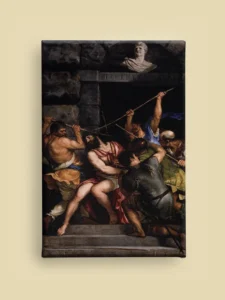
The Crowning with Thorns at the Louvre, painted around 1542-1543, is one of Titian’s most powerful images of the Passion. Christ sits in the center, his arms bound, the soldiers forcing the crown of thorns onto his head with long staffs. The composition is based on an antique relief showing the martyrdom of a Roman hero, and the combination of classical formal structure with Christian subject matter gives the painting a monumental gravity. The quality of the light, the darkness of the setting, the concentrated light on the central figure, anticipates the dramatic chiaroscuro that would become dominant in the next century.

The Entombment
The Entombment at the Museo del Prado in Madrid, painted around 1559 for Philip II of Spain, shows the placing of Christ’s body in the tomb after the deposition from the cross. The composition is one of Titian’s most carefully designed: the figures arranged around the body of Christ form a compact, interlocking group, and the quality of the grief, the Virgin’s collapse, Nicodemus’s effort, Mary Magdalene’s hands, is rendered with a restraint that makes it more rather than less affecting. It is a painting of the late period in which the qualities of Titian’s mature manner, the rich color, the dramatic light, the psychological depth, are all fully present.

The Gypsy Madonna
The Gypsy Madonna at the Kunsthistorisches Museum in Vienna, painted around 1510-1511, is one of Titian’s earliest surviving works and a demonstration of what he had learned from Bellini and Giorgione. The Virgin holds the Christ child against a landscape background, her face and the child’s shown with the warmth and naturalness of the Venetian Madonna tradition at its best. The nickname comes from the dark complexion of the Virgin, unusual in the tradition, and the informal quality of the grouping. It is a small masterpiece of early Titian.

The Last Supper
The Last Supper at the Royal Monastery of El Escorial in Spain, painted in the 1560s for Philip II, shows the final meal of Christ with his disciples in Titian’s late manner: a broad horizontal composition with the figures arranged around the table, the moment of the institution of the Eucharist rendered with a solemnity that befits the setting for which it was made. Philip II was the most devoted royal patron of Titian’s old age, and the religious paintings he made for the Escorial, the severe monastery-palace Philip built as a monument to his faith, show Titian working at the intersection of royal piety and his own spiritual concerns.

Summary of Titian’s Paintings
| Painting | Date | Location |
|---|---|---|
| Assumption of the Virgin | 1516-18 | Santa Maria Gloriosa dei Frari, Venice |
| Crucifixion | c. 1558 | Pinacoteca civica, Ancona |
| Nativity | c. 1532-33 | National Gallery of Art, Washington |
| Noli Me Tangere | c. 1511-12 | National Gallery, London |
| Penitent Magdalene | c. 1533 | Hermitage Museum, St. Petersburg |
| Pesaro Madonna | 1519-26 | Santa Maria Gloriosa dei Frari, Venice |
| Saint John the Baptist | c. 1530 | Gallerie dell’Accademia, Venice |
| The Annunciation | c. 1535 | Scuola Grande di San Rocco, Venice |
| The Archangel Raphael and Tobias | c. 1507-08 | Gallerie dell’Accademia, Venice |
| The Baptism of Christ | c. 1512 | Capitoline Museums, Rome |
| The Crowning with Thorns | c. 1542-43 | Louvre, Paris |
| The Entombment | c. 1559 | Museo del Prado, Madrid |
| The Gypsy Madonna | c. 1510-11 | Kunsthistorisches Museum, Vienna |
| The Last Supper | c. 1564 | Royal Monastery of El Escorial, Spain |
Important Facts about Titian
- Born: Around 1488-1490 in Pieve di Cadore in the Dolomites; trained under Gentile and Giovanni Bellini in Venice and was also closely associated with Giorgione, from whom he learned the revolutionary tonal approach to painting.
- Assumption: The completion of the Assumption of the Virgin in 1516-1518 for the Frari basilica in Venice was the pivotal moment of his career, establishing him as the leading painter in Venice and demonstrating what Venetian oil painting could accomplish on a monumental scale.
- Imperial patronage: He was the favored painter of the Emperor Charles V, who knighted him in 1533, and of Philip II of Spain; the relationship with Philip produced some of his most important late religious works, including the Entombment and the Last Supper for the Escorial.
- Color: His mastery of color, using it as a primary structural and spiritual element rather than a quality applied to drawn forms, was recognized in his own time as unprecedented; his technique of building up layers of glazing and scumbling to achieve luminosity and depth influenced every subsequent school of European painting.
- Death: Died around August 27, 1576, probably of plague, in Venice; he was close to ninety years old and working to the end. His output over more than six decades, in religious painting, portraiture, and mythology, is among the most extensive and consistently excellent in the history of art.
Frequently Asked Questions about Titian
Why is Titian considered the father of Western painting?
Titian is sometimes described as the father of modern painting because his approach to color, using it as a structural and atmospheric element rather than a surface applied to drawn forms, established the foundation for everything that followed in the European tradition. The Flemish painters of the seventeenth century, Rubens above all, were his direct heirs; the French Impressionists recognized in his loose, atmospheric late brushwork a precursor of their own dissolution of form into light; and Velazquez, who studied his work intensively in the Spanish royal collection, is unthinkable without him. More than any other single painter, Titian defined what Western painting has meant by color.
What is the significance of the Assumption of the Virgin for Venetian art?
Before the Assumption of the Virgin, Venetian altarpiece painting was dominated by the intimate, hieratic manner of Giovanni Bellini: figures arranged in calm, frontal compositions against gold grounds or serene landscapes, the emphasis on a devotional peace rather than dramatic energy. Titian’s Assumption, with its massive scale, its upward thrust, its brilliant warm color, and the physical drama of the ascending Virgin, showed that Venetian art could match the Roman ambitions of Michelangelo and Raphael while maintaining its distinctive color tradition. It was the moment at which Venice ceased to be a regional school and became a great tradition in its own right.
How did Titian’s style change over the course of his long career?
The change from early to late Titian is one of the most dramatic stylistic developments in the history of painting. The early works, the Gypsy Madonna, the Noli Me Tangere, show a painter of luminous color and precise form, their surfaces smooth and their figures clearly defined. The late works, the late Entombments, the Pieta now in the Accademia, show a painter who had dissolved form into atmosphere, whose brushwork is loose and gestural, whose surfaces are built up from layers of paint that create depth and luminosity through accumulation rather than smooth application. The late style was long misunderstood as the product of failing eyesight; it is now recognized as one of the most radical and original achievements in the history of painting.
What was Titian’s relationship to the Church and religious subjects?
Religious subjects formed the largest part of Titian’s output throughout his career, and there is no reason to doubt that his faith gave this work its spiritual depth. He painted for the churches and confraternities of Venice, for the papacy, for the Spanish crown, all the major Catholic institutions of his age, and the quality of religious feeling in his sacred paintings, from the early Noli Me Tangere to the late Pieta, reflects an artist for whom the Christian stories were not merely convenient subjects but genuine objects of contemplation. The late Pieta in particular, which he began for his own tomb and which was found unfinished at his death, suggests a painter whose meditation on the Passion deepened rather than faded in extreme old age.
Where can the major religious works of Titian be seen?
The most important works in situ are the Assumption of the Virgin and the Pesaro Madonna, both still in the Frari basilica in Venice. The Gallerie dell’Accademia in Venice holds several important works including the late Pieta. The Prado in Madrid has the finest collection outside Venice, including the Entombment, the Crowning with Thorns, and works from the Escorial. The Louvre in Paris holds another version of the Crowning with Thorns. The Kunsthistorisches Museum in Vienna has the Gypsy Madonna and other works. The National Gallery in London holds the Noli Me Tangere and the Presentation of the Virgin.
Where can I buy Titian paintings reproductions?
You can buy them at jesuschrist.pictures. All the Titian canvas prints are gathered in our shop, printed on premium canvas and shipped worldwide.


