8 Ascension Paintings That Defined Christian Art Through the Centuries
Of all the subjects in the history of sacred art, ascension paintings occupy a place entirely their own. They ask the impossible: paint a departure. Capture the exact moment a human body becomes something the eye can no longer hold. From the 14th century to the 20th, Christian artists across every major movement took up that challenge, and the results are among the most striking, varied, and spiritually charged works ever produced. The eight paintings gathered here span seven centuries, four countries, and radically different artistic visions. What they share is a single, inexhaustible question: how do you show the moment God goes home?

Before We Begin: The Iconographic Challenge of the Ascension
The biblical account is brief. In Acts 1:9-11, Christ lifts from the ground on the Mount of Olives, a cloud takes him from sight, and two angels appear to reassure the stunned disciples. Forty words, roughly. Painters had to fill the silence.
Over the centuries, three main approaches emerged. The earliest medieval tradition showed only the feet of Christ disappearing into a cloud above, a radical cropping that emphasized absence over presence. Then came the Renaissance mandorla: Christ fully visible inside an almond of divine light, facing forward with arms wide, the apostles arranged symmetrically below. Finally, from the Baroque onward, the composition opened up. Christ rises from below, seen from the disciples’ vantage point, often with a turbulence of angels, light and shadow doing the theological work that words had done before.
Each approach reflects not just an artistic era, but a particular way of thinking about God, the body, and what it means to witness the miraculous. The eight painters below each found their own answer.
If you are interested in how artists across different periods depicted Christ more broadly, our guide to the most famous Jesus paintings in art history offers a wider panorama.
1. Giotto di Bondone — The Ascension of Christ (c. 1304–1306)
Scrovegni Chapel, Padua, Italy

Stand inside the Scrovegni Chapel in Padua and you are surrounded by one of the most complete narrative cycles in the history of painting. Giotto covered every wall with scenes from the lives of the Virgin and Christ, and the Ascension occupies a prominent place in the upper register. It is one of the earliest painted Ascensions to treat the disciples as genuinely present human beings rather than decorative attendants.
Giotto’s Christ rises with arms outstretched, already partially obscured by the arc of the composition. Below, the apostles tilt their faces upward in a range of responses: astonishment, grief, something close to incomprehension. The Virgin stands at the center, steadier than anyone else. Giotto was working at the very cusp of what would become the Renaissance, and his instinct here is already modern: the miracle is real because the people watching it are real.
The fresco technique gives the scene a particular weight. This is not a vision on a gold ground. It happens under a blue sky, in the world of bodies and shadows. That decision, made around 1304, would define Western religious painting for the next three centuries.
To understand how Giotto fits into the longer tradition of medieval sacred art, our article on medieval Jesus paintings and their hidden meanings provides essential context.
2. Fra Angelico — The Ascension of Christ (c. 1447–1448)
Corsini Triptych (left panel) — Galleria Nazionale d’Arte Antica, Palazzo Corsini, Rome

This is the panel you uploaded, and it rewards a long look. Fra Angelico worked on the Corsini Triptych during his final years in Rome, a period when his style had reached its fullest maturity. The triptych as a whole depicts three moments in sequence: the Ascension at left, the Last Judgement at center, and Pentecost at right. It was made for private devotional use, almost certainly for a senior cleric, and the intimacy of the format shows.
The Ascension panel is vertical, narrow, and radiant. Christ rises on a wisp of cloud against a burnished gold ground, arms raised, the wounds of the Crucifixion still visible on his hands. Below, the Virgin stands at the very center, robed in her deep blue, hands pressed together in prayer. The apostles flank her on both sides, their golden halos forming an arc of quiet intensity. Fra Angelico does not show shock. He shows devotion. These are not witnesses stumbling backward in amazement, they are people who already understand what they are seeing.
The gold ground is not nostalgia. Fra Angelico, working well into the early Renaissance, made a conscious choice. Gold here is not medieval convention but theological statement: the world behind Christ is not sky, it is eternity. The vertical format compresses the distance between heaven and earth until it barely exists at all.
3. Andrea Mantegna — The Ascension of Christ (c. 1462–1464)
Uffizi Gallery, Florence

Mantegna painted this panel as the central piece of a triptych, alongside the Adoration of the Magi and the Circumcision, likely for the private chapel of Ludovico Gonzaga in Mantua. It is one of the most architecturally rigorous Ascension paintings ever made.
Christ rises inside a mandorla of seraphim, against a sky of pale blue that seems almost mineral in its clarity. He faces the viewer directly, one hand raised in blessing, the other holding a banner of the Resurrection. Below, on a rocky shelf of earth that resembles carved stone more than landscape, the apostles stand grouped in precise formation. Their robes fall in the hard, carved folds that are Mantegna’s signature: these figures look less like painted people and more like figures stepped off a Roman relief.
That is entirely the point. Mantegna was one of the great scholars of classical antiquity among Renaissance painters, and his Ascension brings Roman gravitas to a Christian subject. The result is an image of extraordinary dignity. There is no turbulence here, no emotional overflow. The Ascension, for Mantegna, is an event of cosmic order. The earth is still. Only Christ moves.
Mantegna’s approach is part of a broader tradition explored in our article on Italian Renaissance Jesus paintings.
4. Pietro Perugino — The Ascension of Christ (c. 1496–1500)
Musée des Beaux-Arts de Lyon, France

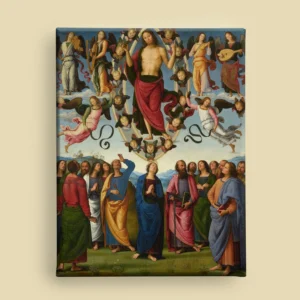
Perugino received this commission from the Benedictine monks of San Pietro in Perugia in 1495. The contract was specific down to the materials. What he delivered was the most serene Ascension in the history of Christian art.
The composition is organized along a strict vertical axis. At the bottom, the apostles and Saint Paul stand on either side of the Virgin Mary, each figure given space, each gesture measured and calm. Musical angels hover between heaven and earth, their instruments as precise as everything else in the picture. Above them, Christ rises inside a mandorla toward God the Father, who appears at the very top within his own sphere of glory. Behind the whole group, an Umbrian landscape recedes in aerial perspective with the delicacy of silk.
Perugino’s great gift was harmony. His figures never crowd each other, never compete. Every element breathes. For the monks of San Pietro, this was a painting meant for daily contemplation, and Perugino understood that perfectly. There is nothing in this image that strains or shouts. It simply opens, quietly, toward heaven.
His direct influence on the young Raphael is unmistakable here. The balanced groupings, the sweet facial types, the luminous landscape: Raphael absorbed all of it before surpassing his teacher entirely. On that subject, our series on Renaissance Jesus paintings traces that lineage in detail.
5. Peter Paul Rubens — The Ascension of Christ (1620)
Akademie der bildenden Künste Wien, Vienna

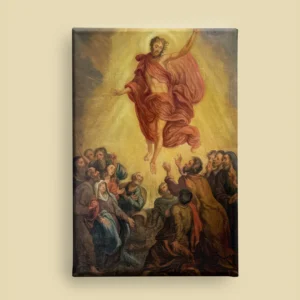
By 1620, Rubens had already transformed Flemish Baroque painting with his great altarpieces in Antwerp. His Ascension, now in Vienna, brings that same volcanic energy to a subject that previous painters had treated with composure and stillness.
The viewpoint is from below. We look up at Christ as he rises, his body twisting in the Baroque manner, his white robes caught in a heavenly turbulence. Angels surge around him. The light comes from Christ himself, casting the disciples below into deep, dramatic shadow. Rubens has removed the mandorla, removed the symmetry, removed everything that made the Renaissance Ascension feel like ceremony. In its place: pure physical force.
This was a theological statement as much as an artistic one. The Counter-Reformation demanded religious images that could move the faithful at the gut level, that could make doctrine felt rather than merely understood. Rubens delivers exactly that. His Christ does not ascend with quiet grace. He departs like a storm clearing.
For a deeper look at how Flemish painters handled sacred subjects, our article on Flemish Baroque Jesus paintings covers the broader context.
6. Rembrandt van Rijn — The Ascension of Christ (1636)
Alte Pinakothek, Munich
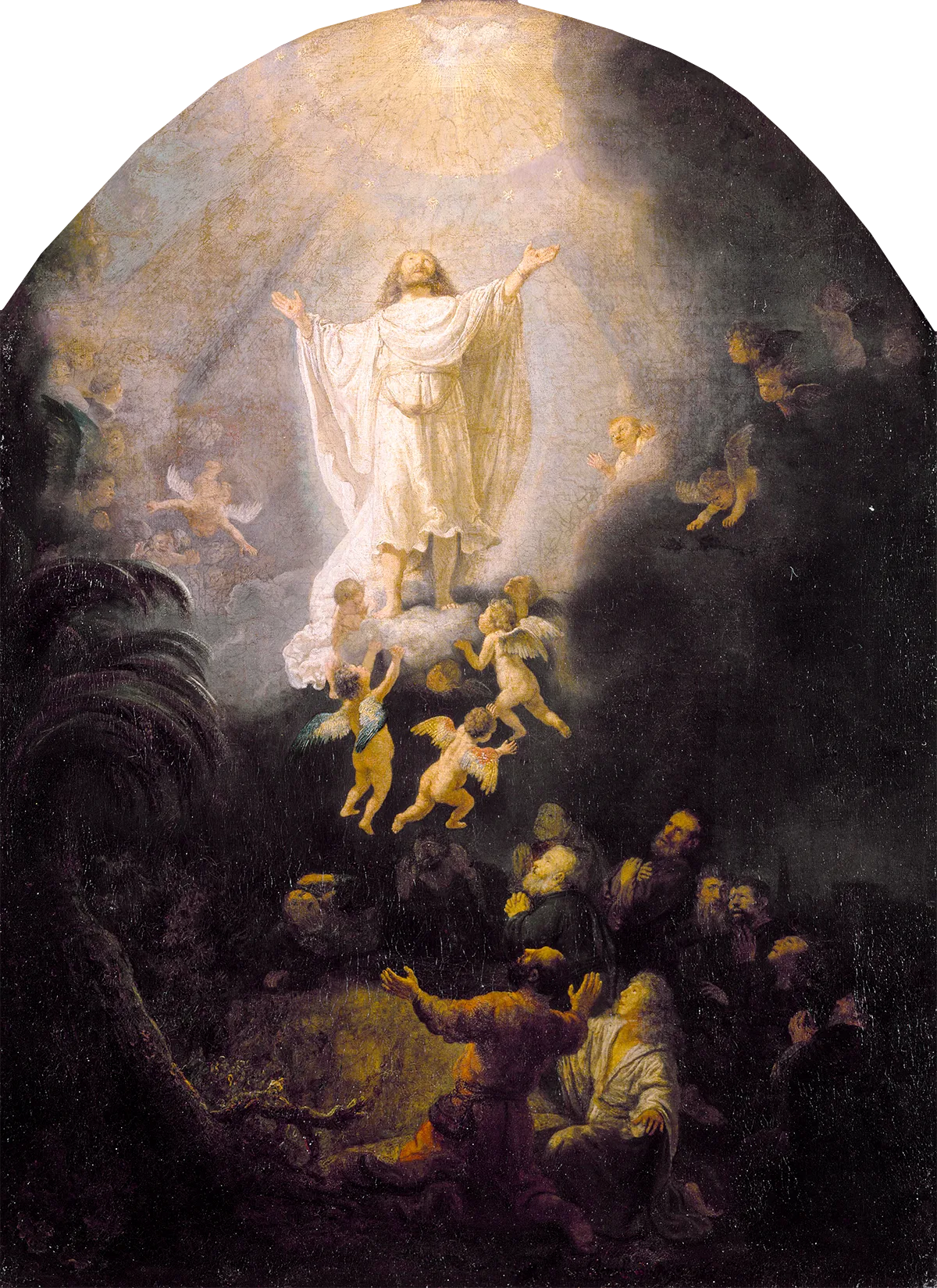
Rembrandt painted this canvas as part of a Passion cycle commissioned directly by the Stadtholder Frederik Hendrik, Prince of Orange. It was the first of three new paintings delivered in 1636, completing a series that had begun with the Raising of the Cross and the Descent from the Cross. Of the five paintings in the cycle, the Ascension is the most unusual, and in some ways the most personal.
The reception at the time was lukewarm. Rembrandt himself mentioned it briefly in a letter to Constantijn Huygens, the Stadtholder’s secretary. One can understand why the commission was difficult. Rubens had set a standard for Baroque drama in this subject, and Rembrandt had no interest in competing on those terms. What he painted instead is quieter, stranger, and ultimately more moving.
Christ rises in robes of pure white that become the primary light source of the entire painting. Around him, cherubs drift in a haze of gold. Below, in deep shadow, the disciples watch with a mix of wonder and grief that is recognizably Rembrandtian: these are not idealized figures but people in the middle of an experience they cannot fully process. A dove hovers at the very top. God the Father was originally painted there, then removed. X-ray examination confirms it. Rembrandt chose restraint, and in doing so made the painting distinctly Protestant: the divine is present, but hidden.
Our article on Baroque Jesus paintings explores how Dutch masters approached sacred subjects in ways that set them apart from their Catholic counterparts in Italy and Flanders.
7. Giovanni Battista Tiepolo — The Ascension of Christ (1754)
Private collection

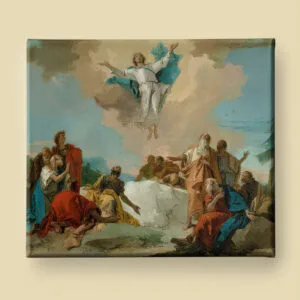
Tiepolo was the last great decorative painter of the Christian tradition, and his Ascension is a fitting summation of everything Baroque and Rococo art had learned about sacred spectacle over the preceding century and a half. Painted in 1754, it belongs to the period of Tiepolo’s absolute mastery, when his command of space, light and celestial machinery was unrivalled in Europe.
The painting is an ascent in every sense. Christ rises at the apex of a swirling vortex of angels, clouds, and radiant light, his figure luminous against a sky that seems to have no ceiling. The figures below are caught in the updraft of the event: arms raised, heads thrown back, garments swept by a wind from another world. Tiepolo understands the Ascension as a visual experience first and a theological one second, and he is right to do so. An image this beautiful generates its own reverence.
It is, in some ways, the last truly confident treatment of the subject in Western art. After Tiepolo, the great religious commissions would become rarer, and the certainty that animated them would begin to fracture. His Ascension catches that confidence at its peak.
8. Salvador Dalí — The Ascension of Christ (1958)
Private collection

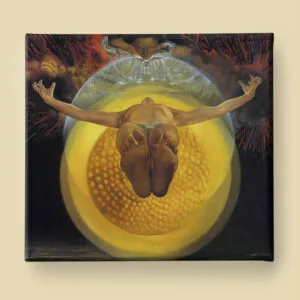
Nothing in the previous seven centuries of Ascension painting prepares you for this. Dalí, in his nuclear mysticism phase, reverses the entire tradition with a single compositional decision: the viewer looks down at Christ from above, as if inhabiting the perspective of God the Father.
Christ ascends toward us, head bowed, his back a perfect ovoid of light and flesh. Below him, the earth recedes into a deep perspective that is part landscape, part geometry, part dream. There are no apostles. No angels. No crowd. Just Christ, rising through a silence so total it feels like a physical pressure. The painting owes something to his earlier Christ of Saint John of the Cross (1951), which explored the same elevated vantage point at the Crucifixion, but the Ascension is more abstract, more cosmic, more removed from human grief. That vantage point was borrowed: it comes from a drawing by Saint John of the Cross, the sixteenth-century Carmelite whose name the earlier painting carries.
Dalí described his nuclear mysticism as an attempt to reconcile modern science with Catholic faith. Here that project reaches its most concentrated form. The body of Christ is rendered with the precision of a geometric proof and the tenderness of devotion. It is the only Ascension in art that feels like it was painted from the destination rather than the departure point.
For a full exploration of Dalí’s religious paintings and what drove his return to Catholicism, see our article on how Salvador Dalí transformed Jesus into a Surrealist vision.
Seven Centuries, One Question
What strikes you, looking at these eight works together, is not the difference in style but the consistency of the problem. Every painter here had to decide where to put the viewer. Giotto placed us among the disciples, sharing their bewilderment. Fra Angelico made us witnesses to a devotional act. Mantegna asked us to contemplate order. Perugino invited us to rest in harmony. Rubens and Tiepolo put us in the middle of a spectacle. Rembrandt left us in the shadow. Dalí positioned us at the destination.
Each choice is a theological statement. The way you paint an Ascension tells you what you believe about the distance between God and the person looking at the canvas. That question has not stopped being interesting. It never will.
If subjects like the Crucifixion, Baptism, or Resurrection interest you alongside the Ascension, our guides to famous Crucifixion paintings and famous Baptism of Christ paintings continue the story.
✦ Free Christian & Catholic Printables
Looking for free Christian & Catholic printables? Our complete collection of illuminated prayer cards & Scripture verses — the Memorare, Psalm 23, Psalm 91 and more — is ready to print, free, in one place.
Browse all free printables →The Eight Ascension Paintings, Artist by Artist
| Title | Artist | Date | Medium | Museum |
|---|---|---|---|---|
| The Ascension of Christ | Giotto di Bondone | c. 1304–1306 | Fresco | Scrovegni Chapel, Padua |
| The Ascension (Corsini Triptych) | Fra Angelico | c. 1447–1448 | Tempera and gold on panel | Galleria Nazionale d’Arte Antica, Palazzo Corsini, Rome |
| The Ascension of Christ | Andrea Mantegna | c. 1462–1464 | Tempera on panel | Uffizi Gallery, Florence |
| The Ascension of Christ | Pietro Perugino | c. 1496–1500 | Oil on panel | Musée des Beaux-Arts, Lyon |
| The Ascension of Christ | Peter Paul Rubens | 1620 | Oil on panel | Akademie der bildenden Künste Wien, Vienna |
| The Ascension of Christ | Rembrandt van Rijn | 1636 | Oil on canvas | Alte Pinakothek, Munich |
| The Ascension of Christ | Giovanni Battista Tiepolo | 1754 | Oil on canvas | Private collection / Canvas available at jesuschrist.pictures |
| The Ascension of Christ | Salvador Dalí | 1958 | Oil on canvas | Private collection / Canvas available at jesuschrist.pictures |
Questions & Answers
What is an ascension painting?
An ascension painting depicts the moment described in Acts 1:9-11, when Jesus Christ rose bodily into heaven forty days after his Resurrection, in the presence of his apostles on the Mount of Olives. It is one of the major subjects in Christian sacred art, painted across every major Western artistic movement from the medieval period through the 20th century.
What is the most famous ascension painting in art history?
Rembrandt’s The Ascension of Christ (1636, Alte Pinakothek, Munich) and Giotto’s fresco in the Scrovegni Chapel (c. 1304-1306) are among the most studied. Salvador Dalí’s 1958 version is arguably the most recognized in the modern era for its radical reversal of the traditional composition. Among religious communities, Tiepolo’s luminous 1754 canvas remains a favorite.
How did the iconography of ascension paintings change over the centuries?
Medieval painters typically showed only the feet of Christ disappearing into a cloud, emphasizing absence. Renaissance artists placed Christ fully visible inside a mandorla of divine light, frontal and serene, with the apostles arranged symmetrically below. From the Baroque period onward, the viewpoint shifted to below: the viewer looks up at Christ departing, with dramatic light, movement and emotional intensity. Dalí reversed all of this in 1958, placing the viewer above Christ, looking down.
Did Rembrandt paint the Ascension of Christ?
Yes. Rembrandt painted The Ascension of Christ in 1636 as part of a five-painting Passion cycle commissioned by Frederik Hendrik, Stadtholder of the Netherlands. The painting is housed at the Alte Pinakothek in Munich. It is notable for its Protestant restraint: God the Father, originally painted at the top, was removed, leaving only a luminous dove and the ascending Christ in white robes.
Where can I see Perugino’s Ascension of Christ?
Perugino’s Ascension of Christ (c. 1496-1500) is in the permanent collection of the Musée des Beaux-Arts in Lyon, France. It was commissioned by Benedictine monks in Perugia and is considered one of the finest examples of High Renaissance religious painting outside Italy.
What makes Dalí’s Ascension of Christ unique?
Salvador Dalí’s Ascension of Christ (1958) is the only major ascension painting in art history painted from above: the viewer looks down at Christ rising toward them, as if sharing God’s perspective. There are no apostles, no angels, no crowd. Dalí applied his nuclear mysticism philosophy, combining Catholic theology with modern geometry and physics. It is part of the same spiritual series as his Christ of Saint John of the Cross (1951).
Where to buy ascension paintings?
You can buy ascension paintings at jesuschrist.pictures. High-quality canvas reproductions of famous ascension paintings are available our shop. The shop offers professionally printed museum-quality canvases, including Tiepolo’s Ascension of Christ (1754) and Dalí’s Ascension of Christ (1958), in a range of sizes suitable for home or chapel.