Famous Jesus Paintings That Shaped Christian Art
The most famous Jesus paintings trace how artists across fifteen centuries have tried to give a face to Christ, from gold-ground Byzantine icons to the cosmic visions of Salvador Dali. The single most famous painting of Jesus is Leonardo da Vinci’s The Last Supper, completed in 1498, though the title of most valuable belongs to Leonardo’s Salvator Mundi, sold for 450 million dollars in 2017. This guide gathers fifteen of the works that shaped how the world pictures Jesus, with the artist, the date, and the place you can still see each one today.
Listen to the Podcast Version
This episode explores the most famous Jesus paintings in history, highlighting their symbolism and artistic impact in a concise audio format.The Last Supper by Leonardo da Vinci
No image of Christ is more recognized than The Last Supper. Leonardo painted it directly onto the refectory wall of Santa Maria delle Grazie in Milan between 1495 and 1498, choosing the exact moment Jesus announces that one of the twelve will betray him. The shock ripples outward through the apostles in four groups of three, while Christ sits perfectly still at the vanishing point, calm at the center of the storm. Leonardo’s experimental oil-and-tempera technique began to flake within his lifetime, and what survives is as much a story of devoted restoration as of genius. It remains the benchmark against which every later painting of Jesus is measured.
 Save
Save
Salvator Mundi by Leonardo da Vinci
Few paintings carry as much mystery as Salvator Mundi, Latin for Savior of the World. Christ raises his right hand in blessing and holds a transparent crystal orb in his left, his gaze meeting the viewer with unsettling directness. Long dismissed as a copy, it was reattributed to Leonardo around 2011, then sold at auction in 2017 for 450 million dollars, the highest price ever paid for any painting. Its current location has not been publicly confirmed, and a number of scholars still debate how much of the surface Leonardo painted himself. Controversy aside, it is the most talked about image of Jesus of the modern era.
 Save
Save
Christ Pantocrator of Sinai
The oldest work on this list is also one of the most powerful. Painted in encaustic, hot colored wax, in the sixth century, the Christ Pantocrator at Saint Catherine’s Monastery in Sinai survived the waves of iconoclasm that destroyed almost every comparable image. Pantocrator means Ruler of All, and the icon shows Christ raising his hand in blessing while holding the Gospels. Look closely and the two halves of the face differ: one side serene, the other stern, a visual statement of Christ as both merciful savior and final judge. Nearly every later icon of Jesus descends from this prototype.


The Transfiguration by Raphael
Raphael’s Transfiguration was the last painting he worked on before his death in 1520, and it was placed above his coffin as he lay in state. The upper half shows Christ rising in radiant light between Moses and Elijah, while the lower half plunges into shadow and confusion as the apostles fail to heal a possessed boy. That deliberate split between heaven and earth, light and turmoil, pointed the way toward the drama of the Baroque. It hangs today in the Vatican Museums and is often called the most perfect painting in Rome.
 Save
Save
The Resurrection of Christ by Raphael
An early work from around 1499 to 1502, the Resurrection of Christ shows a young Raphael already in full command of movement and light. Christ floats above the open tomb holding a white banner, while the startled soldiers below twist away in every direction. The balance and clarity that would define his mature style are already here in miniature. The panel is one of the treasures of the Museu de Arte de Sao Paulo in Brazil, a reminder that masterpieces of Christian art now reach far beyond Europe.
 Save
Save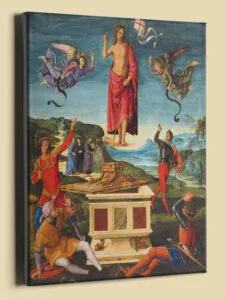
The Isenheim Altarpiece by Matthias Grunewald
Painted between 1512 and 1516 for a hospital chapel that cared for plague and skin-disease sufferers, Grunewald’s Crucifixion is the most harrowing image of Christ ever made. The body is gray and torn, the fingers clawed in agony, the flesh covered in the same sores the patients themselves endured. This was deliberate. The dying could look up and know that Christ had suffered as they suffered. Nothing in art before or since matches its raw physical anguish. At the foot of the cross Grunewald sets the Lamb of God, bleeding into a chalice beside John the Baptist, so that the tortured Christ and the sacrificial Lamb are seen as one. The altarpiece is the centerpiece of the Unterlinden Museum in Colmar.
 Save
SaveNoli Me Tangere by Titian
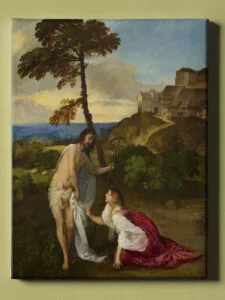
Titian painted Noli Me Tangere, Touch Me Not, around 1514, capturing the instant the risen Christ appears to Mary Magdalene in the garden. She reaches toward him from the ground, and he draws gently away, his body curving into a tender arc that echoes the tree above. The Venetian landscape glows with soft morning light, and the whole scene turns on the smallest of gestures. It is one of the most quietly moving Resurrection images in European art, now in the National Gallery in London.

The Supper at Emmaus by Caravaggio
Caravaggio’s Supper at Emmaus of 1601 captures the breathless second when two disciples recognize the risen Christ as he blesses the bread. A hand bursts toward the viewer, a basket of fruit teeters on the table’s edge, and harsh light rakes across startled faces. Caravaggio gives Jesus a beardless, almost ordinary face, making the miracle feel as though it is happening in a real tavern at arm’s length. This radical realism changed religious painting forever. The canvas hangs in the National Gallery in London.
 Save
Save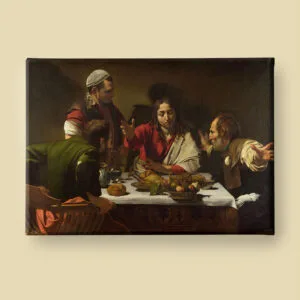
Ecce Homo by Caravaggio
The Latin words Ecce Homo, Behold the Man, are Pilate’s as he presents the scourged Christ to the crowd. Caravaggio’s version from around 1605 strips the scene to three figures pressed close in the dark. Christ, crowned with thorns and wrapped in a red cloak, lowers his eyes in silent endurance while Pilate gestures outward and almost seems to ask the viewer to decide. The restraint makes it more painful than any bloody spectacle. It is held in the Musei di Strada Nuova, Palazzo Bianco, in Genoa.


Christ Carrying the Cross by El Greco
El Greco returned to this subject many times, and his version from around 1580 is among the most beautiful. Rather than showing exhaustion, El Greco gives us a Christ who embraces the cross willingly, eyes lifted to heaven, tears shining on his face. The elongated fingers and the cool, luminous color are unmistakably his. This is not defeat but acceptance, suffering transformed into devotion. The painting is part of the collection of the Metropolitan Museum of Art in New York.
 Save
SaveThe Light of the World by William Holman Hunt
Painted between 1851 and 1854, The Light of the World shows Christ at night holding a lantern, knocking at a door overgrown with weeds and ivy. The door has no handle on the outside: it can only be opened from within, a visual sermon on free will and the soul that must choose to answer. Holman Hunt, a founder of the Pre-Raphaelite Brotherhood, painted much of it by lamplight to get the glow exactly right. The original hangs in the chapel of Keble College, Oxford, and a later version toured the world to enormous crowds.


Christ in the Wilderness by Ivan Kramskoy
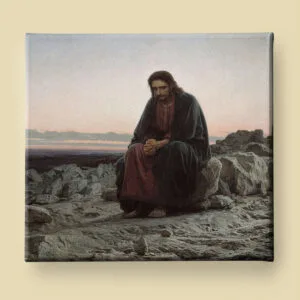
The Russian master Ivan Kramskoy painted Christ in the Wilderness in 1872, and it is unlike almost any Western image of Jesus. There is no halo, no glory, no miracle. Christ sits alone on cold gray stones at dawn, hands clasped, lost in the agony of decision during his forty days of temptation. He looks fully human, weary and torn, a man wrestling with his own mission. Kramskoy said he wanted to paint the moment of moral choice that every person faces. It is a highlight of the Tretyakov Gallery in Moscow.

Christ and the Rich Young Ruler by Heinrich Hofmann
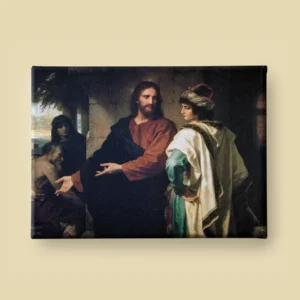
Heinrich Hofmann’s 1889 painting illustrates the Gospel encounter between Jesus and a wealthy young man who cannot bring himself to give up his possessions. Christ looks at him with warmth and sorrow rather than judgment, while a poor figure waits at the edge of the scene. Hofmann’s gentle, accessible style made his images of Jesus enormously popular in churches and homes across the world for more than a century. The original is housed at The Riverside Church in New York.

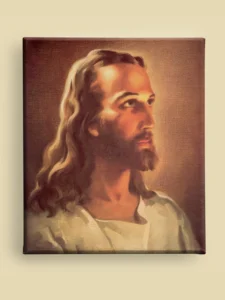
Head of Christ by Warner Sallman
No painting of Jesus has been reproduced more often than Warner Sallman’s Head of Christ, completed in 1940. It has been printed an estimated half a billion times, on prayer cards, Bibles, and living-room walls across the twentieth century. Sallman shows a serene, fair-skinned Christ in three-quarter profile, gazing upward into soft light. Beloved by millions and criticized by others for its gentle, idealized look, it is impossible to deny its reach. The original is kept at Anderson University in Indiana.

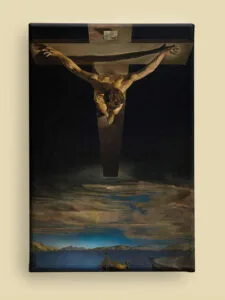
Christ of Saint John of the Cross by Salvador Dali
Salvador Dali’s Christ of Saint John of the Cross from 1951 reinvents the Crucifixion for the modern age. We look down on Christ from above, as if from God’s vantage point, the cross floating over a dark bay with fishermen below. There is no blood, no crown of thorns, no nail wounds. Dali removed every sign of suffering to show divine serenity instead, basing the dramatic angle on a small drawing by the sixteenth-century mystic Saint John of the Cross. It is the jewel of the Kelvingrove Art Gallery in Glasgow.

These portraits and scenes belong to the wider story of Scripture in art; for masterpieces drawn from across the Bible, see our guide to biblical paintings.
The Ten Paintings, Artist by Artist
| Painting | Artist | Date | Medium | Where to See It |
|---|---|---|---|---|
| The Last Supper | Leonardo da Vinci | 1495 to 1498 | Tempera and oil on plaster | Santa Maria delle Grazie, Milan |
| Salvator Mundi | Leonardo da Vinci | c. 1500 | Oil on walnut panel | Whereabouts undisclosed |
| Christ Pantocrator | Anonymous (Byzantine) | 6th century | Encaustic on panel | Saint Catherine’s Monastery, Sinai |
| The Transfiguration | Raphael | 1516 to 1520 | Tempera on wood | Vatican Museums |
| The Resurrection of Christ | Raphael | c. 1499 to 1502 | Oil on panel | Museu de Arte de Sao Paulo |
| The Isenheim Altarpiece (Crucifixion) | Matthias Grunewald | 1512 to 1516 | Oil on panel | Unterlinden Museum, Colmar |
| Noli Me Tangere | Titian | c. 1514 | Oil on canvas | National Gallery, London |
| The Supper at Emmaus | Caravaggio | 1601 | Oil on canvas | National Gallery, London |
| Ecce Homo | Caravaggio | c. 1605 | Oil on canvas | Palazzo Bianco, Genoa |
| Christ Carrying the Cross | El Greco | c. 1580 | Oil on canvas | Metropolitan Museum of Art, New York |
| The Light of the World | William Holman Hunt | 1851 to 1854 | Oil on canvas | Keble College, Oxford |
| Christ in the Wilderness | Ivan Kramskoy | 1872 | Oil on canvas | Tretyakov Gallery, Moscow |
| Christ and the Rich Young Ruler | Heinrich Hofmann | 1889 | Oil on canvas | The Riverside Church, New York |
| Head of Christ | Warner Sallman | 1940 | Oil on canvas | Anderson University, Indiana |
| Christ of Saint John of the Cross | Salvador Dali | 1951 | Oil on canvas | Kelvingrove, Glasgow |

Two of Christ’s most beloved scenes each have their own gallery: see our guides to Jesus walking on water paintings and Good Shepherd paintings.
Conclusion
Across fifteen centuries, every artist on this list faced the same impossible task: to give a human face to the divine. Some, like Grunewald, chose raw suffering. Others, like the icon painters of Sinai or Salvador Dali, reached for serene, otherworldly light. There is no single true face of Jesus, and that is precisely why these paintings still hold us. Each one is a record of faith meeting imagination, and together they form the visual memory of Christianity itself. If one of them speaks to you, it can hang on your own wall as a hand-finished canvas reproduction.
✦ Free Christian & Catholic Printables
Looking for free Christian & Catholic printables? Our complete collection of illuminated prayer cards & Scripture verses — the Memorare, Psalm 23, Psalm 91 and more — is ready to print, free, in one place.
Browse all free printables →Important Facts About Jesus in Art
- No painting of Jesus was made during his lifetime, and no physical description of his appearance survives in the Gospels, so every image is an interpretation.
- The earliest surviving images of Christ date from the third century and appear in the Roman catacombs, often showing him as a beardless young shepherd.
- The familiar bearded, long-haired face of Jesus became standardized in Byzantine art from about the sixth century, with the Christ Pantocrator of Sinai as its model.
- Leonardo da Vinci’s Salvator Mundi holds the record for the most expensive painting ever sold, reaching 450 million dollars at auction in 2017.
- Warner Sallman’s Head of Christ is the most reproduced painting of Jesus in history, with an estimated half a billion copies printed.
Questions and Answers
What is the most famous painting of Jesus?
Leonardo da Vinci’s The Last Supper is widely regarded as the most famous painting of Jesus in the world. Painted between 1495 and 1498 on the wall of Santa Maria delle Grazie in Milan, it shows the moment Christ tells his apostles that one of them will betray him. Its fame comes from Leonardo’s revolutionary composition and its endless reproduction in books, films, and popular culture.
Are there any real paintings of Jesus from his lifetime?
No. There are no paintings or portraits of Jesus made during his life, and the Gospels never describe his physical appearance. The earliest known images date from roughly two centuries after his death and are symbolic rather than literal. Every later painting, including the most famous ones, reflects the artist’s imagination and the conventions of their time.
Who are the most famous artists who painted Jesus?
The greatest names in Western art turned to the figure of Christ. Leonardo da Vinci, Raphael, Caravaggio, Titian, El Greco, and Rembrandt all created enduring images of Jesus. In the modern era, Salvador Dali and Warner Sallman produced two of the most recognized depictions of the twentieth century. Each brought the style and spirit of their age to the subject.
Why is Salvator Mundi so controversial?
The controversy has two sources. First, scholars disagree over how much of the painting Leonardo executed himself, since it was heavily damaged and restored before its reattribution. Second, after selling for a record 450 million dollars in 2017, the painting disappeared from public view and its current location has never been officially confirmed. That mix of doubt, money, and mystery keeps it in the headlines.
What is the most reproduced image of Jesus?
Warner Sallman’s Head of Christ, painted in 1940, is the most reproduced image of Jesus ever made, with an estimated half a billion copies. It became a fixture of churches and homes throughout the twentieth century, especially in the United States. Its gentle, idealized portrait shaped how many people still picture Jesus today.
Where can I buy Jesus paintings?
You can buy museum-quality reproductions of the most famous Jesus paintings in our online shop. Each piece is printed on canvas and hand-finished, from Byzantine icons to Leonardo, Caravaggio, and Dali. Browse the full collection on our Jesus paintings page to find the work that speaks to you.


